Tag: Talking to Kids About…

An Israeli Soldier’s Mother Speaks

How do Israeli moms view the prospect of their children taking up arms to bring quiet to their country’s south? No bombastically.

A Soldier’s Mother, in What I Want… and What I’ll Do, writes:

What I want…is to go collect my little boy and bring him home. I want to lock him in a room and tell Israel that no, you can’t have him. I’ve changed my mind. No, I’m sorry. He’s not allowed to play with guns and big things that go boom. No, I’m his mother. I gave birth to him and no, you simply can’t take him.

What I want…is to call him and make sure he is where I put him, where he told me he was yesterday. Not in the north, where Hizbollah is promising to burn the ground and open a second front and not in the south, where dozens of rockets and mortars have been fired at Israel, where a man was killed and dozens were wounded.

That’s what I want…

And what I’ll do, is sit here at my desk and keep editing this document for my client. I’ll update the copyright statements and change the installation information to reflect the new platforms the product now supports. I’ll answer the phone and I’ll talk to my accountant.

And what I’ll do, is tell my heart to settle. I’ll tell my eyes to take a moment and look at the next beautiful wave of clouds rolling in over Jerusalem. I’ll sign the papers I need to sign; type the words I need to type. I’ll tell my younger daughter to clean her room and my younger son that he has to study for his test NOW. I’ll tell my middle son he can borrow the car like we agreed, but he has to drive carefully. I won’t talk to my daughter because she’s old enough to see the cracks in my smile and know that outside, it’s all a front.

What I’ll do is answer the phone if Elie calls and I’ll talk to him calmly. I’ll listen if he tells me he’s staying where he is. I’ll listen if he tells me they are moving him up north. I’ll listen if he tells me they are moving him down south near Gaza. I’ll listen, I’ll tell him to be careful, and call me when he can. I won’t for a single moment, tell him that I’m scared, that I have no real experience with this war thing and that I don’t really want him to have any experience with it either. Read on

Incidentally, with a niece in Israel somewhere on a base preparing for some action, I share many of her concerns…

A Soldier’s Mother blog explains its blogging purpose:

From the time our children are born, we accept that our identity has changed. We were so many things, and continue to be. But in the moments after we give birth, and in the years that follow, we become something so much more. I have been a mother for more than 20 years, seeing my children through their baby years, their school years, into their teenage years. And now, as I see my oldest son enter the army of Israel, I become a soldier’s mother.

The Demise of Dating OR Teach Your Teen How to Date

We teach our kids that they were created b’tzelem Elohim, in the image of God. That they are unique, worthy, valued.

We teach our kids that their bodies are a gift from God, on loan from the Holy One. That they must take care of their bodies as their most prized possession.

We teach our kids that when two people find each other, share love, bond for life, it is kedushin, holiness. And that relationships that precede “the one” should strive for that holiness.

But I wonder, in this age of the internet, where we can spill out our guts (and our whole lives) on the blog, Facebook or MySpace, where do we learn the give and take of creating a wholesome, mutual, “real” relationship?

Then comes the New York Times announcing The Demise of Dating, saying:

The paradigm has shifted. Dating is dated. Hooking up is here to stay.
(For those over 30 years old: hooking up is a casual sexual encounter with no expectation of future emotional commitment. Think of it as a one-night stand with someone you know.)According to a report released this spring by Child Trends, a Washington research group, there are now more high school seniors saying that they never date than seniors who say that they date frequently. Apparently, it’s all about the hookup.

Kind of sad (though my memories of dating are not all positive). Kind of scary.

It turns out that everything is the opposite … Under the old model, you dated a few times and, if you really liked the person, you might consider having sex. Under the new model, you hook up a few times and, if you really like the person, you might consider going on a date.

Where do we learn to date?

It used to be that “you were trained your whole life to date,” said Ms. Bogle. “Now we’ve lost that ability — the ability to just ask someone out and get to know them.”

Funny. We worry so much about teaching our kids how to study, how to stay away from drugs, how to help friends who are suicidal. Intense stuff. And now we learn that we may need to go back to basics… to teach them how to date…

Death and Dying: Talking to Kids about…

We recently heard about two tragedies in our Conejo Valley educational community:

  • An Oak Park elementary teacher’s husband committed suicide. He had 2 small kids. He was a local photographer who was there as many of the children became B’nai Mitzvah.
  • A Medea Creek Middle School 8th grader, Cody Badalato, died on Sunday after being in a coma for a week. Last Friday night, Cody was having difficulty breathing and after his parents called 911, suffered cardiac arrest. He was airlifted to UCLA, where he was diagnosed with leukemia lymphoma, which caused a large mass in his chest. This condition was unknown to anyone until the emergency. Up to that point he was a healthy 13 year old boy. Cody’s 14th birthday was this past Saturday.

Understandably, students, parents, teachers and the whole community might be feeling a jumble of intense emotions. (Read the complete eLearning with Rabbi Kipnes eNewsletter)

One of the most challenging tasks confronting us all is how to explain death to a child. In the midst of one’s own grief or in the attempt to comfort another, a child’s need to know and understand is often overlooked. Or, adults decide that a child simply won’t comprehend what is happening. Or the tremendous upheaval in the normal routines of the household throws the child into a kind of chaos of unexpected events and uncertainty about his or her future. Yet psychologists tell us that children today, shaped by the constant barrage of death portrayed on television and in the movies, are far more aware of death and its consequences than many adults realize.

The decision about what to tell children will depend largely on the age of the child, her or his sensitivity to the subject, and the child’s relationship to the deceased. As with the “phases” of grief, much of the actual response of a child will depend a great deal on the relationship between the parent and child, and how the parent chooses to discuss the death itself.

In conjunction with the Or Ami Center for Jewish Parenting, we offer these resources to help guide those of you touched by these tragedies. Please forward these to your friends.

Resources for Helping Your Child Cope

Talking to Your Child about Death and Dying, including

* Informing the Child
* Should I Bring a Child to the Funeral?
* Deciphering what is on a Child’s Mind
* Guidance for Talking to Childen of Different Ages
* How to Comfort the Mourner
* What to Say and Not to SayWhen a Child Dies
* Prayers for When a Pet Dies

Facing a Suicide: Talking to Kids about It, including

* Five Initial Thoughts when Dealing with a Child after a Suicide
* Six Warning Signs of Suicide
* Seven Things to Do: When You Suspect Suicidal Feelings

Caring for the Mourners, including

* Writing Condolence Cards
* Supporting the Mourners

A Prayer for a Cure for Cancer

May you find the courage and fortitude to face the realities of life:
that some live and some die
that sometimes things just don’t make sense
that we can chose:
to hold those we love closer
and to count our blessings.

Facing a Suicide: Talking to Kids About…

I heard about another suicide. This time of an Oak Park elementary teachers who has 2 small kids. He was a local photographer who was there as many of the children became B’nai Mitzvah.

Those who knew him and even those who did not, are shocked, scared and anxious. Many are reviewing their interactions with this man to see if they missed any signs about what he was thinking. Others are wondering how someone could be considering such drastic action and they did not know it.

Parents are wondering how to help their children deal with this tragedy. Still others are wondering if they are missing signs from their own children.

Five Initial Thoughts when Dealing with Children after a Suicide:

  1. Be with them, let them talk, or cry, or just be. Suicide is confusing and it may take time for your child to open up and begin to talk about it.
  2. While most suicidal individuals give off warning signs, many of these signs are missed by even those closest to them. Scrutinizing past interactions for such signs is normal, brought about by feelings of guilt, sadness or remorse. Listen to your child, don’t dismiss his/her sadness, but remind him/her that even those closest to the person who killed himself did not recognize the signs.
  3. Most adolescents have thoughts at one time or another about suicide. It is NORMAL to have such thoughts. Let your child know that he or she can talk to you about anything. Be prepared not to “freak out” if your child shares such thoughts.
  4. If necessary, and if your child needs it, consult with a therapist who works with children. I would be glad to refer you to such individuals.
  5. Please do not hesitate to call the synagogue (818-880-4880) to talk to me. When you call, please let them know it is about a suicide and that this is very important.

Finally, allow me to offer a few pieces of information to help you in the future. When the time is right, you might want to discuss this with your child.

Some Statistics and Facts Concerning YOUTH Suicide:

  • Suicide is the third-leading cause of death among young adults ages 15-24 years, following only AIDS and accidents.
  • Among college students, suicide is the second-leading cause of death.
  • Girls are 3 times more likely to ATTEMPT suicide, but boys are 5 times more likely to COMPLETE suicide. Alcohol and/or drugs are involved in 50% of adolescent suicides. Guns and overdoses are two frequently used methods. Out of every 10 suicide attempts, 9 take place in the home.
  • Recent studies indicate that nationwide more than half a million high school students attempt suicide every year.
  • Over 90% of all suicidal adolescents talk to others about their suicidal feelings. They do NOT, however, always talk to their parents, teachers, or counselors but instead talk to their FRIENDS.

Six Warning Signs
Depression and anxiety are the strongest precursors of suicide. Here are some common warning signs:

  1. Direct statements such as “I want to die” or “I don’t want to live anymore”
  2. Indirect statements such as “I want to go to sleep and never wake up” or “They’ll be sorry when I’m gone” or “Soon this pain will be over”
  3. Making final arrangements (giving away possessions, saying good-bye, etc.)
  4. Increased risk taking (reckless driving, etc.) and frequent accidents
  5. Personality changes, withdrawal, apathy, moodiness
  6. Themes of death and dying in a person’s writing and artwork

Seven Things to Do: When You Suspect Suicidal Feelings: How You Can Help

  1. Direct questions about suicidal feelings do not provoke suicidal behavior.
  2. When asking about suicidal feelings, find out if the person has decided how to commit suicide. The person who wants to commit suicide, who has figured out how to go about it, and who has the means to do it is in the greatest danger.
  3. Whether a suicidal person plans to succeed or is using the threat of suicide to get attention does not matter. That person needs the same help.
  4. Having made the decision to die, the suicidal person may seem very calm. That individual is still in great danger.
  5. If someone shares a suicidal intent with you, take it seriously and contact an appropriate counselor, clergyperson, parent or other responsible adult—even if it means breaking a confidence and losing a friend.
  6. If you suspect someone is going to commit suicide, don’t leave them alone.
  7. The paperback book When Living Hurts by Sol Gordon, available from the URJ Press, does an incredible job helping teens deal with depression and difficult feelings. Purchase a copy for your teen now.

Lastly, our thoughts and prayers go out to the man’s family, his students, co-workers and the community. May they find the strength and fortitude to weather the difficult days and months ahead.

The Bible has Nothing to Say about Gay Marriage

Someone in the mainstream press finally said it out loud: Contrary to what conservative preachers would like us to believe, the Bible has nothing to say about gay marriage, and very little (positive) to say about marriage in general. Newsweek comes along with a blazing article – speaking truth to power – about the hypocracy and falsehoods being spread about what the Bible does and does not say about marriage. And why opponents of marriage equality scarcely have a leg on which to stand.

Entitled GAY MARRIAGE: Our Mutual Joy, the article notes that opponents of gay marriage often cite Scripture. But what the Bible teaches about love argues for the other side.

Let’s try for a minute to take the religious conservatives at their word and define marriage as the Bible does. Shall we look to Abraham, the great patriarch, who slept with his servant when he discovered his beloved wife Sarah was infertile? Or to Jacob, who fathered children with four different women (two sisters and their servants)? Abraham, Jacob, David, Solomon and the kings of Judah and Israel—all these fathers and heroes were polygamists. The New Testament model of marriage is hardly better. Jesus himself was single and preached an indifference to earthly attachments—especially family. The apostle Paul (also single) regarded marriage as an act of last resort for those unable to contain their animal lust. “It is better to marry than to burn with passion,” says the apostle, in one of the most lukewarm endorsements of a treasured institution ever uttered. Would any contemporary heterosexual married couple—who likely woke up on their wedding day harboring some optimistic and newfangled ideas about gender equality and romantic love—turn to the Bible as a how-to script?

We read on:

In the Old Testament, the concept of family is fundamental, but examples of what social conservatives would call “the traditional family” are scarcely to be found. Marriage was critical to the passing along of tradition and history, as well as to maintaining the Jews’ precious and fragile monotheism. But as the Barnard University Bible scholar Alan Segal puts it, the arrangement was between “one man and as many women as he could pay for.” Social conservatives point to Adam and Eve as evidence for their one man, one woman argument—in particular, this verse from Genesis: “Therefore shall a man leave his mother and father, and shall cleave unto his wife, and they shall be one flesh.” But as Segal says, if you believe that the Bible was written by men and not handed down in its leather bindings by God, then that verse was written by people for whom polygamy was the way of the world. (The fact that homosexual couples cannot procreate has also been raised as a biblical objection, for didn’t God say, “Be fruitful and multiply”? But the Bible authors could never have imagined the brave new world of international adoption and assisted reproductive technology—and besides, heterosexuals who are infertile or past the age of reproducing get married all the time.)

One correction: the author claims that most Jewish denominations do so publically support gay/lesbian marriage. Not true. The Reform Movement has done so here and here. The Reconstructionist Movement has done so. Some within the Conservative movement have begun to do so.

More on my take on marriage equality and LGBT issues in general here and from our Congregation Or Ami here.

Talking to Parents about Talking to Kids about Drugs

The Acorn published an article about the Or Ami Center for Jewish Parenting’s lecture series on Talking to Parents about Talking to Kids about Drugs. The complete original article, written by congregant Julie Buckley, appears below:

Talking to Parents about Talking to Kids about Drugs
By Agoura Hills Resident Julie Buckley

Congregation Or Ami’s Center for Jewish Parenting knows that children do not come with an instruction manual. That is why we offer a series of lectures that cover a wide range of parenting issues, from raising grateful children in an indulgent society, parenting our parents, to creating ethical wills.

This month Or Ami brought in representatives from Beit T’shuvah and Malibu’s Visions Treatment Facility to help parents understand some of the reasons kids turn to drugs, and to explore ways to prevent or help our children if they do. The program, called “Partners in Prevention,” brought in former addicts who spoke about how they ended up becoming addicted to drugs. Over 180 adults from all over the Conejo and San Fernando Valleys attended the three sessions.

Recovering addicts spoke about the many challenges that kids face today. There are demands to perform academically, athletically, creatively, in the community– all while navigating what might be awkward adolescent years, wanting very much to be liked and to fit in. The adults in attendance, by a show of hands, had themselves experienced feeling different and feeling they were alone in that experience. Our youth is susceptible to experimentation, whether at parochial or secular, private or public school. The drugs available are not only chemically stronger than in years past, the range of what is available has expanded. Prescription drugs are being sold on campuses, sometimes referred to as study aids. The combination of pressure and awkwardness at a time when kids may not have strategies for coping with the feelings which may arise makes them vulnerable to curiosity about drugs. In the absence of alternative methods for managing these age-appropriate stresses, children are at risk of substance abuse.

Providing parents with insights into young people’s social needs and pressures, as well as identifying specifically what drugs are available in our schools is critical to being able to see the signs of trouble. “Partners in Prevention” organizes youth peer groups as well as parent support and education.

Or Ami President Susan Gould, thought she knew why kids turn to drugs: peer pressure, loneliness, curiosity. She was surprised to learn that many kids use drugs to escape the pressure to succeed. “We all want the reassurance that we can keep our kids “too busy” to experiment with drugs. The reality is that no matter how filled their days are, they will have numerous opportunities to experiment.”

Keeping lines of communication open could not be overstated by either treatment group. Rabbi Paul Kipnes, trained in addiction counseling and spiritual care from HazeldenTreatment Center, reiterated that knowing your children’s friends is essential. Monitoring internet, text, and call activity may be warranted. Being certain that there is adult supervision at parties and gatherings is crucial. Noticing changes in kids’ behavior, whether it is grades, new friends, or energy levels is another possible barometer. More information about talking to kids about drugs can be found on the rabbi’s blog: http://rabbipaul.blogspot.com. Ultimately, recognizing that as parents, we can not know all, seek help from experts if there is any doubt that your child is in trouble.

Talking to Your Kids about Teen Dating Violence

A year or two ago, Or Ami’s Temple Teen Night held a program, sponsored by the Family Violence Project of Jewish Family Service, which dealt with teen dating. It profoundly affected our teens, as they had a place to talk about their responsibility to themselves and their peers in terms of appropriate and inappropriate dating.

The Sunday Magazine of the New York Times now published a blog article in Motherlode about

Today is “It’s Time to Talk Day,” supported, as it has been for the past five years, by Liz Claiborne, Inc. …. , and the Burkes [a couple whose child was murdered by the man she was dating] will be spending the day talking. They are both high-school teachers in Rhode Island (Ann teaches health, Chris teaches culinary arts), and they believe the warning signs of abuse in dating should be taught to teens the same way they are taught about sex and drugs. If she had learned that abusers “tell you that your family doesn’t really love you and your friends don’t really like you,” then Lindsay might have been less willing to allow her boyfriend to shut her family and friends out, Ann says. If she had known “that she needed a safety plan when she left him, because when a victim leaves the relationship is when they are at the greatest risk of being harmed,” then Ann believes Lindsay might still be alive today.

The article offers some important links:

The Burke’s goal is to have it taught in every middle and high school in the country, and this morning they teamed with Claiborne to launch a group called MADE, Moms and Dads for Education to Stop Teen Dating Abuse. Teens are reluctant to talk to their parents about this subject, the logic goes, and they turn to their peers instead. So what parents can do to help is make sure those peers are educated and informed, and the goal of MADE is to expand the availability of information to high school students by requiring the subject be a required part of the curriculum in every state. You can learn more about MADE, here. You can visit the Love Is Not Abuse Web site, here. You can contribute to the Lindsay Ann Burke Memorial Fund, here. And teens who can’t talk to their parents can visit loveisrespect.org or call the National Teen Dating Abuse Helpline (1-866-331-9474, or TTY 1-866-331-8453.) Because it’s time to talk.

Enough said?

An Ethical Will for My Children

Some years ago, I wrote this ethical will for my children. With a few adjustments, I shared it with the congregation as a High Holy Day sermon. I still stand by these values.

As Congregation Or Ami’s New Dimensions (activities for adults only) prepares for a seminar on Writing an Ethical Will (Monday, November 17, 2008 at , I went back to my Ethical Will to see what I wrote. I still like it:

On Aaron’s Advice: An Ethical Will for My Children
Rabbi Paul J. Kipnes, Congregation Or Ami, Calabasas, CA
Rosh Hashana 5763 / September 2002

When Becky asked me to officiate at a minyan after her father Aaron’s funeral, I stepped forward without question. Friends help friends. It was only as I stood there, for two nights, before our extended group of friends, before Becky, that I realized the daunting task of trying to find words of wisdom to comfort someone whom I considered more a family member than a friend. Doctors do not operate on their loved ones; rabbis probably should not officiate for family members either. It is just too close.

But there we were. We prayed the prayers, moving forward without comment. Becky seemed to take strength from the regularity of the ritual and comfort from the companionship of the community surrounding her. I worried about what to say to bring uplift to her heart, solace to her soul. I was saved, however, by none other than Aaron himself – yes, the deceased. Before heart surgery ten years earlier, being well aware that “you can never be sure when the end will come,” Aaron, wrote an ethical will to make sure that his ideals would survive. A short, two-page letter to his loved ones, the ethical will bequeaths to them the values he holds most dear. As the letter was read aloud, Aaron himself comforted his daughter and his grandchildren, and led us all with wisdom and humility to a meaningful moment of kedusha, of holiness.

A few weeks later, emboldened by Aaron’s example, I sat down to write. You don’t need 10 years as a rabbi officiating at funerals to know that all it takes is some freak accident, unexpected disease or, however unlikely, some terrorist action to end your life prematurely. So I accepted for myself Aaron’s implicit invitation to impart words of comfort and wisdom to those who would survive me. I will share now but a few of the words I have written down in an ethical will to my family. Should I live to watch my three children mature, make their way in the world, and create their own lives and family, I hope to have passed on these values both in name and by example. But if not, God-forbid, I want them, and you, to know what is in my heart as you all continue to live your lives. With the High Holy Days upon us, this just might be the most important sermon I write this year.

To My Beloved Children:

We live in a world in which celebrity seems more important than what good you have accomplished. Where America’s leading businesses and business watchdogs lied to thousands of investors who counted on their honesty to plan for their future. … Where anti-Semitism – unadulterated hate – has raised its head in Europe, endangering our people yet again. … Where the bravado, self-interest and violence of the Palestinian leadership destroyed our realistic heartfelt offers to end the Mideast conflict. These are frightening times for our people, for all people.

With so many spurious values abound, I find myself contemplating the awesome responsibility we have to guide you in life. As you navigate the uncharted waters of life, I wonder, have we filled your life raft with a strong enough set of ethics and ideals to keep your heads above the raging waters?

The key, it seems, is to remember that you have all you need to bring goodness to yourself and into the world. Do not allow yourself to be limited by others, whether because of your gender… or your religion, race, orientation or age. These provide you with unique tools with which to navigate our world. You can do anything you put your mind to, anything you truly wish to accomplish. By the way, that is the central lesson of the modern Bar and Bat Mitzvah. Having completed an arduous, complex task, you will have learned that nothing is too difficult or beyond your reach.

When each of you was born, we celebrated with a Jewish ceremony. Surrounded by family and friends, and delicious desserts baked by PaPa and LaLa, we shepped nachas, shared the joy. At its most basic level, these ceremonies proclaimed that you were Jews and that we intended to bring you up as Jews. More significantly, it taught, even before you could understand it, that you are inheritors of a sacred tradition. As you grow, immerse yourself in our Jewish values and become our ideal, an Or LaGoyim, a light unto the nations.

My children, you are part of Am bachor, a chosen people. Not necessarily better than others. Merely chosen for a special responsibility. You are chosen to receive Torah values and effectuate them in our world. To help you understand this, we have prioritized our lives around enabling you to gain a strong Jewish education, learning the teachings of Torah. Torah encompasses all that is good and worthy. Hafach ba v’hafach ba d’chula ba – turn it and turn it, everything is in Torah: our stories and traditions, rituals and ceremonies, ethics and values. Taken together, Torah goads us into making our special contribution to this world.

Of course, the pursuit of wisdom begins with Torah, but should not conclude with Jewish learning alone (although your ability to evaluate the world will be severely limited without it). As Am hasefer, the People of the Book, we value secular scholarship too, for its own sake and as the key to our survival. Complete your studies with vigor; pursue college and advance degrees thereafter. Jewish knowledge and secular studies, combine these and you will be able to more easily pursue your dreams. It is a marriage made in heaven.

Speaking of marriage, back in ancient days, I would have had the privilege of picking out your spouse. Today, thankfully, you choose your own. Allow me to share with you what I have learned about love and marriage. Look not to movies or Madison Avenue advertisements for guidance in your search for a soul mate. Look, rather, for a partner who loves you, who helps you realize your fullest potential, with whom you feel enabled to expand your horizons. And find someone who has a commitment to Jewish life. With them you will share a heritage, and an ethical and spiritual encoding that was programmed into you at the moment of conception, nourished within you from the time you nursed at your mother’s breast. With such a partner, your life will be easier and, I believe, fuller. Yet whomever you choose, Jew or non-Jew, a male or a female, know that we will love you and your partner, and will try to support the life you build together.

I have learned that marriage takes as much if not more work than whatever you get paid to do, but the rewards of these efforts far exceed the paycheck you bring home. Continue to date your partner throughout your life. Make your time with him or her a priority, even when you have children, and share the responsibilities equally. That sage Dear Abby wrote, infatuation is to marriage like fireworks are to fireflies. Though infatuation (even lust) will light up your skies with an overwhelming display of light and noise, a mature, strong marriage – like a firefly – will provide you with a beacon of light to guide you home after a long lonely day in the world. And that, the beacon of light shining forth from my wife’s love, is what keeps me sane in our crazy world.

Mishpacha, your family needs to be a high priority. Mom and I made decisions about where we wanted to live based on our desire to raise you in proximity to your grandparents. Yes, family has the ability to push your buttons like no other, but they also have the ability to accept you and love you unconditionally. Find a way to love your family and they will sustain you through the most challenging of times. Let yourself be separated from them when you are adults, and the tragedy of separation will be passed on as a model for your children as they develop their familial relationships. So call your adult siblings regularly and your parents even more. Throughout your life, make Shalom Bayit, peace in the home, one of your goals, and you will find unparalleled strength as you to venture out into the world.

About work, I have learned this: Find a career path that will allow you to bring goodness into our world. Making money for money’s sake, or even just to support your family, will slowly consume your soul. At the end of the day, you will not sustain yourself without seeking a greater good because the sole pursuit of money and material things is unending. And by the way, don’t try to keep up with the Jones’, because you can never keep up with the Jones’, because there will always be more Jones’ who always will have more.

Be ethical in all that you do – especially at work. Not because otherwise you will get caught – which ultimately you will. Rather, be ethical because it is the right thing to do. Always remember that Hebrew National hotdog commercial. It says it all. You are “responsible to a Higher Authority.”

As you prioritize your time, seek out a synagogue that speaks to your heart. Help it fulfill its mission to educate Jews and to respond Henaynu, that we are here to support each other. Attend services frequently. They will heal and uplift your soul in ways that you will recognize only after you have expended the energy to show up. Al tifros min hatzibur, do not separate yourself from the community, since within community, can we best feel God’s loving Presence.

Pray for the peace of Jerusalem. Sha’alu Shalom Lirushalayim. Nowhere is the need for shalom more clear and yet often more difficult than in relationship with the State of Israel. But Kol yisrael areivim zeh bazeh – all Jews are responsible for each other. As you know, I am drawn to Israel even now, when most people are staying away. I have traveled there in both good and in difficult times. And I will again. Ahavat Yisrael, the love of Israel that courses through my veins, calls me to stand on her soil and to speak with her people, even at times that others deem dangerous. Just as I cannot imagine a world without you, neither can I imagine a world without Israel. As such, we all must wrap our arms around this tired little nation, comfort and support her, and tell her that Od yavo shalom, peace one day will come.

We can discern in our hearts a special love for Israel as we learn about her past and her present and as we visit her unique, precious places. As this love and connection grows – even before it fully matures – we need to support Israel with our time, energy and money; and dedicate ourselves to her wellbeing b’chol l’vavcha uv’chol nafshecha uv’chol m’odecha – with all our heart, soul and might. That too is part of the purpose for which God placed us on this earth.

You know that I have been studying Talmud with my colleagues. I recently studied the Talmud’s short list of six responsibilities of a parent to his or her children. Curiously, number six was “teach your children to swim.” Why swimming of all things? Did the rabbis witness their own set of tragedies and understand the simplicity of prevention? I wonder if they recognized the poignant symbolism inherent in swimming: that on occasion we all will be thrown into waters over our heads and we need the skills to keep ourselves afloat. In teaching you to swim, we endeavor to provide instruction in more than just the physical act of treading water and self-propulsion. We confirm that within each of us are many diverse tools – physical, emotional, spiritual – to help us navigate the currents of life. We have taught you the power of seeking out others for help and the wisdom of listening closely to their advice and counsel. I hope we have taught you that turning to others for support – friends and school counselors, rabbis and therapists – is the mark of courage and strength, not of weakness or shame. So seek out help when you need it.

Life, you may be learning, is filled with mysteries. The greatest perhaps is why God placed us upon this earth. Recently, I have discovered a hint of that ultimate purpose. Embedded in Torah, in a portion we read every Yom Kippur, are the words: Kedoshim tihiyu ki kadosh Ani Adonai Eloheichem – you are holy because I, the Eternal your God am holy. Life, I believe, is supposed to be about Kedusha, holiness, about those significant yet indescribable moments of inspirational uplift that result from right-minded actions and intentions. Holiness, like spirituality, is not just a state of being; it is a manner of acting within the world by being compassionate, pursuing justice and seeking truth. When we do this right, our actions reflect shutaf Adonai, a partnership with God.

Well, these are the values I cherish. Values which carried me through the dark days of years gone by. I hope they carry you through too. I wrote these down, on Aaron’s advice, as a way to guide and comfort you in the years ahead. Perhaps one day soon you too will follow Aaron’s example and write down your ethical will. It truly is a holy task.

For now, mine kinderlach – my children and the children of my Torah teaching – honor my memory, and your family’s memory, and the tradition passed down midor lador, from generation to generation since the time of Moses, by being holy, by being kadosh. I know you are… May you know you are…

I love you. Love, Daddy.

Caring for the Mourners: Writing Condolence Cards and Supporting the Mourners

The mitzvah (responsibility) of halvayat hamet (literally “accompanying our dead to their final resting place”) does not end when the deceased’s body is placed in the ground. Rather it continues until the mourners can walk forward into life with some semblance of confidence and strength. Our tradition reminds us that this is a long process, taking a minimum of eleven months and often longer.

So often our intentions are pure but life gets in the way. Or our discomfort with death keeps us from acting. Here are two simple ways to reach out to mourners, to fulfill the mitzvah within a community?

1. Write a Condolence Card.
If you know the deceased or his/her family, but even if you do not, sending a note (or e-mail) of condolence helps break down the sense of isolation that accompanies the death of a loved one. It shines a light through the darkness. A condolence letter has two main goals: to offer tribute to the deceased and to be a source of comfort to the survivors. Some people are uncomfortable writing such a note. We wonder what to say.

Usually, in writing a condolence card/note, focus on accomplishing any of six things:

  • acknowledging the loss and naming the deceased
  • expressing your sympathy
  • noting special qualities of the deceased (if we knew him/her)
  • recalling a memory about the deceased
  • offering help (but only if you can be specific: e.g., “let me bring a meal next week” or “I will come and do some shopping for you.”)
  • ending with a word or phrase of sympathy.

Sometimes I begin a condolence card by noting that “although I did not know (insert person’s name), I am nonetheless saddened by your loss.” Such a letter need not be long – just heartfelt. So many mourners have expressed to me their appreciation for letters from other members of the community have written that they did not even know the author. One person noted that he reread these cards of sympathy and consolation many times during the year of mourning.

2. Call the Survivors on a Regular Basis.
We often forget that mourning is a long process. After pausing for a few days or a week to console our friends over their loss, we are quickly pulled back into the routine of our daily lives: work, school, our kids, our parents, our social life. This is normal and appropriate. Yet the mourners need almost a year to be able to walk forward with some semblance of confidence.

We support those who have lost loved ones by making a point of keeping in touch. Some people write a note in their calendars (datebooks, BlackBerrys) reminding them to call the survivors every few weeks (or at 2 weeks, 2 months, 4 months, 9 months, a year). We can say, “I have been thinking about (insert deceased’s name) and I was thinking about you, and I wanted to tell you a story I remembered about him/her.” Or perhaps “I was thinking about you and I was thinking about (insert deceased’s name), maybe you can tell me a story about (deceased) so together we can remember him/her.”

Nothing is more isolating than when people stop asking about the deceased. Some mourners have told me that they desperately wanted to recall their loved one, yet callers – afraid apparently that such recollections would cause pain – refrained from mentioning his/her name or asking about him/her. Although sometimes we can bring a mourner to tears, more often we provide a loving release from the pent-up sadness.

So Take a Chance.
When someone you know, or know about, loses a loved one, reach out. Send a condolence letter, and then check in in the weeks and months following the death.

You will be doing a mitzvah. You will be bringing them comfort. You may even be training them to reach out to you if and when you experience such a loss in your life in the future.

There’s an Elephant in the Room; He’s Smoking Dope

We, Jews and Jewish families, living relatively comfortable lives, find ourselves increasingly facing uncomfortable truths: that abuse of drugs and alcohol runs rampant through our community. Jews are not immune from the battle with the bottle or the pull of the pills. Though we talk about it less than some communities, alcohol and drug abuse – especially among teens and young adults – continues to ruin lives.

It is time to face facts: too many of our kids have access too much money, easy transportation and freedom from parental oversight that allows them to explore and get hooked on drugs and booze well before we adults even have a clue. For those who are searching for something, our high schools – secular and Jewish alike – provide ample opportunity to experiment and get hooked. It is happening too often with our “nice Jewish boys and girls.”

At Or Ami we talk about the difficult issues: sex, drugs, disease, death. Our Or Ami Center for Jewish Parenting strives to help our community face the future by talking about those subjects that often make us uncomfortable, and by bringing our Jewish values and healing tradition to the conversation. Sometimes we pass on valuable insights through eNewsletters; sometimes we gather parents for open discussions about the challenges we face parenting.

Recently, our Rabbinic/Education Intern Lydia Bloom Medwin gathered together our Temple Teen Night participants for a discussion on the dangers of drug and alcohol abuse. I watched in amazement as our students listened attentively, and responded inquisitively, to the experience of one Jewish mother whose “nice Jewish boy” overdosed on drugs. Read on…

Rabbinic/Education Intern Lydia Bloom Medwin writes:

“You Can’t Compete with Heroin, Mom.”
These words helped speaker and author Rita Lowenthal comprehend just how deeply her son had descended into addiction. Rita’s son Josh began experimenting with drugs at age 13. By age 38, he had died of an overdose. This made Rita a particularly poignant speaker at our Temple Teen Night session focusing on the issue of drugs and alcohol one Wednesday. Rita’s reflections helped us to begin to understand the dangers of drug and alcohol abuse, as well as the nature of addiction, as it functions in our own Jewish community.

Talking to kids about the dangers of alcohol and drugs requires honesty. So we began by admitting that Judaism is not a religion that forbids the pleasures of alcohol. On the contrary, we customarily use wine in our holiday and life cycle celebrations. We drink wine to make these moments special and to increase the joy. However, Judaism also understands that moderation and responsibility are the keys to drinking at Jewish celebrations. Clearly, our tradition understands that there is a difference between alcohol use and alcohol abuse.

Alcohol and drug abuse can be dangerous and is certainly illegal for our youth. Rita explained to a fully engaged group of seventh through eleventh grade students about the risks of even experimenting with these substances, especially for the type of people who are naturally adventurous. We learned that while some people might be able to try a drug and then never touch it again, so many others try it once and cannot stop abusing drugs until the day the substance kills them. As such, just trying drugs could mean a life sentence. That is what happened to Josh Lowenthal when, at age 13, his mother found that it was already too late. In and out of rehab and jail for twenty-five years, Josh went from devastation to healing to hope and back again in a vicious cycle. Josh, a bright and outgoing Jewish kid, was musically talented who was inclined to write poetry and listen to NPR. Still, as Rita so eloquently in her book, “One Way Ticket,” even her “nice Jewish boy” wasn’t immune to the realities of addiction.

Congregation Or Ami is a community where we talk openly about drug and alcohol use. At Or Ami, students can ask the difficult questions and receive honest answers and thoughtful advice. If one of our students or our families is in trouble with drugs or alcohol, they can turn to Rabbi Paul Kipnes (who has been trained in Alcohol and Drug Counseling and Spiritual Care), our Rabbinic and Education Interns and our temple family for help. Or Ami will always respond with an open mind and open arms. For many, Or Ami has already been the first stop on the road to recovery.

Drug and alcohol addiction is nothing new; its roots stretch back to Biblical times. Addiction is a disease that affects a great deal of people, and the Jewish community is not immune to its ravages. At Congregation Or Ami, we are working to understand (and teach) more about the nature of this disease. Simultaneously we support our families who are currently struggling with addiction and we celebrate with those who have found recovery through the Twelve Step Program.

We welcome all those struggling with these issues to contact Rabbi Paul Kipnes or Rabbinic/Education Intern Lydia Bloom Medwin for support or Jewish resources regarding addiction and recovery.

Talking about that Dope-Smoking Elephant
Or Ami is committed to shining a light on this age-old problem. We have learned that when parents talk openly and calmly, kids hear what they have to say. With the support of Bruce and Wendy Friedman, and the Wolfson Family Foundation, Or Ami has been holding conversations – public and private – about the challenges of alcoholism and addiction. Each year Or Ami introduces another rabbinic student to the realities of addiction in the Jewish community and we provide him/her with opportunities to develop pastoral skills to address these challenges. As Lydia Bloom Medwin moves onto her new internship at UCLA Hillel, Rabbinic Intern Sara Mason will learn and teach about the dangers of addiction.

After the High Holy Days, our community will gather again under the auspices of our Or Ami Center for Jewish Parenting to learn from Beit T’shuvah, a Jewish halfway house in Los Angeles, about what we parents can do do help our kids combat the pull of the pills.

Until then, explore my blog article on Talking to Your Kids about Drugs and Alcohol, Part I. We parent more effectively when our eyes are open wide.

As always, I am here to listen, to strategize and to help, as we all walk the tightrope between parenting too much and parenting too little. I look forward to hearing your thoughts. Email Rabbi Paul Kipnes here.

Beit T’shuvah: Jewish Rehab Clinic in Los Angeles County

Our Center for Jewish Parenting is always on the lookout for stories, resources and information to help parents. In conjunction with our Madraygot/Jewish 12 Steps Addiction Education and Prevention Project, we aim to educate, support and prevent addiction.

We get a boost in this week’s Jewish newspaper. The Jewish Journal wrote a beautiful series of articles on Beit T’shuvah, a Jewish rehab clinic/synagogue/halfway house in Culver City. Beit T’shuvah is one of LA’s gems, helping with the vast population of Jewish alcoholics, addicts and their families.

Read on:

In the small lobby, a teenage boy with blondish hair sits passively on a couch, staring at the wall, not reacting to the threats thrown his way.

His mother, her face puffy from crying, pleads with her husband, the boy’s enraged stepfather, who slams in and out of the building, furiously yelling that the boy stole his car and his money to buy drugs.

Rabbi Mark Borovitz tries to calm everyone down, but he gives no solace to the boy, telling him firmly that he’s screwed up and will have to pay for it. “If you can’t do the time, don’t do the crime,” says the rabbi — a refrain from his own criminal past.

Hang out for any length of time at Beit T’Shuvah, a Jewish rehab clinic/synagogue/halfway house in Culver City, and you might have your heart broken by scenes like this. The residents, about 110 men and women of all ages, nearly all of them Jewish, are drug addicts and alcoholics — often with a criminal record. Read more

Take a look at two other articles on this topic:

One day at a time, one person at a time

Drug abuse debate: Legalization, medication or therapy?

Truth Telling when Teaching about Sexuality

How do we communicate to our children the challenges of dealing with their own sexuality and the dangers – physical, emotional, spiritual – of becoming sexually active before they are older? Abstinence only programs, advocated by some, provide incomplete information.

I recently signed onto a Clergy Statement on Public Health and Ethical Concerns with Abstinence-Only-Until-Marriage Programs and the Need for Comprehensive Sexuality Education. The letter was submitted to the Committee on Oversight and Government Reform. A central contention of our statement, sponsored by the Religious Institute on Sexual Morality, Justice and Healing, is:


Young people need to know that “there is a time to embrace and a time to refrain from embracing” but they also require the skills to make moral and healthy decisions about relationships for themselves now and in the future. We call on you to support comprehensive sexuality education programs that honor the diversity of religious and moral values in the community. Such education teaches that decisions about sexual behaviors should be based on moral and ethical values, as well as considerations of physical and emotional health. It affirms the goodness of sexuality while acknowledging its risk, consequences and dangers, and it introduces with respect the differing sides of controversial issues. It includes information about abstinence, contraception, and STD prevention.

Note the statement that we should teach about abstinence, contraception and STD prevention, as well as a positive valued approach to thinking about sexuality.

Talking to Kids about… Governor Spitzer’s Actions

This week, many parents will be asked by their children about the actions of Governor Eliot Spitzer. My colleague, Rabbi Elyse Frishman of Barnert Temple, in Franklin Lakes, NJ, sent this message to her congregants to help them with this complicated issue. Dear Friends, The news surrounding Governor Spitzer has been dismaying: the initial revelation, the details of his behavior, the phone transcripts and financial transfers, the speculation about his wife and daughters. Then we heard startling statistics about the rise of STD in our teens, while on talk shows, high-priced prostitutes justified and even glorified their work. “I used to be a social worker, but I just didn’t earn enough money. Now I can earn $10,000 in one night; I’ll be able to retire by the time I am thirty!” – the American dream? And another: after declaring that the Governor should have recognized his responsibility to his family, she was asked how she felt about the men she slept with; she said, “I make my choices, and they make theirs. It’s not my business.” I offer you two perspectives: a Jewish response, including five talking points to guide conversations with your children, who are deeply aware of what is going on and talking about it in school; and a concern for some of our families who have wrestled with infidelity. God teaches, “You shall be holy for I, God, am holy.” Holy behavior derives from how we treat one another: in marriage, in parenting, in regard to our parents; in business, in the workplace, in the market; towards the disadvantaged and the stranger. Our tradition doesn’t preach; it teaches how to live. Exodus and Deuteronomy detail legislation that is moral and ethical, and builds a just society. Several chapters in Leviticus condemn perverse sexual behavior, which is behavior that hurts or abuses another including persons once or twice removed from the act. Adultery is at the top of the list because it can destroy the family.Read on…

Talking to Kids about Drugs & Alcohol, Part I

From the Or Ami Center for Jewish Parenting
The First in a Series
Adapted in part from Talking to Kids website

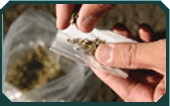
Talk with your kids (and grandkids) about drugs and alcohol. It is not easy. It is often uncomfortable. And one conversation is not enough. But our drug treatment centers are littered with lives ruined because parents did not talk enough about the dangers, or talked too much but did not listen enough, or were ignorant to the real dangers of drinking and using (“Hey, I smoked pot and I survived!” ) or made excuses for behaviors that turned out to be early drug use.

I know this firsthand because I saw it firsthand when I spent a week at the Hazelden Drug Treatment Center in Minnesota last winter for training in their addiction counseling and spiritual care program.

At Hazelden, I met nice people – nice Jewish kids too – who lost themselves amongst the heavy onslaught of mixed messages and parental leniency regarding drinking and drug use. Now they are trying (some for the second and third time) to kick their habit. I came away with a clear sense that we adults – parents, grandparents, siblings and friends – have an important responsibility to educate ourselves about the realities of drugs and alcohol use and abuse. We then need to talk with (not “at”) our young people, listen openly, and help them create strategies to deal with the pressures and enticements of alcohol and drugs.

Alcoholism and drug use is as old as the Bible, when the High Priest Aaron lost two sons to alcohol and when even Noah came off the ark, got drunk and cursed his sons (Gen. 9:20). There are no guarantees that our conversations will protect our kids. But there is plenty of evidence that, absent ongoing, serious conversations, our children are vulnerable to the neverending pull of the pot and pills.

Booze and Barbituates: Distinguishing Between Fact and Fiction

The issue of drugs can be very confusing to young children (and older ones too). If drugs are so dangerous, then why is the family medicine cabinet full of them? And why do TV, movies, music and advertising often make drug and alcohol use look so cool?

We need to help our kids to distinguish fact from fiction. And it’s not too soon to begin. National studies show that the average age when a child first tries alcohol is 11; for marijuana, it’s 12. (Jewish studies show that most Jewish kids first try alcohol at Bar/Bat Mitzvah parties or at Passover.) Older kids raid their parents’ medicine cabinets for pills that will give them a high. (Click here to learn about these “Pharming Parties.”) And many kids start becoming curious about these substances even sooner. So let’s get started!

[Click here for real information about how drugs affect us]

Talk with Your Kids


Listen Carefully
Student surveys reveal that when parents listen to their children’s feelings and concerns, their kids feel comfortable talking with them and are more likely to stay drug-free.

Role Play How to Say “No”
Role play ways in which your child can refuse to go along with his friends without becoming a social outcast. Try something like this, “Let’s play a game. Suppose you and your friends are at Andy’s house after school and they find some beer in the refrigerator and ask you to join them in drinking it. The rule in our family is that children are not allowed to drink alcohol. So what could you say?” If your child comes up with a good response, praise him. If he doesn’t, offer a few suggestions like, “No, thanks. Let’s play with Sony PlayStation instead” or “No thanks. I don’t drink beer. I need to keep in shape for basketball.”

Code for Pick Up
Work out a code with your middle and high school student. Tell him that if he/she is in an uncomfortable situation at a party or friend’s house, he can text you an agreed upon message. When you receive it, you can call her immediately to play the “overbearing parent” who is coming NOW to pick her up. This little game ensures that he has an easy way out of difficult peer pressure. It allows her to save face even as she removes herself from the dangerous situation.

Encourage Choice
Allow your child plenty of opportunity to become a confident decision-maker. An 8-year-old is capable of deciding if she wants to invite lots of friends to her birthday party or just a close pal or two. A 12-year-old can choose whether she wants to go out for chorus or join the school band. As your child becomes more skilled at making all kinds of good choices, both you and she will feel more secure in her ability to make the right decision concerning alcohol and drugs if and when the time arrives.

Establish a Clear Family Position on Drugs and Alcohol

It’s okay to say, “We don’t allow any drug use and children in this family are not allowed to drink alcohol. The only time that you can take any drugs is when the doctor or Mom or Dad gives you medicine when you’re sick. We made this rule because we love you very much and we know that drugs can hurt your body and make you very sick; some may even kill you. Do you have any questions?”

Provide Age-Appropriate Information
Make sure the information that you offer fits the child’s age and stage. When your 6 or 7-year-old is brushing his teeth, you can say, “There are lots of things we do to keep our bodies healthy, like brushing our teeth. But there are also things we shouldn’t do because they hurt our bodies, like smoking or taking medicines when we are not sick.”

If you are watching TV with your 8 year-old and marijuana is mentioned on a program, you can say, “Do you know what marijuana is? It’s a bad drug that can hurt your body.” If your child has more questions, answer them. If not, let it go. Short, simple comments said and repeated often enough will get the message across.

You can offer your teen the same message, but add more ten what marijuana and crack look like, their street names and how they can affect his body. Or together read the youth-run drug facts website freevibe.com. The teen brain is a work in progress. Click here for more on how marijuana use affects the teen brain.

Be a Good Example
Children will do what you do much more readily than what you say. So try not to reach for a drink the minute you come home after a tough day; it sends the message that drinking is the best way to unwind. Offer dinner guests non-alcoholic drinks in addition to wine and spirits. And take care not to pop pills, even over-the-counter remedies, indiscriminately. Your behavior needs to reflect your beliefs.

[How Marijuana Use Affects the Teen Brain]

If You Suspect Your Kid is Using …

Even kids under age 12 can develop a substance problem. If your child becomes withdrawn, loses weight, starts doing poorly in school, turns extremely moody, has glassy eyes — or if the drugs in your medicine cabinet seem to be disappearing too quickly — talk with your child and reach out. If your teen is involved with alcohol or drugs, move ahead thoughtfully.

Begin by downloading this brochure: Suspect Your Teen is Using Drugs or Drinking.

Next, break the silence. Seek out help. Contact your rabbi who has experience with drug counseling. Contact Los Angeles’ Alcohol Drug Action Program of Jewish Family Service. Contact Beit Teshuva, a Los Angeles based recovery house. Get help to guide you through the darkness.

[If You Suspect Your Kid is Using]

Questions and Answers for your Kids

Why do People Take Bad or Illegal Drugs?
There are lots of reasons. Maybe they do not know how dangerous they are. Or maybe they feel bad about themselves or don’t know how to handle their problems. Or maybe they do not have parents they can talk to. Maybe they think it is cool. Why do you think they do it?

Why are Some Drugs Good and Some Drugs Bad for You?
When you get sick, the drugs the doctor gives you will help you get better. But if you take these drugs when you’re healthy, they can make you sick. Also, there are some drugs, like marijuana or crack, that are never good for you. To be safe, never ever take any drugs unless Mom, Dad or the doctor says it is okay.

[Some More Answers for Your Questions]

Talkback

Through Or Ami’s Center for Jewish Parenting, we are committed to providing parents (grandparents and all adults) with information, ideas and strategies for raising healthy children with good Jewish values. Why? Shmirat haGuf, taking good care of our bodies, and acknowledging their sacredness, is inherently a Jewish value.

Our Center for Jewish Parenting now asks for your help. Help us help you (and others):

* What are your concerns about talking to kids about drugs and alcohol?
* What strategies have you found successful in helping young people face these temptations?
* What information would be helpful to you as you try to guide your children?

We are all in this together, striving to raise healthy kids with good Jewish values. So share your answers. Help Or Ami illumine the path ahead for all of us.

[Need a confidential conversation with Rabbi Kipnes? Click here to email me!]