| From the Or Ami Center for Jewish Parenting The First in a Series Adapted in part from Talking to Kids website
I know this firsthand because I saw it firsthand when I spent a week at the Hazelden Drug Treatment Center in Minnesota last winter for training in their addiction counseling and spiritual care program. At Hazelden, I met nice people – nice Jewish kids too – who lost themselves amongst the heavy onslaught of mixed messages and parental leniency regarding drinking and drug use. Now they are trying (some for the second and third time) to kick their habit. I came away with a clear sense that we adults – parents, grandparents, siblings and friends – have an important responsibility to educate ourselves about the realities of drugs and alcohol use and abuse. We then need to talk with (not “at”) our young people, listen openly, and help them create strategies to deal with the pressures and enticements of alcohol and drugs. Alcoholism and drug use is as old as the Bible, when the High Priest Aaron lost two sons to alcohol and when even Noah came off the ark, got drunk and cursed his sons (Gen. 9:20). There are no guarantees that our conversations will protect our kids. But there is plenty of evidence that, absent ongoing, serious conversations, our children are vulnerable to the neverending pull of the pot and pills. |
Booze and Barbituates: Distinguishing Between Fact and Fiction  The issue of drugs can be very confusing to young children (and older ones too). If drugs are so dangerous, then why is the family medicine cabinet full of them? And why do TV, movies, music and advertising often make drug and alcohol use look so cool? We need to help our kids to distinguish fact from fiction. And it’s not too soon to begin. National studies show that the average age when a child first tries alcohol is 11; for marijuana, it’s 12. (Jewish studies show that most Jewish kids first try alcohol at Bar/Bat Mitzvah parties or at Passover.) Older kids raid their parents’ medicine cabinets for pills that will give them a high. (Click here to learn about these “Pharming Parties.”) And many kids start becoming curious about these substances even sooner. So let’s get started! |
 Talk with Your Kids Talk with Your Kids
Role Play How to Say “No” Code for Pick Up Encourage Choice |
Establish a Clear Family Position on Drugs and Alcohol 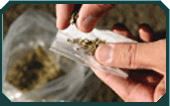 It’s okay to say, “We don’t allow any drug use and children in this family are not allowed to drink alcohol. The only time that you can take any drugs is when the doctor or Mom or Dad gives you medicine when you’re sick. We made this rule because we love you very much and we know that drugs can hurt your body and make you very sick; some may even kill you. Do you have any questions?” It’s okay to say, “We don’t allow any drug use and children in this family are not allowed to drink alcohol. The only time that you can take any drugs is when the doctor or Mom or Dad gives you medicine when you’re sick. We made this rule because we love you very much and we know that drugs can hurt your body and make you very sick; some may even kill you. Do you have any questions?”
Provide Age-Appropriate Information If you are watching TV with your 8 year-old and marijuana is mentioned on a program, you can say, “Do you know what marijuana is? It’s a bad drug that can hurt your body.” If your child has more questions, answer them. If not, let it go. Short, simple comments said and repeated often enough will get the message across. You can offer your teen the same message, but add more ten what marijuana and crack look like, their street names and how they can affect his body. Or together read the youth-run drug facts website freevibe.com. The teen brain is a work in progress. Click here for more on how marijuana use affects the teen brain. Be a Good Example |
| If You Suspect Your Kid is Using … Even kids under age 12 can develop a substance problem. If your child becomes withdrawn, loses weight, starts doing poorly in school, turns extremely moody, has glassy eyes — or if the drugs in your medicine cabinet seem to be disappearing too quickly — talk with your child and reach out. If your teen is involved with alcohol or drugs, move ahead thoughtfully. Begin by downloading this brochure: Suspect Your Teen is Using Drugs or Drinking. Next, break the silence. Seek out help. Contact your rabbi who has experience with drug counseling. Contact Los Angeles’ Alcohol Drug Action Program of Jewish Family Service. Contact Beit Teshuva, a Los Angeles based recovery house. Get help to guide you through the darkness. |
| Questions and Answers for your Kids Why do People Take Bad or Illegal Drugs? There are lots of reasons. Maybe they do not know how dangerous they are. Or maybe they feel bad about themselves or don’t know how to handle their problems. Or maybe they do not have parents they can talk to. Maybe they think it is cool. Why do you think they do it? Why are Some Drugs Good and Some Drugs Bad for You? |
| Talkback Through Or Ami’s Center for Jewish Parenting, we are committed to providing parents (grandparents and all adults) with information, ideas and strategies for raising healthy children with good Jewish values. Why? Shmirat haGuf, taking good care of our bodies, and acknowledging their sacredness, is inherently a Jewish value. Our Center for Jewish Parenting now asks for your help. Help us help you (and others): * What are your concerns about talking to kids about drugs and alcohol? We are all in this together, striving to raise healthy kids with good Jewish values. So share your answers. Help Or Ami illumine the path ahead for all of us. [Need a confidential conversation with Rabbi Kipnes? Click here to email me!] |
Tag: Hazelden

Living as Part of a Family with Addiction: Courage, Hope and Love
Since it warmed up here in Minnesota, I took advantage of the balmy 9 degree weather by taking a walk outside around the lake. Though chilly, it gave me a chance to reflect back on a day that warmed my heart.
 This second day spent in the Family program at the Hazelden Addictions Treatment Center in Minnesota provided me with a glimpse of the heartwarming acts of courage displayed each moment by the families of addicts. As a participant in Hazelden’s Spiritual Care Provider training, courtesy of a grant from the Reform Rabbinical organization CCAR, I was honored to witness the gutsy honesty with which spouses, parents and children of addicts processed the past and looked into the future as relatives of people in recovery. [All the names, situations and stories are composites. In order to protect the confidentiality of all involved, I generalize from my experiences and those of my colleagues.]
A Story
A woman seeks to leave a room. There are only two doors – door number one and door number two. She opens door number one, takes a step out where a person holding a stick whacks her in the head. (Pardon the violent image.) She stumbles back into the room. A little while later, she decides to try again. She opens door number one, takes a step out where a person holding a stick whacks her in the head. She stumbles back in the room. Some hours later, the same thing happens. Opening door number one, getting whacked in the head, and stumbling back inside. This goes on and on. At some point, she opens door one, peers outside, and notices that the person with the stick is no longer standing outside. What does she do? So she begins to look around to find the missing man.
This then is the dilemma of an addict’s family. After living the pain-filled life of one who loves an addict (addicted to drugs, booze, cocaine, pills, gambling, sex or…), is there a point that you stop looking after him or her? Is there a point that you just go through a different doorway and get on with your life? And what is going on inside of you that keeps steering you back toward door number one when you know from experience that you will be whacked in the head?
Here at Hazelden, we are learning that after years of focusing on the needs or dysfunction of the addict, each family member begins to transition into focusing back on him/herself. That transition is incredibly difficult.
We learned that when the loved one descends into the dark pit of addiction, the family member might want to begin a process called “detaching with love.” Detaching with love is not about anger or resentment, fear, anxiety, judgment or numbness. Rather, detaching with love is about taking responsibility for oneself and letting go of responsibility for the actions of the addict.
I learned that in homes of addicts, family members often try very hard to keep the addict from using. Hiding bottles or censoring words or watching what you do, all to ensure that you do not set her off on a drinking or drugging binge. Detaching with love helps you transform your own mindset. No longer must you walk on eggshells. Now, when you say something without intention of hurting anyone that makes her angry, that’s no longer your problem. (It is the addict’s problem.) Detaching with love is about setting boundaries of acceptable behavior.
It also requires one face difficult questions:
- Will our marriage survive?
- Should it?
- Can I trust her?
- Am I responsible for the past, or for the future?
- If I still love him, how can I not try to save him?
- But if I cannot save him, what am I to do?
I spent today with tears in my eyes, my heart filling with awe as regular people wrestled with intense issues. No surefire solutions guaranteed; none were really offered. Just a group of normal people, walking a painful path, struggling with their feelings and sharing insights with each other. No mystical heroes here, just regular Joes and Janes trying to figure out today and hoping to make it to tomorrow. No perfection here, just processing life.
They inspired me with their courage. I will keep them all in my prayers.
The post-LASIK surgery moments of amazement still continue!
In November 2006, I had LASIK eye surgery. You can read about my experience elsewhere on my blog. The post-LASIK surgery moments of amazement still continue!
I am in Minnesota for advanced pastoral training in addictions counseling and spiritual care at Hazelden. It is just above zero degera now and snowing. I grew up in Massachusetts and remember the downside of being out in the snow was the flakes fogging up or smearing my glasses.
Today, for the first time in my life, I looked up and watched the snow fall. No glasses to fog up or smear. Very cool.
Later while walking in the 2 degree weather, I looked over at my friend and saw that the steam from her breath was fogging up her glasses. Though my face was wrapped in a scarf, and steam rose from my breath, I did not have any glasses to fog up.
Venturing Out In the Cold: Exploring Addiction and Recovery in Minnesota
On Sunday, I left Los Angeles with its toasty 78 degree weather. When I awoke the following morning in St. Croix, Wisconsin (just over the Minnesota border), it was minus 19 degrees outside. Walking from the hotel to the waiting van, I thought my tuchis (rear end) would freeze off. Yet, after spending a few days at Hazelden, a residential addiction treatment center in Minnesota, I found myself warmed by the profound healing happening amongst recovering addicts, their families and the incredible Hazelden staff. [All the names, situations and stories are composites. In order to protect the confidentiality of all involved, I generalize from my experiences and those of my colleagues.]
 I am one of four rabbis and a rabbinic spouse attending the Hazelden Foundation’s Spiritual Care Providers Professionals in Residence program. Recognizing that even Rabbis and Rabbinic families suffer from the disease of addiction, the Central Conference of American Rabbis (CCAR), my national rabbinical organization, raised funds so that our delegation could acquire the education necessary to help our own. We seek an understanding of chemical dependence and our role in helping persons affected by addiction recover and heal – physically, emotionally, and spiritually.
Jews Don’t Drink!?! How many times have you heard that Jews don’t drink? Well we do. And we use chemicals, misuse prescription drugs, snort coke, and engage in a myriad of other addictions too! Like just about every ethnic group, our Jewish brothers and sisters too are seduced by their addictions until their lives are damaged beyond recognition. Slowly, too slowly, our Jewish community is waking up to help. So here I schlepped during the frigid Minnesota winter to deepen my pastoral skills in ways that could benefit both my colleagues and my Or Ami congregants.
In the past fourteen years, I have run recovery retreats, led Jewish 12 Step meetings on Yom Kippur, co-written curricula for developing Jewish 12 Step groups, and mentored rabbinical students to become 12-Step-friendly rabbis. None of this, however, prepared me for the intensity and depth of emotion that permeates this wonderful community.
At Hazelden, we participated in a family program in order to understand how addiction affected relationships. We partnered with addicts to learn first-hand about the challenges they faced. We listened to lectures about alcoholism as a disease and heard inspiring speakers who provide guidance and hope. At one point, I looked out the window at the falling snow hiding the frozen ground beneath. It reminded me that there is so much heartache hidden beneath the faces arrayed before me in Hazelden’s community room. But in the fellowship of recovery, the stories were shared and the pain revealed. Always, I was amazed at the strength of character that it took to face it and fight back.
We learned so much about addiction and recovery.
- About how addiction is about a “desire to be numb” and the recovery is about “the desire to be alive.”
- About how many addicts in recovery are grateful for the crisis in their life – their rock bottom – that brought them to recovery.
- About one study which showed that a person with an alcoholic parent but an otherwise stable family was still FIVE TIMES more likely to develop alcoholism as was a person from a multi-problem family without an alcoholic parent.
- About the three C’s: Cause, Control, Cure (a family member of an addict DID NOT Cause the disease, CANNOT Control the addiction, and CANNOT Cure it either).
- About the fifty-pound phone, the notion addicts use to describe how hard it is initially to lift the telephone headset to really reach out for help.
- About how the craving for the object of your addiction (booze, a joint, some pills) is so insidious and powerful that it is stronger than anything else (love of family, concern for job, caring for spouse).
Beyond making me so grateful for all the wonderful parts of my own life, my stay at Hazelden also taught me how addiction can rob anyone of the fullness of life.
This morning we were playing outside during a break. We had heard that in below zero temperatures, you could throw a full cup of boiling water up into the air, and it would vaporize before it hit the ground. We had to try it, and vaporize it did. I immediately thought of my newfound family group partners. Their lives were once so full. Yet as the chemicals heated up their days, those cherished lives – marriages, careers, economic security, families – were vaporized in less time than it took for that water to vaporize.
I feel so honored and fortunate to be learning this. And to have the opportunity to deepen my pastoral skills so I can reach out and help others. May the Holy One grant me the chance to use this learning to lead others down the path of recovery from addiction.