Tag: Healing (Henaynu)

Forgiveness: A Favor We Do Ourselves

A few years ago, our then Rabbinic Intern, now Rabbi Alissa Forrest, gave a sermon on Erev Rosh Hashana about forgiveness, which focused on forgiveness for particularly aggregious sins. In it, she quoted Rabbi Harold Kushner (author of When Bad Things Happen to Good People):

One year, my Yom Kippur sermon was on the theme of forgiveness. The next day, a woman came to see me, very upset about the sermon. She told me how, 10 years earlier, her husband had left her for a younger woman and she has had to raise two children by herself for the past 10 years. She asked me angrily, “And you want me to forgive him for what he did to us?”

I told her, “Yes, I want you to forgive him. Not to excuse him, not to say that what he did was acceptable, but to forgive him as a way of saying that someone who would do that has no right to live inside your head any more than he has the right to live inside your house. Why are you giving a man like that the power to turn you into a bitter, vengeful woman? He doesn’t deserve that power over you.”

Forgiveness is not a favor we do for the person who offended us. It is a favor we do for ourselves, cleansing our souls of thoughts and memories that lead us to see ourselves as victims and make our lives less enjoyable. When we understand we have little choice as to what other people do but we can always choose how we will respond to what they do, we can let go of those embittering memories and enter the New Year clean and fresh.

From Egypt to the Promised Land: Coming Out with the Help of Rabbi Paul Kipnes

We rabbis offer support and counseling to people through the many transitions in life. I recently received this from someone who years ago called me for help:

Coming out in my 50s was painful in the extreme, but having emerged at the other end of a prolonged coming out process, I am so grateful that I had the courage to finally live my truth…and it was Paul Kipnes, rabbi of Congregation Or Ami, who pulled me through the darkness and into the light.

I came home one day a few years back, and my ex-wife asked me if I was seeing anyone else. After having tried for so many years to keep my gayness secret from myself and then, when I could hide from myself no longer, to hold my family together until my youngest child left home, I finally said, “yes,” and all hell broke loose. She became so angry that I had lied to her, not told her of my struggles, not let on how tormented I was. From that moment, my life became almost too much to bear, as all my carefully constructed fictions crumbled.

Rabbi Paul was my refuge. When I called him up, he met me that very afternoon. We sat for hours. I cried, I mumbled, I stumbled my way through my story…and he held me, hugging me and providing me a safe space to try to figure out my life. He talked with me about the Jewish master narrative, leaving the narrow places of Egypt, wandering aimlessly in the desert, and finally arriving at the promised land. In my darkest moment, he showed me a flicker of light.

Today, I am filled with gratitude that I am in the promised land. I have achieved serenity, I have a serious relationship that is almost a year old, I have strong relationships with my grown children, and most important, I have a strong relationship with myself. In those dark hours when I first met with Rabbi Paul, I could not see a way out. He showed me that like Jews and gays so many before me, I too might one day arrive at a promised land.

I could not have seen that on my own. Because of Rabbi Paul, I was able to leave my personal Egypt, was able to muster the courage to wander through my own personal wilderness, and arrived joyously to today. When I say shehechiyanu thanking God for sustaining me, keeping me alive, and allowing me to reach a joyous day, I recognize that I am also thanking Rabbi Paul Kipnes and the divine within him that he showed me that dark day.

Caring for the Mourners: Writing Condolence Cards and Supporting the Mourners

The mitzvah (responsibility) of halvayat hamet (literally “accompanying our dead to their final resting place”) does not end when the deceased’s body is placed in the ground. Rather it continues until the mourners can walk forward into life with some semblance of confidence and strength. Our tradition reminds us that this is a long process, taking a minimum of eleven months and often longer.

So often our intentions are pure but life gets in the way. Or our discomfort with death keeps us from acting. Here are two simple ways to reach out to mourners, to fulfill the mitzvah within a community?

1. Write a Condolence Card.
If you know the deceased or his/her family, but even if you do not, sending a note (or e-mail) of condolence helps break down the sense of isolation that accompanies the death of a loved one. It shines a light through the darkness. A condolence letter has two main goals: to offer tribute to the deceased and to be a source of comfort to the survivors. Some people are uncomfortable writing such a note. We wonder what to say.

Usually, in writing a condolence card/note, focus on accomplishing any of six things:

  • acknowledging the loss and naming the deceased
  • expressing your sympathy
  • noting special qualities of the deceased (if we knew him/her)
  • recalling a memory about the deceased
  • offering help (but only if you can be specific: e.g., “let me bring a meal next week” or “I will come and do some shopping for you.”)
  • ending with a word or phrase of sympathy.

Sometimes I begin a condolence card by noting that “although I did not know (insert person’s name), I am nonetheless saddened by your loss.” Such a letter need not be long – just heartfelt. So many mourners have expressed to me their appreciation for letters from other members of the community have written that they did not even know the author. One person noted that he reread these cards of sympathy and consolation many times during the year of mourning.

2. Call the Survivors on a Regular Basis.
We often forget that mourning is a long process. After pausing for a few days or a week to console our friends over their loss, we are quickly pulled back into the routine of our daily lives: work, school, our kids, our parents, our social life. This is normal and appropriate. Yet the mourners need almost a year to be able to walk forward with some semblance of confidence.

We support those who have lost loved ones by making a point of keeping in touch. Some people write a note in their calendars (datebooks, BlackBerrys) reminding them to call the survivors every few weeks (or at 2 weeks, 2 months, 4 months, 9 months, a year). We can say, “I have been thinking about (insert deceased’s name) and I was thinking about you, and I wanted to tell you a story I remembered about him/her.” Or perhaps “I was thinking about you and I was thinking about (insert deceased’s name), maybe you can tell me a story about (deceased) so together we can remember him/her.”

Nothing is more isolating than when people stop asking about the deceased. Some mourners have told me that they desperately wanted to recall their loved one, yet callers – afraid apparently that such recollections would cause pain – refrained from mentioning his/her name or asking about him/her. Although sometimes we can bring a mourner to tears, more often we provide a loving release from the pent-up sadness.

So Take a Chance.
When someone you know, or know about, loses a loved one, reach out. Send a condolence letter, and then check in in the weeks and months following the death.

You will be doing a mitzvah. You will be bringing them comfort. You may even be training them to reach out to you if and when you experience such a loss in your life in the future.

Structured Caring: Reaching Out to Families with Children with Special Needs

When loving a child with special needs, the pressure and the work to meet his/her needs are constant. Crises come regularly; exhaustion is a constant companion. It is a unique struggle. That’s why at Or Ami, our Henaynu Caring Community Committee, in partnership with our Brandon Kaplan Special Needs Program, has found a unique way of reaching out. We have created a special outreach chairperson who reaches out regularly, multiple times over the course of a year, to each family with a child with special needs.

Once a year the families receive a letter (see below). Then the contacts begin. Caring is heart-felt, but the pressures of life keep us from regularly participating in random acts of kindness. That is why we have created a structure, led by a caring individual, to deepen our support and outreach.

This year’s letter:

Dear NAME:
I am writing on the request of Rabbi Paul Kipnes and our Henaynu Caring Community Committee. I have been asked to co-chair the Henaynu Caring Community Sub-Committee to help serve the needs of the congregants who have children with special needs. As the mother of two special needs children, I understand the daily struggles and joys of parenting our unique children. I also know that, at times, it can seem like no one else “gets it” — the particular sorrows of seeing our son’s or daughter’s differences, the struggle with the school system, or the isolation that our families experience. We all crave community, a place where we can share our extraordinary lives and be understood. Our Rabbi, our Cantor and the members of Congregation Or Ami want to provide you that community. We want you to know that you can reach out to Rabbi Kipnes and to the Henaynu Caring Community Committee for support. Perhaps the stresses that you experience become part of your routine, but there may be times that you feel you need extra care and prayers from others. Please know that we are here for you. I will be calling you sometime within the next couple of months to check in with you. In the meantime, you can reach me at PHONE NUMBER or dianesmithmft@earthlink.net. L’Shalom, Diane Smith

For Those Dealing with Chronic Illness: A Prayer for Persisting

In her article, Prayer for Persisting: Moving Beyond Mi Shebeirach, my colleague Rabbi Julie Pelc, Assistant Director of the Kalsman Institute on Judaism and Health, reflects upon facing the constant long term of chronic illness:

During Rabbinic school, I spent more time in doctor’s offices than in seminary classrooms. Whereas it was initially an acute illness (for which the traditional misheberach and prayers in hopes of a “refuah shleima” would have been appropriate), the years of recovery and the resulting, permanent disability ensuring thereafter no longer qualified for such a hope or wish.

She thinks about the many who are with incomplete health, yet, are not entirely “sick” either:

I think of my coworker with diabetes, a friend with Chronic Fatigue Syndrome, an aunt struggling with chronic clinical depression, a classmate with lupus and ulcerative colitis and an acquaintance living with HIV. I think of my own incomplete recovery. To pray for “complete healing” for those whose ailments cannot or will not ever be completely “healed” seems audacious and even offensive. My coworkers, colleagues, family, friends, and I will negotiate medications, medical appointments, dietary needs, and fears throughout our lives. We will face unexpected side effects, professional and personal repercussions of our special needs, and stigma from many well-meaning strangers every day. Our everyday reality is one of incomplete health; yet, we are not entirely “sick”, either.

She offers a new kind of Mi Shebeirach, a prayer for a different kind of healing:

To pray for the “complete healing of body and spirit” is to misjudge the realties of many people’s lives. To understand or redefine “healing” as “making peace with one’s fate” is to alter the meaning of the prayer and it may also serve to ignore our specific kind of suffering and its ever-changing realities… We need a prayer that acknowledges the reality of chronic illness. We need a prayer that asks God for the strength to persist even in the face of challenges that may seem insurmountable. We need a prayer asking that we be granted the courage to continue in life even as we face the reality of our death; to rage and to praise, to bless and to curse, to accept and to reject diagnoses simultaneously.

Her prayer:

“May the One who blessed our fathers and our mothers, bless _______ son/daughter of _______: strengthen his/her heart and raise up his/her hand, with the blessings you gave to Yaakov, to Yonatan and David, to Daniel the Prophet, to Tamar mother of Peretz, to Miriam the Prophetess, and to Naomi.
May God give to him/her grace, compassion and loving-kindness; love, harmony, peace, and companionship. Speedily, Adonai our God, hear our voices, take up our prayers, and watch over his/her life-force, spirit, and soul. With respect to your power, your loving-kindness, and your great compassion, behold we say to him/her: be strong and of good courage . Spread over us all Your shelter of peace. And let us say: Amen.”

Why these Biblical ancestors?

Rabbi Pelc writes:

  • Jacob struggled with an invisible being in the night, emerging with a limp. He would not cease his wrestling until he also emerged with a blessing from his adversary.
  • Jonathan was the rightful inheritor of his father’s (King Saul’s) throne but desired instead to yield leadership to his beloved friend, David. Because he refused to abandon his deeply held convictions, he fought against his father and died in battle defending his companion and his beliefs.
  • David (King David) is perhaps best known for his battle against the giant, Goliath, though the odds were firmly not in his favor.
  • Daniel’s enemies threw him into the lion’s den, by order of the king.
  • Tamar was twice widowed, childless, and then denied remarriage by her father-in-law because he feared that she would somehow cause the death of a third husband, were she to be allowed to marry again.
  • Miriam was struck with a skin disease, tzarraat, which forced her to live outside the camp until she was healed.
  • Naomi lost her husband and both her sons in quick succession in a foreign land. She cried out, “God has embittered my soul”, feeling that she was left completely empty, devoid of blessing or hope.
  • As Moses passes the mantle of leadership to the next generation, he says, “hazzak v’amatz”, meaning: “May you be strong and courageous”

So often we are able to deal with the crisis of illness. We know how to reach out before or after the surgery or visit to the hospital. But when illness moves into the long-term – like Fibromyalgia, chronic depression, or…, we often do not know how to sustain our support. This prayer may help both the person living with chronic illness and the community as we try to change attitudes.

Read Rabbi Pelc’s full article here. Read my more complete teaching on this topic here.

Prayer for a Cure for Cancer

I just learned that two relatives of two people dear to my congregation and to me were diagnosed with cancer. Seeking solace, I found a prayer written by my friend Rabbi Zoè Klein (Temple Isaiah, Los Angeles):

Prayer for a Cure for Cancer Words of healing By Rabbi Zoè Klein We are sometimes mistaken when we fear that which is big. Godzilla, King Kong, Asteroid, Armageddon. At least we can see it when it comes. We are sometimes mistaken when we fear that which is big. Change, birth, death, love. At least we can throw our arms wide around it.
God of big things, God of great deeds, God of the drama of the Exodus, the parting of the seas, the fire on the mountain, the creation out of nothing we are wonderstruck by You, dazzled by big things.
But are You not also the God of the small, God of the turning leaf, God of the grain of sand, God of the passing shadow, God of the rotting fruit? I address You now as God of the small, because sometimes we are mistaken when we fear that which is big, when that which is most frightening of all is small,
the size of a melanomic cell, the size of a metastatic pinpoint, the size of a golfball, the size of a grapefruit growing where there is no tree.
That immutable danger that makes us victims of our own soft tissue, lymphnodes, and blood, that devastating fear that stalks us out of passing shadows, out of the mist of pesticide, tar, benzene, p.c.b. toxicities, out of the glow of gamma-rays, x-rays, ultraviolet rays, aluminum foil, out of the silicone, the tobacco, the skin of an apple, the high saturated fats, the low fiber, the vegetable hair dyes, out of nothing, out of nothing You are good at that God, Creation out of nothing.
I pray to You now, God of small things, God of miracles-barely-perceived by the naked, mortal eye, I pray to You now, God of small things, for a spontaneous global remission. For erasure of that word that lurks darkly behind our words.
When Moses’ sister was struck Moses spoke five small words to You. El na rafa na la. God please heal her please. You answered, and You healed her. El na rafa na la. El na rafa na la.

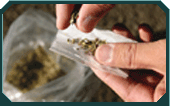
There’s an Elephant in the Room; He’s Smoking Dope

We, Jews and Jewish families, living relatively comfortable lives, find ourselves increasingly facing uncomfortable truths: that abuse of drugs and alcohol runs rampant through our community. Jews are not immune from the battle with the bottle or the pull of the pills. Though we talk about it less than some communities, alcohol and drug abuse – especially among teens and young adults – continues to ruin lives.

It is time to face facts: too many of our kids have access too much money, easy transportation and freedom from parental oversight that allows them to explore and get hooked on drugs and booze well before we adults even have a clue. For those who are searching for something, our high schools – secular and Jewish alike – provide ample opportunity to experiment and get hooked. It is happening too often with our “nice Jewish boys and girls.”

At Or Ami we talk about the difficult issues: sex, drugs, disease, death. Our Or Ami Center for Jewish Parenting strives to help our community face the future by talking about those subjects that often make us uncomfortable, and by bringing our Jewish values and healing tradition to the conversation. Sometimes we pass on valuable insights through eNewsletters; sometimes we gather parents for open discussions about the challenges we face parenting.

Recently, our Rabbinic/Education Intern Lydia Bloom Medwin gathered together our Temple Teen Night participants for a discussion on the dangers of drug and alcohol abuse. I watched in amazement as our students listened attentively, and responded inquisitively, to the experience of one Jewish mother whose “nice Jewish boy” overdosed on drugs. Read on…

Rabbinic/Education Intern Lydia Bloom Medwin writes:

“You Can’t Compete with Heroin, Mom.”
These words helped speaker and author Rita Lowenthal comprehend just how deeply her son had descended into addiction. Rita’s son Josh began experimenting with drugs at age 13. By age 38, he had died of an overdose. This made Rita a particularly poignant speaker at our Temple Teen Night session focusing on the issue of drugs and alcohol one Wednesday. Rita’s reflections helped us to begin to understand the dangers of drug and alcohol abuse, as well as the nature of addiction, as it functions in our own Jewish community.

Talking to kids about the dangers of alcohol and drugs requires honesty. So we began by admitting that Judaism is not a religion that forbids the pleasures of alcohol. On the contrary, we customarily use wine in our holiday and life cycle celebrations. We drink wine to make these moments special and to increase the joy. However, Judaism also understands that moderation and responsibility are the keys to drinking at Jewish celebrations. Clearly, our tradition understands that there is a difference between alcohol use and alcohol abuse.

Alcohol and drug abuse can be dangerous and is certainly illegal for our youth. Rita explained to a fully engaged group of seventh through eleventh grade students about the risks of even experimenting with these substances, especially for the type of people who are naturally adventurous. We learned that while some people might be able to try a drug and then never touch it again, so many others try it once and cannot stop abusing drugs until the day the substance kills them. As such, just trying drugs could mean a life sentence. That is what happened to Josh Lowenthal when, at age 13, his mother found that it was already too late. In and out of rehab and jail for twenty-five years, Josh went from devastation to healing to hope and back again in a vicious cycle. Josh, a bright and outgoing Jewish kid, was musically talented who was inclined to write poetry and listen to NPR. Still, as Rita so eloquently in her book, “One Way Ticket,” even her “nice Jewish boy” wasn’t immune to the realities of addiction.

Congregation Or Ami is a community where we talk openly about drug and alcohol use. At Or Ami, students can ask the difficult questions and receive honest answers and thoughtful advice. If one of our students or our families is in trouble with drugs or alcohol, they can turn to Rabbi Paul Kipnes (who has been trained in Alcohol and Drug Counseling and Spiritual Care), our Rabbinic and Education Interns and our temple family for help. Or Ami will always respond with an open mind and open arms. For many, Or Ami has already been the first stop on the road to recovery.

Drug and alcohol addiction is nothing new; its roots stretch back to Biblical times. Addiction is a disease that affects a great deal of people, and the Jewish community is not immune to its ravages. At Congregation Or Ami, we are working to understand (and teach) more about the nature of this disease. Simultaneously we support our families who are currently struggling with addiction and we celebrate with those who have found recovery through the Twelve Step Program.

We welcome all those struggling with these issues to contact Rabbi Paul Kipnes or Rabbinic/Education Intern Lydia Bloom Medwin for support or Jewish resources regarding addiction and recovery.

Talking about that Dope-Smoking Elephant
Or Ami is committed to shining a light on this age-old problem. We have learned that when parents talk openly and calmly, kids hear what they have to say. With the support of Bruce and Wendy Friedman, and the Wolfson Family Foundation, Or Ami has been holding conversations – public and private – about the challenges of alcoholism and addiction. Each year Or Ami introduces another rabbinic student to the realities of addiction in the Jewish community and we provide him/her with opportunities to develop pastoral skills to address these challenges. As Lydia Bloom Medwin moves onto her new internship at UCLA Hillel, Rabbinic Intern Sara Mason will learn and teach about the dangers of addiction.

After the High Holy Days, our community will gather again under the auspices of our Or Ami Center for Jewish Parenting to learn from Beit T’shuvah, a Jewish halfway house in Los Angeles, about what we parents can do do help our kids combat the pull of the pills.

Until then, explore my blog article on Talking to Your Kids about Drugs and Alcohol, Part I. We parent more effectively when our eyes are open wide.

As always, I am here to listen, to strategize and to help, as we all walk the tightrope between parenting too much and parenting too little. I look forward to hearing your thoughts. Email Rabbi Paul Kipnes here.

Israeli Research into Treating Parkinson’s Makes Scientific American’s Top 50 Breakthroughs

Following Michael J. Fox’s poignant speech to the URJ Biennial regarding research with Stem Cells, it was rewarding to read in Israeli newspaper Ha’aretz (12/18/07) that:

Israeli research among ’50 most significant scientific breakthroughs in 2007′

A groundbreaking discovery in the field of artificial intelligence, conducted by two Tel Aviv University academics, and Israeli research into treating Parkinson’s disease, have been selected as among the past year’s greatest advancements in science by a top U.S. periodical. Scientific American magazine placed Professor Eshel Ben-Jacob and Dr. Itay Baruchi’s creation of a type of organic memory chip on its list of the year’s 50 most significant scientific discoveries.

Treatment for Seasonal Affective Disorder Takes a Page from Chanukah

I recently learned that a relative has Seasonal Affective Disorder, SAD for short. Like others effected by SAD, this relative is profoundly changed as the seasons change. Her moods, her energy, and her concentration are dampened as the weather darkens. I laughed as I heard this, sharing that I prefer it out here in California because the the days of overcast skies are fewer and farther between.

Here comes the New York Times (12/18/07) article, Brought on by Darkness, Disorder Needs Light (By RICHARD A. FRIEDMAN, M.D.), which argues that More than winter blahs, seasonal depression is recognized and treatable.
The article notes that: Researchers have noted a similarity between SAD symptoms and seasonal changes in other mammals, particularly those that sensibly pass the dark winter hibernating in a warm hole. Animals have brain circuits that sense day length and control the timing of seasonal behavior. Do humans do the same? In 2001, Dr. Thomas A. Wehr and Dr. Norman E. Rosenthal, psychiatrists at the National Institute of Mental Health, ran an intriguing experiment. They studied two patient groups for 24 hours in winter and summer, one group with seasonal depression and one without. A major biological signal tracking seasonal sunlight changes is melatonin, a brain chemical turned on by darkness and off by light. Dr. Wehr and Dr. Rosenthal found that the patients with seasonal depression had a longer duration of nocturnal melatonin secretion in the winter than in the summer, just as with other mammals with seasonal behavior.

So what do they suggest? Bright lights. Here’s what’s fascinating to me: We Jews figured that out a long time ago. At the darkest times of the year, the winter solistice, Jews celebrate Chanukah. Our rabbis, in their brilliance, told us that in the dark darkness, we Jews should light lights, increasing the lights evening by evening. Where darkness and overcast skies bring depression, Chanukah brings hope. Score one for the rabbis!

Michael J. Fox on Parkinson’s, Stem Cell Research and His Reform Jewish Family

Michael J. Fox, upon receiving the Maurice N. Eisendrath Bearer of Light Award, spoke about his own journey with Parkinson’s disease, about creating his foundation, and about how it is so difficult to move scientific research from an idea toward a cure.

Words of wisdom from Mr. Fox:

On Parkinson’s disease: It’s a gift. (On reflection he said) It’s a gift that keeps on taking.

If you contemplate the worst case scenario and it happens, you have lived it twice.

God gave us hands and feet and brains. We need to use them.

Some suggest that Stem Cell research must not occur because embryos are life. Jews think differently. We believe that life begins after the fetus leaves the body. According to Judaism, an embryo is not a fetus. It is not life. Judaism supports stem cell research. Jews believe that the government should not limit Stem Cell research, even on embryos.

Read more about Michael J. Fox’s life and work here.

Asperger’s Syndrome Gets a Very Public Face

The New York Times (December 4, 2007) wrote eloquently about the challenges and successes of Asperger’s Syndrome (Asperger’s Syndrome Gets a Very Public Face). It warmed my heart as a relative and as a rabbi.

I care deeply about someone with Asperger’s Syndrome, a relative of autism, characterized by unusual social interaction and communication skills and by an inability to read social cues. Years before this syndrome was diagnosed, we shared frustration with many interactions.

Today, we recognize Asperger’s Syndrome for what it is, a mental health issue, a personal challenge. I am pleased to have read about the poignant experience of Heather Kuzmich, who as a contestant on “America’s Next Top Model,” simultaneously served as a model for others with Asperger’s syndrome. She didn’t win (I wouldn’t really know since I don’t watch the show), but she did win the hearts of hundreds of thousands of viewers, not to mention scores of people with Asperger’s and their family members who were cheering her on.

As a rabbi, I retain fond memories about officiating at the B’nai Mitzvah ceremonies of so many children with with autism, Asperger’s and other special needs. Each was meaningful and heartwarming. Each was both special and exceedingly normal.

Perhaps that is the larger lesson that Heather Kuzmich’s experience teaches. Though facing challenges which are sometimes overwhelming, our special needs children and adults, relatives and friends deserve all the opportunities that we give to others. With patience and some assistance, they too can serve as top models for themselves and others.

Talking to Kids about Drugs & Alcohol, Part I

From the Or Ami Center for Jewish Parenting
The First in a Series
Adapted in part from Talking to Kids website

Talk with your kids (and grandkids) about drugs and alcohol. It is not easy. It is often uncomfortable. And one conversation is not enough. But our drug treatment centers are littered with lives ruined because parents did not talk enough about the dangers, or talked too much but did not listen enough, or were ignorant to the real dangers of drinking and using (“Hey, I smoked pot and I survived!” ) or made excuses for behaviors that turned out to be early drug use.

I know this firsthand because I saw it firsthand when I spent a week at the Hazelden Drug Treatment Center in Minnesota last winter for training in their addiction counseling and spiritual care program.

At Hazelden, I met nice people – nice Jewish kids too – who lost themselves amongst the heavy onslaught of mixed messages and parental leniency regarding drinking and drug use. Now they are trying (some for the second and third time) to kick their habit. I came away with a clear sense that we adults – parents, grandparents, siblings and friends – have an important responsibility to educate ourselves about the realities of drugs and alcohol use and abuse. We then need to talk with (not “at”) our young people, listen openly, and help them create strategies to deal with the pressures and enticements of alcohol and drugs.

Alcoholism and drug use is as old as the Bible, when the High Priest Aaron lost two sons to alcohol and when even Noah came off the ark, got drunk and cursed his sons (Gen. 9:20). There are no guarantees that our conversations will protect our kids. But there is plenty of evidence that, absent ongoing, serious conversations, our children are vulnerable to the neverending pull of the pot and pills.

Booze and Barbituates: Distinguishing Between Fact and Fiction

The issue of drugs can be very confusing to young children (and older ones too). If drugs are so dangerous, then why is the family medicine cabinet full of them? And why do TV, movies, music and advertising often make drug and alcohol use look so cool?

We need to help our kids to distinguish fact from fiction. And it’s not too soon to begin. National studies show that the average age when a child first tries alcohol is 11; for marijuana, it’s 12. (Jewish studies show that most Jewish kids first try alcohol at Bar/Bat Mitzvah parties or at Passover.) Older kids raid their parents’ medicine cabinets for pills that will give them a high. (Click here to learn about these “Pharming Parties.”) And many kids start becoming curious about these substances even sooner. So let’s get started!

[Click here for real information about how drugs affect us]

Talk with Your Kids


Listen Carefully
Student surveys reveal that when parents listen to their children’s feelings and concerns, their kids feel comfortable talking with them and are more likely to stay drug-free.

Role Play How to Say “No”
Role play ways in which your child can refuse to go along with his friends without becoming a social outcast. Try something like this, “Let’s play a game. Suppose you and your friends are at Andy’s house after school and they find some beer in the refrigerator and ask you to join them in drinking it. The rule in our family is that children are not allowed to drink alcohol. So what could you say?” If your child comes up with a good response, praise him. If he doesn’t, offer a few suggestions like, “No, thanks. Let’s play with Sony PlayStation instead” or “No thanks. I don’t drink beer. I need to keep in shape for basketball.”

Code for Pick Up
Work out a code with your middle and high school student. Tell him that if he/she is in an uncomfortable situation at a party or friend’s house, he can text you an agreed upon message. When you receive it, you can call her immediately to play the “overbearing parent” who is coming NOW to pick her up. This little game ensures that he has an easy way out of difficult peer pressure. It allows her to save face even as she removes herself from the dangerous situation.

Encourage Choice
Allow your child plenty of opportunity to become a confident decision-maker. An 8-year-old is capable of deciding if she wants to invite lots of friends to her birthday party or just a close pal or two. A 12-year-old can choose whether she wants to go out for chorus or join the school band. As your child becomes more skilled at making all kinds of good choices, both you and she will feel more secure in her ability to make the right decision concerning alcohol and drugs if and when the time arrives.

Establish a Clear Family Position on Drugs and Alcohol

It’s okay to say, “We don’t allow any drug use and children in this family are not allowed to drink alcohol. The only time that you can take any drugs is when the doctor or Mom or Dad gives you medicine when you’re sick. We made this rule because we love you very much and we know that drugs can hurt your body and make you very sick; some may even kill you. Do you have any questions?”

Provide Age-Appropriate Information
Make sure the information that you offer fits the child’s age and stage. When your 6 or 7-year-old is brushing his teeth, you can say, “There are lots of things we do to keep our bodies healthy, like brushing our teeth. But there are also things we shouldn’t do because they hurt our bodies, like smoking or taking medicines when we are not sick.”

If you are watching TV with your 8 year-old and marijuana is mentioned on a program, you can say, “Do you know what marijuana is? It’s a bad drug that can hurt your body.” If your child has more questions, answer them. If not, let it go. Short, simple comments said and repeated often enough will get the message across.

You can offer your teen the same message, but add more ten what marijuana and crack look like, their street names and how they can affect his body. Or together read the youth-run drug facts website freevibe.com. The teen brain is a work in progress. Click here for more on how marijuana use affects the teen brain.

Be a Good Example
Children will do what you do much more readily than what you say. So try not to reach for a drink the minute you come home after a tough day; it sends the message that drinking is the best way to unwind. Offer dinner guests non-alcoholic drinks in addition to wine and spirits. And take care not to pop pills, even over-the-counter remedies, indiscriminately. Your behavior needs to reflect your beliefs.

[How Marijuana Use Affects the Teen Brain]

If You Suspect Your Kid is Using …

Even kids under age 12 can develop a substance problem. If your child becomes withdrawn, loses weight, starts doing poorly in school, turns extremely moody, has glassy eyes — or if the drugs in your medicine cabinet seem to be disappearing too quickly — talk with your child and reach out. If your teen is involved with alcohol or drugs, move ahead thoughtfully.

Begin by downloading this brochure: Suspect Your Teen is Using Drugs or Drinking.

Next, break the silence. Seek out help. Contact your rabbi who has experience with drug counseling. Contact Los Angeles’ Alcohol Drug Action Program of Jewish Family Service. Contact Beit Teshuva, a Los Angeles based recovery house. Get help to guide you through the darkness.

[If You Suspect Your Kid is Using]

Questions and Answers for your Kids

Why do People Take Bad or Illegal Drugs?
There are lots of reasons. Maybe they do not know how dangerous they are. Or maybe they feel bad about themselves or don’t know how to handle their problems. Or maybe they do not have parents they can talk to. Maybe they think it is cool. Why do you think they do it?

Why are Some Drugs Good and Some Drugs Bad for You?
When you get sick, the drugs the doctor gives you will help you get better. But if you take these drugs when you’re healthy, they can make you sick. Also, there are some drugs, like marijuana or crack, that are never good for you. To be safe, never ever take any drugs unless Mom, Dad or the doctor says it is okay.

[Some More Answers for Your Questions]

Talkback

Through Or Ami’s Center for Jewish Parenting, we are committed to providing parents (grandparents and all adults) with information, ideas and strategies for raising healthy children with good Jewish values. Why? Shmirat haGuf, taking good care of our bodies, and acknowledging their sacredness, is inherently a Jewish value.

Our Center for Jewish Parenting now asks for your help. Help us help you (and others):

* What are your concerns about talking to kids about drugs and alcohol?
* What strategies have you found successful in helping young people face these temptations?
* What information would be helpful to you as you try to guide your children?

We are all in this together, striving to raise healthy kids with good Jewish values. So share your answers. Help Or Ami illumine the path ahead for all of us.

[Need a confidential conversation with Rabbi Kipnes? Click here to email me!]