Tag: Or Ami

The Joys of Being a Rabbi: Engaging Teens

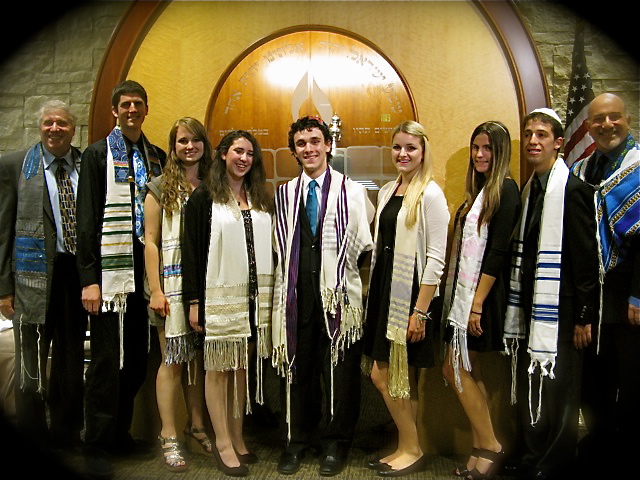
Confirmation is a reaffirmation of all that Congregation Or Ami is about. I wish you could have been there. On Friday night, 7 Or Ami teenagers – Jessa Cameron, Libby Coufal, Nathan Fried, Ben Ginsburg, Dakota Keller, Marissa Meyer, and Peter Young – stood on our bimah to articulate those values and experiences which bind them to our Jewish tradition and community. Listening to them speak, my eyes misted over.

I remember watching each one of them grow up, some since they were infants. We rabbis and cantor have the unique privilege of walking the journey with our teens as they matured into Jewish adulthood. We smile at memories of them singing with joy at Shabbat services, laughing as they learned in religious school, and chanting ancient words from an ancient scroll as they traversed the divide between childhood and adulthood. We watch them assume leadership roles in our LOMPTY temple youth group. We kvelled alongside their parents every step of the way. We remember the challenges of their teenage years, the sadness shared during family illness and loss, the joy of graduations and simchas.

Our national Reform movement, the Union for Reform Judaism, has told us that after years of post-Bar/Bat Mitzvah dropouts, the future of our Jewish people rests on our ability to engage our youth through high school. What makes for such engagement?

  • The creation of relationships between our youth beginning when they are young 
  • The developing of connections between our youth and their rabbis and cantor 
  • The use of social media to build community among our teens and their clergy 
  • Openness to asking deep questions, and to talking about difficult subjects 
  • Willingness to offer unconditional love and acceptance 

But mostly, as we listened to these teens confirm their connection to Torah, Jewish tradition and the Jewish people, I realized how deeply I love these future adults. So I gave them each my business card (complete with my email, facebook, twitter and cell phone number) with the promise that the relationships will endure and their rabbis and cantor will be there for them always.

I know we will remain in touch. Because Or Ami’s former teens – now adults – stay in touch regularly. We go out for coffee, to grab sushi, for help with a paper, and joyously, to plan the ceremony when they will bind their lives under a chuppah with their beloved.

Confirmation offered a glimpse into the future, and a peak into the past. All wrapped up in Judaism. That’s the work of being a rabbi; that’s the joy of the Confirmation ceremony.

Read more: In their own words: 7 Inspiring Teens Speak Out About Being Jews

Jill’s Coats for Kids: 2 Kids Collect 150 Coats

The Or Ami Center for Tikkun Olam (social justice) was created to foster the knowledge and commitment of young people to become social justice advocates. We stive to instill in them an awareness of our obligation as Jews. As Torah teaches, lo ta’amod al dam rei-acha – don’t stand idly by while your neighbor bleeds.

Thus we schep nachas (share our prideful joy) about the work of Sabrina (8 years old) and Chelsea (five years old) Stone, two Or Ami California kids, who collected over 150 coats this winter to bring warmth to needy children. According to their website, www.jillscoatsforkids.com, they created this project in honor of their “grandmother, Jill Stone, who started a coat drive in Dallas, Texas. We thought it would a good idea to help children who need coats in our community, too.”

They delivered the 150 coats to Hope of the Valley Rescue Mission in Sun Valley, CA, which is “committed to meeting the needs of the hungry, homeless and destitute.”

This simple act by Sabrina and Chelsea touched so many people.  So writes Ken Craft of the Valley Rescue Mission, who kvelled (praised) about them:

How beautiful it is to see people truly care about the genuine needs of others. This winter, though milder than others, there are still many nights where the temperature dips into the 30’s and 40’s. At times like these, our friends living on the streets are desperately seeking coats and jackets in order to stay warm.  

THANK YOU for the three large bags of coats you collected through Jill’s Coats for Kids. Each jacket will be given to a man, woman or child who finds themselves homeless in the San Fernando Valley. Only God knows the importance of your act of love and the generosity of your donors!
On behalf of those we serve each day….THANK YOU for providing the coats. Your efforts are not only appreciated, they are deeply needed! 

Sabrina and Chelsea acted in concert with longstanding Jewish values. As our Religious Action Center for Reform Judaism reminds us,

Our Biblical prophets themselves exhorted us to follow a long-standing tradition of hospitality among the Jewish people. According to one midrash (rabbinic teaching), Abraham is judged to be greater than Job because while the latter “opened his doors to the road” (Job 31:32), Abraham left his tent to seek guests among the passers-by (Genesis 18:1-8). Furthermore, Abraham “got busy and built spacious mansions along the highways, and stocked them with food and drink, so that whoever entered ate, drank, and blessed Heaven” (Avot 1:5; Avot d’Rabbi Natan 7). More recent Jewish history, with its exiles and expulsions, is a powerful reminder of our special obligation to provide for those with no protection.

So it is like this. There are people in need. There are people with more. The latter must act to help the former. This is what we try to teach at Congregation Or Ami. This is why our Center for Tikkun Olam (social justice) was created.  May the actions of Sabrina and Chelsea inspire us all!

Moses Wasn’t a White Boy

I love the look on the faces of our students when I point out to them that Moses could not have had the pinkish white skin that I have. First their brows furrow, then they go wide, then they smile with understanding and agreement.

Since Moses descended from people born in Canaan (with ancestry harkening back to Ur, near the intersection of the Tigris and Euphrates rivers) and he grew up under the hot Egyptian sun. His skin had to be significantly darker than your average caucasian. That means that Cecil B. DeMille got it wrong casting Charlton Heston as Moses, at least with regards to skin color.

Not that skin color should matter. Often – too often – it seems to matter. Especially in Jewish life. But it shouldn’t.

Introducing Be’chol Lashon, Celebrating the Mosaic of Jewish Life 
Thankfully, there exists an incredible organization, Be’chol Lashon (In Every Tongue) which “grows and strengthens the Jewish people through ethnic, cultural, and racial inclusiveness. They advocate for the diversity that has characterized the Jewish people throughout history, and through contemporary forces including intermarriage, conversion and adoption. And they foster an expanding Jewish community that embraces its differences.”

Be’chol Lashon’s monthly eNewsletter overflows with insights, news, arts and culture, and a plethora of programs and events. They run kids and family camp, send out speakers, and encourage creative mitzvah projects.  Be’chol Lashon reminds us of the fact that Jewish community has always been a mosaic.

Or Ami Has a Multicultural/Multiracial/Multiethnic Webpage
At Congregation Or Ami (as our “Multicultural/Multiracial” webpage declares),

We celebrate that Judaism has always been mosaic, a beautiful collection of different colored and shaped pieces. We are also “Mosaic” in that we connect back to Moses, a Hebrew child, raised by Egyptians, who married a non-Jewish woman of color and became the leader of his people. We rejoice that at least 20% of the Jewish population is racially and ethnically diverse, including African, African American, Latino (Hispanic), Asian, Native American, Sephardic, Mizrahi and mixed-race Jews by heritage, adoption, and marriage. Recognizing that we are all created b’tzelem Elohim, in the image of God, we are pleased to welcome the multicultural/multiracial/multiethnic Jewish individuals, couples and families in our community. 

Some couples that begin with two individuals from different backgrounds need to integrate separate lives into one family. Some families adopting a child from a different culture look to celebrate all parts of the child’s mosaic. Individual Jews, raised in multicultural homes, strive to be accepted as Jews, no questions asked. Remember: you are not alone. 

Congregation Or Ami, our Rabbi Paul Kipnes, Cantor Doug Cotler, Rabbi Julia Weisz and our Reform Jewish movement, welcome you. Congregation Or Ami is already proud to be a home congregation for many multiethnic, multiracial and multicultural individuals, couples and families, and we welcome you to share in the warmth of our community. We invite you to begin a conversation with Rabbi Kipnes to share your hopes or questions about being part of Or Ami. 

Congregation Or Ami offers individuals and couples who connect to multiple cultures, races and/or ethnic groups the opportunity to explore their Judaism in a warm, welcoming environment. We work to empower people to make Jewish choices for themselves and their families and we strive to provide resources to inform educated decisions. We strive to be a welcoming place for people of diverse religious backgrounds, sexual orientations, and ethnic, racial and cultural backgrounds. We invite you to begin a conversation with Rabbi Kipnes to share your hopes or questions about being a multicultural, multiethnic and/or multiracial individual or family at Or Ami.
[Note: It is quite possible that much of this language was borrowed from Be’chol Lashon publications.

So let’s celebrate: our Jews and Jewish families of all colors, racial or ethnic backgrounds, and cultural connections. You make our mosaic ever more colorful, engaging and interesting.

Tell Your Non-Caucasian Jewish Friends
Check out Be’chol Lashon, and share it, especially, with your non-caucasian Jewish friends. Check out:

And may our synagogues, and federations, and organizations, and schools, and individual Jews, remember the truth: that mosaics are way more interesting when they are made up of all different colors, shapes and sizes.

The Motif of Light in Jewish Tradition

On Chanukah we light the menorah/chanukiah, increasing the light in a very dark world. What is the significance of light in Judaism and Jewish ritual? What purpose did the menorah in the Jerusalem Temple originally serve?

Rabbi Adin Steinsalz offers some answers to these questions in an article that appeared in the Jerusalem Post. The excerpt below are his words. Thanks to Or Ami congregant David Eshaghpour for bringing it to my attention.  

***

Light is the genesis – the creation of the world. The primary utterance of creation is “Let there be light,” its separation from darkness. The Midrash asks – from what was light created? The answer is whispered: “G-d cloaked [Godself] in a white shawl, and the light of its splendor shone from one end of the world to the other” (Genesis Rabba 3:4).

In other words, fundamentally, light does not belong to this world. Rather, it is an emanation of a different essence, from the other side of reality. Light serves as the symbol of good and the beautiful, of all that is positive….


The use of light as a symbolic expression of the positive aspect of reality is … realized also in the use of light and lamps as concrete means of expression. These symbolize and point to an essence that contains holiness, in all its different appearances in reality: in the sanctity of place (in the Holy of Holies at the Temple), in the sanctity of time (on the Sabbath and Festivals) and in the sanctity and importance of events (on special occasions).

THE TEMPLE menorah, for all its ornate and elaborate craftsmanship, did not serve any practical purpose. It was there as a symbol of the holiness of that place, its relation to light. The menorah was a sphere of sunlight, which shone through the walls and curtains. It is little wonder that this meaning of the Temple menorah was conceived by the Jewish people as the symbol par excellence of Jewish existence, as can be seen in Jewish ornaments from all periods.

The same goes for the Sabbath and Festival candles. Initially, the Sabbath candles were lit for a very prosaic reason – to make light for those who eat the Sabbath evening meal, so that they would not spend the evening in utter darkness. The light of the candles has turned into the very symbol of the Sabbath itself, a sort of “light of the seven days of Creation,” shining in a sanctified niche of time.

The festival of Hanukka is expressed by the ceremonial lighting of candles, which increase daily in number – to symbolize how “light exceeds darkness” in the festival of victory, purification and historic upheaval. So, too, is the tradition for parents to escort their children to the wedding canopy with candles or torches. They are a light of pure joy and hope….


Thus, on one hand we have the light of the Holy place, which does not even have to be seen, while on the other hand is the light of the Shabbat candles, which is to be used. The Hanukka candles are “holy” – we have no right to use them, but only to behold them. The same goes for the messages that these lights convey: glory, the joy of victory, a remembrance of eternity, or an outburst of merriment….
The difference between the single wicks of the Sabbath candles and the braided torch of the Havdala candle is the distinction between a light of calmness, of repose and of homeliness, and the stronger light of the torch – a light with which, on the one hand, accompanies the departing [Shabbat] queen, and on the other, lights the darkness which becomes more marked in her absence. The Hanukka candles stand in one line to mark and count the days, and the shamash (helper or servant) candle, stands apart to indicate that, unlike the other candles, it is there for practical use.

Yet, above all, the function of light is to illuminate. In Judaism, darkness has never had religious significance. The curtain of darkness and mist is the kelipah (husk or shell). And to the extent that light does have a role to play, it is, as the Sefer Yetzirah says, that “the existence of darkness underscores light, emphasizes the yearning for it.”….

Of Course Your Child with Special Needs Can Become a Bar Mitzvah

I received a message recently about a parent of a child with special needs.  It seems that this parent was unsure that the special needs child could ever become a Bar Mitzvah.  Here’s my response to the parent:

Recently, Cantor Doug Cotler and I officiated at two different B’nai Mitzvah services of children with special needs. In each case, the parents were sure that their child would never read from Torah, lead the service or become a Bar Mitzvah. Like the few dozen other such families who thought the same, they were overwhelmed and blown away when their child led the service, read from Torah and gave a speech. There wasn’t a dry eye in the house!  

At Congregation Or Ami, we are committed to the idea that any child of a member who works to the best of his or her ability, has the privilege and right to a Jewish learning experience and to becoming a Bar/Bat Mitzvah. The children participate in a real service, just one that is subtly tailored to each child’s unique abilities (which, by the way, is basically what we do for EVERY child).  

What does that mean?

  • Maybe he will read Torah but not Haftarah. 
  • Maybe he will sing the prayers he knows and explain others. 
  • Maybe his service will be before only 15-20 of the closest and then there will be a bigger party. 
  • Maybe he will only chant one verse of Torah per aliyah. 
  • Maybe his Torah portion will be the V’ahavta prayer, which he will already know by heart (the V’ahavta in the prayerbook, comes from the Torah). 
  • Maybe… maybe… maybe… 

The keys to it all are three interlocking elements:  

  1. The commitment of the Temple to say “YES, this CAN and WILL happen.”  
  2. The creativity of our B’nai Mitzvah tutor Diane Townsend to figure out ways to get each child to do his/her best. Diane works with me to tailor the service in a way that outsiders would not realize is tailored, but makes your child shine brightly.  
  3. The willingness of the parents to let go of their sense that it cannot happen, but instead to believe that yes, my son – just like every other Jewish boy – can become a Bar Mitzvah. 


By the way, I have NEVER encountered a child with special needs (at Congregation Or Ami or at my previous synagogues) who could not and did not become a Bar/Bat Mitzvah.  

I so look forward to celebrating as your son becomes a Bar Mitzvah. So don’t worry.
Just say to yourself, “Yes, this will happen.” Then breathe…  

We can talk more if you want.

Gosh, I wish we could better publicize this message.  I wish that all synagogues would realize that there should be NO barriers to children with special needs, especially with regard to Jewish ritual.

Alas, we can only work in our little corner of the world…

Henaynu Caring Community Youth Coordinator: Helping Teens Reach Out To Each Other

What might a young person appreciate when he or she is sick, loses a grandparent, or has some other problem? Besides the love and support of parents, he/she also might enjoy the support and text/email/Facebook outreach from his/her peers.  

That is why Congregation Or Ami is preparing to unveil a new way that we will be extending the love and support of the Henaynu Caring Community Committee to our youth.

Beginning very soon, a congregant will assume the role of Henaynu Youth Coordinator (HYC).  Her responsibilities will be:
  1. To compile a list of 6th-12th grade youth who are willing to reach out to other youth who are facing illness or other difficult times;
    1. HYC will create a short blurb to put in the Illuminating News, for a few weeks in a row, asking for teens and middle schoolers to volunteer to be in contact with other teens in need. The blurb will be sent to our Program and Marketing Director for inclusion in Illuminating News and run between 2-4 times.
    2. HYC will arrange with our Rabbi to come to a Temple Teen Night to speak with students to invite them to volunteer.
    3. HYC will connect with the LoMPTY youth group leader, who will serve as LoMPTY Henaynu Contact.  
  2. To collect the email addresses, cell phone numbers (for texting) and Facebook contact info for these volunteer youth;
  3. To create (with Henaynu Caring Community Chairs and with Rabbi Kipnes) guidelines for how teens can reach out to other youth: what to say, how often to contact, what to report back to HYC;
  4. Upon hearing about a young person who is sick either through the Henaynu Tracker (caring community email system) or from a contact with the Henaynu Chairs or Rabbis, to contact LoMPTY Henaynu Contact and other youth volunteers and invite/encourage them to call/email/text/Facebook, and report back that they did.
I wonder if other synagogues have created a youth outreach component to their Caring Community program.  I look forward to finding out.  

If your Or Ami 6th-12th grader is interested in
volunteering, please contact me and I will pass their information on to our
Henaynu Youth Coordinator. 

Suicide, Drinking and Dying: What to Say to Your Children (and yourself)

Suicide, Drinking, and Dying
What To Say to Your Children (and yourself)
Rabbi Paul Kipnes headshotThe news spread quickly, which is to be expected when it involves a pair of suicides of young people and the death of another, allegedly by alcohol poisoning. 
Those who knew the young men and even those who did not, are shocked, scared and anxious. Many are reviewing their interactions with these youth to see if they missed any signs about what the young people were thinking. Others are wondering how someone could be considering such drastic action and they did not know it. 
Some parents are wondering how to help their children deal with this tragedy. Others are wondering if they are missing signs from their own children. Still others are wondering where God is in all of this. 
Our hearts break for their families; we seek to console them, their loved ones, and our loved ones.  What can we say that will be meaningful to our children, to the families of the deceased… to ourselves?
In conjunction with the Or Ami Center for Jewish Parenting, we offer these resources written and/or compiled by Rabbi Paul Kipnes, Cantor Doug Cotler and Rabbi Julia Weisz:
5 Initial Thoughts when Dealing with Teens after a Suicide 
  1. Be with them, let them talk, or cry, or just be. Suicide is confusing and it may take time for your child to open up and begin to talk about it.
  2. While most suicidal individuals give off warning signs, many of these signs are missed by even those closest to them. Scrutinizing past interactions for such signs is normal, brought about by feelings of guilt, sadness or remorse. Listen to your child, don’t dismiss his/her sadness, but remind him/her that even those closest to the person who killed himself did not recognize the signs.
  3. Most adolescents have thoughts at one time or another about suicide. It is NORMAL to have such thoughts. Let your child know that he or she can talk to you about anything. Be prepared not to “freak out” if your child shares such thoughts.
  4. If necessary, and if your child needs it, consult with a therapist who works with youth. I would be glad to refer you to such individuals.
  5. Please do not hesitate to contact Congregation Or Ami (818-880-4880) to talk to Rabbi Julia Weisz or with me. When you call, please let them know it is about the suicides and that this is very important.

Read Facing a Suicide: Talking to Your Kids…, for:

  • Some Statistics and Facts Concerning YOUTH Suicide
  • Six Warning Signs
  • Seven Things to Do: When You Suspect Suicidal Feelings: How You Can Help

Read A Letter to our Teens and College Students: About Safe Places and Safe People… Like Your Rabbi and Cantor 

An Excerpt: …Your rabbis and cantor reach out to our teens after the Tyler Clementi suicide: Whether you are gay, straight, bi or transgendered or just plain confused, Judaism teaches that each individual is created B’tzelem Elohim, in the image of God.  It does not matter what other people think about you as you struggle to figure out what you think about yourself… If you are feeling sad, angry, scared or any of a myriad of confusing emotions, and you need someone to talk to, please be in touch with one of us. And always remember that you have rabbis and a cantor and a community that care about you deeply and accept you for who you are.  No matter what.


  • Resources for Helping Your Child Cope
  • Deciphering what is on a Child’s Mind
  • Guidance for Talking to Childen of Different Ages
  • How to Comfort the Mourner
  • What to Say and Not to Say When a Child Dies
Read Some Jewish Responses
Finally, pass this onto friends, teachers, and others for whom this information might be helpful.  
In the days and weeks ahead, may you find the courage and fortitude to face the realities of life: 

that some live and some die
that sometimes things just don’t make sense 
that we can chose: 

to hold those we love closer
and to count our blessings. 
Your rabbis and cantor are always here to talk to, to consult with, to listen. Because we care for you.  

Introducing Torah Surfing (TM)

Challenge: Over 1,000 congregants gathered for Rosh Hashana and Yom Kippur services. All 1,000+ worshippers want to be able to touch or kiss the Torah during the Hakafah. We have only two aisles in the Fred Kavli theater in Thousand Oaks where we worship, and those aisles go up the sides of the theater. Too much of a balagan (craziness) when Torah scrolls are carried up the aisles because of the lack of space in those side aisles.

Idea: Have you ever seen a concert when the musician on the stage turns around, leans back, falls into the up-stretched arms of the crowd?  It is called “crowd surfing“.  Sometimes it looks like this.

Solution:  What if the Torah went crowd surfing? 

This year, after removing the Torah scrolls from the ark, we had congregant honorees carry two scrolls, one up each of the aisles.  Then…

Introducing Torah Surfing (TM): Before the Torah service we explained the following:

Since we have so many congregants who want to honor Torah by touching it or kissing it, and since we only have two aisles down the sides, we want to introduce Torah surfing.  After we remove Torah scrolls from the Ark and sing the appropriate prayers, we will send two scrolls up the side aisles, and two scrolls up the center of the crowd.  If Torah comes to you, hold it like you would a baby.  Use clean hands (and a pure heart); adults only hold it. Using all necessary means, do NOT drop the Torah (which results in a 40 day daytime fast for this whole community; or instead, expect to quadruple your High Holy Day pledge).  Go slowly so that everyone has a chance to kiss Torah, using either their tzitzit, their machzor (prayerbook) or their CLEAN hand.  Ushers will be at the back of the sanctuary space to receive the Torah scrolls and bring them back to the bimah.

The Result? Check out this video by Michael Kaplan (Torah Surfing (TM) may be seen midway through are pictures/video).  Worshippers lovingly carried Torah, held it alot, and stretched out so others could get to touch/kiss the Torah.  It was freilich (happy, joyous) and meshugenah (crazy).  And it increased Ahavat Torah (the love of Torah).

I’m Overjoyed, Overwhelmed, and at Peace

These days I am feeling overjoyed, overwhelmed and at peace with all that is happening at Congregation Or Ami.

Overjoyed: I love to watch the reactions as people stop by our newly remodeled synagogue. With wide eyes and big smiles, each exclaims in amazement how beautiful our synagogue home looks. [Stop by sometime to see it with your own eyes. And celebrate with us the synagogue rededication on Friday, August 26 at 7:30 pm.]

Overwhelmed: I love to meander around our remodeled home, imagining our new youth lounge filled with teens connecting to each other and Judaism. I relish sitting quietly in the sanctuary, pondering it’s holiness and life’s meaningfulness. I enjoy imagining the many different activities for adults, families, and individuals we now can enjoy simultaneously. In the quiet that still pervades the building, I imagine the cacophony of voices as people eat, pray and love Jewish living.

At Peace: I love visiting our new rabbi Julia Weisz in her office as she and an endless group of congregant adults and teens dream and reimagine our learning programs. A whirlwind of activity, this newly minted rabbi has already transformed the way we will look at learning in our community. The future is very bright indeed.

Join me as we prepare to formally welcome Rabbi Julia into Or Ami.

  1. Save the date – Friday, October 14 – when we will consecrate Julia Weisz as our rabbi, during a family friendly campfire service, and/or 
  2. Participate in giving her a gift, honoring Rabbi Julia’s ordination and welcoming her to the temple. We are gifting her what she wants/needs: a new computer to help organize her creativity. You may donate by contacting Barbara Gordon in our office at 818.880.4880. Or you may donate at www.orami.org/donate.]

Kvell with us about our new home.
Kvell with us about our new rabbi.

But mostly kvell with us because the new year 5772 promises to be one of tradition and innovation, of blessing and goodness.

Counting the Blessings – Kvell, don’t Kvetch

Gathering at Michelle’s home, we enjoyed a delicious brunch and we got down to work. Fifteen of us, enjoying Brunch with the Rabbi, were about to engage in one of the most important acts a Jew (or any person) can do. One at a time, we each shared a “kvell,” something in our lives at the moment, which brings us joy or pride. A child graduating, a teen getting his license, a mother recovering well. Completion of a project at work, moving into a new home, a child assuming a leadership role. We clapped for each other, sometimes laughing in joy or relief.

These kvells – a.k.a. these moments of blessing – were especially poignant because they were being shared by people who otherwise had plenty to kvetch (complain) about. In that room were people facing financial challenges, caring for a dying parent or a special needs child, or recovering from a very difficult surgery. Yet in the midst of the anxiety and worry, they each found the courage to number their blessings in their lives. So Jewish an action. All of us can do this. Counting our blessings.

This week, the Jewish community will read a section of Torah (the Five Books of Moses) that includes Birkat Kohanim (the Priestly Benediction). We will recite “Yivarechecha Adonai v’yishm’recha – May God bless you and watch over you. May the Holy One shine upon you and be gracious unto you. May God be with you always, and grant you peace” (Numbers 6:24-26). With these ancient words, the ancient religious leaders blessed the people. With these words even today, parents bless their children on Friday night, and Rabbis and Cantors bless wedding couples and Bar/Bat Mitzvah students.

The Priestly Benediction combines hopes for protection with recognition that peace and wholeness is within our grasp. In our Brunch discussion, we realized that blessings are all around us and within our lives. The challenge is to notice them – to name them – even as we deal with the tsuris (the problems) of our lives.

Shai Peretz, a Montreal-based learner, noted that the word “blessed” comes from the Hebrew root “b.r.ch.”, which has an additional meaning of “to graft” (“le’havrich“). Grafting in winemaking involves taking a new vine shoot, and attaching it to older roots. The new vine connects to the old root system and gains nourishment and life. The act of grafting in essence returns the shoot to its source, to its roots, and allows it to mature on its own.

When we count our blessings, we graft ourselves onto the deep roots of existence. Our goodness – the goodness that exists within us and that comes to us – which derives from the ultimate Source of Goodness, from the Holy One of Blessing, can nourish us and help us grow.

So here’s some spiritual homework:

Each day, for the next week, before you go to bed, write down three wonderful things that happened in your life that day. Count your blessings every day and may you will soon find yourself kvelling more than you ever imagined.

New Visions of Jewish Community

Once again, Congregation Or Ami has been held up as an example of meaningful, visionary Jewish community. We kvell!

What makes a community uniquely compelling, such that people strive to be part of it? This question consumes the attention of so many in the American Jewish world, as our numbers and rates of affiliation declines and as the tightening of our finances and free time forces restructuring everywhere. In an America where Jews have gained unprecedented acceptance and access to the halls of power and wealth, the need and desire for communal connection varies. With our numbers shrinking through assimilation, low Jewish birthrates and intermarriage, we wonder: what will the Jewish community of the future look like?

This month the Central Conference of American Rabbis devoted a special issue of it’s CCAR Journal (of Reform Judaism) to “New Visions of Jewish Community.” I was honored to be asked to co-edit this issue along with the former URJ regional director Rabbi Alan Henkin.

Reading through the demographic studies and analyses of denominations and institutions, a few things become clear:

Successful synagogues will:

  • Need to be warm welcoming meaningful communities;
  • Utilize the latest technology to integrate local and long distance relationships into a coherent whole;
  • Be fully innovative and unafraid to remake themselves time and again;
  • Engage people in innovative Jewish spiritual experiences.

Before accepting the honor of co-editing this Journal issue, I asked the publisher why they chose me. I was told “because Or Ami stands out as a meaningful and significant community.” They pointed to our Vision and Values:

Congregation Or Ami is home to a warm and welcoming, innovative, musical Jewish community. We deepen relationships with each other, while immersing in Torah, Israel and the Source of All Life. We travel together down Jewish paths which inspire our hearts and souls, and transform us to seek justice and nurture compassion in the world.

We will have copies of the Journal available to read in our office. So whether you read just my editor’s article, the whole journal or merely glance at the Table of Contents, kvell a little (okay, a lot) that our little shul has an outsized reputation as place of innovation, excellence, and warm, welcoming community.

My Questions: Why are you affiliated with Or Ami? What do you see in our community’s future?

On Sunday I was Kissed by a Stranger

Torah commands to feed the hungry, the widow, the orphan and the stranger.  Congregation Or Ami partners with other churches and synagogues to provide hot meals and a warm smile for those in need.  Fariba Cooper, chair of this project for the past few years, shares this powerful experience with us:

It has been a while since I started to volunteer with “Feed the Homeless” program; each time I participated was a different experience but always truly rewarding.

Well, this time was surely different. I just got back from Congregation Or Ami’s amazing Seder in the Wilderness with trays of delicious leftovers from our amazing Bahador Catering.

As we were setting up to serve dinner at 6:30 pm, we reminded our Or Ami teens, including Jared and Josh Swedelson and Bar Mitzvah student Zachary Oschin that because this is Easter Sunday, please welcome the guests, wish them Happy Easter and don’t forget to smile. As I was serving the rolls, a middle age gentleman smiled after I said, “Happy Easter Sir.” He asked me if I celebrated Easter. “No,” I replied. “I celebrate Passover.” He shook his head and said, “You people are remarkable!!” I was analyzing the comment when he signaled me to come out from behind the serving table.

When we both got to the end of the table, he held my cheeks in the palm of his hands, pulled me over, and kissed my cheeks. He said, “Even though you don’t celebrate Easter and you are celebrating your own holiday, you are acknowledging my holiday. You Jewish people are very accepting of others and always helping everyone else. You don’t have the attitude of ‘our way is the only way, the best way’.” I was stunned. Then he gave me a hug and left to eat his Persian dinner.

I was truly touched. He was a well-dressed man who spoke eloquently and who was clearly down on his luck, like many other people these days. But he was wrong about one thing. He gave me a much greater gift than I had given them by volunteering for a few hours. For that, I am grateful.
Congratulation to Joshua Swedelson for accepting the responsibility for Or Ami’s “Feeding the Homeless” program. I know you will do amazing.
To all of our Seder in the Wilderness family, thank you for sharing your leftovers. Rest assured they were truly appreciated.

Welcoming Chaverim, for Developmentally Disabled Adults

Torah teaches, “Do not place a stumbling block before the blind.” The RiPiK, a twentieth century commentator, suggested that beyond refraining from placing blocks, we should actively remove stumbling blocks. To what might this be compared?

A story…

Even as the Director of Chaverim, a local program for developmentally disabled adults asked the question, his discomfort was evident: “How do you feel about opening your congregation to a local group for developmentally disabled adults?”

“Why wouldn’t we?” I asked.

“We’ve been to other synagogues that have opened their doors, only to feel slowly push us out, after their members became uncomfortable with the presence of our members,” he responded.

The conversation continued. “What’s the worst that might happen?” I asked.

“We have one member who can sing loudly, and sometimes off-key.” He paused, “And you might have someone read slowly, completing a communal reading after others have already finished.”

“Sounds like some of our current members.”

“However, they will usually be accompanied by the Chaverim program director or program rabbi, either of whom will help direct our members if necessary. Would you like to come by one of our events to check out the Chaverim members?”

“Why? Give me a heads up when you think there might be an issue. Make sure that in the early months you attend services only when I am leading them. That way I can witness and deal with any issues that might arise.”

So We Welcomed Chaverim
“Yes, we would love to welcome you,” I said. “Let me speak to our Board in two weeks, when I know they will openly embrace the idea and your members. We will extend to any of your members full membership at our synagogue. Two High Holy Day tickets per Chaverim member – one for the member, one for his/her driver or guest. We will make you, as Director of Chaverim, a complimentary synagogue member, so that we can give you access to our synagogue afterhours for use during your scheduled programs and classes. We ask only that your members fill out a synagogue membership form so we can get them into our system.”

“They should pay membership dues,” he said. “So that they have a sense of commitment. How much should they need to pay?”

“We won’t care. Whatever you think is appropriate. No more than $50; no less than $10. We only ask that they pay it in one lump sum, to ease the work on our bookkeeper. To make it easier, you collect the forms and information, and pass them onto my assistant, who will oversee the processing of the forms.”
“Are you sure you don’t want to meet them first?” he inquired.

“Listen, we pride ourselves on being a congregation that is open and welcoming. And we have families with developmentally disabled children and relatives. So no, I don’t need to approve them. They are Jews. Let them come home.”

Not a Mitzvah (good deed), but a Mitzvah (religious obligation)
It saddens me when I hear kvelling about how this synagogue or that is especially accessible to people with disabilities. This is no mitzvah (colloquially, a good deed); it is a mitzvah (literally, a religious obligation). It is the responsibility of every Jewish community to make Jewish life and celebration accessible to every Jew and Jewish family. We strive to remove stumbling blocks from before all Jews – including those with disabilities.

As expected, the Board discussion lasted less than five minutes. The motion to welcome Chaverim was a “no-brainer.” Our CFO and his wife volunteered to be the liaisons with the program; our Program Director was tasked with smoothing the process from the staff side. We created a new membership category called ‘Chaverim,’ though we were aware that it would be a few months before anyone would officially sign up.

The next week, we designated a few Friday nights as Shabbatot when they would officially come worship with us. As I had been informed, only a few Chaverim regulars showed up at the first services to check us out and to make sure we were welcoming. Based on guidance from the Chaverim Director, early in the service when we welcome others, I just said, “We welcome our members who are connected to Chaverim, a program for developmentally disabled adults, ages 18-88.” We did not ask them to identify themselves at that time; we let them just be Jews at services.

A Service Honoring Exceptional People
We are now close to a year into our relationship. I am told that Chaverim members have attended services regularly and appreciate NOT being singled out. They hang out at the oneg like everyone else; last week I enjoyed watching our president chatting up a few Chaverim members, just like she does ever other non-regular who shows up at services. A few read prayers in our annual Service Honoring Exceptional People (our annual “Special Needs” service); others sang along and just felt like they belonged.

All because of one 20-minute phone call, one email from the Rabbi, five minutes in a board meeting, and a few calls by the Program Director. All in the span of a month.

That, and because we took seriously the Torah teaching, “Do not put a stumbling block before the blind.” It should be that easy. Please tell us your story.

Or Ami Wins URJ Techie Awards

They like us… they really like us!


Okay, though it isn’t the Academy Awards, we celebrate that Congregation Or Ami won 3 (of 5 available) Union for Reform Judaism Techie Awards in the first year they were awarded.  Out of 900 Reform Movement congregations in North America, Or Ami was chosen for having the:

We take special pride in these Techie Awards for they recognize our purposeful process of using new technology to spread the ancient words of Torah. Once upon a time, books, newspapers and even two stone tablets, were new technology.  Today, we use blogs, Facebook, Twitter and more to promulgate our Jewish tradition and values.

So as we celebrate these honors, we recognize and thank a long list of people involved in the creation or continuation of Or Ami’s ventures into technology (I apologize at the outset for those who I neglected to mention):
  • David and Marla Greenman, who birthed our first website
  • Educator Josh Barkin (currently at Temple Isaiah, Los Angeles), who as an intern set up our first blog, and later was my tweeting role model
  • Steve Besser, who created our first Illuminating News eNewsletter template
  • Rabbi Phyllis Sommer, who blogs as Ima on (and off) the Bima, by whose example I became a better blogger
  • Educator Michal Rozenberg-Yalovsky, who as Program Director, served as webmaster for over four years
  • Marsha Rothpan, who as Program Director, took over Illuminating News and who serves as webmaster
  • Susan Gould, Steve Keleman, Darryl Lieberstein, Vadim Pariser, and Alice and Donald Goldsobel, who revised our website
  • Educator Rachel Margolis, currently of Raleigh, NC, who taught me the Constant Contact eNewsletter program
  • Rabbi Dan Medwin, who as an intern introduced us to Visual T’filah, pushed me into Apple products, and taught me about Twitter
  • Susan Gould and Kim Gubner, who attended a Social Networking Seminar with me and pushed our Facebook page – designed in part by teen Jessa Cameron – to the next level
  • Michael Kaplan, whose photographs and videos guided Or Ami into Pbase and later MobileMe galleries
  • Jewish Non-Profit professional David Harris, whose graduate thesis provided insights into the use of Facebook in non-profits and who is one of our Twitter role model and friends
  • Vadim Pariser, who set up Constant Contact, set up our first webcasts, transferred our email quickly to Gmail Applications, and does all things technological
  • Jacob Braunstein, who first webcast our High Holy Day services
  • Cantor Doug Cotler, who encouraged the expansion into technology and guided our Visual T’filah work
  • Susie Stark, Joy Haines, Barbara Gordon and Lori Cole, who make our technology work – from Chaverware Membership Data Base system to Hineynu Tracker to our webcalendar
What’s your favorite technology at Congregation Or Ami?