Category: blog archive

We gathered together, 35 of us, to continue our discussion about how to be the best parents for our children. With our worlds rocked recently by the suicide deaths of two seemly content 18 year olds, we each sought some grounding and guidance from our Jewish tradition.

Our previous session of the Mishpacha Family Alternative Learning program became an emotion-packed support group, as adults shared heartfelt concerns and fears. We agreed that if young men who appeared fine were actually roiling in turmoil, then perhaps our own children could be struggling with demons of their own. How do we open up conversations, without stepping into a minefield that shuts our children down?

Our Mishpacha Coordinators directed us to three Jewish values that could guide our communication:

  • Miyut sicha, minimizing the conversation – striving to choose words carefully and speaking about meaningful subjects. 
  • Emet, being honest and truthful – recognizing and owning the emotions and judgments that lead to conflict. 
  • Shema, listening – allowing our young people to talk while we hold back on the critiques, suggestions, or judgments.

    Listening, we learned, is a form of sacred communication, that needs to be practiced. Our most sacred act, reciting our most sacred prayer, compels us shema yisrael – listen you Jewish people

In chevruta (study pairs), we delved into favorite texts about these three Jewish values. We then talked about situations for which we might have responded differently (better?) had we thought about this particular value or text.

Are you interested in exploring more Jewish texts about effective communication? Check out our  favorites!

By the way, the Or Ami Center for Jewish Parenting is hosting presentations in the coming months to help parents improve our parenting:

  • Parent/Teen Collaboration Models: How and Why to Work With Your Teen To Raise Your Teen on Wednesday, November 30, 2011 at 6:30 pm with Dr. Bruce Powell who knows teens. In addition to raising his own 4 children, Dr. Powell, founder and Head of School at New Community Jewish High School, was instrumental in founding two other LA Jewish High Schools. This is NOT a recruitment event for the High School; we bring Dr. Powell to Or Ami because his parenting wisdom is so enlightening and helpful. 
  • Cyberbullying: What Families Don’t Know Will Hurt Them on Wednesday, December 7, 2011 at 7:00 pm with the Anti-Defamation League’s Eva Vega-Olds, Project Director (Pacific Southwest Region A World of Difference® Institute) and Matt Friedman, Associate Regional Director.
    This interactive workshop for parents and teens (grade 7 and older) will increase understanding and awareness about the problem of cyberbullying, educate and empower adult family members to effectively discuss and respond to experiences with cyberbullying, and provide tools and skills to teens for responding to cyberbullying and being allies to others. 
  • Rabbi Kipnes’ Top 10 Tips for Raising Decent Jewish Teens and Pre-teens on Wednesday, February 8, 2012 at 6:30 pm. Come learn with Rabbi Kipnes how to effectively communicate with your kids about sex, drugs, love and more.

Or Ami as an Ever-Expanding Group of Centers

What’s a synagogue? 

The traditional answer (in Talmud Bava
Metzia 28b) is a synagogue is a Beit Midrash (house of study), a Beit Knesset
(house of assembly), and a Beit Tefillah (house of prayer). Many synagogues
today add a fourth, that it should also be a Beit Tikkun Olam (house of social
justice). 

At Congregation Or Ami, we see our synagogue as a series of
intersecting circles, a community of communities.  Where the Talmud speaks about three Bayit’s (houses), we
tend to talk about an ever-expanding group of Centers. Like the Kabbalistic sefirot which are interrelated, each Center addresses
meta-concerns of overlapping communities within Or Ami and our surrounding Valleys. 
At present, we have two formalized Centers:

  • our Or Ami Center for Jewish Parenting, which helps us –
    parents, teachers and other adults – to discover healthy ways to raise ethical,
    Jewishly connected young people and guides us as we become “parents” for our
    aging parents, and
  • our Or Ami Center for Tikkun Olam, recently inaugurated,
    which aims to nurture young people who are committed to and skilled at being
    Jewish social justice activists.
I dream of a third center, an Or Ami Center for Jewish
Culture
, which would bring Jewishly-relevant arts, music, drama and other
media, to Congregation Or Ami to elevate our aesthetic sense of Judaism. 

While the creation of this third Center for Jewish Culture is still a way off, I invite you to join me this Sunday night (November 20th) from
5:00-7:00 pm at our Mureau Road sanctuary for a fantastic performance
:

Actor and Playwright Tom Dugan will perform selected
scenes from his critically acclaimed one-man play, Nazi Hunter: Simon Wiesenthal
, followed by a question and answer
period. Nazi Hunter: Simon Wiesenthal was
written and is performed by Mr. Dugan. This one-man play is historical and
provides a narrative of Wiesenthal’s life as he transforms himself from a
victim of the Nazis into the renowned hunter of Nazi war criminals. Nazi Hunter: Simon Wiesenthal has
been nominated for three LA Theatre Ovation Awards. Click
here for the flyer
. RSVP by email to Joy Haines.
To read glowing reviews of the play, Nazi Hunter, click
here for LA Times review 
and click
here for Jewish Journal review
.  This event is open to adults of all ages.  Come join us for an enjoyable
evening.  

I just signed onto a petition to the United States Senate, urging them to push forward the Respect for Marriage Act, which would repeal the discriminatory Defense of Marriage Act.  I have written before about the sanctity of unions between gay men and between lesbians.  It is about B’tzelem Elohim, that we were all created in the image of God.  

Petition to the Senate 

Push forward DOMA repeal! 

Dear Senator,  

As a supporter of the Human Rights Campaign, I am writing to urge you to push forward the Respect for Marriage Act (S.598), introduced by Sen. Feinstein. As you know, this bill would repeal the discriminatory Defense of Marriage Act, and provide equal federal marriage rights to legally committed same-sex couples. 

The Human Rights Campaign has been fighting to repeal the Defense of Marriage Act ever since it was enacted — from the delivery of over 340,000 petition signatures and letters to Congress in just the past two years to HRC President Joe Solmonese’s testimony at the Senate Judiciary Committee hearing in July.  

It’s time to advance the Respect for Marriage Act. With the Senate Judiciary Committee now moving this bill forward, I’m counting on you to demonstrate a commitment to the cause of equality by doing everything in your power to repeal DOMA.  

I and a majority of Americans support the repeal of this law, and I thank you for considering our position at this critical time for the issue of equality.

Perhaps you will consider signing onto the petition also.  Click here

Shiviti: Sometimes God’s Wisdom is Right Before Us

Sometimes wisdom is right before us.  Sometimes God’s presence is nearby, if only we open our eyes to it.

On a plane ride back from installing our former intern, now rabbi, Brett Krichiver as Senior Rabbi of Indianapolis Hebrew Congregation, I was thinking about an issue that was troubling me. Instead of wasting the time playing games on my iPhone, I took out my iPad to read.  Instead of reading the delicious novel, I picked up the book our other Rabbi Julia Weisz and I assigned to ourselves. Next thing I knew, there before my eyes was a response to the troubling issue.

God’s presence, nearby, directed me to find my own answer.  At least that’s how I see it.

Similarly, the Velveteen Rabbi (a poet, a fellow blogger) explores the desire to find God – and find wisdom – in the most painful of places.  I thank her again for her piercing wisdom.

SHVITI – a poem about finding God, even when it hurts
by the Velveteen Rabbi

I keep God before me always. — Psalm 16:8

Always before me:
in the checkout line
at the pharmacy
where I’m reading mail
on my phone, in the pixels
of my computer screen

in the locked ward
where I never know
who will want
to talk about God
and who will shuffle past
without meeting my eyes

in the stranger
whose barbed words
leave me sick and sad
and in the tallit
I wrap around my shoulders
to hold me together

in my toddler’s cries
at four in the morning
in the painful conversation
I don’t want to begin
in every ache
help me to find You

The Velveteen Rabbi continues:

The title of this poem is the Hebrew word “Shviti,” which means “I have set” (or, more colloquially, “I keep.”) It is the first word of the line from psalms which serves as this poem’s epigraph. Artistically, a shviti is an image (usually of God’s name) designed as a focus for meditation on the presence of the divine. (Here are images of a whole bunch of them.)  

The Baal Shem Tov, founder of Hasidism, teaches that this word is related to the Hebrew word hishtavut, which means “equanimity.” When I keep God always before me, then I have equanimity; nothing can shake me. (I posted about this teaching back in 2007.) This is not an easy teaching to embody.  

It’s easy (for me) to find holiness, and to find God’s presence, in the world’s beauty: the pink smear of sunrise across the horizon, a child’s laughter, the embrace of a friend. It’s a lot harder (for me) to recognize the presence of God in suffering and in discord. But even in what hurts, there is opportunity to open the heart to God. 

 Wishing all of y’all a Shabbat of wholeness and peace.

Protecting Our Children

Today I signed onto an OPEN LETTER to Village Voice Media, saying that “we agree with 51 Attorneys General. Girls and boys should not be sold for sex on Village Voice Media’s Backpage.com.”

Mr. Jim Larkin, CEO and Chair
Members of the Board of Directors
Village Voice Media 

Dear Mr. Larkin and the Board of Directors of Village Voice Media: 

It is a basic fact of the moral universe that girls and boys should not be sold for sex.

So we were surprised and stunned to realize your company, Village Voice Media, continues to publish an Adult section on its classifieds Web siteBackpage.com that has been used as a platform for the trafficking of minors. 

Arrests of adults selling minors for sex via Backpage.com have been reported by the media in Colorado, Florida, Georgia, Kansas, Maryland,Massachusetts, Minnesota, New Mexico, Ohio, South Dakota, Tennessee, Texas, Washington, and Wisconsin. And these are just some of the cases that have been documented. 

As moral and religious leaders of many creeds and backgrounds, we are united in calling on your publication to shut down the Adult section of Backpage.com. We appreciate your efforts to put in place new measures attempting to screen for ads featuring minors. 

However, we do not believethat these measures are doing enough to adequately solve the problem, and we share the opinion of the nation’s 51 Attorneys General that the bestway to eradicate your company’s connection with the sex trafficking of minors is to shut down the Adult section of your Web site, as Craigslist did. 

We trust that your company shares our outrage over the sex trafficking of minors. While we empathize with your business challenges and the increasingly difficult marketplace in which Village Voice Media competes, we trust that you are committed to running your business withoutcompromising the lives of our nation’s girls and boys. 

We know there is much more to be done to end the sex trafficking of minors beyond what we ask of you. Ending this practice for good requires agroundswell of people in our business, media, and religious communities joining together in partnership. We need educational campaigns and robustlaw enforcement to challenge all dimensions of the problem, including the poverty and abuse at the root of the practice. 

But we can do something right now to help these girls and boys. Please shut down the Adult section of Backpage.com immediately so that no minor is exploited through advertisements on your Web site.

[The letter is signed by leaders of national religious organizations including: Rabbi David Saperstein, Director of URJ Religious Action Center for Reform Judaism and Rabbi Jill Jacobs, Executive Director of Rabbis for Human Rights-North America…


and now by me…

Rabbi Paul Kipnes, Congregation Or Ami, Calabasas, CA

Learn more about this campaign to protect our children on the Groundswell website.  Perhaps you will sign onto the citizens letter.  


Henaynu Caring Community Youth Coordinator: Helping Teens Reach Out To Each Other

What might a young person appreciate when he or she is sick, loses a grandparent, or has some other problem? Besides the love and support of parents, he/she also might enjoy the support and text/email/Facebook outreach from his/her peers.  

That is why Congregation Or Ami is preparing to unveil a new way that we will be extending the love and support of the Henaynu Caring Community Committee to our youth.

Beginning very soon, a congregant will assume the role of Henaynu Youth Coordinator (HYC).  Her responsibilities will be:
  1. To compile a list of 6th-12th grade youth who are willing to reach out to other youth who are facing illness or other difficult times;
    1. HYC will create a short blurb to put in the Illuminating News, for a few weeks in a row, asking for teens and middle schoolers to volunteer to be in contact with other teens in need. The blurb will be sent to our Program and Marketing Director for inclusion in Illuminating News and run between 2-4 times.
    2. HYC will arrange with our Rabbi to come to a Temple Teen Night to speak with students to invite them to volunteer.
    3. HYC will connect with the LoMPTY youth group leader, who will serve as LoMPTY Henaynu Contact.  
  2. To collect the email addresses, cell phone numbers (for texting) and Facebook contact info for these volunteer youth;
  3. To create (with Henaynu Caring Community Chairs and with Rabbi Kipnes) guidelines for how teens can reach out to other youth: what to say, how often to contact, what to report back to HYC;
  4. Upon hearing about a young person who is sick either through the Henaynu Tracker (caring community email system) or from a contact with the Henaynu Chairs or Rabbis, to contact LoMPTY Henaynu Contact and other youth volunteers and invite/encourage them to call/email/text/Facebook, and report back that they did.
I wonder if other synagogues have created a youth outreach component to their Caring Community program.  I look forward to finding out.  

If your Or Ami 6th-12th grader is interested in
volunteering, please contact me and I will pass their information on to our
Henaynu Youth Coordinator. 

Suicide, Drinking and Dying: What to Say to Your Children (and yourself)

Suicide, Drinking, and Dying
What To Say to Your Children (and yourself)
Rabbi Paul Kipnes headshotThe news spread quickly, which is to be expected when it involves a pair of suicides of young people and the death of another, allegedly by alcohol poisoning. 
Those who knew the young men and even those who did not, are shocked, scared and anxious. Many are reviewing their interactions with these youth to see if they missed any signs about what the young people were thinking. Others are wondering how someone could be considering such drastic action and they did not know it. 
Some parents are wondering how to help their children deal with this tragedy. Others are wondering if they are missing signs from their own children. Still others are wondering where God is in all of this. 
Our hearts break for their families; we seek to console them, their loved ones, and our loved ones.  What can we say that will be meaningful to our children, to the families of the deceased… to ourselves?
In conjunction with the Or Ami Center for Jewish Parenting, we offer these resources written and/or compiled by Rabbi Paul Kipnes, Cantor Doug Cotler and Rabbi Julia Weisz:
5 Initial Thoughts when Dealing with Teens after a Suicide 
  1. Be with them, let them talk, or cry, or just be. Suicide is confusing and it may take time for your child to open up and begin to talk about it.
  2. While most suicidal individuals give off warning signs, many of these signs are missed by even those closest to them. Scrutinizing past interactions for such signs is normal, brought about by feelings of guilt, sadness or remorse. Listen to your child, don’t dismiss his/her sadness, but remind him/her that even those closest to the person who killed himself did not recognize the signs.
  3. Most adolescents have thoughts at one time or another about suicide. It is NORMAL to have such thoughts. Let your child know that he or she can talk to you about anything. Be prepared not to “freak out” if your child shares such thoughts.
  4. If necessary, and if your child needs it, consult with a therapist who works with youth. I would be glad to refer you to such individuals.
  5. Please do not hesitate to contact Congregation Or Ami (818-880-4880) to talk to Rabbi Julia Weisz or with me. When you call, please let them know it is about the suicides and that this is very important.

Read Facing a Suicide: Talking to Your Kids…, for:

  • Some Statistics and Facts Concerning YOUTH Suicide
  • Six Warning Signs
  • Seven Things to Do: When You Suspect Suicidal Feelings: How You Can Help

Read A Letter to our Teens and College Students: About Safe Places and Safe People… Like Your Rabbi and Cantor 

An Excerpt: …Your rabbis and cantor reach out to our teens after the Tyler Clementi suicide: Whether you are gay, straight, bi or transgendered or just plain confused, Judaism teaches that each individual is created B’tzelem Elohim, in the image of God.  It does not matter what other people think about you as you struggle to figure out what you think about yourself… If you are feeling sad, angry, scared or any of a myriad of confusing emotions, and you need someone to talk to, please be in touch with one of us. And always remember that you have rabbis and a cantor and a community that care about you deeply and accept you for who you are.  No matter what.


  • Resources for Helping Your Child Cope
  • Deciphering what is on a Child’s Mind
  • Guidance for Talking to Childen of Different Ages
  • How to Comfort the Mourner
  • What to Say and Not to Say When a Child Dies
Read Some Jewish Responses
Finally, pass this onto friends, teachers, and others for whom this information might be helpful.  
In the days and weeks ahead, may you find the courage and fortitude to face the realities of life: 

that some live and some die
that sometimes things just don’t make sense 
that we can chose: 

to hold those we love closer
and to count our blessings. 
Your rabbis and cantor are always here to talk to, to consult with, to listen. Because we care for you.  

Rabbi Donniel Hartman, President of Shalom Hartman Institute and Director of the Engaging Israel Project, wrote this article about Living with Missiles. Because it offers an important perspective on how to live in a dangerous neighborhood, the article appears fully. It is well worth the read:

By DONNIEL HARTMAN

It’s a strange thing, having to live with missiles. Even though it has happened so often, it just doesn’t feel normal. One would not expect that the citizens of a normal country would be subjected from time to time to a barrage of missiles which terrorize, maim, and sometimes kill. One would not expect that a country with Israel’s power would find its hands tied and unable to provide for its citizens the security that is their inalienable right.

Terror has become “normal,” and when kept to a certain degree, tolerable, in modern society. We have come to learn that there are evil and deranged people and groups walking in our midst for whom the language of ethics and sanctity of life are meaningless. But we tolerate them mostly because we don’t know where they are. They emerge and inflict their harm, and what we tolerate is not so much them, but the price they extract from us.

The case of the missiles being fired at Israel from the Gaza Strip has a bizarre twist, for the terrorists are neither hidden nor unknown. They hide in plain sight in the midst of a civilian population and cloak their evil under the mantle of the generic Israeli-Palestinian conflict and the ongoing “cycle of violence.” They roam free, openly declare their intent, and from time to time, on the basis of a schedule known only to them, decide to spend a few hours terrorizing southern Israel.

It’s not normal, and the situation is profoundly intolerable. How should we – the sovereign Jewish State of Israel – respond to this abnormality? On the one hand, sovereignty entails the acquiring of power and both the ability and right to exercise it in self-defense. Sovereignty provides us with a military option. The challenge of a sovereign people, however, is to distinguish between the right to use this option and when it is right to do so.

The nature of asymmetrical war and a conflict not merely with a terrorist organization but also with a population which embraces terrorism is that one’s options are profoundly limited. Neither political overtures nor concessions, or conversely, sanctions will transform the population of Gaza from foe to friend. They have fed themselves a steady diet of evil ideology from which only they can free themselves. At the same time, a reoccupation of Gaza will not alter the reality on the ground but at best merely freeze it for a short time. When one has the power and confronts a situation in which one has the right to use it, it takes great strength to avoid the temptation of succumbing to the short-term comfort associated with using it and the just feeling of revenge which it provides. We come from a tradition which has taught that true strength is sometimes to be found in self-control.

So, where does that leave us, we the sovereign Jewish State, with our powerful army and a just cause?
I don’t know. But what I do know is that when one doesn’t know, it’s best not to pretend that one does. This has been the policy of the Israeli government over the last number of years, and despite my frustration, I commend it for having the ongoing wisdom that it has exhibited in not pretending that it possesses a magic bullet.

While I don’t know, I wonder whether a policy of targeted assassinations of leadership would not move the status quo slightly in our favor. I mention this consideration only because it is self-evident that neither Hamas nor Islamic Jihad, nor other rogue terrorist groups that call Gaza their home, are potential peace partners. The same logic, which guides the United States policy against al-Qaeda, should be assessed as to whether it would be constructive here.

Israeli society must double and triple its efforts to ensure that those in harm’s way feel that their danger and pain is shared by us all. The citizens of the south do not need empty gestures of solidarity but the real allocation of all the resources necessary in order to ensure their safety to the best of our ability and significant financial compensation to offset the hazard under which they find themselves on an ongoing basis. If life in the south is precarious, then those living in the south must be treated as the pioneers and heroes that they are.

If we cannot destroy our enemy, let’s isolate them. An Israel which initiates peace discussions with those Palestinians who can be peace partners strengthens them, marginalizes the terrorists, and creates a political environment in which Israel has more resources at its disposal to protect itself. Allowing the terrorist reality which is Gaza to define our perspective on our neighborhood is to give them a victory they neither deserve nor warrant.

We need to learn to live in an abnormal world. Our people’s embracing of sovereignty entails a willingness to live within the realities of realpolitik and alas, terror is a part of this reality. To be either passive on the one hand, or to succumb to the fantasy that for every problem there is a military solution, is to perpetuate the childlike naivete of our pre-sovereign existence. Sovereignty has its gifts and its challenges, and as a mature people we have to embrace both.

We need to learn to live in the Middle East. By live, I mean that we cannot allow our neighborhood to define or control our world. While we must learn to respond to their dictates, our priorities and values cannot be exhausted by them. We prevent terror every time our technology knocks one of the missiles out of the sky. We defeat terror when we continue to build a society of values, when we not only worry about whether we will be, but about who we will be. When issues of social justice, loyalty, and kindness, democracy, and Jewish identity reverberate throughout our public conversation and policies we are building foundations of strength which no terrorist can destroy.

It’s a strange thing, having to live with missiles, but live we will.

Introducing Torah Surfing (TM)

Challenge: Over 1,000 congregants gathered for Rosh Hashana and Yom Kippur services. All 1,000+ worshippers want to be able to touch or kiss the Torah during the Hakafah. We have only two aisles in the Fred Kavli theater in Thousand Oaks where we worship, and those aisles go up the sides of the theater. Too much of a balagan (craziness) when Torah scrolls are carried up the aisles because of the lack of space in those side aisles.

Idea: Have you ever seen a concert when the musician on the stage turns around, leans back, falls into the up-stretched arms of the crowd?  It is called “crowd surfing“.  Sometimes it looks like this.

Solution:  What if the Torah went crowd surfing? 

This year, after removing the Torah scrolls from the ark, we had congregant honorees carry two scrolls, one up each of the aisles.  Then…

Introducing Torah Surfing (TM): Before the Torah service we explained the following:

Since we have so many congregants who want to honor Torah by touching it or kissing it, and since we only have two aisles down the sides, we want to introduce Torah surfing.  After we remove Torah scrolls from the Ark and sing the appropriate prayers, we will send two scrolls up the side aisles, and two scrolls up the center of the crowd.  If Torah comes to you, hold it like you would a baby.  Use clean hands (and a pure heart); adults only hold it. Using all necessary means, do NOT drop the Torah (which results in a 40 day daytime fast for this whole community; or instead, expect to quadruple your High Holy Day pledge).  Go slowly so that everyone has a chance to kiss Torah, using either their tzitzit, their machzor (prayerbook) or their CLEAN hand.  Ushers will be at the back of the sanctuary space to receive the Torah scrolls and bring them back to the bimah.

The Result? Check out this video by Michael Kaplan (Torah Surfing (TM) may be seen midway through are pictures/video).  Worshippers lovingly carried Torah, held it alot, and stretched out so others could get to touch/kiss the Torah.  It was freilich (happy, joyous) and meshugenah (crazy).  And it increased Ahavat Torah (the love of Torah).

This Rabbi’s Hollywood TV Shoot

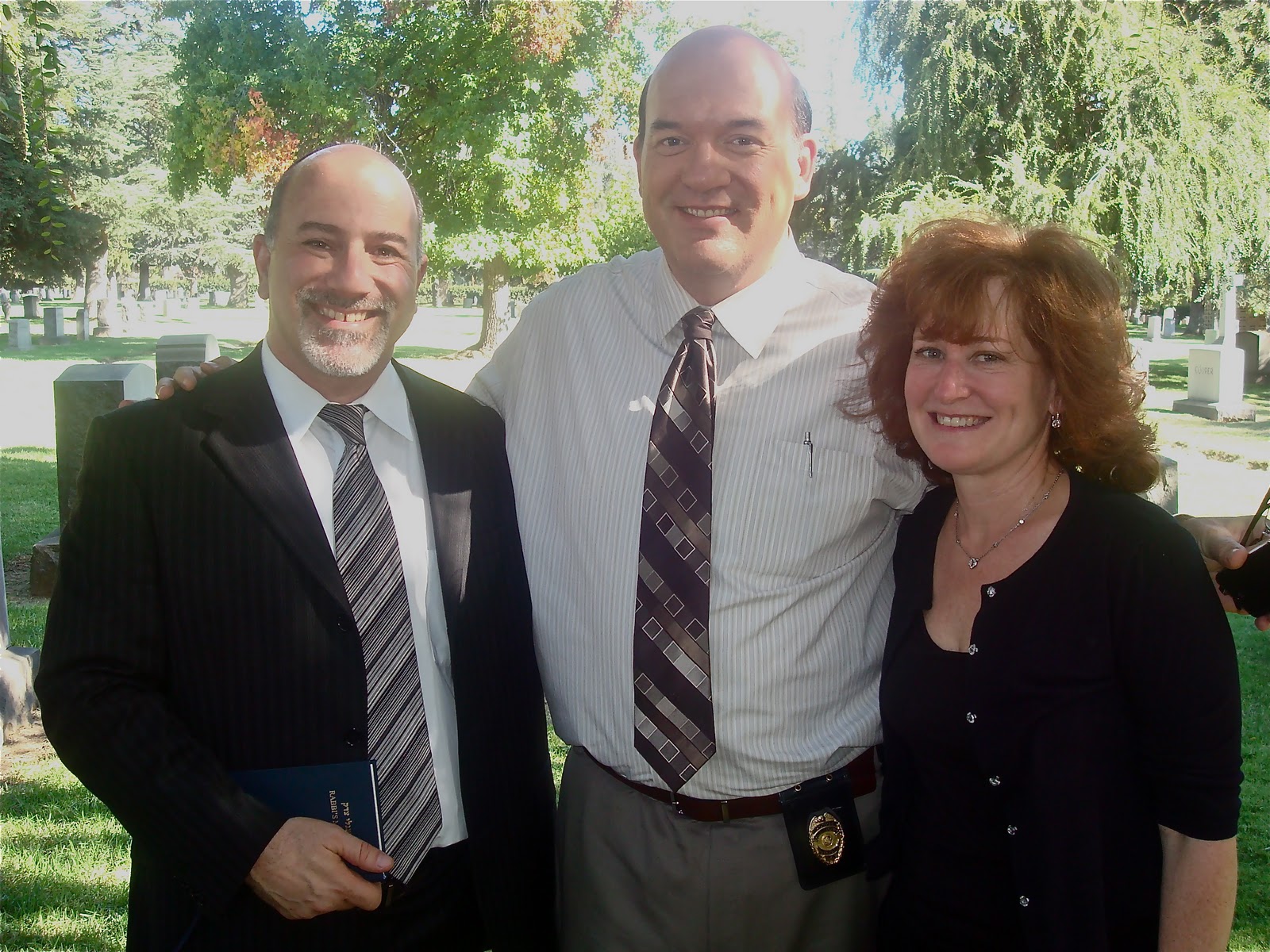
I always expected that Hollywood sets were peopled with entitled stars and prima dona producers. That is, until I spent two days for my star turn as the marrying/burying Rabbi on ABC’s Body of Proof. There on location at the hotel, I witnessed one of the nicest and most welcoming workplace environments and approachable cast and crew ever.

Let me step back. As I was elbow deep in preparations for the Jewish High Holy Days, my congregant Matthew Gross approached me about an idea he had for his TV series Body of Proof.

Body of Proof follows the life and career of Medical Examiner Megan Hunt, once a high-flying neurosurgeon, who works in Philadelphia’s Medical Examiner’s Office. As a Medical Examiner Megan applies her vast medical knowledge, keen instincts and variously charming and scalpel-like personality to the task of solving the medical mysteries of the dead and bringing the people responsible for their deaths to justice.

What did I think, Matt asked, about a wedding where moments before it starts, the bride jumps off the seventh story balcony and falls through the chuppah (marriage canopy)? I told him that I thought he was a sick man if as Executive Producer and Writer, he spent his days dreaming up innovative ways to kill people. Then he made an offer I couldn’t refuse…


Would I like to officiate at the wedding and funeral for the show?

Thus I found myself two days after Yom Kippur, dressed in my tallit and “wedding officiation suit,” preparing to be filmed at the pre-wedding cocktail reception. After being introduced around to a few of the crew members, I was walked through my role in the scene (no lines but lots of fun nonetheless).

It was during the downtime that my wife Michelle (who was background as a mourner at a funeral) noticed that how wonderfully approachable and kind the people were. They exhibited what we Jews call the middah (or Jewish virtue) of nedivut lev, a generous heart.

The stunt coordinators proudly and patiently explained how they would have a woman fall from seven stories up and “die”. The make up guy showed me how they planned to push a leg bone “through the skin.” The props and crew showed their faux gravestones, while the lighting crew demonstrated how huge lighting shields brightened a darkening sky. And the on location caterers piled our plates with delicious desserts, that rivaled my parents’ baking. Everybody was gracious, inviting, and welcoming.

You’d expect the Hollywood types to be, well, unapproachable. But it wasn’t so.

Each actor approached us during our days of filming, to say hi, introduce themselves, and see how we were enjoying being on the set. Over the course of two days, we met most all of them – including Dana Delany (Dr. Megan Hunt), Jeri Ryan (Dr. Kate Murphy), Peter Dunlap (Nicholas Bishop), Sonja Sohn (Det. Samantha Baker), John Carroll Lynch (Det. Bud Morris), Geoffrey Arend (Dr. Ethan Gross), and Windell Middlebrooks (Dr. Curtis Brumfield).  And like the episode’s director, AD’s and the whole crew, they were wonderfully kind.

Knowing that the kindness must emanate from the top, we complimented our host Matt on the kind staff he brought together. Matt indicated that like our Congregation Or Ami – where warmth, kindness and compassion define the community – he and his staff work diligently to surround themselves with like-minded people for whom creating a caring community is a priority.

There is a lesson in there somewhere. That if you want to live a life of kindness and compassion – if you want to be embraced by nedivut lev, by kindness of heart – then surround yourself with people whose personalities bring forth the same. It is easier to be caring when surrounded by caring people.

I have been told that our episode will air over the next few months. Catch up previous episodes of  Body of Proof so you will be prepared to understand our episode. Body of Proof airs on ABC-TV Tuesdays at 10 pm/9 Central time. Find out about it on Facebook, Twitter or ABC-TV.

[Full disclosure: (1) I get no kickbacks or residuals if you watch the show or not.  But do watch, because it is great. (2) This is not the first show on which I had a walk-on part. Back in the 1990’s, when then Executive Producer Ira Steven Behr was a member of my then pulpit Temple Beth Hillel, my wife arranged for me to play a Lieutenant Jr. Grade Starfleet officer in Quark’s Bar during a scene on my beloved Star Trek: Deep Space 9 (final season, episode: Strange Bedfellows).  It was one of the best birthday presents ever.  (3) When not tending to his nascent/non-existent TV career, I am rabbi at Congregation Or Ami and an avid blogger. ] 

Still Sitting in the Back of the Bus

From Anat Hoffman, the Executive Director of the Israel Religious Action Center (IRAC):

Agriculture is one of Israel’s greatest industries. It is innovative and creative. Israeli fields use the least amount of water. Israeli cows have the highest milk production in the world. Israelis have also innovated new fruits and vegetables over the years. Israelis have created the cherry tomato, new types of peppers, and over 400 new varieties of fruits and vegetables. Israel exports these all over the world.  

Recently however, Israel has begun exporting a diseased fruit; a fundamentalist interpretation of Judaism.

According to this extremist view, men and women must be separated from each other in the public sphere; at the Western Wall, at the bank, on a public street, in a post office, on a bus, and in a cemetery. He who stays away from women is the most religious. So men who want to score high on religiosity won’t ride buses with women, won’t shop with women, and won’t hear them sing.

This sort of fundamentalist view of religiosity, fertilized by the government, has now been exported to New York as well.  

Last week, it was discovered that a publicly funded bus in Brooklyn, the B110, has been forcing women to sit in the back of the bus so men do not need to see them. Even though this fruit has a Jewish star on it and says imported from Israel, it is a fake Jewish product that is dangerous, illegal, and backwards. Throw it out. Judaism has never had monks and this radical view towards separation of women goes against 2000 years of history.  

At IRAC, we are promoting and fighting for pluralism every day. Extreme elements in the ultra-orthodox community are still trying to force women, both religious and secular, to sit in the back half of city buses. This is in direct violation of Israeli law and counter to a recent Supreme Court ruling on the matter. IRAC and its volunteer Freedom Riders have been monitoring the situation by constantly riding the bus lines the ultra-orthodox are trying to segregate. We have seen results but much more needs to be done so we are launching a Freedom Rider campaign for Americans.  

We invite all congregations coming to Israel, to join us for a two and half hour program, where you will ride a segregated bus and get an up close look at the situation on the ground. We have been doing this successfully with Israelis and it has made a difference, one bus at a time. Take part in the change IRAC is bringing to Israeli society. Anita Silver, who lives in New York, participated in many freedom rides with us during her visit to Israel and said “It was the highlight of my trip. I encourage everyone to take a ride to help Israel stay on the right route.” 

For more information see the IRAC’s Freedom Rider webpage.

Gilead Shalit’s Release – Reflections of an Israeli Rabbi

We celebrate the release of Gilead Shalit from more than 5 years of captivity. After observing the High Holy Days with his picture sharing our bimah, we take comfort that our prayers are answered.

It is difficult to gauge from the United States what Shalit’s coming home feels like to the citizens of Israeli Progressive Movement Rabbi Mickey Boyden, shared these reflections with rabbinic colleagues. With his permission, I invite you to read his stirring words:

Eyes were glued to the TV screens as we watched Gilead Shalit being transferred by the Hamas to the Egyptians. He looked pale and thin – so different from the condition of the Palestinian terrorists, who were released in the prisoner exchange. (Israel TV reported that Gilead felt nauseous while on board the IDF helicopter that took him to the Tel Nof base and that he had to be given oxygen. All those who accompanied him said that he was extremely weak.)

And then there were the two Palestinian female terrorists, who held up the transfer because of their desire to be released to Egypt rather than being sent to Gaza. One wonders why.

But most cruel was the interview that Egyptian TV forced on Gilead Shalit before he was finally handed over to Israel. Although Gilead was clearly under tremendous emotional strain and was being tortured with questions, his answers were nevertheless thoughtful and to the point. He hoped that the peace process could be advanced and believed that additional Palestinian prisoners could be released in the future provided that they refrained from further acts of terror.

In contrast to the Egyptian TV propaganda assault on Gilead, the manner he was treated by Israel was entirely different. Even those all Israel’s TV and radio stations devoted all of their programmes to Gilead’s release, there were nevertheless no interviews with him, the press was kept at a distance and the only film footage and photos to be released were those taken by the IDF. Apart from one photograph released by the IDF, the emotional reunion
between Gilead and his family took place behind closed doors.

While today is a day of celebration in Gaza and Ramallah, feelings in Israel are far more muted. There is joy at Gilead’s release after over five years of solitary confinement while in captivity, but there is also the recognition that many terrorists with blood on their hands were set free instead of spending the rest of their lives in prison. It was only last night that Israel’s Supreme Court ruled against the petition by families of terror victims, who tried to stop the exchange taking place.

However, against that, there was the memory of how there might have been a chance of rescuing Ron Arad, but that that opportunity had been missed. Gilead Shalit had to be brought home in one piece and almost at any price.

There are already calls for the reinstitution of the death penalty for terrorists found guilty of murdering Israeli civilians. There are those who believe that the Knesset should pass legislation against prisoner exchanges of this nature in the future. However, there are also the calls of those who believe that Gilead’s release should serve as a springboard for trying to reach some kind of an accommodation with the Palestinians in general and Hamas in particular.

In spite of everything, today is nevertheless one of joy for us all as we see Gilead finally returned to his family.

Mo’adim l’simcha,

Micky Boyden
We Are For Israel
www.WeAreForIsrael.org

Sukkah as Time Machine

This year, we built our sukkah in stages: the structure was reconstructed by the boys and my parents, the top was relaid by me late one afternoon, and the decorating happened betwixt and between with the help of the whole family.  It was wonderful to welcome friends, relatives and some members of our Or Ami family into our sukkah for dinner and celebration.

Recently, I came across this beautiful explanation of the sukkah.  Compliments to the website of Temple Isaiah of Los Angeles:

In many ways the sukkah is like a time machine. When we sit in this sketch of a home, we are transported to the desert where the Israelites wandered for forty years. We might remember that the rabbinic legend which says the sukkot the Israelites dwelt in were made from clouds God provided for them. We are also transported to Israel, where during the harvests the farmers would live out in their fields in little booths to be able to keep watch over their crops. As we sit in the flimsy sukkah, we might also be transported to Skid Row where people live in flimsy makeshift homes of boxes and scrap wood. We might think about the tsunami, or Hurricane Katrina, and how despite the walls we build, how vulnerable we really are. When we build a sukkah we remember that our strongest foundation lies in our relationships with each other as well as our deeds. 

Sukkot is more than the reenactment of the Israelite’s wandering in the desert toward the Land of Promise. It is the acknowledgment that we are all wanderers in this world. We are all transients in the world’s ageless history, and when we erect a temporary sukkah, we are essentially nailing our tent pegs into the rich earth of eternity. We are acknowledging that we are transients, but we are simultaneously staking our faith in everlasting truth. When we realize the beauty and hope of Sukkot, we cannot help but rejoice.

May we rejoice of the many blessings and abundances that we count in our lives.

Top 15 Reasons Rabbi Julia Weisz is So Fabulous

On Friday night (October 13th), at the Rudyan Family Campfire Circle Or Ami consecrates (formerly “installs”) Julia Weisz as Or Ami’s second rabbi. Through a Sukkot inspired ceremony, she officially joins the clergy team with Cantor Doug Cotler and me. Come celebrate with us (6:00 pm for a BYO picnic; 7:30 pm for the service).

Rabbi Weisz served for two years as Or Ami’s Rabbinic Intern. Last year, she also served as our Educator. She has become an integral part of our Or Ami community. Why?

Top 15 Reasons Why Rabbi Julia Weisz is So Fabulous

  1. Her energy and enthusiasm for Jewish learning is transforming our educational programs.
  2. She has inspired over 32 teens to become Madrichim, teen teaching assistants in Kesher, Mishpacha and Hebrew Tutoring.
  3. In partnership with our program director Marsha Rothpan, she has developed an exciting, engaging program of adult learning.
  4. She fits well into our clergy team of Rabbi Paul and Cantor Doug.
  5. She delivers meaningful sermons.
  6. She tells great Shabbat stories.
  7. Her counseling is particularly insightful.
  8. Her wit is wonderful.
  9. Rabbi Paul and Cantor Doug have particularly enjoyed having another colleague to brainstorm with and learn from.
  10. As Super Kesher, she makes our students love being at Or Ami.
  11. She epitomizes Henaynu, our commitment to being there for each other.
  12. She has reinvigorated our High Holy Day youth program.
  13. Her Faculty meetings are incredibly inclusive.
  14. She looks way better in a dress than either Rabbi Paul or Cantor Doug (as they have done on many a Purim night).
  15. She is a fabulous female Jewish role model for our youth.
Add to our list: What other reasons is Rabbi Julia so fabulous?

Gilad Is Coming Home: A Bittersweet Victory?

Gilad Shalit is to be freed. A deal with Hamas, Israel’s terrorist neighbor, has been struck in which one Israeli soldier (held for 5 years without a Red Cross visit) is to be traded for 1,000 Palestinians in Israeli jails.

A bittersweet victory. Celebration mixes with worry.

We celebrate that Gilad is to be freed. We worry that such a trade will make it more likely that Hamas or others will try to kidnap other Israeli soldiers. We kvell that Israel will go to great lengths to bring their soldier-citizens home. We are made anxious that it might appear like Israel is negotiating with terrorists.

As Rabbi Josh Hammerman explains:

For Jews, this is a classic search for the lesser of the evils, a choice we’re quite experienced at making. The Talmud considers “Pidyon Shevuyim,” the rescue of captives, to be among the highest of priorities (Bava Batra 8b) and later legal authorities concur. Medieval Jewish communities often were called upon to pony up big bucks to redeem kidnapped kin. In contemporary Israel, it has become standard practice to swap busloads of prisoners for one captive soldier, or even for his remains.

How do we reconcile these complex feelings? The Israeli Movement for Progressive Judaism released this statement which concludes:

The Book of Ecclesiastes, which we read on the festival of Sukkot, teaches us that “there is a time to cry and a time to laugh, a time to mourn and a time to dance.” The reality of life in Israel often requires us to laugh and cry at the same time; to dance while we are still mourning. We will continue to cherish the memory of the victims of terror even as our hearts fill with joy as God returns Gilad to his family. 

Here are a few thought-provoking articles:

  • Everyone’s Son (Gilad Shalit is Every Israeli’s Son) by Yossi Klein HaLevy in Tablet Magazine.  In opposing the mass release of terrorists in exchange for Gilad Shalit’s freedom, I felt as if I was betraying my own son.
  • A Thousand Terrorists for Shalit? Rabbi Joshua Hammerman in The Jewish Week.  Is the release of Gilad Shalit worth an exchange of a thousand Hamas prisoners, including some who have blood on their hands and could well kill more innocent Israelis (and others)?

We conclude with a Prayer from Rabbi Joel Simmonds:

M’kor Chayim (Source of Life), as we enter this holiday of Sukkot we are reminded of the command to be joyful.

As this festival is called Z’man Simchateinu, the time of our joy, we enter it with a cautious pinch of optimism.

As we welcome guests into our Sukkot we rejoice as Gilad Shalit will be welcomed back into the Sukkat Shalom of Eretz Yisrael.

Just as our Sukkot are temporary dwellings; fragile and vulnerable to the elements, so too is the hope for peace.

May our feet dance with added joy in our Sukkot this year and may the temporary joy spill into this new year as Gilad our son and brother is permanently home.