Category: blog archive

Realigning the Jewish GPS

Serenity. Inspiration. Exhaustion. Uplift. Shalom.
Choice words to describe the essentially indescribable feelings which permeate my heart, soul and mind as I depart five days of the Union for Reform Judaism’s Biennial Convention outside of Washington DC.  With six thousand Jews gathering to learn, dream, celebrate and plan for the Jewish future, the experience was also profoundly overwhelming.  
A Shmorgasbord of Spirituality
Whether singing Kiddush during the largest Shabbat dinner ever in existence, charting a new course with Dr. Wendy Mogul to engage Jewish youth more deeply, exploring our shared values of Tikun Olam (social justice) with President Barak Obama, embodying simcha (joy) through rocking out with singer/songwriters Dan Nichols, Doug Cotler and Michelle Citrin, exploring tachlis (hands on, how to) topics such as creating a “social media sermon” and “redefining Jewish adolescents through Jewish summer camps,” or just connecting one-to-one with dozens of old friends, colleagues or new friends, the URJ Biennial gave me so much to enjoy and so much more to consider.  
Realigning the Jewish GPS
Most of all, the Biennial experience recharged our batteries and realigned our Jewish GPS.  Out wandering as individuals in the wilderness of communal life, we sometimes lose sight of the difference between the important and abiding, and the small stuff. Each Biennial Meet Up, each conversation, each session pointed the way forward by anchoring in the past and dreaming toward the future.  
The Biennial brought me back toward these insights: 
  • I believe with all my heart and soul that Judaism – our teachings, our values, our Torah, our tradition, our people, our homeland, our beliefs, our culture, our religion, our… – exist to transform us into Am Kadosh (holy people) and our world into a Makom Kadosh (a holy people).  
  • We people called Yisrael are those destined to yisra (struggle with) El (our existence within Existence).  Our world – the beautiful, the material, the broken and the whole – exists to be a Makom Kadosh (a place of holiness), where every thing and every moment can connect to every other thing and every other moment.  Past to future, tree to sky, street to building, you to me.  
  • Israel, the land and state, is central to our spirit and story, that its wellbeing is our concern, that its future as a democratic/Jewish home must be assured in conjunction with real peace with a neighboring Palestine, and that more of our peeps must get over to visit her.
  • The synagogue is THE primary gateway to the Jewish past, present and future, and if open enough, innovative enough, simcha-dik (joyous) enough and thoughtful enough, the synagogue can touch deeply so many more Jews and Jewish families.
  • Engaging youth needs to become our mantra as we create places and spaces for them to struggle, connect, be nurtured and grow.  It is not pediatric Judaism we pursue; it is the Jewish future.
  • As Am HaSefer, the people of the book, we express ourselves and continue the holy conversation through the written word.  Whether that written word be on two tablets, animal skin scrolls, paper back books or the 1’s and 0’s on the computer screen, the emes (truth) becomes clearer, the deeper we delve into the words past down midor lador (from generation to generation). 

Watch the Speakers; Read the Sermons
A picture speaks 1,000 words, so I wish I could download my short-term memory bring to life the still and moving images swirling in my head.  Since our technological wizards have not yet discovered the process by which to do that, I instead invite you to venture over to the Union for Reform Judaism’s website to see what I saw and hear what I heard.  
Then, we can together continue the conversation, and thereby find Serenity. Inspiration. Exhaustion. Uplift. And Shalom.  
Seeking Your Insights
For those who attended, what were your favorite moments from the Biennial?

Jewish Education is Dead; Long Live Jewish Education

I wish I had coined that phrase: “Jewish Education is Dead; Long Live Jewish Education.”  But in truth, this is the title of the talk by Dr. Jonathan Woocher, the Chief Ideas Officer of JESNA, the Jewish Educational Service of North America.  Dr. Woocher, whom I have followed through his writings for years, spoke at the Union for Reform Judaism’s Education Summit 2011, as part of the URJ Biennial Convention 2011. (Yada yada yada.)

To quote one of my tweets: “I was so inspired by Dr. Woocher’s talk that I could barely breathe.”

Dr. Woocher, in his own piercingly insightful way, challenged us to allow old paradigms about Jewish education to quietly go to sleep, as we embrace new realities and new paradigms for the Jewish present and future.  His talk, combining the best of technology including real time polling and engaging videos, offered a compelling critique of the present and a glance into the future of Jewish education.

The Case for Change
Said Woocher, these are the elements that make the case for change:

  • Success of assimilation: we are assimilated. We have not given up our Jewish identities doing so. 
  • Hybrid identities: Our kids (and we) have multiple identities, are fully involved but are asking what Judaism means to them. 
  • We are many things at once. How does that Jewish component speaks? 
  • Diversity of our community. Enuf said!?! 
  • The “sovereign self” – we are all “choosing Jews” 
  • “Patch dynamics”. Never one thing happening at a time. Rather many things happening at once 
  • Prosumerism: simultaneouslsy producers and consumers of our experiences people want to co-produce their Jewish experiences 
  • Institutional loyalty is declining 
  • Constant Busyness and pressure to achieve – how can we carve out space for their busy learning. 
  • Technology – not cause of any of these changes but an accelerant. Helping us to be less dependent on intermediary institutions.


This is Abiding
Not everything has changed.  These factors still remain:
  • Our search for meaning and purpose 
  • Our desire for connections and relationships 
  • Our satisfaction from accomplishment and growth.


Necessary Paradigm Shifts for the Future of Jewish Education
We need to:

  • Put learners at center of Jewish education.  Not institution or leaders 
  • Empowering learners and families
    Educating the whole person. Not just the “Jewish” part. 
  • Educate whole persons, making meaning and impacting lives not jut imparting content and promoting continuity 
  • Engage multiple intelligences 
  • Emphasize relationships 
  • Widen landscape of learning: concerts, media, trips, radio, etc. 
  • Create multiple points of entry
    Bringing innovation in from the edges 
  • Redefine the role of educators as guides, help others to find their way on the Jewish journeys 
  • Break down the silos and forging synergies.


What Should We Do?
Dr. Woocher suggests these new models and collaborations:

  • Magnet programs 
  • Link camps and congregations and year round youth activities 
  • Explicit pathways from early childhood education to next stages of learning. 
  • Day schools as community education centers.
    L
  • Learner- and family-generated learning options 
  • Using technology anywhere and everywhere.
Conclusions?
How wonderful to be able to offer you now a clear, well thought out synthesis of Dr. Woocher’s talk.  Yet it is 1:00 am, and it is just the first day of this amazing Education Summit.
Suffice it to say that Dr. Woocher’s talk, and the whole introduction and subsequent sessions of the Education Summit goad me (and our lay leaders and other rabbi) to rethink the whole enterprise of Jewish education within our synagogue.

It is one thing to kvell about what we are doing.  It is another thing to be open to reexamining every element of our program and vision to dream about what could and what should.

Bravo to the Union for Reform Judaism, and especially Rabbi Laura Novak Winer and her team for all they are doing to challenge and inspire us!

That Tiny Cruse of Oil: Truth amidst the Myth

This post was slightly edited from a posting by Rabbi Phil Cohen.  This is wonderful piece on the Truth in Chanukah, or better, the ahistorical truth that still lives on in the non-historical story of the cruse of oil.  For background, you might want to first read the New York Times’ What Historically Happened Back During the Time of the Maccabees and my The True Story of Chanukah. Rabbi Cohen’s writing is another of those “I Wish I Wrote This” articles.  Insightful and significant, the article addresses why we can still believe in legends that are not historical:

Rabbi Phil Cohen writes:
I first learned of the history of the story of that jar of oil on my first visit, pre-interview, to Hebrew Union College-Jewish Institute of Religion in New York City.  I sat in on an Education class.  The professor demonstrated through the use of texts from the apocryphal books of Maccabees I and II through the place where the Miracle of the Oil first appears in the Talmud, that there is a span of around 650 years between the Maccabean wars and the first sighting of the miracle story.  Hmm…

The Challenge of Legend
There are undoubtedly analyses of this phenomenon which I have read and which I have missed.  But this rationalist presentation teaches me a very great deal.  

  1. Legends arise.  
  2. Legends may not be, and, indeed, likely as not, never happened. 
  3. Legends often, but not always, teach inner truths, their lack of historicity notwithstanding. 
  4. We can eschew the legend and lose the truth or, 
  5. We can embrace the legend and embrace the truth.  
  6. We can embrace the truth and then drash (interpret) on it to find more truth and more truth, ad infinitum.

Meaning Abides
The modernist conundrum has always been, how to keep the baby and lose the bathwater, or some such.  The universal loss of Torah m’Sinai (the non-historical idea that Torah was given at Mt. Sinai) has not resulted in the loss of Torah as the founding Jewish document and never will.

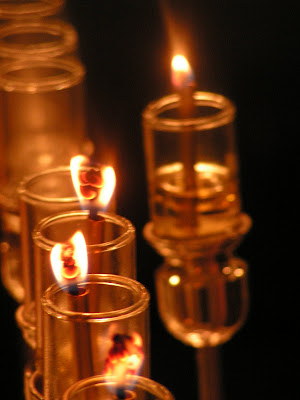
Similarly, the loss of the Chanukah Miracle of the Oil has not resulted in the loss of the chanukkiah, and never will, the power of the chanukkiah being undeniable.  The chanukkiah still produces light; it is always our task both the make that light and, far more important, understand the light and then proclaim that understanding.

It makes no sense to me to stand up and deny the fact that there is inner meaning to the story of that tiny cruse of oil.  Though this amounts to an argument from authority, it’s been going on for a long time–who are we to deny its meaning?  Just what is its meaning?  Ah, that’s our continuing challenge.

Finding Meaning in our Legends
Our task has always been to find meaning, new meaning, and then newer meaning. Our parameters differ from those of our not so distant rabbinic ancestors.  So what? Jews are in the meaning business, no matter what side of the historical divide they find themselves.  Always have been.  That’s why Rabbinic commentators Rashi, Ibn Ezra, Ramban, and Seforno and so forth are all on the same page, right? Because each of the shines new light on ancient truths which allows them to illuminate greater and greater parts of our lives and world.

So let’s fry up some latkes, sing a few songs, light that chanukkiah, and figure out, anew, why we bother.

So how does this article illuminate (or darken) your perspective on Chanukah?  I’d love to know.  

Chag Chanukah Samayach – Happy Chanukah

My Kid’s Got Medical Problems; Where is God?

A mother of a son with significant medical issues wrote me recently about God.

Dear Rabbi Paul: 

In general I’m a believer in hope but at the moment I feel lost for direction which takes me to my original contemplation about God. Why do the bible stories suggest that God spoke to our leaders? Doesn’t that lead to false hope that we can get some answers or guidance directly from God? If we’re all suppose to be equal why does it seem that they got special attention? 

Struggling Jew

I responded this way:

Dear Struggling Jew 

Your questions are so poignant and personal, pained and hopeful, exhausting and energizing. As I pondered how to respond, I found myself a bit anxious that I would not be up to giving an answer that would help. But this has been sitting with me, so I’m jumping in.

I believe with all my heart that there is a God to whom we are connected, with whom we can communicate, for whom our well-being matters.

I believe with all my heart that God loves us, cares for us, and is helping us get through, even the most difficult times in our lives.

I believe that seas do split and bushes do burn, only don’t be looking at the Pacific Ocean to split or the Azaleas outside our front doors to burn unconsumed. Look for the strength that comes from out of nowhere to face the possibility of yet another surgery – if that strength is not miraculous, I’m not sure what is. Look in wonderment at your children who have grown up with good values, with love in their hearts, with hope and possibilities of bright futures – even though one of them has significant medical trouble. That they have survived and find joy and/or goodness many days of their lives – without being consumed by the fires of anger and/or the self-pity of “poor me” – is no less miraculous than the bush that burned unconsumed.

In the Bible, God talked to people like you and I talk (on the phone) to each other. The people were sure they were talking to God and they then decided whether or not to heed God’s voice. 

I believe that God still talks to us; I have conversations with God regularly and have received answers to my prayers (though not always the answers I have wanted). But the communication comes in ways as different from talking as texting is to face-to-face. It might be a butterfly that is out of context, or a feeling in my guts that this is the right path. It might be a surge of courage when I am feeling weak or afraid.

Sometimes the answers come when we least feel we can go on, and yet we do. When we are sure we cannot make another decision, and somehow we face the issue and decide anyway. Sometimes it is the love that still fills our hearts when our anger bubbles up.

I say all this without the wealth of experience with the challenges and turmoil of your life. But I still believe, because I watch people like you get by and get through and still love and educate and walk forward step by step…

Those are my thoughts for the moment. What do you think?

Rabbi Paul

And what do you think?  How would you answer the mother’s questions?

11 Rituals for 8 Nights of Chanukah Celebration

The Calabasisher Rebbe, the RiPiK, teaches: One does not fully celebrate Chanukah, the Festival of Lights, unless one does 11 rituals over the 8 nights.

  1. Lights the candles and puts the Chanukiyah (Chanukah menorah) in the window to publicize the miracle. Print out the Chanukah blessings.
  2. Tell the story of Chanukah. This is a festival when Jewish values triumphed over Greek pagan practice, when religious freedom overcame the impulse for religious coercion. An important reminder that America too is home of religious freedom. Download the story.
  3. Sing Chanukah songs. We transform king Antiochus’ impulse to annihilate the Jews through simcha, the impulse to celebrate life and Jewish living. Singing is the glue that binds us to the Jewish soul. Get Cantor Cotler’s Favorite Chanukah Songsheet.
  4. Eat latkes or sufganiot (jelly-filled donuts). Both are cooked in oil, allowing us to consume the message of the Chanukah tale, that oil enough for only one night lasted for 8 nights. By playing with our food (or better, eating it), we become the oil, prepared as Jews to outshine any impulse to give up our values. Read the recipes.
  5. Give presents. Cool to give, cool to get. But be wary of becoming too materialistic.
  6. Have Parents’ Night. Set aside one night only for kids to give to parents. By insisting on this and helping facilitate it, we teach our children the values of kibud av v’em (honoring one’s father and mother), and ahava (love means giving, not just getting).
  7. Give Tzedakah (charitable giving). Set aside one night for only giving tzedakah. Everyone contribute something, then as a group choose recipients and amounts. Search the web for do gooder organizations. Here’s my 8 ideas for 8 nights of tzedakah.
  8. Celebrate with family and friends. ‘Nuff said?!
  9. Celebrate with community. Congregation Or Ami’s multigenerational Chanukah celebration on Friday, December 23, 2011 at 6:30 pm is open to the entire community. Bring a Chanukiyah to light. Enter a plate of homemade latkes into our Latke Baking Contest.
  10. Play the dreidel game. Through sacred play, we reteach that Nes Gadol Haya Sham, a great miracle happened there. Play with chocolate gelt, raisins and nuts or M&M’s, and the spoils are tasty too. Review the rules for play.
  11. Remember the (second) Miracle. Yes, that oil enough for one night lasted for 8. But as significantly, think about that one Jewish priest in the Jerusalem Temple who, knowing there was not enough oil to last until new oil could be made, lit the menorah nonetheless. From him we learn the eternal Jewish value of Tikvah, hope. Jewish families never give up hope because we believe that goodness is just a night or 8 away.
Resist the urge to allow Chanukah to become just 1 minute of candle lighting and 3 minutes of gift opening.  Celebrate the Festival with these 11 rituals. 

What did I miss?  Do tell!?!
For everything you need to celebrate Chanukah, take a look at Congregation Or Ami’s Chanukah resources page at www.orami.org/Chanukah.

He Raped, She Complained, Judges Spoke, and The President Goes to Jail

Alternative Title: Sex, Harassment, Jail and a President: You Gotta Love Israel


Score one for Women’s Rights!  Score another for Israel doing Justice and for Ethical Standards! 

It is bittersweet but ethics-affirming to read that Israel distinguishes itself again. Very soon, Israel’s eighth President Moshe Katsav will enter jail to serve a seven year sentence for the unanimous conviction of him in the Tel Aviv District Court a year ago of two counts of rape, two counts of sexual harassment, an indecent act using force, and obstruction of justice. 

In its judgement, the court said the testimony of the main complainant in the case, a woman known only as “Alef” from the Tourism Ministry, was credible.  Alef testified Katsav had raped her twice, first in his office and then two months later in the Sheraton Hotel in Jerusalem. 

There are those who will be embarrassed by the whole situation, that Israel’s then president was convicted and is being jailed. What will “they” think?

Celebrate a Victory for Women’s Rights and Justice
I, for one, observe this as a moment to celebrate. We don’t celebrate the downfall of a once important political leader; rather we celebrate the victory of women’s rights and justice over machismo and sexism.

Israel exists in a macho neighborhood, awash with a culture of patriarchy and paternalism. Just this week, Israeli journalists caught on tape another shameful example, in the form of sexist comments – about female soldiers defending Israel no less – between the Israel’s Defense Minister Ehud Barak and Israel Defense Forces Chief of Staff Benny Gantz.

But Katsav’s conviction and the impending incarceration are watershed moments. The message is clear: no more must women be subjected to, and silently endure, the sexist comments, groping or worse by men in power. If the President of the country can be tried, convicted, jailed (and forced to resign) over these heinous actions, then it can happen to YOU too. So clean up your language, your attitude and your behavior!

A Much Needed Win in the Struggle over the Role of Women in the Public Sphere
Israel is in the midst of a battle with fundamentalists Jews (yep, OUR fundamentalists) over the role of women in the public sphere. Groups are protesting recent decisions forbidding women for singing at public gatherings in Jerusalem, forbidding women’s pictures from appearing in ads on buses and billboards, and forbidding women’s active participation at relative’s funerals. This fight is part of an all-religion, global struggle between fundamentalism and liberalism. And we Jews must struggle to retain and expand hard-won women’s right.

Israel is a country that has made so many strides for the equality of women (think Golda Meir and the early inclusion women in the military).  Given the issues with ultra-orthodox fundamentalists, Israel still has a long way to go. But let’s pause in the fight for a moment to praise this little county for doing what so many other places couldn’t, wouldn’t or didn’t. Israel held responsible a man in the highest echelons of power who sexually harassed his female employees.

Israel Religious Action Center at the Center of the Struggle
A side note: yasher koach (May your strength be firm!) to our Israel Religious Action Center (IRAC) and its Executive Director Anat Hoffman, who have been – and are -at the forefront of many a fight for women’s equality in Israel. Read more here.

Jewish Spiritual Seeker: A Facebook Experiment in Spirituality

A few years back, we started a Jewish Spiritual Seeker website.  About a dozen of us participated regularly, posting and commenting on each other’s posts.  Once a month I would post a question about spirituality and invite congregant-volunteer-bloggers to respond.  Each blogger was also asked to comment on 2-3 posts by others.  We had a great conversation about spirituality.   The blog won an inaugural North American Union for Reform Judaism Techie award since it engaged congregation members in Jewish conversation using a blog as the medium.  (I would share the URL but the site has recently been hacked and until we figure out the fix, I don’t want to give the “medical pills” website any more business.)

Since Facebook is the medium of preference for so many, we thought, why not experiment to see if people would participate in serious spiritual conversations in this online community. Thus the Jewish Spiritual Seeker Facebook community was born.

An Idea: What kind of conversation could we create if we brought together a dozen adults to explore, over the course of a year, their thoughts and experiences on the Jewish spiritual journey? 

The Technology: What if we could harness technology – a Facebook Community – to provide the opportunity for these adults to reflect upon their Jewish spiritual journey? (Meaning: no meetings, just think your thoughts and go online.)

Monthly Questions: What if every month a question was posed – about spirituality or holiness, about how you pray, about questions you have about God, about when you feel most spiritual – which you could consider and then reflect upon by writing on the Facebook community page?

We are preparing to kick off the discussion within two weeks.  We have already a dozen who are interested.  

Do you think of yourself as a spiritual person?  Are you willing to engage others in conversation about what that means to you and them?  Then check out the Jewish Spiritual Seeker Facebook community page, and if you are willing to take a chance, LIKE the page.

Questions? Contact me through the Jewish Spiritual Seeker Facebook page.

And may the conversations to come be inspiring and uplifting.

How do we Connect, Inspire, and Engage Kids: What We’ve Learned from Camp

Counting the days until the Union for Reform Judaism’s Biennial convention outside of Washington DC became that much more exciting
after a planning session with some colleagues.  Gathering together by telephone from all across the US, we –
three camp directors, three rabbis, and one talented URJ specialist – put our
heads together to plan a biennial session on the “magic of camp.” (I am a URJ Camp alum, parent of 3 campers, and Camp Newman Rabbinic Faculty dean each summer – here’s my Camp blog.)  Who would
have thought that just the planning process alone would illuminate why we all love
URJ Jewish summer camping so much.

Our initial plan incorporated a series of seven minutes
frontal presentations, mixing the reflections of the camp rabbis with the
insights of a collection of talented camp directors. Reserve some time for Q
& A, and the session would quickly be over.  Our planning session could have ended then and there. 
That is, until Ruben Arquilevich, Director of Northern
California’s URJ Camp Newman challenged us to fashion our program session in
the image of what happens effortlessly at camp. With that one comment, the
ideas started flying.  How do we
craft a presentation session for the biennial that captures and shares the
“magic” of camp?
Any camp staffer knows that what might appear to be
effortless fun and recreation at a Jewish summer camp is actually quite
intentional, as camp staff work diligently (and late into the night) to create
strong interpersonal relationships and communities of meaning.  
Ruben’s piercing comment got us all thinking, and in
minutes, the program transformed: Let’s begin with some music; singing is
camp’s spiritual glue. How about adding in some personal stories of how camp
has transformed the life of one former camper, now camp parent/camp rabbi!  Oh, let’s gather participants with like-minded
people – former campers together, congregational leadership wondering how to
invigorate their camp delegations, people who don’t know what Jewish camping is
about, camp leaders/staff – and have them talk about something in small
groups.  After all, camp is all
about meeting new people and making new friends.
Oh, burning questions. Invite people to share their burning
questions with the group by means of old-fashioned poster board technology.
Then the camp directors can respond to real questions and concerns, raised by
real people to ensure that everyone walks away with better understandings of the
strategies and tools used at camp to connect, inspire, and engage kids in
Jewish life and learning.  To set
the mood, we can throw into the background some pictures, quotes and
mini-videos from summer camp 2011. How about ending with a big friendship
circle, singing Hashkiveinu, like
most camps end each day?  
In just an hour, our draft plan for serial frontal
presentations transformed into a musical, experiential, informational, and
technological camp-like program. 
And we on the call were reinvigorated by an energetic camp programming
process to recreate camp for biennial participants.  I cannot wait for URJ Biennial to start!
So don’t miss our session – How do we Connect, Inspire, and Engage Kids: What We’ve Learned from
Camp
– on Thursday, December 15, 10:30 AM to 12:00 PM (during Learning
sessions Block C).  Once you sign
up, help us focus our program even more. 
Go to our session page on the URJ Biennial website and leave a comment
on why you chose to attend this session
and/or what burning questions do you bring to it
.  We will use your responses to better prepare an engaging
session.  
We – Camp Newman Camp Director Ruben Arquilevich, Rabbi Paul Kipnes, Greene Family Camp Asst. Director Rabbi Ana Bonnheim, Camp Harlam Director Aaron Selkow, Rabbi Phyllis Sommer, and URJ Associate Director of Camping Lisa David – look forward to seeing you there. 

Strangers No More: Academy Award Winning Film about a Tel Aviv School on HBO

Strangers No More, the Academy Award winning documentary about Tel Aviv’s Bialik-Rogozin School, debuts on Monday, December 5th (6:45-7:30 p.m. ET/PT), exclusively on HBO.

According to the eJewish Philanthropy blog:

The school, serving one of the most economically challenged and socially diverse student populations in Israel, has morphed from a failing one to a highly successful and closely watched model for improving students’ lives and outlooks, strengthening and supporting families, advancing assimilation and socialization into Israeli society, and changing social and cultural attitudes toward respect of the other. Karen Tal, Bialik-Rogozin’s former principal, was recently awarded the 2011 Charles Bronfman Prize for her work with the school. [They] highly recommend tuning in if you haven’t yet seen the film. 

The film is poignant and highlights the creativity that is Israel:

In the heart of Tel Aviv, there is an exceptional school where children from forty-eight different countries and diverse backgrounds come together to learn. Many of the students arrive at Bialik-Rogozin School fleeing poverty, political adversity and even genocide. 

Here, no child is a stranger.

Strangers No More follows several students’ struggle to acclimate to life in a new land while slowly opening up to share their stories of hardship and tragedy.

With tremendous effort and dedication, the school provides the support these children need to recover from their past. Together, the bond between teacher and student, and amongst the students themselves, enables them to create new lives in this exceptional community.

Barking Dogs and Reflective Rabbis

A story…

Nachman of Bratzlav, the great Rebbe was walking with Rabbi Nathan, his greatest disciple, through town and they passed a fenced yard that was guarded by dogs. These were vicious, half-starved, half-mad beasts that rushed up to the edge of the property to lunge, bark and howl at the two men walking by.  

Rabbi Nathan, the student, did what any of us would have done; he jumped at their barking, picked up his pace and cast those dogs a glance, hoping the fence was well secured.  

But Nachman didn’t jump, he didn’t react like we would. Instead he stayed at the fence, and just said in a patient, calm and sympathetic voice “I know, I know”.  

Later, Nachman explained that those dogs weren’t just dogs. They were souls trapped in the bodies of dogs, souls caught in the gilgul, the cycle of ascent and descent, and as they were not human, never mind Jewish, they could not perform the necessary teshuvah (repentence) to ascend again. Whereas Reb Nathan heard only angry, ferocious beasts ready to devour him, Reb Nachman heard instead the cries of pain of those who could not recover their own spiritual selves. And it would be Reb Nachman’s job to help release them of their pain, to find a way to descend toward them in order to help those dog-trapped souls ascend.  

What are we to make of this story? Most of us don’t know how to talk to dogs, or at least identify when dogs have an existential crisis. (I don’t even have a dog.)  

But more to the point, most of us – like Reb Nathan, the disciple – miss the spiritual element of the moments of our lives, of each individual encounter, as easily as Reb Nathan missed the souls trapped in those vicious dogs. 

Rabbi Yair Robinson, a Delaware Rabbi, makes meaning of this story:

To be sure, we hear cries of pain; in those suffering from AIDS, from poverty, from humiliation and hunger and abuse. God-willing, we may even heed those cries and try to bring some kind of relief. But whether it’s in our own lives or in the lives of others, we often miss the element of holiness, the spirit, the Godliness, of other moments.  Read on.

Again, I just ask:

How do we slow down enough to recognize the reality of each moment of our lives?   

I’m sitting here with my daughter on our daddy-daughter day (she’s studying right now before dinner).  Enough pondering.  Time to focus on my kid.

6 Strategies to Pre-Address the December Dilemma Difficulties Well Before December

December, the “happiest time of year.”  Enjoy Chanukah. Celebrate Christmas or
Kwanza with friends. Joyous music. Dancing Chanukiah candles and simmering
potato latkes. Bright lights. It is a joyous time of year.

Except for two groups: Jewish scrooges and some
interfaith couples and families

The former (with whom I identify every few years) get freaked out by
what feels to them like the oppressive Christian joyousness of the holiday
season.  The latter are again
forced to address the potentially painful reality that the holiday with its
family gatherings, cherished memories and vague theologies open up differences
(sometimes chasms) between what each partner holds dear. 
At Congregation Or Ami we long ago concluded that December
is probably the most difficult time to try to address these issues.  Rather the real work must occur year
round.  We strive to be welcoming
and work hard to develop non-judgmental relationships with interfaith couples/families
and especially with the non-Jewish spouses, so that when the issues arise, they
know that the rabbi, cantor and educator offer non-judgmental support to face
and address the challenges.
Thus our strategy is to trumpet loudly and repeatedly how
welcoming we try to be to interfaith couples and families.
6 Strategies to Pre-Address the December Dilemma Difficulties
  1. A Belin-award winning Interfaith Couples/Families Webpage,
    which makes it clear that “no one is more welcome at Or Ami than you”,
    addresses many of the issues interfaith families face, while providing them an
    invitation and direct email link to talk to the rabbi about their questions and
    concerns. Allowing those wondering about
    openness to maintain their anonymity represents a more widely open gateway.
  2. On Yom Kippur every few years during adult and family
    services, we invite all non-Jewish spouses, partners, and significant others to the bimah to receive our appreciation and a blessing from thecongregation for the beyond-thanks gifts they give by connecting with our
    congregation and, for those with children, for raising their children as Jews.  Ritual
    articulates the truth: that you too are blessings in our communities.
  3. The adult learning program allows people to explore the
    similarities and differences between Judaism, Christianity and Islam, to learn
    in a URJ Introduction to Judaism class about the basics of Judaism.  Learning
    leads to understanding.
  4. At each service, particularly at our B’nai Mitzvah service,
    we recognize that in our midst are Jews, Christians, perhaps Muslims,
    Buddhists, Hindus, and others, as well as all kinds of Jews.  We introduce them to our prayerbook,
    Mishkan Tefilah, as a “Tent of Prayer” which makes it possible for such a
    diverse group together for a spiritual, meaningful experience.  We then quickly offer a verbal roadmap
    through the double page spread.  Naming the diversity and minimizing
    roadblocks encourages connection.
  5. I remind interfaith couples and families that they should
    visit their non-Jewish parents during the December holiday season, even being
    there on Christmas eve or day to celebrate their parents’ holiday of
    Christmas.  When religion separates families, both families and religion suffer.
  6. We talk about Jews and Jewish families when referring to our
    congregants and when talking about “what we do.”

The above strategies do not obviate the need to address
directly issues of the December dilemma. 
But they do ensure that those struggling recognize that they are part of
a welcoming, non-judgmental congregation. Perhaps they will thus be more likely
to turn to their rabbis, cantor and educator when and if they struggle to
address the challenges posed by this “joyous season.” 
Need help figuring out how to better publicize the openness of your congregation to interfaith couples and families?  Check out the Union for Reform Judaism’s Supporting Interfaith webpage in their Outreach initiative.  

What Keeps Me Up at Night

Here’s what I worry about, what sometimes keeps me up at
night: that some person, out of his own insecurities or just plain meanness,
finds a way to weasel under the skin of one of my kids, plays on her
insecurities, and inflicts a wound that could prove fatal.

Here’s what keeps me up at night: that this wound, infects
my kid deeply, metastasizes and, because it is all happening under the skin, I
don’t even know it is happening.
Sometimes I shake myself out of that nightmare, convincing
myself that there is no way my outwardly confident, content, happy kids could
fall into such a trap – especially without my knowing it – until I think about
the three kids who died recently by their own hands,  Tyler Clemente (the college student, outed by a roommate, who took his own
life), and the countless other stories of bullying and cyberbullying that seem
to multiply across our television screens. 
Our Mishpacha Family Alternative Learning program
Coordinators Lisa Berney and Sarah Lauing are teaching families the story of a
2nd century rabbi who taught that one who publicly shames a neighbor
is as though that person has shed blood
(Talmud Baba Metziah). On one hand an
example of rabbinic hyperbole, this teaching names the reality we are
experiencing in our world today – that embarrassing another and shaming them is
so heinous that it is like – and can lead to – a mortal wound inflicted upon another.
That’s why it is important, again and again, to tell our
children how much we love them. It is why we rabbis and cantors and educatorstell “our children” (students) face to face and by email how much they mean to us.  It is
why I tell each Bar and Bat Mitzvah student in front of the ark that they are
beautiful and valuable. 
Program Promo:  And it is why, on this Wednesday, December 7th at 7:00 pm, the
Or Ami Center for Jewish Parenting is hosting the interactive workshop Understanding
and Addressing Cyberbullying:
What Families Don’t Know Will Hurt Them. Led by Anti-Defamation League experts, the program geared for teens
(grades 7 and older) and adults will address:
What can we, as adults, do about cyberbullying? What tools can our
children use to respond to a bullying experience – whether it is them or
another person being victimized? What can we do as a community to address this
growing problem?
Those will younger children will significantly benefit
from attending the workshop as bullying and cyberbullying knows no bounds.  RSVP by email to Susie Stark, or call 818.880.4880. Childcare is
available at no charge, reserve space when you RSVP.

Bullying and cyberbullying are cancers that need to be constantly diagnosed, treated and eradicated.  Our youth movement NFTY (North American Federation of Temple Youth) has an Anti-Bullying website filled with great links, articles, strategies and suggestions.  Check them out.

Our children are too precious.  Let us help them live in peace so we can sleep peacefully.  

Of Course Your Child with Special Needs Can Become a Bar Mitzvah

I received a message recently about a parent of a child with special needs.  It seems that this parent was unsure that the special needs child could ever become a Bar Mitzvah.  Here’s my response to the parent:

Recently, Cantor Doug Cotler and I officiated at two different B’nai Mitzvah services of children with special needs. In each case, the parents were sure that their child would never read from Torah, lead the service or become a Bar Mitzvah. Like the few dozen other such families who thought the same, they were overwhelmed and blown away when their child led the service, read from Torah and gave a speech. There wasn’t a dry eye in the house!  

At Congregation Or Ami, we are committed to the idea that any child of a member who works to the best of his or her ability, has the privilege and right to a Jewish learning experience and to becoming a Bar/Bat Mitzvah. The children participate in a real service, just one that is subtly tailored to each child’s unique abilities (which, by the way, is basically what we do for EVERY child).  

What does that mean?

  • Maybe he will read Torah but not Haftarah. 
  • Maybe he will sing the prayers he knows and explain others. 
  • Maybe his service will be before only 15-20 of the closest and then there will be a bigger party. 
  • Maybe he will only chant one verse of Torah per aliyah. 
  • Maybe his Torah portion will be the V’ahavta prayer, which he will already know by heart (the V’ahavta in the prayerbook, comes from the Torah). 
  • Maybe… maybe… maybe… 

The keys to it all are three interlocking elements:  

  1. The commitment of the Temple to say “YES, this CAN and WILL happen.”  
  2. The creativity of our B’nai Mitzvah tutor Diane Townsend to figure out ways to get each child to do his/her best. Diane works with me to tailor the service in a way that outsiders would not realize is tailored, but makes your child shine brightly.  
  3. The willingness of the parents to let go of their sense that it cannot happen, but instead to believe that yes, my son – just like every other Jewish boy – can become a Bar Mitzvah. 


By the way, I have NEVER encountered a child with special needs (at Congregation Or Ami or at my previous synagogues) who could not and did not become a Bar/Bat Mitzvah.  

I so look forward to celebrating as your son becomes a Bar Mitzvah. So don’t worry.
Just say to yourself, “Yes, this will happen.” Then breathe…  

We can talk more if you want.

Gosh, I wish we could better publicize this message.  I wish that all synagogues would realize that there should be NO barriers to children with special needs, especially with regard to Jewish ritual.

Alas, we can only work in our little corner of the world…

Favorite Jewish Texts that Lead to Better Communication and Better Parenting

Compiled by Mishpacha Coordinators Sarah Lauing and Lisa Berney


Miyut Sichah (Minimizing the Conversation)

Say little and do a lot. (Pirke Avot 1:15)

“The wise man does not speak before him that is greater than he in wisdom;
He does not break into his fellow’s speech.
He is not in a rush to reply.
He asks what is relevant and replies to the point.
He speaks of first things first and of last things last.
Of what he has not heard he says, “I have not heard,”
And he acknowledges what is true.
And the opposites apply to the clod.” (Pirke Avot 5:9)

Quiet yourself there’s nothing to say
Stop all the chatter that gets in the way
Listen, listen to our God

When the wind and the thunder finally disappear
there’s still a voice that you will hear
If you listen, listen to our God (from “Listen” by Doug Cotler)

Emet (Being Honest and Truthful)

“Those who deal deceitfully shall not live in My [God’s] house; those who speak untruth shall not stand before my eyes.” (Psalms 101:7)

“People should not say one thing with their mouths, and something else with their hearts.” (Talmud Baba Metziah 49a)

“To avoid insulting someone, you are allowed to tell a white lie.” (Sefer Hasidim)

Shema (Listening)

Shema Yisrael Adonai Eloheinu Adonai Echad – Listen Israel (or all who struggle to understand) Adonai is our God, Adonai Alone.

While hearing is simply receiving, listening is an active form of communication. By engaging in certain actions — nodding our heads, making eye contact, leaning in—we show others that we are present for them in that moment. Rather than thinking about how we will respond, we can focus completely on the other person, understanding their needs. We can offer them our “precious presence.” By listening with the intent to understand, we are responding “henaynu” (“we are here”).

Lashon HaRa (Avoid Gossiping)

The story of Miriam (Num 12:1-15)

A Story: A man went about the community telling malicious lies about the rabbi. Later, he realized the wrong he had done, and began to feel remorse. He went to the rabbi and begged his forgiveness, saying he would do anything he could to make amends. The rabbi told the man, “Take a feather pillow, cut it open, and scatter the feathers to the winds.” The man thought this was a strange request, but it was a simple enough task, and he did it gladly. When he returned to tell the rabbi that he had done it, the rabbi said, “Now, go and gather the feathers. Because you can no more make amends for the damage your words have done than you can recollect the feathers.”