Category: blog archive

“You All Are Going to Die,” Said the Rabbi to the 3rd-6th Graders. Appropriate or Not?

You all are going to die!” said the rabbi to his 3rd thru 6th grade students. It was all part of a day of death and dying at Congregation Or Ami’s Mishpacha Learning session.

While Rabbi Julia Weisz walked parents through the Jewish rituals and ideas about death and mourning and Cantor Doug Cotler taught Jewish songs to other students which explored Jewish ideas about life and loss, I – Rabbi Paul Kipnes – had the unenviable task to walking young students thru the realities of life, namely, that we are all going to die.

A Story…
There’s a rabbinic tale about a most powerful king who commanded the community’s rabbi to bless him with Judaism’s best blessing. Began the rabbi, “May you die. May your son die. And may your grandson die.” The king became apoplectic, barking, “How dare you…”, at which the rabbi continued, “…in that order.”

This story articulates three long held truths about death:

  • That everyone will die. 
  • That we hope that the older generation dies before its descendants. 
  • That, while each loss is painful, the death of a child or grandchild is even more painful. 

Accepting (at least for the remainder of the class) that death is inevitable, the students and I shared thoughts about what happens after we die, a theme introduced in Cantor Doug Cotler’s song, Nefesh. We talked about what the nefesh (soul) is or might be. We talked about Jewish ideas about how the soul returns to the Eternal Soul of the universe, what some call “God.” We considered diverse Jewish beliefs, from the belief that the soul dies with the body to the Kabbalist/mystic teaching that the soul is reincarnated (gilgul hanefesh) after death.

Lighting Candles to See into the Soul
We spent much time analyzing Jewish belief that we live on within future generations. I took out a pair of candles. I asked students to watch closely. Using one lit candle to light another candle, I then blew out the first candle and asked, “what happened to the flame?” Most said it disappeared. So I used the lit candle to again light another candle and then blew out the first. “What happened to the first flame,” I again asked?

One student intuited the lesson: “Two things happen at once. The flame disappears, and is gone. But also, the flame lives on in the second candle.” That’s my teaching.

From the flame that disappears, we learn that upon our deaths, part of our soul is gone, returning to the Eternal Soul of the universe. From the flame that continues to burn upon the candle it lit previously, we learn that our soul lives on in the lives of our biological children and our adopted children (Talmud explains that one who teaches a child is as important as his biological parent). Our soul also lives on – in a sense, we gain immortality – through the lives of those whose lives we enriched by our teaching, and those who we help with tzedakah and gemilut chasadim (acts of loving kindness).

Our Soul Lives on After Us
So just as our biology overcomes death when we pass on our DNA to our children, so too our soul passes in part to those who borne to or touched by us.

Heady stuff for kids who can barely contemplate the truth of “you are all gonna die.” We hope these conversations helped the students begin to deal with death, as did the round robin stations created by HUC-JIR interns Lisa Berney and Sarah Lauing, which investigated Jewish mourning customs.

You see, at Congregation Or Ami we strive to teach about all issues, even the most difficult, even when the mere thought of them make us uncomfortable. Because that is what Judaism should be about – helping us face, with courage, strength and holiness, the challenging moments of life.

What Does Being “Pro-Israel” Look Like: A Dozen or More Diverse Answers

Sometimes when we argue about heartfelt subjects, we discuss them with a sense of mutual respect and of eilu v’eilu divrei Elohim chayim (both of these opinions are for the sake of Heaven). At other times, when the stakes seem so high, we become convinced that our way is the right way, the blessed way, the only way. The positions of others are deemed heretical, unpatriotic, blasphemous.  

Such is what has happened to the discourse about Israel in parts of the American Jewish community. Fly over to Israel (or read the editorials in Israeli papers Ma’ariv, Yedidot Achronot and Ha’aretz – as well as on a host of Israeli blogs) and you will discover passionate debate that far overshadows ours here in the United States. Not long ago, I wrote about this example of American Jewish hypocrisy in my post, Blasphemers No More.  [Truth be told, even in Israel some resort to name calling or worse: see Prime Minister Netanyahu’s calling Ha’aretz an “enemy of Israel.“] 
Now comes a breath of fresh air from Moment Magazine, offering a wide variety of opinions about what it means to be pro-Israel. We read perspectives from Reform, Conservative, Reconstructionist, Orthodox and Secular leaders, from supporters of AIPAC, J-Street, WZO and others, from people all over the spectrum.  Left, right, center, up, down and more.
What’s beautiful about Moment’s symposium is that is represents what I believe is the mainstream Jewish perspective: that there is a spectrum of ways to be pro-Israel, far more than we often admit.  Read Morton Klein, Peter Beinart, Anat Hoffman, Jeremy Ben-Ami, Laura Novak Winer, Martin Peretz, Judea Pearl and others.  
Let this article be a reminder that Ohavei Yisrael, lovers of Israel, come in various sizes, shapes and a multiplicity of perspectives. We in the organized Jewish community need to be careful about slandering each other by calling one opinion “anti-Israel,” “self-hating Jew,” or the like. While some opinions fall outside acceptable boundaries – support for BDS for one – most of the rest should be part of robust discussion in our communities, on our pulpits and on our campuses.  
May robust discussions continue to flourish.

Thanks, Roe v. Wade: You Are One of the Best Things to Happen in my Life

Happy anniversary Roe v. Wade. You are one of the best things that happened in my life!

Yes, today is the 39th anniversary of Roe v. Wade, the landmark Supreme Court ruling. On January 22, 1973, the Supreme Court said, in simple terms, that women have a constitutional right to privacy to make decisions about whether to have an abortion. Because this decision involves moral as well as medical considerations, the Court ruled, a woman has the right to consider her personal circumstances and the dictates of her conscience.

Life Before Roe v. Wade
Before Roe v. Wade enshrined the right to privacy into law, and with it a woman’s right to an abortion, America was an even more dangerous place for women – our wives, our daughters, and especially those who lived in the less affluent parts of this country.

Before Roe v. Wade, a woman needing to terminate a pregnancy turned down down dark alleys or into unsanitary “operating rooms” to do what needed to be done. It didn’t matter if the mother’s life was in danger, or if some guy raped her, or if a family member incestuously forced himself on her, abortion was not available to her. Too many faced ostracism by their families. Too many died from medical procedures gone bad.

Before Roe v. Wade, our country forced upon us all – Jews included – a Christian moral perspective which was at odds with our own Jewish tradition. The tyranny of the majority, it was.

When Does Life Begin, for Jews?
You see, for Jews, life does not begin at conception, as Christian theology would have us believe. Jewish biblical scholars have long read the verses from Exodus in the Bible very differently.

Exodus 21:22-25 says:

And if men who are fighting together, and hurt a pregnant woman, so that her fruit departs, and yet no harm follows, the offender shall be surely fined, according as the woman’s husband demands, and he shall pay as the judges determine. But if any harm follows, then you shall give life for life, eye for eye, tooth for tooth, hand for hand, foot for foot, burning for burning, wound for wound, stripe for stripe.

For us Jews, plainly speaking a fetus is not a life. We read the distinction the Torah makes between “a life for a life,” and “the offender shall surely be fined,” and understand that since the offender has to pay a fine when he causes the loss of the fetus (by miscarriage or spontaneous abortion), this indicates that the fetus is not considered a life.

Why? Simple. Had the fetus been considered by Torah to be a life, the offender would have been required to give up his own life. as Torah teaches, “a life for a life.”. Later scholars argue about precisely when life begins. Many follow the teaching that life begins when the head comes out of the mother’s body.

In Some Cases, Abortion is Required
If we read further in later Jewish texts, we learn that there are cases where an abortion is required: when the fetus is endangering the mother’s life (Mishnah Ohalot 7:.8). And we learn that abortion is permitted whenever carrying the fetus to term would cause “ka-eiv gadol,” great pain (Responsa by Rabbi Jacob Emden).

So for Jews, making abortion illegal would force Jews to transgress the moral laws of our tradition. In the case of a mother whose life is threatened by the fetus, Jewish tradition requires that abortion be available

For Jews, making abortion illegal would limit the moral options for a pregnant Jewish girl. Without an option for safe, accessible, and legal abortion Jews lose their religious freedom to follow our tradition’s moral teachings.

In the Land of Religious Freedom, Jews Should not be Subjected To Christian Morality when it Conflicts with Ours
Why should the Christian view of when life begins receive preferential legal status to our Jewish view? Choice, as the law of the land, allows each religious group to follow its own tradition.

So happy anniversary Roe v. Wade. You are one of the best things that happened in my life!

Since you were enacted, we fathers have once less thing to worry about if our children face an unplanned or dangerous pregnancy.

Since you were enacted, we parents have once less thing to worry about concerning what kind of medical attention our children receive (because it seems that those who oppose choice also seem to be in the opposition when it comes to all sorts of other women-specific medical treatment for women.)

Protecting My Kids and Yours
I have three children of my own and hundreds who are “my kids” by virtue of being members of our synagogue or my campers at our Jewish summer camp. There is plenty enough to worry about without adding back alley abortions.

So thanks Roe v. Wade. You made life safer for our children.

And you ensured that the teachings of our Jewish tradition are honored too.

Andrew Adler Should be Arrested, Tried and Jailed

Late yesterday I came upon an article in Haaretz which described the controversy surrounding the editorial written by the owner and publisher of the Atlanta Jewish Times, Andrew Adler. As reported in Haaretz, Adler write vile words:

The owner and publisher of the Atlanta Jewish Times, Andrew Adler, has suggested that Israeli Prime Minister Binyamin Netanyahu consider ordering a Mossad hit team to assassinate U.S. President Barack Obama so that his successor will defend Israel against Iran. 

Adler, who has since apologized for his article, listed three options for Israel to counter Iran’s nuclear weapons in an article published in his newspaper last Friday. The first is to launch a pre-emptive strike against Hamas and Hezbollah, the second is to attack Iran’s nuclear facilities and the third is to “give the go-ahead for U.S.-based Mossad agents to take out a president deemed unfriendly to Israel in order for the current vice president to take his place and forcefully dictate that the United States’ policy includes its helping the Jewish state obliterate its enemies.”

Haaretz blogger Chemi Shalev writes:

The three or four infantile paragraphs of vile text that Adler published in his obscure Atlanta newspaper last week, in which he suggested that Israel consider assassinating President Obama, almost slipped under the radar, but was picked up yesterday by Gawker.com, and is now going viral. “A fool may throw a stone into a well which even a hundred wise men cannot pull out”, the saying goes, and it will indeed take a long time and a great effort to undo the damage that Adler has wrought, in one fell swoop, in defaming Israel by implying that it might, in anyone’s wildest dreams, consider such a kooky conspiracy; in staining American Jews by appearing to supposedly represent their twisted way of thinking; and even by undermining the institution of Jewish journalism by exposing that it harbors such birdbrained bozos in its midst.

How do we, American Jews, respond to Adler’s article – even after he apologized?

My response is simple: Adler should be arrested for incitement and tried. His 3rd suggestion is far worse than “idiotic” as his multiple apologies noted. They were words that incite. They reduce arguments over the relationship between America and Israel – between Obama and Netanyahu – to sewer-talk, or worse, to incitements to violence.

We Jews know that America is our home, and that Barak Obama is our president. Adler’s words are wrong, dangerous, offensive to all Americans and all Jews. There is no apology that can remove the damage. There is no way to excuse these words.

I look forward to hearing that all the major organizations of American Jewish life have denounced Adler’s editorial.  Abraham Foxman of the ADL denounced it, saying:

There is absolutely no excuse, no justification, no rationalization for this kind of rhetoric. It doesn’t even belong in fiction. These are irresponsible and extremist words. It is outrageous and beyond the pale. An apology cannot possibly repair the damage.

Irresponsible rhetoric metastasizes into more dangerous rhetoric. The ideas expressed in Mr. Adler’s column reflect some of the extremist rhetoric that unfortunately exists — even in some segments of our community — that maliciously labels President Obama as an ‘enemy of the Jewish people.’

Mr. Adler’s lack of judgment as a publisher, editor and columnist raises serious questions as to whether he’s fit to run a newspaper.

 So again I say, Andrew Adler should be arrested and tried for incitement against the President. And the American Jewish community should support the arrest and call for his punishment and jailing.

Not because the words embarrass us. Not because they make us uncomfortable. But because they are wrong, dangerous, extremist, unAmerican, unJewish, and maliciously unrepresentative about how American Jews feel about America and about President Obama.

Most Parents Monitor Their Kids’ Facebook, and You Should Too!

Most parents (especially of younger children) are on Facebook, monitor their kids’ Facebook pages, and even have their passwords. We insisted that our kids “friend” us and provide us with the widest access to their Facebook feeds. This allowed us to monitor their use during homework (and bedtime), and to ensure they were being “appropriate.”

The following graphic reveals the results of a significant survey of parental use of Facebook. Read the full article here.

Click here to view the graphic.

Bruce Springsteen, Dan Nichols and Electrifying Music


Music is like that. Electrifying, exhilarating, intoxicating. Music can transport us to higher planes of existence. I notice it whenever we go to a concert. Or go dancing. When just sitting in the sanctuary listening to Cantor Cotler when he is in the groove.


Connecting Teens Thru Music
If you want your kids to connect Jewishly, bring them to a Jewish Rock Concert. Watch them interact with their peers, even those they don’t know, as the music transforms them and transports them.


Watch Dan Nichols singing Redemption.]

A Mosh Pit in the Sanctuary
So we invite you to connect or reconnect your kid to Judaism and Or Ami in a uniquely energetic way. Bring them (yes, you should attend but like me will sit toward the back and sides, while the kids are in a mosh pit in the center of the sanctuary). The concert is appropriate for all ages, but every 6th-12th grader should be at or Ami for that 1+ hour experience. Adults should come too.

Tickets are only $10.00 ahead of time (reserve yours online here) or $15.00 at the door. Seats will sell out, so reserve yours now. Reserve your tickets here.

Music speaks louder than words. Make sure your kids and their friends are at Or Ami for this Jewish Rock Concert. 

Israeli Breakthroughs in 2011: Prepare to be Impressed!

Want to be impressed by the achievements of a little country in the Mideast? Check out this review, by the Near East Report, on Israeli Breakthroughs in 2011. Prepare to be impressed:
Israel remains the world’s top investor in R&D as a proportion of its GDP. And, based on its achievements in the fields of medicine, clean energy, high tech and other cutting-edge industries, the investment is paying off.
This year, Prof. Daniel Shechtman won the Nobel Prize in Chemistry for his groundbreaking discovery of “quasicrystals.” The Technion professor, who does double duty at Johns Hopkins University and Iowa State, becomes Israel’s 10th Nobel laureate. Kudos to Tel Aviv University Prof. Yosef Shiloh for winning the top cancer research prize from the American Association for Cancer Research (AACR).
Hebrew University Prof. Haim Sompolinsky took home the top prize at the Society for Neuroscience’s annual meeting in the United States. Meanwhile, two Israeli geneticists from the Hebrew University – Aharon Razin and Howard Cedar – were the first Israeli winners of the prestigious Canada Gairdner International Award, presented annually to researchers around the globe for outstanding contributions to medical science.
Howard wasn’t the only family member honored in 2011. His son, Israeli film director Yossi Cedar, won the best screenplay award at the Cannes Film Festival for his picture “Footnote.” Born in New York, Cedar grew up in Jerusalem and has also directed “Beaufort,” which won the Silver Bear at the 2007 Berlin Film Festival and was nominated for an Oscar.
More Hollywood news: The documentary film “Strangers No More,” about a Tel Aviv elementary school that boasts students from 48 countries, won the Oscar for Best Documentary Short Subject; the hit Israeli TV series, “Hatufim,” has been remade in America as “Homeland,” which U.S. critics are calling one of the best new shows on television; the Walt Disney Company is partnering with an Israeli cinema chain to build a $160 million amusement park in Haifa; Jewish-American filmmakers Ethan and Joel Coen won the $1 million Dan David Prize, handed out at Tel Aviv University; and American movie icon Leonardo DiCaprio has invested in the Israeli start-up Mobli, whose product allows users to see real-time events that others are watching.
There were plenty of blockbuster deals in 2011 between the United States and Israel. Cornell University and the Technion-Israel Institute of Technology in Haifa won a competition to launch a “super science school” on Roosevelt Island off Manhattan. New York City Mayor Michael Bloomberg expects the campus to generate as much as $6 billion in economic activity by creating up to 600 new companies and thousands of permanent jobs in its first 30 years of existence.
Apple is purchasing Israel’s Anobit – a global leader of flash storage solutions – for $500 million. Apple has also announced that the tech giant will be opening an R&D center in Israel – its first facility outside of the United States. Apple will join the ranks of companies with R&D centers already in Israel such as Google, IBM, Oracle, Motorola, Microsoft, Dell and Intel, whose new “Sandy Bridge” microprocessor chip – developed at its Haifa R&D facility – was all the rage at this year’s Consumer Electronics Show (CES) in Las Vegas. And it isn’t only high-tech companies that have decided to establish research facilities in the Jewish state. Barclays, one of the ten largest banking and financial services groups in the world, plans to open an R&D center in Tel Aviv.
Medical patients have new hope thanks to a series of Israeli breakthroughs in 2011. An Israeli drug company is testing a promising vaccine that can kill cancer cells. Another company’s device that combines MRI and ultrasound technologies was cited by TIME Magazine as one of the 50 best inventions of the year. Technion researchers have found a way to reverse the aging process. The FDA has approved the “Rewalk,” a device that helps paralyzed people get back on their feet, featured last year on the TV show “Glee.” A new Tel Aviv University study claimscinnamon can prevent and fight Alzheimer’s. Good news, because the U.S. chain Cinnabon has opened for business in Tel Aviv.
Israel’s medical prowess came in handy this year in coping with humanitarian disasters. The Jewish state was the first foreign country to set up a field hospital in Japan following the earthquake and tsunami in March, and an Israeli humanitarian organization was recognized for its relief efforts in the wake of this disaster.
Finally, other stories that made headlines in 2011: Electric cars went on sale in Israel this summer; NASA’s final space shuttle mission included an Israeli bone cell experiment; Israel opened a 62-km “Gospel Trail” trail from Nazareth to Capernaum for Christian pilgrims to retrace the route of Jesus; the Israel Museum put the complete Dead Sea Scrolls on the Internetattracting millions of online visitors; two Israeli Arabs represented the country at the Special Olympics in Athens as part of the tennis delegation; the world’s oldest human remains have been found in a cave in Israel; and IDF soldiers delivered a Palestinian baby.
Dear 2012: Can’t wait.

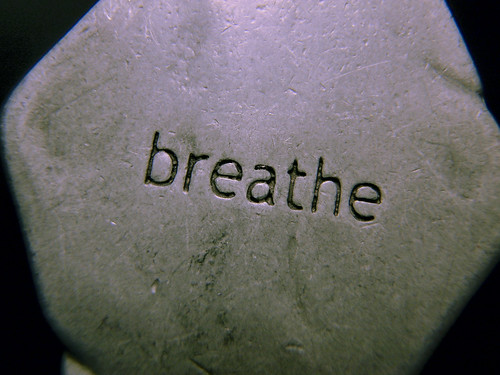
Breathing Through God

Did you know that when you breathe you are connecting to God? Or you could be if you were aware of what you were doing. Really.

As part of our experimental Jewish Spiritual Journey Facebook Group, one participant asked me, “Does the word SHEMA have something to do with our breath?” I love the question. Here’s how I answered him:

Shema absolutely has to do with the breathe because it twice invokes the name we call God, the four letter name Yud Hey Vav Hey which we often pronounce as Adonai. Adonai is just a euphemism for Yud Hey Vav Hey, meaning “my Lord”. My Lord was once considered a very high honorific in human society, thus that’s what we used to call God (today we would choose something like “Celestial CEO”).

But this four letter name of God Yud Hey Vav Hey is really unpronounceable, as it consists of four expulsions of breath from the mouth or throat. Yud occurs back where the hanging thing in the back of your throat is. There is no sound unless combined with a vowel. Try making a “y” sound without a vowel attached. Hey, twice appearing is just the expulsion of breath through the open throat. Unless accompanied by a vowel, it just is the unsounding sound of breath release. Finally, Vav stands for the “O” or “OO”, neither of which really make a sound beyond the stop and start of the breath in the mouth.

So when we twice say Yud Hey Vav Hey during the Shema, we are saying that the Breathe that makes no sound IS God, or at least where God resides. God resides in the breathe. God is the breath.

That breath is echad, one, the oneness or unity that unites all life and all creation.

So I ask all of you: Do you connect spirituality and/or breathing with Shema? Do you find yourself more spiritual when you are connected to your breath or breathing?

BTW: Our Jewish Spirituality Journey Facebook group is a closed group (meaning the answers do not appear in the Facebook pages of non-participants). Anyone can join the discussion. Just email Rabbi Paul Kipnes and ask for me to add you to the group. Of course, you have to Facebook Friend me first. Join in. We have already had some great discussions.

Simcha Wars: The Battle For Joy (Part 1)

[This article first appeared in Congregation Or Ami’s Divray Or Ami newsletter. It directs readers to this blog to discover the 7 Intentional Strategies to Infuse Simcha (Joy) in our Congregation.

Judaism, according to one accounting, has at least 15 different words to describe joy. From rina (meaning joyous song) to sasson (exaltation) to simcha (pure joy), Jewish life is supposed to be an expression of joyous living. So significant is the mitzvah (literally, the divine commandment) to life a life filled with simcha, that when we articulated Or Ami’s Vision and Values, we listed simcha/joy as one of our primary values. We aim to “celebrate life through word and song because we believe that life is filled with blessing.”

It is easy to say – be joyous! – yet succeeding in doing so is far more complex. From the personal to the historical to the existential, we each face an army of forces arrayed against just that impulse – to be joyous. We live intensely cognizant of our own suffering, be it medical, familial, financial, psychological, or romantic; such awareness itself conspires with the real pain.

Our Jewish history is easily reduced to a chronology of crisis – genocidal in the 1940’s, hate-spewing anti-Israel in the present, and pogrom-filled before those. (I suspect our readers could easily list their choice moment of Jewish trauma.) Similarly, American life today is dominated by financial crisis and post-9/11 fear. Our television newscasts and online blogposts are filled with reports of things that could make us sick or worse. Our jobs, our schools, and our daily lives are pressure-filled cauldrons of anxiety and worry.

Up against this, can we really find simcha? I have learned that simcha is possible even during the darkest of times; once purposeful openness to allow it to permeates the way we live. That’s where Judaism comes in.

Judaism as a religion, culture and peoplehood is predisposed to joyfulness. Congregation Or Ami, as a synagogue community, acts intentionally to invest every moment we are together with simcha. How so? We have 7 intentional strategies to guide our work. Read them here on my blog.

Dementia in the Family

The Jewish community is aging, and Jewish communal leaders are facing up to this reality.  We are contemplating what Sacred Aging looks like (including a new book Seekers of Meaning by Rabbi Richard Address, D.Min.); our Union for Reform Judaism among others is developing new resources.  Next spring, we hope to see the publication of Broken Fragments, a book about Jewish perspectives on Alzheimer’s disease, dementia, caregiving and more. I am honored to have written a chapter on how the Jewish community can respond with compassion and Jewish support.

Guided by the Biblical Psalmist – Cast me not off
in the time of
my old age;
when my strength fails,
forsake me not
 (Psalm 71:9) – we seek to prepare for those seemingly inevitable moments when we find our parents, our loved ones, or ourselves beginning to enter the haze of dementia.

Recently, someone dear to me wrote about his beloved’s new diagnosis. His words are poignant and eye opening.  With his permission and some edits to preserve anonymity, I share his reflections.

Dementia in the Family 

My wife and I are in our 80’s. A short time ago, we were sitting in our living room and she asked me, “What is our granddaughter’s name?” 

Almost immediately a red flag went up. I told her what the name was and suggested to her that we make an appointment with her internist, which we did.  At her appointment, the internist gave her a little test which she flunked, leading the doctor to suggest she see a geriatric specialist. 

When the day of the appointment arrived, we were ushered into the doctor’s office and he explained that he would give her a few simple tests over the next 20 or thirty minutes. After taking these tests, he excused himself and said he would take a few minutes to evaluate the results of the tests he had given. 

Diagnosis: Dementia 

On his return, he explained that my wife was showing the beginning of dementia, and he explained what he meant by dementia, and what could be done about it. He explained further that he would like to place her on a medication regimen. He told us that the medication was not a cure, but should slow down the process. The medicine he recommended was Aricept, 5mg. tab daily. He also suggested a couple of vitamins (D and B1) that he indicated were important.  

We started her on this medication and indeed it seemed to work. We did not notice any improvement in her short term memory, but it did not seem to get worse, and her long term memory was quite good.  She was still able to run our household; she played bridge every week and things seemed to be working. 

At the end of six months we went back for further testing and she seemed to be able to do at least as good as before and perhaps a bit better. The doctor told her to use the same medication in the same amount. 

Omigosh, I thought I was Talking to our Son 

At this time, she is about the same except for the following: twice now, she has been looking at me but talking to our son. This confused me at first but both times she snapped out of it and said, “Omigosh, I thought I was talking to our son.”  We scheduled another appointment with geriatrics. 

Time has passed (about six months) and we had our evaluation with a new geriatric physician. Most of her blood tests are O.K. and she has lost about two pounds. No big deal. Her short term memory has become a bit worse but her long term memory is better than mine. She has shown a little more confusion than before. She still plays bridge, but with a bit less enthusiasm than prior games; this might be a memory thing. She still does the shopping and the meal planning and of course she plans her personal care (hair and nails). Her doctor increased her medication from 5 mg to 10 mg, and made us a follow up appointment for six months from now. 

The past few days have been the first time she has verbalized where she may be headed and she has been extremely unhappy.  We all are.   

I have used some home-spun psychology but I feel it is not enough and I need to be sure I am going in the proper direction. Fortunately, I know a great psychologist and my next stop is to meet with him. 

Our Hearts Ache As We Hear Such Stories
We want to reach out and support. Synagogues cannot seem to do enough to reach out to our loved ones who faced with dementia and Alzheimer’s disease, or are caregivers for their loved one.  So at Congregation Or Ami, we try:

  • We connect congregant caregivers up with each other. 
  • We share stories, like the one above and the award-winning essay, The Gift of Caregiving, by another congregant about her experience caring for her father. 
  • We have brought in professionals from Jewish Family Service to the congregation to help guide the sandwich generation on how to care for their parents (and once on how to take away the car keys in a compassionate way). 
  • We have held services honoring caregivers
  • I have spoken on the High Holy Days about Alzheimer’s disease.  
  • We regularly let people know about the resources on caregiving, sacred aging and planning for both, from the Union for Reform Judaism and on our Or Ami webpage for Adult Learning (scroll down).  

Still, it never feels like we are doing enough.

Do you have any suggestions on how to reach out – Henaynu, we are here? Please let us know.  

Letter from Jerusalem: To an Progressive American Jewish Friend

For Jews (and others) struggling between two equally problematic presentations of Israel: ‘Israel, right or wrong’ or ‘Israel is an apartheid demon state,’ comes this Letter from Jerusalem: To a Progressive American Jewish Friend from Israeli author Gershom Gorenberg.  It is a bit long, but well worth the read.  

***
Dear L——, 
Please don’t give up on Israel. And please give me a chance to explain before you hit the delete button. 
I know, your last e-mail virtually asked me not to write this one. You said that you were tired of news about growing West Bank settlements, stalled peace negotiations and Foreign Minister Avigdor Lieberman’s bellicose statements. Your daughter says the campus debate between anti-Israel and pro-Israel groups is too shrill to bear. You would prefer to focus your progressive political energies on issues close to home. When I write, you implied, I should stick to updates about my kids. May I mention that my own daughter isn’t in college yet because she’s serving in the Israel Defense Forces, or that last summer, to my dismay, she drew a week of guard duty at a West Bank settlement? 
O.K., I’ll skip family news. I know you are not alone in your despair. In the recent, excellent documentary Between Two Worlds about American Jewry’s internecine battles, there’s a scene in which Daniel Sokatch, head of the liberal New Israel Fund, explains why young Jews are leaving the conversation: “People will walk away from an argument that looks like [a choice between] ‘Israel, right or wrong’ or ‘Israel is an apartheid demon state.’ That is not a compelling paradigm for most young American Jews.” My only quibble is that lots of older Jews are equally unhappy with a debate restricted to those choices.
But I don’t think you can walk away. If you choose silence on Israel, your silence will also be a statement, interpreted in a way entirely different from what you intend. Besides that, “progressive” means “working for progress.” Giving up on Israel because it isn’t living up to your liberal values would violate those values. 
Let me go back. in the American suburb where you and I grew up, “Jewish” and “liberal” were nearly synonyms. As a teenager, I walked our precinct for a Democratic candidate. Seeing a mezuza on a doorpost was a reassuring sign that I’d get a sympathetic hearing. This made our neighborhood typical of Jewish America, then and now. 
More than party affiliation is at work. You and I regard commitment to social justice as basic to our identity as Jews, and we are not alone. Scholars argue about the reasons for the attraction of large numbers of Jews to the left, in Europe, America and elsewhere. Have progressive Jews been inspired by the Torah’s teaching to remember that we were strangers in Egypt? Or, as some historians argue, are their politics a product of the experience of Jews trying to integrate into modern society as a minority? Trying to untangle the two factors, I’d argue, is pointless. We interpret the ancient text in the light of experience—and our experiences in light of the text.
Long before 1948, progressive Jews presumed that if our tribe were ever in power, we would create a utopia, somewhere between socialist and liberal. The prophet of political Zionism, Theodor Herzl, promised as much in his novel, Altneuland. The left’s domination of prestate Zionism and the kibbutz-centered PR of Israel’s early decades seemed to fulfill the promise. Back then, Israel’s economic policy was remarkably egalitarian. The gap between rich and poor was small. Inexpensive, nonprofit health care was nearly universal. The Jewish state was a Scandinavian social democracy displace to the Levant. Besides, Israel looked like the underdog in the Arab-Israeli conflict, and there is a reflex to assume the underdog is in the right. 
Hence the bone-deep surprise you feel each time you read a news item showing that Jews, now in charge of their very own country, can be illiberal. Truly, I’m sorry. Israel has a political movement—Lieberman’s Israel Is Our Home Party [Yisrael Beitenu]— that builds support by attacking an ethnic minority. It submits Knesset bills aimed at disenfranchising Arab citizens. Israel has fundamentalist parties whose government-funded schools keep evolution and even English off their curriculum for fear of eroding their students’ faith. This year, Prime Minister Benjamin Netanyahu’s coalition pushed through a law making it illegal to call for consumer boycotts of goods from West Bank settlements—a legislative assault on free speech. Netanyahu says he favors a two-state solution, but he encourages settlement construction whose strategic purpose is blocking such an agreement. What is a Jewish liberal to do?
Yes, Israel does face disproportionate criticism. As a tribe we Jews suffer the curse of celebrities: Everything we do gets more attention. Next to the civilian casualties from America’s wars in Afghanistan and Iraq, the costs of Israel’s Operation Cast Lead in Gaza pale. Every foreign correspondent who has worked here knows that her editor gets more excited about a minor clash between Palestinians and Israeli soldiers than about a whole war south of the Sahara. But other nations’ cruelty is poor comfort. As the old television commercial said, we feel that “we have to answer to an even higher authority”—be it God or the inchoate spirit of Jewish liberalism. And the news reports from here are not inventions.
The name for the discomfort that American Jews feel while reading that news is cognitive dissonance. That is when “opinions, beliefs [and] knowledge of the environment…do not fit together,” pioneer cognitive psychologist Leon Festinger wrote in his 1956 classic When Prophecy Fails. Festinger described one way in which people reflexively deal with facts that “disconfirm” their belief. They stick to the belief, and try to convince others that it is nonetheless true: “If more and more people can be convinced that the system of belief is correct, than clearly it must, after all, be correct.” Persuade others, and the pain of dissonance fades. So when some establishment Jewish groups try to refute every negative report about Israel, they serve a psychological need as well as a political one. 
A variation is to switch the subject to the external threats facing Israel. In his Commentary magazine broadside last June against rabbinic students “distanced from Israel,” the Shalem Center’s Daniel Gordis used the trump card of recalling the start of the Six-Day War, when Israel “was seemingly on the very precipice of destruction.” Never mind that Israel’s initial news blackout on its victories in June 1967, while necessary militarily, amplified diaspora fears. “Siege Zionism” plays on a tendency of some American Jews to think of Israel as a replacement for the lost Jewish “Old Country” of Eastern Europe—and to imagine it as a country-sized shtetl about to be overcome by Islamic Cossacks. This image is profoundly ahistorical. It ignores the emergence of a sovereign Jewish state, its military strength and its opportunities for peacemaking—some of which have been seized and some squandered. 
To my sorrow, some Jews take the opposite approach: They accept that their received picture of Israel is wrong—and direct the fury of the betrayed at “the God that failed.” Hence the obsessive anger of some Jewish anti-Zionists.
And yet another response is to try not to think about the problem. As Peter Beinart, former New Republic editor, wrote last year, “For several decades, the Jewish establishment has asked American Jews to check their liberalism at Zionism’s door, and now…they are finding that many young Jews have checked their Zionism instead.” 
Beinart’s warning was correct, and belated. The danger is that young Jews will not only check their Zionism at the door, but their connection to all things Jewish. The existence of a Jewish country is too large a part of the 21st-century Jewish reality to be excised from Jewish communal life in America. But when students find Jewish campus organizations devoting their energy to refuting any criticism of Israeli policy (including criticisms voiced daily here in Israel), many stay away from campus Jewish life entirely. 
Nor will Israel disappear from congregational life. If you allow the Israel conversation at your congregation to be dominated by the advocates of siege Zionism, you risk letting your community be shaped by the fearful mentality of “the world is against us” rather than by a universalist commitment to tikkun olam.
More than that, as a Jew you can’t avoid taking a stand on Israel in the American political arena: Silence is also a position. As you know only too well, AIPAC and the Conference of Presidents of Major American Jewish Organizations have presented themselves for decades as speaking for American supporters of Israel—a category that many politicians and lazier journalists treat as synonymous with American Jews. If you say nothing, those organizations are presumed to speak for you.
The bottom line is that you should be working for a better, more progressive Israel and for a more open discussion of Israel among American Jews—a discussion in which supporting Israel includes supporting peace and social change. And the dissonance that makes you want to give up on Israel is a result of two assumptions that I think you will reject once you examine them.
The first is that a Jewish country will automatically be progressive, because that’s how Jews naturally act. Think about it: You don’t believe in the inborn superiority of particular ethnic groups any more than you believe in the opposite, the inherent inferiority of ethnic groups. The Torah does not tell us to remember that we were strangers in Egypt because Jews are instinctively, unequally committed to equality. It repeats that message in a loud drumbeat because we are people, and the natural thing for people to do when they get power is to forget that they were once powerless. 
On the other hand, the only way for people to act morally is to have power over their lives. Israel presents the opportunity for Jews to have power over their lives as a collective—to express our values not just as individuals but as the majority in a sovereign state. The critical contribution that diaspora Jews can make in engagement with Israel is to remind those of us here of the sharp experience of being the outsider, the stranger, so that we Israelis don’t forget where we came from. 
The second flawed assumption is that you should feel tied to Israel only if it is already a progressive country. Think about that word: Progressives are people who work for progress. To your good fortune, Israel is rich with organizations working for change— groups promoting human rights, women’s rights, gay rights, religious freedom, Jewish-Arab dialogue and, of course, peace. In the last several years, American Jewry has seen a flowering of organizations supporting those efforts.
My old friend, don’t give up. Get involved. 
Gershom Gorenberg’s latest book is The Unmaking of Israel (Harper). He blogs at South Jerusalem.

The Motif of Light in Jewish Tradition

On Chanukah we light the menorah/chanukiah, increasing the light in a very dark world. What is the significance of light in Judaism and Jewish ritual? What purpose did the menorah in the Jerusalem Temple originally serve?

Rabbi Adin Steinsalz offers some answers to these questions in an article that appeared in the Jerusalem Post. The excerpt below are his words. Thanks to Or Ami congregant David Eshaghpour for bringing it to my attention.  

***

Light is the genesis – the creation of the world. The primary utterance of creation is “Let there be light,” its separation from darkness. The Midrash asks – from what was light created? The answer is whispered: “G-d cloaked [Godself] in a white shawl, and the light of its splendor shone from one end of the world to the other” (Genesis Rabba 3:4).

In other words, fundamentally, light does not belong to this world. Rather, it is an emanation of a different essence, from the other side of reality. Light serves as the symbol of good and the beautiful, of all that is positive….


The use of light as a symbolic expression of the positive aspect of reality is … realized also in the use of light and lamps as concrete means of expression. These symbolize and point to an essence that contains holiness, in all its different appearances in reality: in the sanctity of place (in the Holy of Holies at the Temple), in the sanctity of time (on the Sabbath and Festivals) and in the sanctity and importance of events (on special occasions).

THE TEMPLE menorah, for all its ornate and elaborate craftsmanship, did not serve any practical purpose. It was there as a symbol of the holiness of that place, its relation to light. The menorah was a sphere of sunlight, which shone through the walls and curtains. It is little wonder that this meaning of the Temple menorah was conceived by the Jewish people as the symbol par excellence of Jewish existence, as can be seen in Jewish ornaments from all periods.

The same goes for the Sabbath and Festival candles. Initially, the Sabbath candles were lit for a very prosaic reason – to make light for those who eat the Sabbath evening meal, so that they would not spend the evening in utter darkness. The light of the candles has turned into the very symbol of the Sabbath itself, a sort of “light of the seven days of Creation,” shining in a sanctified niche of time.

The festival of Hanukka is expressed by the ceremonial lighting of candles, which increase daily in number – to symbolize how “light exceeds darkness” in the festival of victory, purification and historic upheaval. So, too, is the tradition for parents to escort their children to the wedding canopy with candles or torches. They are a light of pure joy and hope….


Thus, on one hand we have the light of the Holy place, which does not even have to be seen, while on the other hand is the light of the Shabbat candles, which is to be used. The Hanukka candles are “holy” – we have no right to use them, but only to behold them. The same goes for the messages that these lights convey: glory, the joy of victory, a remembrance of eternity, or an outburst of merriment….
The difference between the single wicks of the Sabbath candles and the braided torch of the Havdala candle is the distinction between a light of calmness, of repose and of homeliness, and the stronger light of the torch – a light with which, on the one hand, accompanies the departing [Shabbat] queen, and on the other, lights the darkness which becomes more marked in her absence. The Hanukka candles stand in one line to mark and count the days, and the shamash (helper or servant) candle, stands apart to indicate that, unlike the other candles, it is there for practical use.

Yet, above all, the function of light is to illuminate. In Judaism, darkness has never had religious significance. The curtain of darkness and mist is the kelipah (husk or shell). And to the extent that light does have a role to play, it is, as the Sefer Yetzirah says, that “the existence of darkness underscores light, emphasizes the yearning for it.”….

Simcha Wars: The Battle For Joy (Part 2)

[This article is the conclusion of an article entitled Simcha Wars: The Battle For Joy (part 1), which appeared Congregation Or Ami’s Divray Or Ami quarterly Newsletter.  Read the beginning here.]

Happy New Year!

Up on our Jewish Spiritual Journey Facebook group (Facebook message me if you want to join the closed group.  It is quite a discussion!), we are engaged in a discussion about what resolutions for the coming year we would make regarding our own spirituality.

At the same time, I came across a link on Facebook titled 12 Things Happy People Do Differently.  From Expressing Gratitude to Not Over-thinking to Learning to Forgive to Practicing Spirituality, this posting challenges us to commit to happiness by imitating happy people.  It reminds us that bringing happiness into our lives, like with any other middah (attribute/quality) we seek, demands intentionality and mindful living.

Congregation Or Ami, our Calabasas, California synagogue, flourishes in part because we see Judaism as a religion, culture and peoplehood that is predisposed to joyfulness. Congregation Or Ami, as a Jewish community, acts intentionally to invest every moment we are together with simcha. How so? We have 7 intentional strategies to guide our work.

7 Intentional Strategies to Infuse Simcha (Joy) in our Congregation

  1. Welcoming People with a Smile and a Hello. At the front door, near the receptionist’s desk, and over the phone, we strive to stop our “work” and engage our “passion,” that is, making you feel welcome. In a busy world which often allows me to prioritize my needs/task over yours, Or Ami tries to make you the center of our purpose. Amazing how much joy that brings into our lives.
  2. Music Speaks Louder than Words. Well aware that a music soundtrack can bring forth specific emotions (notice this next time you sit in a movie), Or Ami strives to infuse our services, our programs, and even our congregant gatherings include plenty of uplifting music. Music, especially that of our Cantor Doug Cotler, can transport us from the stressful pressures of life to a more content, simcha-dik place.  
  3. Kvell, Don’t Kvetch. We speak about Kvelling, not Kvetching repeatedly. Kvetching is that typically Jewish act of complaining, loudly and regularly about things big and small. We kvetch about our families. We kvetch about our kids, our jobs, spouses/partners, the economy, the government… everything. Our biblical ancestors kvetched during their desert trek about the food, the lack of water, the danger from enemies, about Moses’ leadership. Such a typical Jewish act, and yet, kvetching is profoundly the antithesis of what it means to be authentically Jewish.

    To be a Jew is to be a kveller! Kvelling means to praise. Kvelling lets others know that good things are happening. It leads us to be filled with joy as we count our blessings. We could be praising the important things: our health, our relative wealth (we always have more than others somewhere), the roof over our heads, the community of which we are part…

  4. Ask: What is Your “Or Ami” Moment? How often do we provide the community opportunities to kvell? They know they can kvetch – the squeeky wheel gets the oil – but do they know they can kvell too? So at Congregation Or Ami – at services a few times a year, at board meetings, at dinner gatherings with the rabbis and cantor – we invite people to share with each other, and the group, their cherished Or Ami moment from the past year or two. Tears of joy, expressions of feeling supported, experiences at a simcha, all come forth. When we allow people the chance to share meaningful experiences, their hearts seem to soar as simcha deepens.
  5. Seek a Spiritual Path. I try to talk – write, blog, tweet – often about my spiritual journey, because finding one’s spiritual center seems to correlate directly with being happy. Making the spiritual journey a central part of the conversation at the synagogue may allow people to rise up and be happy.
  6. Simcha at Services. Our other Rabbi Julia Weisz creates moments within our Kesher (youth learning) services for people to share their simchas (good grade, new job, recovery from illness, scored a goal, etc.). Such a simple yet profoundly simcha-dik addition to the tefillah. We speak at services about those who are ill (at the Mi Shebeirach) and those who have died (at Kaddish), yet where do we allow people to kvell about their simchas? We are trying to remember to include this element in our regular Shabbat services.
  7. Smiling is So Simple. Smiling is so simple and so contagious. We remind our greeters at services, in our office, and at the Mishpacha Family Alternative Learning program to smile when someone enters the synagogue.  We remind teachers to smile at their students and clergy to smile at everyone. A smile uplifts, refreshes, infects, and inspires. Simply put, a smile points people toward simcha, joy.  
These 7 Intentional Strategies to Infuse Simcha (Joy) in our Congregation may not constitute “brain surgery,” but they seem to uplift and inspire people to be a little more simcha-dik.  
In this secular New Year 2012, perhaps we all might try to be a bit more joyous in your life, in your work, and in your family and community.

Do you have any additional strategies that lead to simcha (joy) in the community?  Do tell!