Category: blog archive

Encountering the Essence of the Ten Commandments

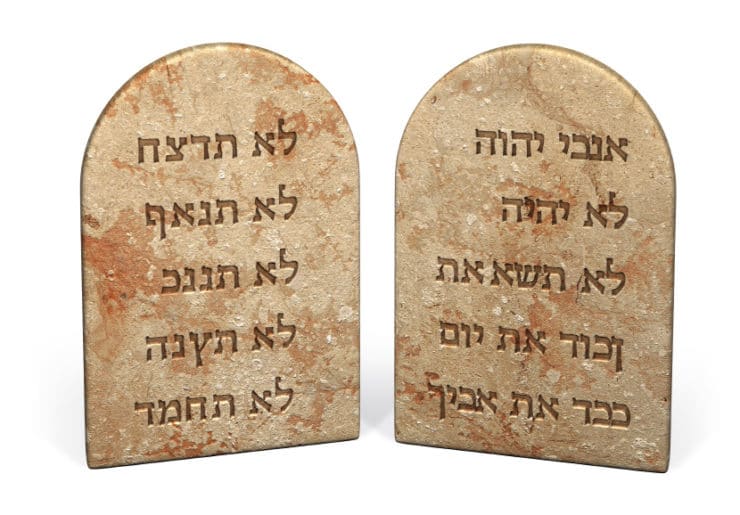
Most of us would recognize the Ten Commandments, even though few of us could actually list them. Beyond arguing about whether the commandments belong on the walls of schools and in the Federal Courts (they don’t), fewer still have tried to explore deeply the essence of this list.

Recently, I read Rabbi Yael Levy‘s Torah Commentary, Journeying with the Torah: Week by Week, Season by Season, Moment to Moment (from the Institute for Jewish Spirituality), which delves through and beyond the words to discover the essence of the Ten Commandments. Her explication of the list, through a Jewish spiritual lens, is breath-taking and refreshing.

Top 10 Commandments: The Usual Listing
We begin recalling a “traditional” listing of the commandments (from Ron Isaacs). While there are multiple ways to count the Ten, the prevailing Jewish tradition appears to be:

  1. First Commandment (Exodus 20:2): I am the Eternal Your God, who brought you out of the land of Egypt, out of the house of bondage.
  2. Second Commandment (Exodus 20:3-6): You shall have no other gods beside Me. You shall not make for yourself any graven image, nor any manner of likeness, of any thing that is heaven above, or that is in the earth beneath, or that is in the water under the earth. You shall not bow down to them, nor serve them…
  3. Third Commandment (Exodus 20:7): You shall not take the name of the Eternal Your God in vain…
  4. Fourth Commandment (Exodus 20:8-11): Remember the Sabbath, to keep it holy. Six days you shall labor, and do all your work; but the seventh day is a Sabbath unto the Eternal Your God…
  5. Fifth Commandment (Exodus 20:12): Honor your father and your mother, that your days may be long upon the land which the Eternal God gives you.
  6. Sixth Commandment (Exodus 20:13): You shall not murder.
  7. Seventh Commandment (Exodus 20:13): You shall not commit adultery.
  8. Eighth Commandment (Exodus 20:13): You shall not steal.
  9. Ninth Commandment (Exodus 20:13): You shall not bear false witness against your neighbor.
  10. Tenth Commandment (Exodus 20:14):You shall not covet your neighbor’s house, nor his wife, … nor anything that is your neighbor’s.


Reimagining the Transcendent Moment
Rabbi Levy imagines the moment at Mt. Sinai, when

…the world disappeared.
All distinction vanished.
There was no I, no you, no tree, no bird, no water, no rock.
There was only One:
One breath,
One life,
Only One.
Infinite.
Eternal.
One. 

And all of us stood
With the One breath still on our lips
And we knew.
We knew
The One inside the many
The One beyond anything that could be or seen known
The One:
Infinite,
Eternal
And we trembled in awe… 

We listened to the One reverberate in our hearts
And in the silence, we heard the Mystery call:

Going Beyond the Words
Rabbi Levy pierces the essence of the Ten Utterances:

  1. I am, I was, I will be. I am the unfolding of all that is. I am constant transformation calling you forward to be.
  2. You cannot arrest me in motion. You cannot grasp or hold onto time. Do not strive for certainty. Do not seek permanence.
  3. Do not use a Divine name to make false promises. Do not use sacred teachings to lift up a destructive path.
  4. Rest, Stop, Pause. Be. Honor creation. Declare your freedom. Rest and allow others to rest as well.
  5. Honor your parents. Honor your ancestors. Honor those upon whose shoulders you stand.
  6. Do not murder.
  7. Do not betray.
  8. Do not steal.
  9. Do not use the power of words to hurt or destroy.
  10. Feel the fullness of your life. Don’t be led astray by comparing yourself to others. Don’t get lost in desiring what others have. Be content, be fulfilled with what your life brings.

Breath-taking, mind-altering, refreshingly expressive
Rabbi Levy invites us to reencounter the holy list.

In what ways can you embrace this interpretation of the Ten Commandments?

When Harriet Met Herman

Herman and his granddaughter Stacey

How Harriet and Herman Met
Harriet had nothing to do that evening, when her friends prepared to go out to a dance party. So she agreed to tag along.

It was toward the end of World War II; the dance hall was filled with servicemen of all types, handsome in their dress uniforms. Harriet and her friends danced and rested, then danced some more. As they left the dance floor to rest their tired feet, she noticed that all the chairs were taken.

With a clear sense of purpose but perhaps a twinkle in her eye, Harriet looked over all the servicemen sitting in their seats. She picked out one, the safest looking, who was handsome nonetheless. Approaching him, she asked if she could sit on his lap. Herman said, “Yes.”

They were married 3 months later.

People said it wouldn’t last. That was 46 years ago.

I buried Herman last week, on an overcast day, between drizzling and downpours. Though the day was dreary, the stories about Herman and Harriet were uplifting. Especially this one about how they met.

It is not hard to imagine Harriet approaching Herman or the romance that ensued. Harriet still has that twinkle in her eye, even amidst the sadness of mourning.

More than Just “Old People”
Like Harriet and Herman, in the stories of our own Bubies and Zaydes we are reminded that our current travails, challenges, joys and dreams are simultaneously intensely immediate and timelessly universal. More than just being “old people,” or the deceased being merely names on a page, they point to warm-blooded living, loving, struggling people. Like our Biblical ancestors Abraham, Isaac and Jacob, Sarah, Rebecca, Rachel and Leah, our loved ones sought good times, good fun, comfort in community, and perhaps meaning in a relationship with God.

They Were All Once Young
Sometimes we forget that our older relatives were once young, that those who anchor our families’ histories once laughed and played and were just plain silly. We seemingly ignore the fact that like each of us each of them enjoyed young love, recklessly pursued thrills, and defied the safe for the fun. Our Nanas and Papas, Zaydes and Bubies have seen so much of history and experienced as much and more than any of us have.

Well Herman has returned to the Source of All Life, so his memory carries on in the stories his family tells about him. And his beloved, now 90 years old, still has that same twinkle in her eye and perhaps even the chutzpahdik fire in her belly, that gave her the guts, 46 years ago, to sit down on that serviceman’s lap.

Thinking about Herman and Harriet
Maybe that’s why I keep thinking about Herman and Harriet. Because in the story of these two great grandparents, I see not old people but young vibrant individuals who grew up. May each of us retain those qualities which made us fun when we were young, even as we grow older. And may Herman’s memory be for a blessing, and the memory of their meeting serve as an inspiration.

At 103 Year Old, Lil is Still Learning (and Teaching)

I’ve known Lil for almost 14 years, a minuscule portion of her quite long life. Still, I have grown quite fond of her as our paths crossed and recrossed through vicissitudes of life: celebrations of B’nai Mitzvah, visits to her during a near death hospital stay, holy day services and the more mundane moments in between.

I remember being touched that she was the inspiration that led three of her great grandchildren (and her adult daughter) to become B’nai Mitzvah, and being inspired by her finesse at helping them craft each d’var Torah (speech). I am prepared each High Holy Day morning to find “Nana”, right after services, to give her a kiss and a few words of blessing.

Who Knew?
So when I was asked if I had time to visit Nana at the Convalescent Home, I just tossed a date out and recorded it in my iPhone. Who knew that the request to visit a congregant’s 103 year old mother would turn out to be one of the most meaningful, spiritual moments of the week?

Sightless but Insightful
Lil was waiting for me in the Sun Room at the end of the hallway. I approached; she offered me a seat. We held hands; I gave her a kiss. 
Lil may not be able to see, but she is very insightful. We talked about her grandkids (who call almost every day) and her family, about the convalescent home and her upcoming 104th birthday (not a big deal to her). Our conversations delved into the joys of family and the sometimes incomprehensible depression that temporarily descends (perhaps the result of being old?). 
Well Before its Time, A Girl Advocates for the Chance to Study Torah
Lil reminisced about her own Jewish upbringing. Hers was a very religious family; two older brothers were taught by a tutor – Mr. Yunefsky? – who came by every day. Although girls generally were not taught Torah and Hebrew back then, Lil very much wanted to learn. With the help of her brother, she convinced her father to let her learn.  “Why don’t you have a teacher for me? Because I’m a girl?” Her dad responded, “Is that what you’d like?” She responded “Yes, because I’m a girl doesn’t mean I don’t want to learn.” So she started to absorb everything that the teacher would teach: Hebrew, Torah, and Bible.
Time and again Lil explained about how important it was that the next generations (her grandchildren) love being Jewish and are involved in the synagogue. Hers are! Her youngest is a Madricha (teaching assistant) in our schools and a leader on our LoMPTY youth group board; the two boys regularly stop by to visit me (their rabbi) when they are in town from school. Lil takes great pride in the fact that they are members of Congregation Or Ami and are bonded with Judaism. 
Learning Torah Together

During a lull in the conversation, I asked her if I could read her this week’s parasha (Torah portion).  She lit up. Opening the Tanach for All (Bible) app on my iPhone, I proceeded to read the portion in Hebrew; Lil surprised me by translating the words. Back and forth we went. Hebrew then English; me then she. I was moved in this moment. Separated by three generations, we nevertheless shared Torah, something that transcended the generations.
I needed to drash (interpret) the parasha for that Shabbat. So I asked her how to best interpret these words for our congregation. 103-year-old Nana was full of suggestions. I wondered just what was really happening here. To the casual observer, it might appear that I – the Rabbi – was teaching Torah to this older woman; in truth, Lil was passing the wisdom onto me.
A Moment when Blessings Overflowed 
Today I learned Torah from a 103-year-old woman. Her wisdom filled my soul; her love overflowed into my heart. On reflection, I keep coming back to the blessing one says upon seeing a Torah scholar (found in my iPhone CCAR Daily Blessings app):

Baruch Ata Adonai Eloheinu melech haolam, shchalak meichochmato lirei’av.Praise to You, Adonai our God, Sovereign of the universe: You share Your wisdom with those who revere You. 

Yes, 103-year-old Lil was my Torah teacher.  Thank you God, for this moment of wisdom in the midst of everyday life.

Happiness is Good, But Torah Tells Us to Strive to be Holy

Passing Torah Midor Lador at Ethan’s Bar Mitzvah

When passing down Torah midor lador (from generation to generation), especially at a Bar/Bat Mitzvah service, we illuminate the unique contributions Torah brings to the way we look at and live out our lives. I often say,

  • In a world that teaches us its all about being happy, Torah says that we should strive to be holy.
  • In a world that teaches us that its all about making a buck, about getting rich, Torah says that money is okay, but we have been given what we have in order to help enrich the lives of others.
  • And in a world that teaches us that its all about me, that I can do what I want, Torah comes to teach us that we were put on this earth for a higher purpose, to transform it, into a place filled with emet (truth) and tzedek (justice), to fill it with ahava (love), so that it will become a place of shalom (peace).

Self interest, making money, seeking happiness – these are all positives within the Jewish mindset.  But they are not enough.  As partners with God, we seek higher purpose. We call that “holiness” or “kedusha“.  Some call it “finding meaning”.

There’s More to Life than Being Happy
Thus comes an essay, entitled There’s More to Life than Being Happy (The Atlantic, Jan. 9, 2013), which argues that seeking happiness is overrated and in many ways selfish. Rather, we should strive to find meaning, which most often is found when we turn outward, engaging and being in relationship with others.  Quoting Holocaust survivor Viktor Frankl and new studies on happiness and meaning among others, the well-argued essay suggests that Leading a happy life, the psychologists found, is associated with being a “taker” while leading a meaningful life corresponds with being a “giver.”

In a new study, which will be published this year in a forthcoming issue of the Journal of Positive Psychology, psychological scientists asked nearly 400 Americans aged 18 to 78 whether they thought their lives were meaningful and/or happy. Examining their self-reported attitudes toward meaning, happiness, and many other variables — like stress levels, spending patterns, and having children — over a month-long period, the researchers found that a meaningful life and happy life overlap in certain ways, but are ultimately very different. Leading a happy life, the psychologists found, is associated with being a “taker” while leading a meaningful life corresponds with being a “giver.”  

“Happiness without meaning characterizes a relatively shallow, self-absorbed or even selfish life, in which things go well, needs and desire are easily satisfied, and difficult or taxing entanglements are avoided,” the authors write [emphasis mine]. How do the happy life and the meaningful life differ? Happiness, they found, is about feeling good. Specifically, the researchers found that people who are happy tend to think that life is easy, they are in good physical health, and they are able to buy the things that they need and want.

Its about Finding Meaning
The Atlantic essay moves us toward finding meaning, continuing:

“Partly what we do as human beings is to take care of others and contribute to others. This makes life meaningful but it does not necessarily make us happy,” Baumeister told me in an interview. 

Meaning is not only about transcending the self, but also about transcending the present moment — which is perhaps the most important finding of the study, according to the researchers. While happiness is an emotion felt in the here and now, it ultimately fades away, just as all emotions do; positive affect and feelings of pleasure are fleeting. The amount of time people report feeling good or bad correlates with happiness but not at all with meaning. 

Meaning, on the other hand, is enduring. It connects the past to the present to the future. “Thinking beyond the present moment, into the past or future, was a sign of the relatively meaningful but unhappy life,” the researchers write. “Happiness is not generally found in contemplating the past or future.” That is, people who thought more about the present were happier, but people who spent more time thinking about the future or about past struggles and sufferings felt more meaning in their lives, though they were less happy.

Moving from Inward-Focused to Other-Focused
Torah, with its focus on helping others, reaching out to the vulnerable and the stranger, moves us from being inward focused to being other focused. We assume responsibility for transforming the world and thereby transform ourselves (thus tikkun olam encompasses and leads to tikkun atzmi).

May our work on this earth, in this life, lead us toward meaning and purpose, so that in relationship with others and our world, we can deepen our lives and ennoble our souls.

Where do you find meaning? 

Marking MLKing Day and The Inauguration with Diverse Celebrations

Michelle and I blogged together:

Amidst accessible pomp and circumstance, a president was again inaugurated peacefully in America. Partisan politics set aside, everyone gathered to celebrate the freedoms fought for by President Abraham Lincoln and dreamed about by Martin Luther King Jr.
Our President Barak Obama set a high bar: to extend equality to all, across races, religions, national origins and gender. He drew a straight line from Selma to Stonewall, between the struggles for civil rights for blacks and equal rights for gays and lesbians. He pointed us toward our best selves, that part of our nation which strives for liberty and justice for all.

We were Inspired
By the pastor offering blessings who invoked the prophet Micah, goading us to “pursue justice, seek mercy and walk humbly before God”. By the diverse gathering surrounding the president and involved in the official ceremony. And by the realization that once again, the United States achieved a peaceful transition from one presidential term to another.

How does one mark this multifaceted day of celebration?

We chose to venture down to Santa Monica to walk amongst the most diverse community around. Framed by the beach on the west side and the unique beachfront properties and Venice vendors on the east, we enjoyed the cacophony of sights, sounds and smells as people rollerbladed, biked and tossed frisbees. It was a tapestry of color.

We were especially touched by a recently painted mural “From the city of angels to the angels of Connecticut.” The names of the children killed in Sandy Hook, CT were spray painted on the mural to mark their memory and as a demonstration of American support for them and their families. If it is a civil right to be safe from gun fun violence, how do we achieve this and when?

B’tzelem Elohim, Created in the Image of God
Genesis teaches us that we were all created b’tzelem Elohim, in the image of God. We find it perplexing that we still struggle to translate that vision I worthiness and equality of all people into policies and practices that protect us all. May the memory of MLKing and the actions of Barak Obama bring us closer to the day when all will be united in peace and friendship.

That’s how we marked Dr. Martin Luther King Jr. Day and the Presidential Inauguration.

How did you?

Planting Seeds of Hope (Even Though Its Easier Not to Have Hope)

By Rabbi Amy Scheinerman (originally published as Planting Seeds of Hope: Let Them Bloom, by Mekor Chaim, JFNA)

Lying on his back atop his doghouse, Snoopy gazes at the sky and bemoans, “Yesterday I was a dog. Today I’m a dog. Tomorrow I’ll probably still be a dog. Sigh! There’s so little hope for advancement.” Curiously, Snoopy doesn’t shut out all possibility of hope: “so little hope” suggests there is some.

Overwhelming change and events can generate gratitude and hope, or despair and hopelessness. The Israelites, despite a spectacular and public redemption, go the latter route.

As Pharaoh drew near, the Israelites caught sight of the Egyptians advancing upon them. Greatly frightened, the Israelites cried out to the Lord.

they said to Moses, “Was it for want of graves in Egypt that you brought us to die in the wilderness! What have you done to us, taking us out of Egypt? Is this not the very thing we told you in Egypt, saying, ‘Let us be, and we will serve the Egyptians, for it is better for us to serve the Egyptians than to die in the wilderness’?” (Exodus 14:10-12)

The Israelites are gripped by fear (“greatly frightened”), certain that they are doomed (“it is better for us to serve the Egyptians than to die in the wilderness”), and looking for someone to blame for their predicament (“What have you done to us, taking us out of Egypt?”).

Where is their hope for the future? We might expect that redemption at the Reed Sea was an enormous mikveh that transforms them from slaves to free people and would thus attune them to mikveh-Yisrael. Yet the midrash[1] describes: Reuven then said to Shimon: “In Egypt we had clay, and now in the sea again clay. In Egypt we had mortar and bricks, and now in the sea again mortar and bricks.” Perhaps their inability to appreciate the miracles God wrought in Egypt precludes their ability to feel hopeful about the future.

Gratitude is a powerful drug. When it courses through our souls it ignites hope for the future. I write this in the immediate aftermath of Hurricane Sandy. The devastation is horrifying. Yet many victims appear before TV cameras to their gratitude to be alive, coupled with their hopes to rebuild.

Gratitude fuels hope, but it is not always sufficient. Many of us need to ground hope in empirical evidence: we need to know that what we would hope for is possible. Tradition comes to the rescue. Pesach reminds us to hope for redemption: if it happened once, it can happen again.

But what if you regard the Exodus as religious legend, and not history? It is said that King Louis XIV of France asked Blaise Pascal to provide proof of God’s existence. Pascal responded, “Why the Jews, your Majesty, the Jews!” On countless occasions, we have been redeemed from degradation and deprivation. Our amazing survival over the centuries supplies reason to hope. So, too, in our personal lives, we have seen people brought from the depth of addiction, depression, disability, calamity and illness, and go on to lead meaningful lives. This reality is reflected in our sacred stories: As R. Yehudah ha-Nasi approached death, his maid hoped for his peaceful passing. Amidst devastation, Job hoped for wisdom.

I work with hospice patients. You would think someone close to death would have no reason to hope, but they all do. They hope their children and grandchildren will remember them and grow up to be successful, contributing members of society. They hope their loved ones will forge and maintain close and loving relationships with one another. They hope to be remembered for blessing.

The nasty irony of hope is that the worse things are and the more you need it but the harder it is to hold on to. Viktor Frankl wrote: “In a last violent protest against the hopelessness of imminent death, I sensed my spirit piercing through the enveloping gloom. I felt it transcend that hopeless, meaningless world, and from somewhere I heard a victorious ‘Yes’ in answer to my question of the existence of an ultimate purpose.”[2]

So it is hope that makes it possible for all of us to actually face everything. As Rabbis we can help people find seeds of hope to plant. With caring and compassion, we can tenderly nurture the emergent sapling of hope. After all, are we not here to heal one another? What better healing balm than hope.

[1] Shemot Rabbah 24:1.
[2] Viktor Frankl, Man’s Search for Meaning.

God Loves Like a Dog

My teacher, Rabbi Jonathan Slater of the Institute of Jewish Spirituality illuminates this week’s parasha by comparing Loving God to Loving a Dog. His first sentence grabbed me so (I’m not a pet person either), and it just got better and better.

I reprint Rabbi Slater’s wisdom here for pet lovers who might find meaningful this metaphor of God’s love. [Reprinted from Selections from Birkat Avraham: Ongoing Text Study Program, The Institute for Jewish Spirituality, on Parashat Bo (15)]

Rabbi Slater Writes: 

I am not a dog person, but I’m watching family and friends who are and trying to understand the phenomenon. I’ve come to feel that part of it is that dogs allow us to express love and attention and never be rejected (and forgive me my mistakes – but the argument is for the sake of our lesson). As opposed to cats, dogs do not turn away impassively, ignoring offers of attention, blasé to expressions of care and concern. They pant, roll over, fall into paroxysms of ecstasy when rubbed just right. Dogs rarely reject the invitation to play, to go for a walk, or be hugged. They are always there for us, and receive our notice with joy.

Loving Like a Dog
From what I’ve observed, dogs don’t make us feel guilty. Sure, they may whine when we leave them. But, they don’t sulk (for long) when we come home – they lavish attention on us, welcoming us back. There is never a “what have you done for me lately”; whatever we are doing for or with them now is received with immense gratitude. And, while dogs do seem to have their own personalities, they mold themselves to their families with great sensitivity and insight. They know what we want from them, and they figure out how to give it unconditionally.

That is hardly the case with our human family and friends. There are always conditions, and the love we may wish to offer is not always accepted. We have decided that it is important to tell others how our needs should be met, and that they are not doing so. We are the ones who fall into and out of love. We are the ones who figure we can fix up our partners, while resenting every suggestion they might make for us to shape up. We allow our egos to get in the way, making our needs and desires, our fears and grudges, more important than the people who love us, more important than loving the people around us.

So, people turn to their dogs for solace, and for affirmation. In offering love to their dogs, and receiving love in return, their hearts find ease. Resentment thins, anger abates, confusion settles down. Dogs, responding with love, meet our love, inviting its growth. Received without judgment or challenge, we can once again allow our love to flow. Their unconditional love allows us to practice unconditional love.

God Loves Like a Dog
God, too, wants to be able to express unconditional love. But, God does not have a dog, only we humans. And we’re just not as good as dogs in receiving God’s freely given love. We think that if God loves us it must be like the human love we know: and so we feel we can tell God how we want to be loved, how our needs should be met, how God is not doing it right.

And we imagine that God, like we, will turn away from us to take care of other business, to watch TV, or play with the family. So, we are resentful, thinking that God wants us just to wait around until God gets back to us. R. Avraham is always inviting us to turn to that unconditional love without conditions, and to trust that it is always there. But, it is hard. We cannot be dogs. We are not programmed like them. We have to choose to give up our agendas, and actually learn to notice what is there. We have to turn to that love and receive it however it comes, whenever it comes.

Waking Up in the Moment to What is True Right Now
We have to let go of what we learned before, what we thought yesterday or last year; we have to recognize what is happening now, the conditions of this moment. Over and over we have to choose to let go of habits of mind and heart and be present to what is happening now, without prejudice or preference. This is what it takes to live our lives fully. That is, this is what it takes to be able to welcome whatever comes, knowing that this is the only life we have, and this is the only moment we have to live it.

We have a Choice: We can be a Cat or a Dog
We can turn away from our lives, looking only for the sunny patches in which to snooze and offer gratitude only when our bellies are full. Or we can be present to each instant, grateful for this moment of attention, delighted in receiving love.

We humans are imprisoned by our confusion, our fear, our pain, our needs; God … cannot force us to receive love. We can be liberated when we learn to connect to each moment, to receive the love offered in this breath, this instant of aliveness. And God will be redeemed when God’s love is accepted by our open, willing hearts.

Lisa Friedman on Shema

Recently, I invited congregants to reflect on what it means to them to recite the Shema. Many spoke about their connections to the Holy One.

One involved young person – a Congregation Or Ami member, Madricha (Teaching assistant), and Camp Newman camper – offered some unique, thought-provoking ideas. For her, it seems, Shema connects her to the Jewish community.

Lisa Friedman writes:

When I hear or recite the Shema, I think about Camp Newman. At camp, we recite the Shema at least twice a day, during afternoon t’fillah and nightly siyum. We experiment with the prayer, keeping our eyes opened or sitting down sometimes. We talk about what this prayer means to us and what we think about when we recite it. When I recite the Shema, I think about how lucky I am to be a free Jew and be able to pray to G-d. I also think of the soldiers in the IDF, fighting for our freedom, reciting the same prayer as I am. I am very grateful to be able to pray and recite the Shema beside my family and friends here at Congregation Or Ami. 

What does reciting the Shema lead you to think about?  Do tell.  

When Sarah Laughs, God Rejoices

Adults study Torah commentaries in Mishpacha Family Learning

While studying about Sarah’s laughter in response to God’s announcement of her imminent pregnancy, I came across this gem from Rabbi Elizabeth Dunsker. The adults in our Mishpacha Family Alternative Learning program, who explored commentaries from Rashi, Onkelos, and The Torah: A Women’s Commentary, agreed that this was by far the best interpretation. Rabbi Dunsker, a 21st Century Rabbi in Washington State, wrote this first for the URJ Ten Minutes of Torah commentary on Vayeira. Rabbi Dunsker teaches:

As I read this though, Sarah’s laughter seems just as joyful and faithful as Abraham’s. What I see in these two moments is that God gave each of them the news in a way that they could each enjoy it alone. This child will be a gift to both Abraham and Sarah, they will conceive and raise him together, yet they still each must process this information personally and privately.

Abraham was alone with God and had the freedom to fall down and laugh out loud, but Sarah’s experience was different. She overheard a conversation (that it seems she was meant to overhear) in which this information was revealed, and so she laughed in her own way. Inwardly, quietly, to herself, or at herself—it doesn’t much matter to me which of these ways she laughed, just that she laughed. She laughed for the joy of receiving the blessing of a child after being denied for so long. She laughed at the miracle this birth would be. She laughed at the idea of the sexual experience she would enjoy with her husband conceiving this child. And she laughed at her poor old body experiencing pregnancy so late in the game. 

As many people do when they are caught doing something, Sarah denies it. I imagine Sarah denying her laughter while at the same time struggling to wipe the smile off her face, perhaps even snorting a little from the effort. But that lie brings her a reward. It brings her a direct communication from God. I imagine God trying to hide a smile as well when calling her on the lie, the way a parent does when he or she catches a young child in a small lie or a moment of absurdity. If God were truly angry with Sarah, this prophecy may have been rescinded or she would have been punished in some way. It seems to me that God rejoices at her laughter and rewards her with more as we read in Genesis 21:6 – Sarah says, “God has brought me laughter; all who hear will laugh with me.” Of course Isaac (Yitzchak) is named for all this joy that he brings.

I just love it when new perspectives bring forth poignant lessons from Torah. As Ben Bag Bag said (I paraphrase), when we keep looking at Torah from different angles and different perspectives, we discover even greater depths of wisdom than we ever imagined.

When AIPAC’s Jonathan Kessler Took a Collect Call from This College Student

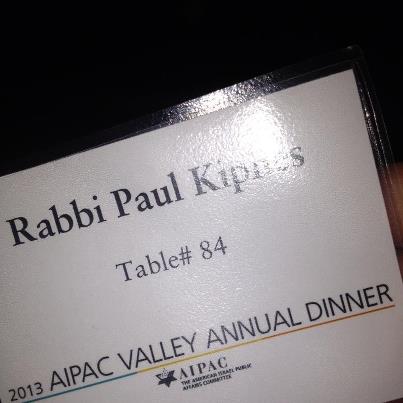
Michelle and I joined Patti Jo Wolfson and Dennis Bernstein, Rabbi Julia and David Weisz, President Helayne and Randy Sharon and at least 15 other Or Ami congregants** at the annual AIPAC Valley Dinner. AIPAC is the American Israel Public Affairs Committee, a lobbying organization dedicated to the American-Israel relationship. Around 1,000 Israel activists gathered at the dinner to discuss and strategize how to support and continually strengthen the American-Israel relationship.

Prior to the dinner, AIPAC’s media crew sat me down to film my AIPAC story (Patti Jo was also interviewed). They asked about my earliest memory of AIPAC. So I told them:

Meeting AIPAC’s Jonathan Kessler
Between high school and college, I spent a gap year in Israel on the Reform Movement Leadership Machon. While in Israel, we met with a young Jonathan Kessler, then a 20-something year old Israel activist, who taught us about the history of the American-Israel relationship. I remember being inspired by his passion and convinced by his teaching. To this day, I recall with clarity his offer to us: that if and when any of us needed help in our pro-Israel activism, we could call Jonathan, collect, and he would respond. I wrote down his phone number (being before cell phones, it was the main AIPAC number), and filed it away.

Calling Collect
Six months later, a freshman on an East Coast liberal arts college, I found myself standing before a banner calling people to gather for a rally against the “Illegal Israeli and American Occupation of Palestine.” Simultaneously I was incensed that such a mean-spirited, exceedingly biased event could happen on our campus and energized by the possibility that I could now make a difference as a pro-Israel activist. And then I realized I had no idea where to start… until I remembered Jonathan Kessler’s offer.

Back in the dorm, I stood in line for an hour awaiting my chance to use the hall pay phone. Unbelievably, AIPAC took a collect call from me, then a young college kid. When Jonathan and I talked, he walked me through some steps I should take: finding out who would be speaking, making contact with the local head of the Federation and Jewish Community Relations Council, and speaking to the small Hillel group. With Jonathan’s help, I researched through the background of the main speaker. He taught me how to partner with the directors of the Federation and JCRC to coordinate our responses during the session. Jonathan then provided me with the encouragement to ask questions – respectfully but with confidence – to illuminate the biases and prejudice of the speakers.

31 Years Later
I am now the parent of two college students (and one high school student) and rabbi to many dozens of other college kids. (Jonathan is Leadership Development Director of AIPAC.) I want to ensure that when anti-Israel activists (especially of the BDS movement) speak on their campuses, and they need to reach out for guidance on how to respond, there will always be someone on the other end of the phone to answer the call.

Yes, 31 years have passed since I made that collect call to Jonathan. I may not remember who spoke at that rally, or what happened during or after that terrible gathering. But I will never forget this: that in in the person of Jonathan Kessler (then a young activist; now unbelievably even more effective), AIPAC helped a young Jewish college student respond to anti-Israel lies and delegitimization.

That, among other reasons, is why I am a proud member of AIPAC.

Thank you AIPAC, and thank you Jonathan Kessler.

** Filling out the Or Ami delegation were Board Member Jon and Stephanie Wolfson and their (law school student) daughter Sarah Wolfson, Shirley Wolfson, Mark and Linda Wolfson, Jeff and Julie Glaser, David and Teresa Litt, Steve and Alison Martini, Faculty member Jodi Wilson, Andrea Jacobs and Richard Slavett, and Steve and Laura Gubner.

3 Rabbis in a Minivan

Rabbis Paul Kipnes (Congregation Or Ami, Calabasas), Rick Winer (Temple Beth Israel, Fresno) and Laura Novak Winer (Jewish Educational consultant) drove in minivan for the ride back from the Pacific Area Reform Rabbis (PARR) conference. Rick’s driving, Laura’s navigating and Paul’s typing. 
We all reflected on what we gained from 4 days with 160 rabbis plus spouses/partners. We enjoyed:
Studying with scholar Melila Hellner-Eshed of Israel’s Hartman Institute. We explored applications of Kabbalah’s Zohar text to Jewish healing for individuals, rabbis and congregations. It sounds really esoteric but rabbis get into that stuff. 

Meeting with Israel’s Consul General David Siegel who updated us on the latest behind the scenes news from Israel, including issues of religious pluralism, women’s equality, and the security situation with surrounding countries. 

Dialoguing with new president of the Union of Reform Judaism, Rabbi Rick Jacobs, whose presence underlined the importance to the URJ of connecting with West Coast Reform leadership. Rabbi Jacobs spoke eloquently about the far-reaching moves to transform our national organization into a nimble, flexible, responsive and effective movement. 

Organizing Reform Rabbis (and congregations) into Reform CA, a unified Jewish religious voice on issues of concern in California. We energized each other as we recognized that our values should have a voice in the public sphere. 

Kvelling about the continued growth and efficacy of our Movement’s Camp Newman which engages over 1,400 Jewish kids each summer. We reviewed the master plan for the transformation of the physical space to deepen our educational and religious program. 

Sharing collegiality where we could pray, support and laugh with others whose experiences can offer wisdom and guidance as we continually deepen our rabbinates. 

Benefitting from private one-on-one consultations with rabbinic coaches, CCAR Chief Executive Steve Fox, an our URJ District Rabbi, Point of Contact, and Specialists. 

Studying with Hebrew Union College Dean and Professors as well as student, which provided insights ini best practices and new ideas. 

Finally, hiking through Indian Canyon Indian Reservation provided gorgeous vistas, healthy exercize and meaning conversations with close friends. 
Jason Gwasdoff, Lindy Passer, Michelle and me, Laura Novak Winer and Rick Winer 
When rabbis go off to conferences, we welcome the opportunity for reflection and rejuvenation. and we thank our communities for supporting an encouraging our participation. 
See you next year, PARR colleagues. 

God’s Name is a Four-Letter Word

What is God’s Name?

According to Torah, God is a four-letter word. These four Hebrew letters – Yud-Hey-Vav-Hey – represent, according to Jewish tradition, the proper name of God. Just as my father is an accountant whose name is Ken, so too God is a God, whose name is … Yud-Hey-Vav-Hey or in Hebrew, יהוה .

We have lost the correction pronunciation of this name. Originally, because our ancestors worried about taking God’s name in vain, they decreed that this name would be recited only on Yom Kippur, when the Kohen Gadol, or High Priest, entered the inner sanctum of the Temple in Jerusalem. Passed down from Kohen Gadol to Kohen Gadol, generation after generation, the correct pronunciation was lost when the priesthood collapsed with the destruction of the Temple in 70 CE.

Adonai is a Euphemism
Today we pronounce Yud-Hey-Vav-Hey – יהוה – as “Adonai,” but this is a euphemism. “Adonai” means “Lord,” and to the ancient Israelites, God was the regal being who benevolently lorded over us, as the landed Lords of the British Empire lorded over their subjects. One religious group combined the vowels of Adonai with the letters YHVH to invent Yehovah or Jehovah; while scholars and other groups merely sounded out the letters, creating Yahweh. Each of these miss the essence.

Rabbi Lawrence Kushner, the Reform movement’s scholar-mystic, writes, “…in truth [these four letters] are unutterable. Not because of the holiness they evoke, but because they are all vowels and you cannot pronounce all the vowels at once without risking respiratory injury. The word is the sound of breathing. The holiness name in the world, the Name of the Creator, is the sound of your own breathing.”

Rabbi Kushner continues, “that these letters are unpronounceable is no accident.”

Is – Was – Will Be
Think about the letters. The last three – Hey-Vav-Hey – הוה – combine to form the word “hoveh,” which means present tense. Hebrew as a language lacks the word “is.” Whereas in English we say “He is wise,” in Hebrew, we say “Hu chacham,” two words without a third, because Hebrew as a language lacks the word “is.” So part of these four letters refers to “is” or the present.

Now in Hebrew the vowel “Vav” can be interchangeable with the vowel “yud.” Thus Hey-Vav-Hey may be read Hey-Yud-Hey –  היה – to form the word “haya.” “Haya” is the past tense, meaning “was.”

You know where this is going. In Hebrew, when you place the letter “yud” before a verb, the tense changes from past to future. “Haya” becomes “yihiye” – יהיה, “was” becomes “will be.”

So Who or What is God?
From an unutterable four-letter word – יהוה – comes a multilayered understanding of God. God is that which simultaneously IS, WAS and WILL BE.

“God’s Name,” to quote Kushner, “is the Name of Existence itself.” Or more clearly, God is Existence.

Do you believe in God? Does it matter? We are all part of the river of life that was, is, and will be forever more.

Perhaps the more appropriate question is:


Are you living life consciously, mindfully and in connection with everyone and everything else in existence?

How Reciting Shema Can Save a Kid’s Life

Shema. More than a prayer, it is a bold theological statement. More than a verse from Torah, it is an idea which goes to the heart of what it means to be a Jew. The Shema holds a power that is mystical.

A Story 
…about an incident at the San Diego airport. A police officer approached a woman and the four- or five-year-old girl standing beside her. Said the police officer, “I am sorry to bother you, but a four-and-a-half year old girl has disappeared. The description given by her parents very much fits this girl – blonde, blue eyes, curly hair, wearing a red dress and black shoes. I don’t want to alarm you, but I am going to have to ask you some questions to prove that this little girl is really yours, that she isn’t the girl who is missing.”

What a horrible situation! Every parent’s nightmare. This woman had to prove that her daughter was really her daughter. Privately, the police officer asked the woman’s name, address, hometown and husband’s name. Then he said to the little girl, “What’s your name?” “Mary,” she answered. “What’s your last name?” Silence. “Well, where do you live?” “At home.” “Do you know the name of your city?” “Nope.” “What’s your father’s name?” he asked. “Daddy.” “What does he do?” “He goes to work.”

Not getting anywhere with the little girl, the police officer asked the woman if she had any pictures of the little girl in her wallet, or pictures of her husband that the little girl might recognize. She hadn’t any. He asked to see the plane tickets, but they were flying on standby, and besides, they had different last names.

Shema: One Way to Prove Your Child is Actually Your Child 
So what would you do? How would you prove that your child is actually your child? How would you prove that the little girl or boy with you isn’t really someone else’s child whom you’ve kidnapped? Or worse, that your missing child is actually your child? Frightening, isn’t it?

Eventually, the mother offered the police officer a way to prove that the child was hers. She said, “Rachel, tell the police officer what we say each night before we go to bed.” And little four-and-a-half-year-old Rachel answered, “Shema Yisrael Adonai Elohenu Adonai Echad.” And the mother smiled widely as the police officer confirmed that this is just what the mother predicted that little Rachel would answer.

The Power of Shema to Save
Such is the power of Shema to save. Whether bonding a child to her parent, or a believer to his God, Shema is a powerful prayer. With my own eyes, I have seen the words of Shema calm a dying woman in her final days. I have witnessed Shema give strength to a man frightened about the future. Words, which evoke the calming presence of a hundred generations gone by, connect us in the present to that Force which unifies all existence.

This week and next, I am spending some time studying about and meditating on the Shema.

Question for You to Ponder
What do you think about when you recite or hear the Shema?

A Teen with Asperger’s Tells Her Story to Her Peers

On the TV show Parenthood, teenager Max has Asperger’s Syndrome. While running for student body president, Max tells his classmates about his Asperger’s. The episode is riveting television, but not quite as poignant as when one of our Congregation Or Ami teens stepped up before her peers and shared her own Asperger’s story.

It all began when one of our teens and her mother watched the Parenthood episode. It inspired her to contact their rabbis to suggest that our teen tell her fellow teens about how her Asperger’s affects her. Since at Congregation Or Ami we start at “yes” – especially with regards to full accessibility for individuals and families with special needs – we moved quickly to scheduling a date for her presentation to her peers.

Our teen worked with her parents to compose a paragraph about her strengths and challenges she wanted to share with the group. To make it most comfortable for our teen, one of our rabbis was present to support her when she was speaking.

Jewish Teenager with Asperger’s Shares Her Story with Her Temple Peers

Our teen said:

I have Asperger’s Syndrome. It is a part of me. I might think differently than you do. My brain is kind of like a MAC and everyone else is PC. I just do things a little differently. My brain functions a different way than yours does. It’s not wrong or bad to have Asperger’s Syndrome. It’s just another way of thinking and being. 1 out of 88 people is on the autism spectrum. This is a recent number. Chances are you, or your mom, dad, sibling, grandparents, whichever, may know someone who works with, is friends with, or goes to school with someone on the autism spectrum. Scientists are still not sure what causes Asperger’s Syndrome. They have been working since the 1930’s to discover what it is and what causes it. 

There are people who have been suspected to have some form of autism or Asperger’s Syndrome. 

  • Temple Grandin is an American doctor of animal science.
  • Bill Gates is the creator of Microsoft and is one of the richest men in the world.
  • Albert Einstein was a German/American theoretical physicist.
  • Abraham Lincoln was the 16th President of the United States. 

My Strengths:

  • Artist
  • Ambitious
  • Honest
  • Loyal
  • Loves Animals, and
  • Loves Reading

My Struggles

  • I can take things out of context.
  • I may say things that might seem rude, but I don’t mean it.
  • It’s hard for me to make eye contact and make friends.
  • If it seems like I walk away sometimes, I just need a little break.

What can you do?

  • Understand that I struggle with social interaction and try to understand what I am going through.
  • Accept everyone as unique and valuable.
  • Talk to kids who seem shy. Include them.
  • Stand up for kids that are being bullied.
  • Don’t be reluctant to give friendship advice, but be kind about it.

Our teen answered some questions and the session continued with the scheduled session plan. But like the fictional Max from tv’s Parenthood, our real-life teen inspired her peers and taught us all about strength, grace and courage.

On Judaism and Accessibility

Congregation Or Ami in Calabasas, CA has long been committed to accessibility for individuals with special needs and their families. We have a webpage emphasizing our accessibility to Jews with Disabilities. Our Brandon Kaplan Special Needs Fund helps us integrate people with special needs and their families into all aspects of our congregation. We are also the synagogue for Chaverim, a program of Jewish Family Service, for developmentally disabled adults, age 18 to 88. I blog regularly about the intersection of Judaism and Jews with Disabilities.

Our national Reform Jewish movement – especially the Union for Reform Judaism – has a long history of working for full inclusion and openness for people with disabilities and special needs.

URJ Camp Newman in Santa Rosa, CA has a dedicated Nefesh team comprised of psychologists, therapists and social workers who are at camp all summer. The Nefesh team helps the counselors and roshim (unit heads) integrate and support all children with unique situations (including emotional, physical, psycho-social and other “special needs”). Read about Ethan’s experience at Camp Newman.

New Year’s Re-SOUL-utions

New Years – for me, mostly Rosh Hashana – provides the opportunity to look back on the past year and to measure the distance between who I am and who I wanted to be, between where I am and where I wanted to be. And then to figure out what I need to do to get from here to there.

At the secular New Year, I rarely make resolutions. Most resolutions focus on losing weight, breaking addictions, quitting smoking, changing jobs, etc. (A US Government website even lists resources to help people succeed on the most popular New Year’s resolutions.) They seem to set people up for failure.

Re-SOUL-utions for the New Year
But if we think of them as re-SOUL-utions, as attempts to return one’s focus on one’s soul, the process seems more enticing. I definitely could use a push to return to my soul, as daily life seems to get in the way of my better intentions. If I learned anything from my time with the Institute of Jewish Spirituality – and I learned so much from these experiences – it would be that a spiritual practice needs to be planned and followed for it to be meaningful.

So hear are my New Year’s Re-SOUL-utions for 2013:

  • Yoga: To return to a 3x/week yoga practice, as a spiritual practice
  • Walking/Running: To move my butt 2x/week
  • Study: To weekly study Birkat Avraham with my chevruta partner
  • Meditation: To meditate 2x/week – and to accept 10 minutes of meditation as meaningful 
  • Blogging: To blog 4x/week as a way of reflecting upon life and living, and to emphasize and expound upon the values and ideals that are important to me. 
  • Eating: To return to thoughtful eating, eating when I’m hungry, stopping eating when I am satisfied.
  • Blessing: To bless the food I eat and find 3 things each day for which I can say “Thanks”
My Kavannah (intention)
As I begin this practice of re-SOUL-ment, I pledge to be compassionate with myself (if I don’t succeed one week, I’ll try the next). I promise to be hopeful (knowing that what I do is more important than what I do not do). And I intend to reflect upon the en-SOUL-ment that occurs along the way. 
Check In Times
I’ll check in on my progress at Purim, Pesach, Shavuot, Rosh Hashana, and Thanksgiving and Chanukah.  Feel free to encourage me.
What about YOU?
What re-SOUL-utions do you want to make to return you to your soul?