Category: blog archive

10 Ideas for a Spiritual Thanksgiving

(Adapted and expanded from works of Rabbi H. Rafael Goldstein)

Rabbi H. Rafael Goldstein writes: “We do not often think of Thanksgiving as a Jewish holiday – it is an American holiday which we, as Americans observe. Thanksgiving in America was started by Christian pilgrims, and infused by many Christian values. In the media, we are surrounded by images of people sitting down to their Thanksgiving dinner and “saying grace,” celebrating the Christianity of Thanksgiving. There are always special program episodes on TV of all of our favorite shows, in which, for one episode a year, the people in the show actually express some human kindness. Homeless people are visited and fed, others in need are helped, and the heroes of our shows demonstrate that they can be “good people.”

It seems that we have not developed our own specifically Jewish traditions for Thanksgiving. Yet, Thanksgiving is an interpretation of our holiday, Sukkot, the fall festival designated to thank God for the bountiful harvest. As American Jews, we should revel in celebration of an American holiday, and not have any feelings of discomfort about it. Thanking God, after all, is a value we all share.”

  1. Begin with a blessing. A collection of Blessings for Your Thanksgiving Table are found at www.orami.org on the Holidays page.
  2. Light Candles: Light candles at your table. There is no blessing for Thanksgiving candles, which means you get to make your own!!! Start out with the way we start all our blessings, Baruch Atah Adonai, Elohaynu Melech Ha’olam… (Blessed are You, Adonai our God, Guide of the Universe, who we thank for …) Then finish the sentence as you see fit. As you light your candles, invite others at your table to make their own blessings, using the same formula.
  3. Challah and Wine: Have challah (or delicious bread) and wine at your table, and say the blessings for them. Wine: Use the blessing formula above plus: Boray p’ri hagafen (who brings forth fruit of the vine). Challah: Use the blessing formula above plus: Hamotzi lechem min ha’aretz (who brings forth bread from the earth).
  4. Shehecheyanu: Thanksgiving is a great time to say shehechayanu (the blessing for thanking God for keeping us alive to enjoy this moment). Use the formula plus: shehechayanu, v’kiyimanu, v’higianu lazman hazeh (who has kept us alive, sustained us, and enabled us to reach this moment).
  5. Share Symbols of Thankfulness: Ask everyone invited to your dinner to bring something which symbolizes what they are thankful for. After the blessings, before dinner, have everyone talk about what they brought and its significance. Be sure everyone knows to bring something, and has a chance to talk, including children.
  6. Light a Yahrzeit Candle to Remember Deceased Relatives: Make some time for remembering the people who are not with you, either because of distance, family obligations (or preferences) or death. Families change. The people sitting at your table all have other family members with whom they are not sitting (in-laws, cousins, parents and grandparents, children who are with former spouses, etc.) Talk about who else is not physically there. A moment of silence for people who have died, and are missed can be a great way of allowing people to remember. Have people talk about who they miss and special things about them from previous Thanksgivings. You can also light Yahrzeit candles for people who have died as a part of remembering.
  7. Do some random mitzvot (acts of lovingkindness): Collect and deliver food, household and personal supplies to people who need them. There are plenty of food drives at this time of year. Contribute food. Make a donation in honor of the people coming to your dinner (or alternatively, in honor of your hosts) to your congregation, the Jewish Federation, Jewish Family Service, Mazon (Jewish hunger organization) or a local shelter. Invite a single person, or people whose families are distant, to be your special guests. If you are a guest this year for the first time, donate what you would have spent hosting a dinner for others in honor of those you would have invited, or in honor of your hosts.
  8. Teach children about the connections between Thanksgiving and the Bible. Remember, for the Jewish community, Thanksgiving offers a special opportunity to be grateful not only for the bounties and comforts of our lives but especially for the religious freedom we have found in the United States of America. The Bible was very important in the Pilgrims’ lives. When they wanted to give thanks to God for helping them survive, they recalled the harvest festival (Sukkot) they had read about in the Bible (Deuteronomy 16:13-17). They used the Sukkot celebration as their model. In 1702, author Cotton Mather referred to the Plymouth colony as “this little Israel.” He compared William Bradford, Plymouth’s second governor, to “Moses, who led his people out of the wilderness.” More at URJ’s Thanksgiving page.
  9. Read Jewish Perspectives on Thanksgiving Day. Kevin Proffitt writes: “The Pilgrims of Plymouth observed the first American Thanksgiving in 1621, when Governor William Bradford proclaimed a special day of thanks for the colony’s first harvest. To celebrate, the Pilgrims prepared a feast that they shared with their Native American neighbors. Some time later, in the eighteenth century, many of the thirteen colonies observed days of prayer and gratitude during the harvest season. But it was not until 1777 that they agreed to observe a common day of thanksgiving.” Read more
  10. Review Jewish Values about Hunger and Poverty. As we sit down with our family and friends at the Thanksgiving table and offer thanks for the bounty that is ours, we often forget about the thousands of people in America, Canada and around the world who do not share our prosperity. While we gorge ourselves on turkey, stuffing, cranberries, and pumpkin pie, others do not even have the bare necessities to sustain themselves and their families. Jewish tradition teaches us that we are required to feed the hungry. Instead of celebrating this holiday in our own insular family units, Thanksgiving is a perfect time to reach out to the community and serve those who are most in need. Print out these Jewish texts, read them at your table, and then discuss how you can make a difference in the world. More ideas at www.rac.org.

If there is among you a poor person, one of your kin, in any of your towns within your land which God gives you, you shall not harden your heart or shut your hand against them, but you shall open your hand to them, and lend them sufficient for their needs, whatever they may be. –Deuteronomy 15:7-8 

This is the fast I desire: to unlock fetters of wickedness, and untie the cords of the yoke, to let the oppressed go free; to break off every yoke. It is to share your bread with the hungry, and bring the homeless poor into your house; when you see the naked to cover him, and not to hide yourself from your own flesh. (Isaiah 58:7-8)
When you are asked in the world to come, “What was your work?” and you answer: “I fed the hungry,” you will be told: “This is the gate of the Eternal, enter into it, you who have fed the hungry.
(Midrash Psalms 118:17) 

When you give food to a hungry person, give your best and sweetest food. (Mishneh Torah, Hilchot Issurei Mizbayach 7:11) 

Hunger is isolating; it may not and cannot be experienced vicariously. He who never felt hunger can never know its real effects, both tangible and intangible. Hunger defies imagination; it even defies memory. Hunger is felt only in the present. (Elie Wiesel)

How will you make your Thanksgiving Spiritual? 

Thanksgivukkah? ChanTHANKSukah? Tur-Lat-Key Day?

We each have moments when we step back and take stock. Opportunities afforded to us because the year has turned one full cycle and we, clay to touched by holiness, are allowed a glimpse into the essence of our lives.

A significant birthday.
An anniversary.
A Yahrzeit.

2 years of sobriety.
25 years since ordination.
3 years since you came out of the closet to your family.

Each of these moments transcend time, allowing us – like Adam haKadmon “in the beginning” – to see clearly the past and our present. They invite us to imagine the future.

Holy Days are for Accounting
Our Jewish holy days, set in the Torah or by rabbinic decree, invite a similar accounting. These holy days cycle back annually, calling us to recall who we were and who we are becoming now.

  • Rosh Hashana, as the new year begins, invites us to count our blessings.
  • Yom Kippur calls us to balance the accounting of our ma’asim (good deeds) and averot (errors/sins).
  • Pesach, a new beginning, invites us to recount the freedom which we once had, then lost, then with God’s help, reclaimed anew.

Each of these holy days turn us inward to the essence of our lives, and then subtly force our gaze and focus outward to the needs and concerns of our people.

The Unique Convergence of Chanukah and Thanksgiving

Even this “once in a lifetime” holiday – Thanksgivukkah… ChanTHANKSukah… Tur-Lat-key Day – moves us through the same eternal cycle.

For many, the beauty of the Chanukah-Thanksgiving pairing is that it leads us away from the prevalent (narcissistic) “gimme-gimme” culture (gimme presents, gimme food) instead turns our focus outward. We find ourselves being especially thankful for the food, the family surrounding us and the blessings that uplift our lives.

Now if only we could harness those warm fuzzy feelings and transform them into a force for tikkun (repair).

#GivingTuesday
That’s why I’m particularly excited about the relatively new venture called #GivingTuesday.

You know about Black Friday and Cyber Monday – two days designated in American retail culture for conspicuous consumption and for getting deals. #GivingTuesday — the Tuesday after Thanksgiving, the Tuesday in the middle of Chanukah — is a day when we are invited to give to others to act to create a better brighter world.

We will light the lights of Chanukah. We will offer our thanks on Thanksgiving. Let’s also transform our warm feelings into real action by supporting organizations which truly transform the world.

Who I Think about for #GivingTuesday
On #GivingTuesday, I will be supporting two favorite “do good” organizations – my own Congregation Or Ami and the CCAR: Central Conference of American Rabbis. I will be donating to them to help Jews and rabbis bring light into the world.

CCAR’s #GivingTuesday and Congregation Or Ami’s #GivingTuesday brighten our world. Please be a force for good. Visit and support them.

Happy Tur-Lat-Key Day!

About Congregation Or Ami
I’m pleased that Congregation Or Ami is inviting you to share your blessings – and tzedakah – on #GivingTuesday. At Or Ami, people matter. Congregation Or Ami is home to a warm and welcoming, innovative, musical Jewish community. We deepen relationships with each other, while immersing in Torah, Israel and the Source of All Life. We travel together down Jewish paths which inspire our hearts and souls, and transform us to seek justice and nurture compassion in the world.

About the CCAR
I am pleased that the Central Conference of American Rabbis is inviting you to share your blessings – and tzedakah – on #GivingTuesday. The CCAR strengthens and enriches the entire Jewish community and plays a critical leadership role in the Reform Movement through its work by fostering excellence in Reform Rabbis, unifying the Reform Jewish community through the publication of liturgy, providing essential support to rabbis – professionally and personally, and offering important resources to congregations and community organizations. Services to the Reform Rabbinate, in-turn, enhance connectedness among Reform Jews by applying Jewish values to the world in which we live and help create a compelling and accessible Judaism for today and the future.

Meditation: Unplugging and Seeking the Silence

I just began meditating again, this time with Oprah and Deepak Chopra. They personally invited me to join them for a 21-day meditation experience and I just couldn’t refuse. So daily I have been meditating again, guided by Oprah and Deepak.

The meditation comes at an opportune time. The adventure in daily silence meshes smoothly with my experiences during five recent days of vacation.

Seeking the Silence
After investing an intense summer of synagogue administration focused on the spiritual and administrative growth of my temple, Congregation Or Ami (Calabasas, CA), I knew I needed some time away to retreat and refresh my soul. When it became clear that I was doing this on my own – my wife had a major work project and my friends could not take the time away – I realized that this was a gift just for me. So I checked into a hotel in Long Beach and with Yelp’s help, I set about to renew my soul.

Yelp guided me well – to a yoga studio, to great Oceanside walking locations, and to restaurants that boasted good food, wine and live jazz. With iPad filled with books and articles, I venture off daily in search of non-excitement.

Unplugging
I ignored email. I stopped returning phone calls. I wrote a little and thought a lot. Even when I was in public spaces, I kept to myself, allowing my introverted side to push aside the usual public extroverted persona. I talked to very few people and I actually enjoyed it.

The silence – external and internal – recalled the six silence retreats I attended with the Institute for Jewish Spirituality. Recalling the lessons of my teachers Rabbis Sheila Weinberg and Jonathan Slater,

whatever arose in my mind, I noted non-judgmentally, mentally marked it “pleasant” or “unpleasant,” and then pushed it aside. 

Whether overlooking the water, reading my book or breathing in yoga, I allowed nothing to replace that silence. I celebrated and embraced it.

Getting Out of My Head
I confess that every so often I would return in my mind to the synagogue work I left behind. It happened during yoga and meditation, during dinner, and while I was watching blues in a local club. Instead of getting angry or frustrated, I recalled the words of my new teacher Deepak Chopra:

Because we are alive, thoughts, feelings, and sensations in our bodies are a normal part of our human experience—even while meditating. When you have thoughts and sensations during your meditation, just be with them, then notice your breath, and allow your breathing to gently bring you back to center. See your thoughts without judgment—just allow them to drift across your mind much like clouds in the sky. Once you realize that you are involved with your thoughts and no longer repeating the mantra, simply return your awareness to the mantra and continue repeating it, just mentally. As you engage in the practice in this way, after a little bit of time, the mantra and thoughts will begin to cancel each other out.

How freeing it was to let it all go! What stress relieved when I was able to just be.

Feeling Transformed
Soon I will return to the conversations, pressures, joys and noise of regular life. For the moment, I feel transformed. In fact, I feel like our Biblical ancestor Jacob, whose nighttime experience transformed him. So the Torah teaches:

And a man wrestled with [Jacob] until the break of dawn. When he saw that he had not prevailed against him, he wrenched Jacob’s hip at its socket, so that the socket of his hip was strained as he wrestled with him. Then he said, “Let me go, for dawn is breaking.” But he answered, “I will not let you go, unless you bless me.” Said the other, “What is your name?” He replied, “Jacob.” Said he, “Your name shall no longer be Jacob, but Israel, for you have striven with beings divine and human, and have prevailed.” Jacob asked, “Pray tell me your name.” But he said, “You must not ask my name!” And he took leave of him there (Gen. 32:25-30).

My long distance text study teacher Rabbi Larry Bach of the Institute for Jewish Spirituality explains it this way:

Jacob is utterly transformed that night. He is changed physically, his hip strained from the wrestling. The name change is perhaps the deeper transformation. “You shall no longer be Ya’akov, the sneak, the schemer, the supplanter.” As explained in the text itself, the patriarch’s new name, Yisra’el, points to his successful striving with the ish who opposed him.

Yashar El: Straight Path to God
One Hasidic reading (Kedushat Levi on Genesis 32:27) sees the “wrestling” was more of a “settling,” as Jacob learned to let go of distraction and remain attached to the Source. Jacob is able to connect “directly to God” (yashar el, the same letters of yisra’el, but simply re-vocalized).

So I return soon from five days away, transformed (I hope). Able to rise above the noise to remain connected yashar El, directly to the holiness that is life, I look forward to guiding others back onto the straight path to holiness.

And now, shh… It is time to meditate…

Do you meditate? What has your experience with meditation been like?

I’m Starting to Hear Voices and It is Affecting My Sanity

I grew up believing that when people start hearing voices, it’s the sign that they are beginning to go crazy. How much the more so when the person is hearing “religious” voices. Such occurrences often I thought were followed up with medication, hospitalization, or – in a few special cases – a move to Jerusalem where the voice-hearer declares himself the messiah.

I started hearing voices. That should be making me feel nervous, but surprisingly it hasn’t. In fact, as I’m hearing voices, it’s making me feel increasingly sane.

Am I Going Crazy?
It began in a pseudo-religious setting, Yogaworks Tarzana, where I engage in the spiritual practice of yoga. After a long weekend of inspiring teen-led worship services, intense pastoral counseling, awesome adult learning and our heartwarming Mitzvah Day social action project, I arose early to start my week with an energetic 6:30 am class.

Yoga mat spread out – 2 blankets, 2 blocks and a strap by my side – cell phone silenced, I assumed the cross-legged Sukasana pose to begin. I set a practice-guiding intention (that’s English for kavannah) to guide my day’s yoga practice: that I be mindful, becoming aware of the thoughts that arise in my mind, yet simultaneously moving them aside non-judgmentally so I can focus on my yoga practice. Simple enough to declare; challenging to live.

The Voices
That’s when it began. As the yoga increased in purposefulness, I began to lose focus on the poses. At first, thoughts about work – the growing to do list, people I need to call, intriguing new ideas – invaded my mental space. Although I wanted to contemplate each one, I let them go, lest they turn me aside from being present in the yoga flow. “That was good,” I thought to myself.

Then our yogi intensified the practice, leading us into Utthita Parsvakonasana (Extended Side Angle Pose). Stretching along the top side of the body, from the back heel through the raised arm, my body began to complain. My thighs burned in concert with my breathing; my brain kept telling me I couldn’t hold this pose or others for more than a breath to two. I began berating myself for my failure, my inability to do what days ago was so simple and natural. An old story, perhaps, but quite effective in sabotaging my spiritual work.

Along Came New Voices, More Intense
That’s when the voices became quietly insistent. “Listen,” they said. “Listen to yourself, and see the judgments that pervade your mind. Let go. Let go of judgmentalism and just embrace what is. Accept what you can do for today without assigning blame or finding fault.”

“I’m hearing voices,” I thought. And I let it go.

I smiled. I slowed my breathing. I reengaged with the flow. I let go.

I recognize those voices, I realized. And I let that realization flit away. I let them go.

Naming the Voices
Only later, on reflection, could I put names to the voices. The cautionary voices, reminding me that I could choose to let go of judgment, were those of Rabbis Jonathan Slater and Sheila Weinberg, my teachers and spiritual directors from the Institute for Jewish Spirituality. I attended a two year rabbinic program with IJS – silent retreats, yoga, meditation, study of chassidic texts – and years of distance learning and Spiritual Direction since.

My teachers engrained within me the need to let go of the stories we spin about good and bad, and success, and more often, failure.

Accept what is without judgment. 
Notice it. 
Name it. 
Move on beyond it.

My teachers had gotten into my head. And yet again, when my practice – and my life – threatened to spin away from me, their voices – implanted within – helped stabilize me until in savasana – the lying on back restorative pose – I was subsumed by silence outside and silence within.

Yes, Today I Heard Voices, and They Kept Me Remarkably Sane.


May you too find voices within that calm you within and without. Thank you Institute for Jewish Spirituality and YogaWorks for the lessons and the mindfulness.

Changing the Conversation about God: A How To

I am getting tired of this conversation:

Jewish Person: But rabbi, I don’t believe in God.
Rabbi: That’s okay, but what kind of God don’t you believe in?

So many God conversations seem to include this refrain.

It’s time to change the conversation. I yearn to hear this conversation:

Rabbi: So what do you believe about God?
Jew: While I don’t believe in the God of “reward and punishment,” I am drawn to the God-concepts of Martin Buber’s I-Thou and Milton Steinberg’s Limited Theism.

Setting aside the Pew Research study’s conclusions about the religiosity and spirituality of American Jews (my take here), there is no doubt that we Jewish leaders can and should spend more time talking about God. Only when our congregants hear about the wide variety of perspectives, theologies and experiences of God will they open themselves up to more Jewish conversations about God. At Congregation Or Ami (Calabasas, CA), we are facing the challenge head on. This year, God-talk purposely permeates all aspects of congregational life. We hope to change the conversation by reframing the issue.

Talking Frankly about God, our Beliefs and Our Doubts at the High Holy Days
During the High Holy Days, our clergy spoke personally and passionately about their beliefs and struggles regarding God. On Rosh Hashana, I preached on 18 Different Ways to Believe in God (a.k.a. 18 Different Jewish God-Concepts). On Kol Nidre all three clergy shared their understanding of B’tzelem Elohim: Cantor Doug Colter preached a home-made multimedia sermon, new mother Rabbi Julia Weisz spoke about how while everyone talks about which parent her newborn son resembles while no one talks about how he is in God’s image, and I addressed the very essence of tzelem – that God is unseen yet ever present within us.

God-Talk Theme Permeates Our Learning Programs
Our Educational team selected B’tzelem Elohim (Creation in God’s Image) as the thread that binds together our tapestry of learning programs. In Kesher, our camp-like drop-off learning program, our teachers regularly lead students to explore how they are created in God’s image. Rap with the Rabbis time allows open discussions about different ways to think about and believe in the Holy One. In Mishpacha, our family alternative learning program, we focus this year on God, Belief and Disbelief, which has been so successful that we have adults without children in the program who are studying with us. Finally, our Adult Learning programs include multiple options for engaging God-talk.

Board Meetings Transformed into Spiritual Journeys
Our president Hedi Gross identified a return to the Jewish spiritual search as the central focus of the first term of her presidency. During her Rosh Hashana presidential message, she shared her own Jewish spiritual path and her belief in God. She then transformed our Board meetings so that almost half of our meeting time is now God-focused. The meeting opens as one board member shares and explains a short quote that inspires her, after which another recounts his Jewish spiritual journey in a 5-10 minutes prepared talk. Next, one of our rabbis leads the board in analyzing then praying a prayer, and following a discussion of congregants and family members who are in need of healing, the cantor leads a spiritual singing of the Mi Shebeirach healing prayer.

Board Member Gary Kaplan
Shares his Jewish Journey

We balance the time devoted to Jewish spirituality and God-talk with fiscal responsibility by instituting new procedures for the board meetings: all presentations must be written out beforehand and must be limited in time and scope. Those items that can instead be shared by email are shared that way. Board members no longer leave the temple frustrated by arguments and divisiveness. They leave inspired, and often tears now flow as heartache and hope are shared in equal measures. They then can guide their families and other congregants toward these same central values of God-talk and spirituality.

Ever Wonder What Your Mom and Dad Believe about God?
During their B’nai Mitzvah speeches, our students discuss what they believe and do not believe about God. After capturing those ideas, often with the rabbi’s help, the students return home to record three statements from each parents (or one or three or four parents, as the case may be) about what the parent(s) believe about God. A most amazing thing happens: mom, dad and B’nai Mitzvah student (or mom and mom, or just dad or…) share a discussion about who and what God is. Some students incorporate the statements with which they agree into their own D’var Torah God statement, writing “Like my mother, I believe…”. This process allows the rabbi with a chance to share his or her own thoughts about and relationship with God, thus providing additional in depth adult modeling of God talk.

God Shopping: Choosing from 18 Jewish God Ideas Dramatically Changes the Conversation
Most exciting are the sessions of the Mishpacha Family Alternative learning program. Revising a curriculum written originally by then HUC-JIR interns, now Rabbis Sara Mason-Barkin and Dan Medwin, current Mishpacha Coordinator rabbinic/education student Dusty Klass leads the families to pray, play, engage in age specific learning, and spend time doing family-focused God-talk.

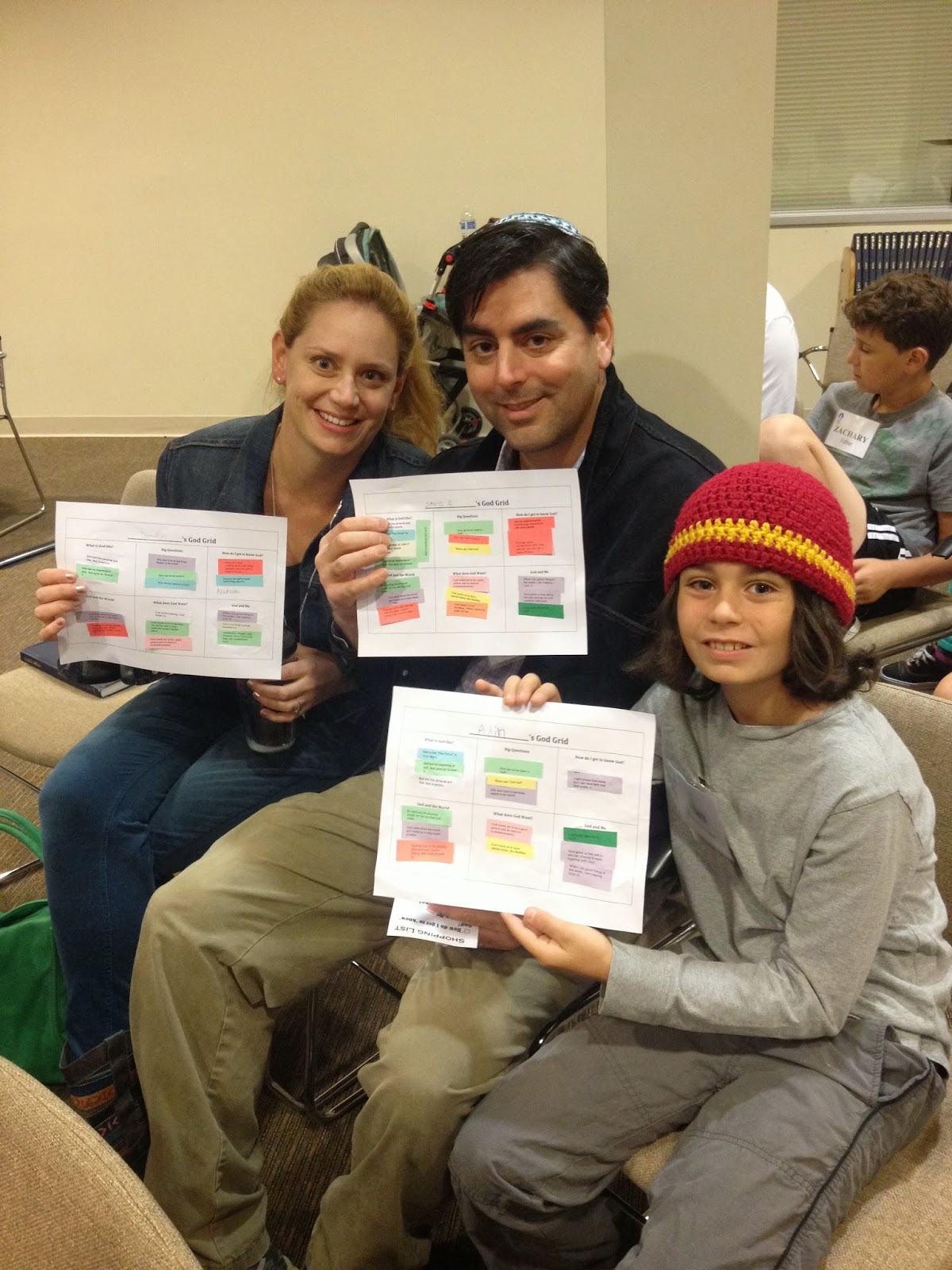
Recently, we used Rabbis Medwin and Mason-Barkin’s God Shopping lesson plan, an adaption of a NFTY program, which in our version introduces participants to the plethora of Jewish God-concepts and modern Jewish theologies. Each participant – young and not so young – received a blank “God Shopping Grid.” As families, they traveled through the “God Shopping Mall,” visiting six different “God Stores.” Each God Store presented one category for understanding God: What is God like?; God and the world; What does God want?; How do I get to “know” God?; God and me; and Big questions I have about God. Each God Store offered up to 18 different responses, based on the ideas of twelve different Jewish theologians.

Participants read the responses, chose as many responses as they agreed with or connected to, and pasted the chosen responses into the corresponding square in their God Shopping Grid. Those who could not find a response that reflected their ideas could write in their own statements.

Reassembling in the sanctuary, family members compared their God Shopping Grids. Since same color responses represented the thinking of one specific Jewish theologian, a quick look at the colors of the God Shopping Grids showed how parents and children shared similar or different God-concepts.

Faculty Hikers Prepare to Ascend
their own Paths to Finding God

During same age-learning, small groups of students continued to explore the God-concepts, utilizing the metaphor of different paths up the mountain to God. Older students met the theologians themselves through their writings and biographies. In each group, participants created/decorated/illustrated their own individual “path” up the mountain to God. Adults, meeting with a rabbi, discussed a color-coded “God Concept Grid” which delineated the thinking of each theologian across the six categories for understanding God. Adults were encouraged to identify intriguing God-concepts and to continue learning about them at home by first googling the theologian, and then exploring other secondary and primary sources.

Wow, I Might Actually Believe In God…
Toward the end of the God Shopping session, we asked the adults to raise their hands if they arrived thinking that they did not, or were not sure whether they, believed in God. The same group was asked if this activity enticed them with new God-concepts so that they might actually be able to believe in God. Almost half of the people kept their hands raised. Over the next weeks, adult participants, and their children, remarked at how they found the session to be both eye-opening and belief altering.

Danielle, her husband David
and one son Aidan

As participant-parent Danielle Waldsmith reported:

A few weeks ago when we began our Mishpacha study of “God: Belief and Disbelief,” I was definitely one of the participants who was unsure that I believed in God. But while shopping for God last Sunday, it became very clear to me that I do in fact believe in God – it’s just that I haven’t been sure what that means to me. As we visited the stores around the God Shopping Mall, a picture of MY God – my own belief in God – began to emerge. 

I am inspired that I now know that I am on my path to realizing what God means to me. And it is a wonderful experience for our family to be able to find our paths together. Certainly God means something different to each of us, but exploring it together is strengthening our ties to each other. We are looking forward to learning more about the ideas of Isaac Luria and Martin Buber, and to discovering more about God through nature, our connections and Tikkun Olam (social justice).

6 Lessons Learned about God-Talk
We have so much more to accomplish if we want to fully alter the God-conversations. Yet through these immediate steps we learned a number of lessons:

  1. Adults, teens and children do want to talk about God, especially when a variety of Jewish options are presented.
  2. Vast numbers of Jews do not believe in the “God rewards the good and punishes the bad” Torah-literal theology.
  3. So many Jews, even those very involved in synagogues and Jewish life, do not realize that there are a plethora of alternative modern Jewish theologies.
  4. When introduced creatively to multiple God-concepts, Jews of all ages are intrigued by the possibilities for belief.
  5. More work needs to be done to publicize newer God theologies, including those of female Jewish thinkers.
  6. Jews of every age can and should engage in God talk, especially in the synagogue.

The Antidote to Pew Study Anxiety

Soon after I finished reading the Pew Research’s Religion and Public Life Project study – a Portrait of Jewish Americans – the first thing I did was to ensure that I was registered for the Union for Reform Judaism’s Biennial Convention in San Diego on Wednesday to Sunday, December 11-15, 2013. Getting together with 5,000+ committed American Jews ranks high on my short list of responses to the more worrisome portions of this landmark study of American Jewish identity and values.

To Agonize or Not to Agonize: That is the Jewish Question
The Pew study lays out its analysis of the successes and challenges facing the Jewish community. Depending upon how one reads the study, there is much to celebrate and much to fret about. The internet is replete with analyses, praises and critiques of the study and its conclusions. Of course, we can soon expect the conversation to move from where we are to what we can do to strengthen the identity and religious commitment of Jews and the Jewish community.

Experience suggests that significant responses can be discovered when we take advantage of unique opportunities to gather together with others who share these concerns. For me, this happens whenever I attend a Union for Reform Judaism Biennial convention. Each Biennial offers the Jewish spiritual high and the programmatic low down to guide front line Jewish synagogues regarding the way forward. That is why I am attending the Biennial and taking with me many of our Congregation Or Ami (Calabasas, CA) leadership. And that’s why you should too.

Our Temple Transformed by Biennial Attendance
Over the years, the congregations I have served and my own Jewish life have been transformed by the Biennial. Most recently, the 2011 Biennial in Washington, DC, which challenged us to rethink our Youth Engagement activities. Following that gathering, Or Ami’s clergy and lay leadership quickly evaluated our offerings and created a new process and program. We have since enjoyed a 20% increase in post-B’nai Mitzvah youth participation and a stellar reputation for our Tracks for Temple Teens (“Triple T”) program.

Previous Biennial conventions inspired us to deepen our congregation’s accessibility for Jews with disabilities, to articulate officially our outreach to the LGBTQ Jews and Jewish families, and to pursue an energetic foray into eNewsletters and social media. Similarly, we have answered the call to innovate our worship services, expand our Torah study, and creatively embrace and educate interfaith couples.

Transdenominational Participation Promotes a Wide Variety of Perspectives
I am even more excited about this year’s Biennial in San Diego because for the first time ever, the Biennial is open to those outside the Reform Movement. Registration is open to anyone – not just to members of Reform synagogues. The cross denominational and cross organizational interactions promise to point all of us toward more comprehensive analyses of and workable responses to the challenges the Pew study illuminated.

Jews of all stripes – lay leaders and professionals, youth, congregants, and clergy – gather together to be energized, inspired and uplifted. Intellectually challenged by the high level scholars and Jewish thinkers, we participants face the challenges that the study only talks about. The ability to network with leaders and thinkers from all over the Jewish world makes the Biennial the place to retreat, respond and rejuvenate.

Bonding at Biennial
Personally, I cherish the opportunity to spend long hours in sessions, in services and over scrumptious meals with leaders of my congregation. Many a Biennial has provided just the opportunity to deepen the bonds that ensure a smooth partnership back home at our synagogue. We create a common language and shared insight on national issues and local concerns. By seeking out leaders from other parts of the country who have faced and successfully addressed the issues we have identified allowed us to return home with a “can do” attitude and a toolbox of options.

Finally, there is Shabbat. It is rare that a clergy person gets to sit and pray without the responsibility to act as Shaliach tzibur (communal worship leader). The poignancy and power of worshipping alongside 5,000 other Jews is unmatched. The kahal (community) is transformed by an emotional-spiritual high that our ancestors called hitlahavut (the passion of prayer). The study options – from the Shalom Hartman Institute, Zingerman’s Delicatessen, the Mussar Institute, and others – bring Torah to life and refill our souls with the succor from our Jewish tradition.

So Stop Worrying
We have been here before, worried about the present, anxious about the Jewish future. With the instantaneous conversations afforded by the internet and social media, those worries are compounded and seemingly all pervasive. Yet, I am breathing easy. Not because I know the way forward. Not because I understand fully the problems we face. Rather, because as the Jewish world continues to get worked up about the Pew study on American Jews – trying to wring meaning from it and prophesy the path(s) ahead, I know that I will be at the best place I can be to address these issues: spending five days with 5,000 thinking Jewish leaders at the URJ Biennial Convention in San Diego.

Maybe you will join me as well?

Spiritual but Not Religious: How Religion Lets Us Down

The

Pew Research Center’s Portrait of Jewish Americans, its survey and analysis of American Jewish attitudes and beliefs, has emerged as THE topic of conversation in the Jewish world. Some celebrate the survey; some wring their hands over what it says about us Jewish Americans.

The Union for Reform Judaism released a preliminary analysis for the Reform Movement.

Jewish Religiosity or Lack Thereof

Most fascinating are questions about the religiosity or lack thereof of our Jewish brothers and sister. According to the study, only a slim majority of U.S. Jews say religion is very important (26%) or somewhat important (29%) in their lives. We might surmise that almost half of the Jews do not consider themselves religious.

In a related category, we see that Jews are not significant worship service attenders. Roughly one-third of Jews (35%) say they attend religious services a few times a year, such as for the High Holidays (including Rosh Hashana and Yom Kippur). And four-in-ten say they seldom (19%) or never (22%) attend Jewish religious services.

Similarly, those Jewish practices defined by the study – beyond the popular Passover Seder and, for some, fasting on Yom Kippur – do not attract significant adherents. Only a quarter of Jews (23%) say they always or usually light Sabbath candles, and a similar number say they keep kosher in their home (22%).

Yes, it seems that a vast majority of U.S. Jews consider themselves “spiritual, but not religious.” Just what does this mean?

What’s the Difference Between Being Spiritual and Being Religious?

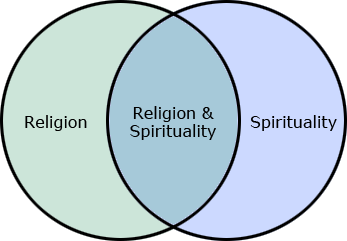
I think spirituality is the sense that we are all part of something greater. Spirituality can lead to behaviors and thought-processes, which connect us with a larger reality. Spirituality can but does not necessarily include a connection to a higher power or divine.

Now religion is a collection of beliefs, rituals, and prayers intended to help people retain a feeling of connection to an intensive spiritual encounter. Religion aims to connect us with our spirituality. For Jews, our Torah teaches that generations ago, our people – the children of Israel, the Jewish people – had a spiritual encounter with the Holy One that embedded within us a clear sense of who we were and how we should live forevermore.

Jewish rituals are intended to lead us back to the central experience of the Exodus from Egypt and our later spiritual encounter at Mt. Sinai. Jewish religious prayers return us to these spiritual events, as well as our arrival into the Promised Land, and our covenant with God.

Religion Sometimes Spoils Spirituality


So why do so many people say they are spiritual but not religious? Religion can be its own worst enemy. Sometimes religion just gets in the way of the spiritual quest. When the religious rituals become overly dry and ritualistic, they tend to suck life out of a potentially spiritual moment. When religious leaders become overly concerned about saying just the right prayer or about standing in exactly the right position when they pray, our traditions can strangle the spirituality right out of us.

I don’t believe that God cares how big our sukkah is or how long we sound the tekiah gedolah on the shofar. Nor does God does ask us to separate out our women, to eschew the non-Jew, or to extend our power over others for so-called holy purposes. Of course, when religious leaders – rabbis, teachers, communal leaders – speak such nonsense in God’s name, they further alienate Jews from the religious part of Judaism that could be strengthening their spirituality.

What do we do?

Rituals find meaning when they point us back to the holy, the spiritual. Rituals are significant when they inspire our spiritual core.

It becomes the responsibility of religion – and religious leaders – then, to return to Judaism’s roots, to rethink/reform/renew Judaism’s ritual components, and to embrace the holy in the midst of the rest.

How do we do that? 


Let me know what you think…

Tanzanian Doctor, Trained in Israel by Save a Child’s Life, Returns to Build a Heart Clinic

Dr. Godfrey Godwin, a Tanzanian doctor, spoke at Congregation Or Ami in Calabasas this past Friday. Dr. Godwin has been training in Israel for the past 5 years at Save a Child’s Heart (SACH) in Holon, Israel. 
The only pediatric cardiac surgeon in Tanzania, he is now returning to Tanzania to establish his own heart clinic. This will be quite a challenge for third world medicine, and he will certainly need the promised support of the government of Tanzania.  
 
Currently, Save a Child’s Life has saved 3300 children from 46 countries since the medical organization was created in 1995.  All of the children who have been treated (primarily through open heart surgery) are from third world countries.  
Last year 60 % of the children treated by SACH in Israel were Palestinian.  Every Tuesday there is a clinic for Palestinian kids.   SACH also operates a home for the children where they typically stay for three months before and after their surgery.  SACH is also training doctors and medical staff from many countries and organizes medical missions.  The treatment is free to all of these families thanks to private donations and grants from a variety of international sources including USAID and the European Union.  Because all of the Israeli medical personnel volunteer their time, the estimated cost of treatment and care is only $10,000.  This probably one tenth or even less of what this care would cost in the United States.
 
There are lots of individual stories to tell, including the story of Lilu who is a Chinese orphan who is leaving SACH on Monday after two successful surgeries.  Lilu is returning to China and then has been adopted by a Christian family in San Diego.  This whole project was funded and sponsored by an evangelical family who live just “up the block” in Moorpark.
 
SACH is probably right now Israel’s largest international humanitarian project.  Recently two children came from war ravaged Syria and were successfully treated.  CNN is planning to follow him when he returns to Tanzania next month to participate in a SACH medical mission. 
 
For more information about Save a Child’s Life, speak to Or Ami congregant Jack Mayer

How a Whole Congregation Wrote its Rabbi’s Yom Kippur Sermon

The Genesis of a Social Sermon

Utilizing a process called the Social Sermon, I developed my Yom Kippur morning sermon this year in partnership with Facebook Friends, TED talkers and a group of insightful congregants. To be blunt, this year, the whole Congregation Or Ami wrote its rabbi’s Yom Kippur sermon.

Where Great Sermon Ideas Come From
Rabbis explore sermon ideas from within the Machzor (prayerbook) and Torah, through conference calls organized by Jewish non-profit organizations, and at sermon seminars run by local Boards of Rabbis. Ideas are generated from Jewish text study, current events, issues in the public sphere, bestselling books, and powerful movies. Some clergy ask friends, colleagues, congregants for ideas. Deciding upon topics and themes for High Holy Day (HHD) sermons can be a multi-month process. The social sermon encourages rabbis to engage the congregants (and other contacts in the social media sphere) in the process of exploring the topic and teasing out important themes.

Fleshing out a Topic
Over the summer, as our community struggled to deal with illnesses and deaths of beloved congregants, I knew it was time again to explore Unetaneh Tokef, the haunting HHD prayer most remembered for its opening lines: On Rosh Hashana it is written and on Yom Kippur it is Sealed… Who shall live and who shall die. I read this text as a cosmic wake up call: God reminds us that “stuff” happens. Unetaneh Tokef forces us to face this reality and to decide: how are YOU going to deal with it?


The prayer offers three responses to the severity of life’s decree of misfortune, pain and death. We may reach around (teshuva or repentance – by fixing our relationships with those around us), reach inward (t’filah or prayer – by finding our center and the truth within), and reach up (tzedakah or charitable giving – by lifting up others we lift ourselves).

But how did this play out in real life? What lessons do people learn from enduring the hardships or challenges that life throws out way?

Facebook Friends Chime In
For assistance, I turned to Facebook (and Twitter) where my personal and congregational pages yielded some poignant answers to the question, What did you learn from going through hardship or challenge? Responses poured in from all around the congregation and around the country. The question struck a few heart strings as people posted publicly and some privately about the tsuris (problems) in their lives. Face-to-face conversations with other community members elicited many significant lessons learned. From these responses, as well as those from people I spoke with over the course of a few months, three categories of hardship rose up as being particularly challenging: financial ruin, turmoil from dealing with children with special needs, and horrible medical diagnoses.

TED Talks Provide Inspiration
Around that time, I was watching some TED Talks and became inspired by the stories I heard. About people in challenging situations, who found meaning and purpose nonetheless. The most moving sermons include powerful personal stories to illustrate the central message. It occurred to me that rather than my telling those inspiring stories, I would ask a few congregants to tell their own stories. After all, High Holy Day services offer just the forum for Jewish TED Talks. Thus was a sermon born.

I invited three congregants reflect on what they learned personal through their personal challenge. Their initial drafts were poignant. Each participant had learned powerful lessons on how to overcome the “stuff” of life on which Unetaneh Tokef focuses. Guiding the speakers to understand how their experiences embodied teachings similar to those in Unetaneh Tokef, I worked with them to weave references into their sermonette.

Simultaneously, I crafted a short introduction – utilizing a sledgehammer, if you believe it – to sharply make the point that Unetaneh Tokef comes as a Divine wake-up call. Like a sledgehammer, Unetaneh Tokef comes to break down the walls of naivety and denial that keep us from accepting a simple truth: that between this year and next, so many will live but many will die. Some will experience success; others failure. So many will encounter the unpredictability and pain of life. We are left to discover how do we keep ourselves from becoming angry, embittered, and crotchety, from giving up?

Congregants Tell their Own Stories
At different points in the service, these congregants and our President shared their stories:

Their presentations were poignant. Worshippers sat at the edge of their seats, listening in silence. Certain moments were unforgettable: When Eric and Jill Epstein spoke just after their 14 year old son Ethan led the congregation in prayer. When Mike Moxness was moved to tears as he recalled the overwhelming mix of sadness and gratitude. When Congregation Or Ami President Hedi Gross, in the traditional end-of-service Presidential sermonette, recounted her Jewish spiritual journey, including their struggle with fertility issues, unexpectedly reemphasizing the theme of the sermon and service.

Suffice it to say, the responses to the Jewish-TED-talk/HHD-social-sermon touched and moved so many worshippers.

What Lessons were Learned?

  1. Social Sermons Work: A number of worshippers later described the Facebook discussion on Facebook as a meaningful way to get them to prepare for the Holy Days. Others reflected on the Facebook discussion as an inviting way of previewing am upcoming sermon theme.
  2. Jewish TED Talks Inspire: In comments about the High Holy Days, this multi-speaker sermon topped the list of worshipper kvells (positive comments). Unanimously, post-service comments called the congregant presentations inspiring, powerful, very real, and intensely thought-provoking.
  3. Rabbinic Tzimtzum Fosters Deep Reflection: As clergy “pull back” from their up front role as sermonizer to work in partnership with congregants to craft a Jewish teaching, the message becomes that much more influential. In an increasingly DIY (Do It Yourself) Jewish world, involving other Jews in the teaching/preaching/liturgy leading roles cements their relationships to the community, the synagogue and the rabbi.
  4. Weaving in New Technologies and Methods Animate CommunitiesDarim Online and The Convenant Foundation introduced me to the Social Sermon. TED Talks inspired me to invite congregants to speak. Just Congregations of the Union for Reform Congregations taught me about listening campaigns. eJewish Philanthropy constantly pushes me to explore new perspectives and methods. Visual T’filah of the Central Conference of American Rabbis propelled me to rethink the entire worship experience. Finally, Rabbi Eugene Borowitz’s 1973 essay, Tzimtzum: A Mystic Model for Contem­porary Leadership, has long goaded my rabbinic style to pull back to invite others in.

What’s next? Already, congregants are wondering which congregant speakers will elucidate which themes next year.  And so am I!

But I do not expect to wait until the High Holy Days to invite my congregation to write my next sermon!

Hedi Gross’ Presidential Speech on Yom Kippur: A Spiritual Journey

Hedi Gross 
Congregation Or Ami Presidential Speech on Yom Kippur 2013/5774
A Spiritual Journey

Hedi Gross and family

I believe in G-d; I think I always did. I have vivid memories of being a little girl and talking to G-d, feeling that he was always with me, around me, a part of my life…

I remember times when I doubted G-d, even questioned his decisions, but I clearly believed he existed.

I was 14 years old, my Grandfather was dying of cancer, and I was angry at G-d. I refused to go to services during the High Holy Days, and I remember my parents pleading with me, urging me! I was taking a stand! I was angry at G-d, but ultimately I believed he existed.

Matt and I struggled to conceive on our own; we needed in-vitro fertilization to have our 3 children but I remember (even then) questioning G-d’s decisions. Why did we have to struggle?

But you deliver that baby…

That little miracle that they put in your arms, and for me there wasn’t a doubt in my mind that a G-d MUST exist!

Installation of Hedi Gross
as President of Congregation Or Ami

Today, yes, I am a synagogue President, and from the outside it appears that my commitment and faith in Judaism is (and always has been) strong; but believe me I have shown up for many High Holy Days where my silent prayers sounded something like this, “Hi, it’s me Hedi…” First the introduction and then the begging would begin. “Please G-d watch over my family. Keep us healthy. PLEASE G-d keep my children safe”

We get older, life gets a little more complicated, our parents begin to get a little older, people get sick, and I began again a time of self-exploration…

I believed in G-d, but did I have a relationship with G-d? Was it a two way street?

There I was standing at the Kotel (the Wailing Wall in Israel) for the 1st time, and if I were completely honest, I could admit that I felt a little humiliated. At that time, my father had recently recovered from cancer. I was so filled with gratitude as I arrived at the wall but when I got there all I could do was cry from embarrassment. Had I ever really said, “Thank you?” Had I truly been “of service” to give back for all the good fortune I feel so blessed with? So, I began to take stock of what my relationship looked like until that moment:

I always saw myself as a Jew, a good Jew. A person that did community service, participated in social action, was “active” in my shul, had always belonged to a synagogue, our children were enrolled in religious school, we attended sporadic Shabbat services on Friday nights… And yet, as I took pause and looked back at my own reflection I saw that yes- I have always had an on-going dialogue with G-d, but a “relationship”? A relationship as I now know doesn’t exist by constantly asking for things, and then making promises in return. “Please G-d, if YOU… then I will…”

I am 45 years old. I am old enough to know the difference that a Holy Day shouldn’t be a time where I arrive at services, and need to reintroduce myself to G-d, and begin my list of how G-d could help ME – let alone, asking (begging), to be inscribe in the “Book of Life” for another year!??

I remember when our daughter Molly was old enough to begin asking questions about religion, and faith- she must have been 4 when she asked me, “Mommy, What is G-d?” The advice I was given through my synagogue (at the time) was to not explain the “WHAT” but the “WHEN”….

WHEN is G-d? So, Matt and I began pointing out the miracles to our children: the sunrise, the moon, the breeze in our hair, the rays of sunlight shining out from behind a cloud, the hug and safety in an embrace from a grandparent, the color of the leaves changing, and in all of those moments and millions more. We simply say, “THAT’S G-D”. We point out the when and not the what, and our children now find G-d in moments of their own. They’ll say, “Look at the beautiful ocean, and the horizon… THAT’S G-d”.

I have always been a person that says the prayer of Shema each and every day. I used to say it while in the shower, alone with my thoughts, and in the utter quiet I would say it inside my own head. But, about a year ago, I made a change. I now wake my children every day to the prayer of Shema. I kiss them good morning, and whisper in their ear, “Shema Yisrael Adonai Eloheinu, Adonai echad. Echad Eloheinu, gadol Adoneiynu kadosh shemo.” I say it out loud because NOW I am having a constant dialogue with G-d.  I am saying thank you, I am acknowledging that my G-d is in this moment; my children waking up healthy each and every day is a reason to say thank you OUT LOUD. And I now share my dialogue, my on-going relationship, (and my gratitude) in front of my children. I want them to know that G-d is a part of me, our family, and YES, G-d in that moment with us.

I enter these Holy Days feeling so differently than I used to and I share this with you in hopes of inspiring you, too, to begin a new, deeper relationship with G-d; one that is two sided. Filled with as much giving as it is in the asking. In the past I would come to services on Rosh Hashana, and Yom Kippur hoping to leave inspired. I wanted the services to elevate me, force me to into self-reflection, or at the very least open a world of deeper connection to G-d. The onus was all on the Rabbi’ sermon, the Cantor’s singing… NOW it’s on ME.

I remember thinking about the role of the “Rabbi”; always giving, counseling, listening, inspiring- leading services (WORKING). He couldn’t possibly wait for a day like Rosh Hashana or Yom Kippur to pray. On the other hand, he must arrive at these days of worship so “full,” so secure in his relationship with G-d. I wanted that feeling. For me, working during a service – being a greeter, or an usher, working at the membership table – it feels good now. I am not missing out on my opportunity to pray, or strengthen my relationship with G-d because NOW I do that each and every day.

Being “of service” is a reminder that I am in a relationship with G-d. And like all other relationships in my life, I have to give without asking (or expecting) things in return.

It is my hope in the coming year to encourage each and every one of you to attend one more thing than you did last year – find something that interests you (or your family) and to be a part of what brings about change for our temple – or maybe even the world. Create your own moments of the WHEN and not the WHAT, so that G-d-willing next year we will all take our seats together for worship on the highest of Holy Days as a stronger community. Hopefully filled with more gratitude, more giving, and deeper connections. I wear a circle necklace to remind my myself (and my children) that the world is round. Relationships are what WE make of them. Life is circular – the more you give, the more you get.

Thank you for allowing me to serve as President. Wishing all of you an easy and meaningful fast. Happy New Year.

View Hedi Gross’ Speech at 02:34:32

Hedi Gross’ speech on Yom Kippur capped off a Jewish-TED-talk/HHD-social-sermon during which three other Congregation Or Ami members shared sermonettes throughout the service on Lessons They Learned Living Through Hardship. These sermonettes were each moving individually and very inspiring as a whole. Read about How a Whole Congregation Wrote its Rabbi’s Yom Kippur Sermon.

Lessons Learned from Living Through Hardship #3, by Mike Moxness with Debbie Echt-Moxness

On Yom Kippur, three Congregation Or Ami members shared sermonettes throughout the service on Lessons They Learned Living Through Hardship. These Jewish TED Talk/Yom Kippur Social Sermons were each moving individually and very inspiring as a whole. Read about How a Whole Congregation Wrote its Rabbi’s Yom Kippur Sermon.

***

Lessons Learned from Living Through Life’s Challenges  
by Mike Moxness with Debbie Echt-Moxness

Just over a year ago, I was diagnosed with metastatic stage 4 colon cancer. I suffered through a period of being very ill and it didn’t seem likely that I would be standing here today. Thanks to some effective medicines, I was able to get back on my feet and start living again. I’m not out of danger, but I’m experiencing the joy of life again. However, it wasn’t just the drugs that put me on this path, to make me whole, I frequently meditated on the love and support of family and friends.

Aaron, Mike, Molly and Debi
The Moxness Family

Being raised as a stoic Norwegian (similar to the characters from Lake Wobegon), it was difficult for me to ask for help. Many of you brought us dinners, transported our kids and provided emotional support during those dark days. I am so appreciative of everyone who came to our aid, without being asked.

Given the chance to live again is an awesome responsibility. I took the opportunity to discover what makes me happy and let go of those things that don’t. We all have a limited time on this earth and nobody knows how many moments are really left. That’s the lesson of the Unetaneh Tokef prayer – each year, some will live and some will die. So, every day, I ask myself what will bring me joy at this moment. Experiencing the beauty of the world and being with friends are usually are my first choices. I also tried to stop worrying about the future, what others thought about me and striving to get ahead. Without those worries, an amazing thing happened: I started to enjoy my work and to be more productive while spending less time at the office and more time at home.

This perspective is liberating and I wish I could teach it to everyone. It is not easy. The dark thoughts are always looming on the edge and sometimes they seep into my consciousness. Yet being open and honest about my disease has been the most effective at keeping me out of depression.

I have also learned that being engaged in a community like Congregation Or Ami has been particularly helpful to my recovery. Two of the most profound experiences of the past year have occurred at Or Ami. Last April, my 16 year old son Aaron articulated his interpretation of the Mi Shebeirach healing prayer at a teen-led Friday night service. I felt vulnerable but was comforted by the warmth of my community. This past August 3rd, my daughter Molly became a Bat Mitzvah. All of my loved ones were there to celebrate Molly and the life that our family has been able to live over the past year. I exist with a scary reality, but I have learned to let it guide me through a fulfilling life.

Yom Kippur reminds us that everyone will eventually die, we just don’t know when. My advice to you is this: Don’t wait for the life-changing event, try to change your life now.

G’mar Chatimah Tova. May you be sealed for a blessing in the Book of Life.

Listen to Mike Moxness’ Sermonette (at 00:49:49). 

Lessons Learned from Living Through Challenge #2, by Eric and Jill Epstein

On Yom Kippur, three Congregation Or Ami members shared sermonettes throughout the service on Lessons They Learned Living Through Hardship. These Jewish TED Talk/Yom Kippur Social Sermons were each moving individually and very inspiring as a whole. Read about How a Whole Congregation Wrote its Rabbi’s Yom Kippur Sermon.

***

Lessons Learned from Living Through Challenge  
by Eric and Jill Epstein

It is often said that God will not give you more than you can handle. When our third child Ethan was born, he must have wondered if God was right and whether he was up for the challenge of truly enlightening us.

Challenge is a relative and dynamic term. One person’s challenge is another’s day-to-day existence. Our son Ethan is within the Autism Spectrum. Just uttering those words – Autism Spectrum – used to be a challenge for us. Now, we laugh at the label, as Ethan is so social and happy defying customary views of such a diagnosis. The truth is that the only spectrum we deal with these days is the spectrum of goals we have been blessed to look forward to accomplishing.

Jill, Ethan and Eric Epstein
When Ethan Became a Bar Mitzvah

We used to wonder if Ethan would ever speak, and now we have to hold him back from pushing Rabbi Paul aside at the bimah. Congregation Or Ami has become such an important place for Ethan for many reasons. When our first son, Andrew, became Bar Mitzvah, we were so worried that Ethan might distract from the services that he was sequestered to the sound-proof kids’ room. Ethan would have none of that, as he grabbed a prayer book and took part in the services on the bimah with a quiet calm we had not seen previously.

Seven years later, Ethan was leading services at his own Bar Mitzvah service with that quiet calm we had become accustomed to. Although Rabbi Paul, Cantor Doug and Diane Townsend were prepared to modify the service as needed, Ethan would have none of that and participated as fully as another other Or Ami student. Gazing out to a crowd of friends and family, Ethan unrehearsed exclaimed, “This is my moment!”

Of course, tackling Ethan’s special needs is a team sport. That “moment” didn’t happen without a team of teachers, educational therapists, speech therapists, and behavioral therapists to challenge his short-comings head-on and who stood proudly with Ethan for a very special Aliyah. These challenges merely amplify his accomplishments.

Former Or Ami President Michael Kaplan swears that Ethan will be President of Congregation Or Ami someday. Such a statement seems as challenging as his Bar Mitzvah service was seven years ago. Why not set this as his next goal? We have learned that you hit what you aim for, and if you aim at nothing, you will hit it every time. Isn’t that a lesson of the Unetaneh Tokef prayer? That life will necessarily throw challenges our way. Our job is to reach out and find ways of finding goodness and blessing nonetheless.

For Ethan, he seems to have a special companion on this unlikely and challenging course of life that draws him to services on many a Friday evening. When Rabbi Paul once asked him in front of the Congregation what draws him to Temple. In a sentence that was simultaneously simple and yet complicated, Ethan answered, “I feel close to God.”

And we have no doubt that God is particularly close to him too.

G’mar Chatimah Tova. May you be sealed for a blessing in the Book of Life.

Listen to Eric and Jill Epstein’s Sermonette (at 00:33:40). 

Lessons Learned from Living Through Hardship #1, by David Sackman

On Yom Kippur, three Congregation Or Ami members shared sermonettes throughout the service on Lessons They Learned Living Through Hardship. These Jewish TED Talk/Yom Kippur Social Sermons were each moving individually and very inspiring as a whole. Read about How a Whole Congregation Wrote its Rabbi’s Yom Kippur Sermon

***
Lessons Learned from Living Through Hardship 
by David Sackman

The Unetaneh Tokef prayer talks about the struggles of life. As Rabbi Kipnes calls it, it is the “stuff happens” prayer. This is the part of Yom Kippur that I really enjoy if that’s ok to say … it’s the time to really reflect on yourself, your beliefs, and your actions.

As I reflect on this, I have realized for quite some time that it is not one’s ability to thrive during good times that make the person, but one’s ability to survive — and learn from — life’s toughest moments. Furthermore, one never knows what’s really the good and what’s really the bad. Do you think that Bill Gates’ parents were excited when 20-year old Bill told them that he was dropping out of Harvard to start his own company? Two similar phrases — “We’ll see” and “More shall be revealed” — have guided my reactions to life’s events — both good and bad — for a number of years now.

David Sackman

Because of some business and material success, I have heard some people say that I have a charmed life. What they may not be aware of are the many life’s challenges – hard times – that I have endured to learn the life’s lessons that have allowed me to have this so-called charmed life. It is, in fact, the challenging times that I think of first when I think about what has allowed me to be the man that I am.

As a child, I grew up without much money. I recall my parents actually alternating nights that they ate dinner, as there wasn’t enough money for adequate food. I recall one Chanukah with my mother crying because she couldn’t even buy small gifts for us that year.

We’ve experienced several serious health situations over the years, each quite scary, but from which we recovered. I wish I could share them with you, but they are just too private for this broad an audience.

While I’ve experienced some business success, I’ve also failed in four businesses. For one of the earlier businesses, I had borrowed a large amount of money. When it failed, I was devastated, having no idea how I would repay the money that I borrowed or properly provide for my family.

While I was going through one of these particularly tough times, a new friend said to me, “You know, Dave, this is actually a gift.” At the time, I couldn’t fathom what he was saying. But since, I’ve come to understand completely.

I have learned that each of life’s challenges – hardships as might be a more direct way of putting it – give us an opportunity to learn things that we otherwise wouldn’t learn, develop new skills, and, most of all, appreciate life for all that it is. As a result of the hardships that life has given me, I’ve developed traits and skills that I probably never would have developed without these very tough experiences — tenacity, resilience, better interpersonal skills, better leadership skills, a better ability to negotiate and compromise, a keen ability to problem solve, a more true understanding of love, and an abundance of gratitude.

Life is great. But it is fragile. And it must be cherished. As the Unetaneh Tokef prayer teaches us, we will all be faced with challenging times and joyful times. Some of the challenging times seem so unfair … whether it’s dealing with life threatening cancer, a teen’s life threatening battle with drugs and alcohol, a long period of time out of work … you get the idea … we must learn to take it all in, recognizing that this is, in fact, a gift of life’s lessons – hard as they are – that, ultimately, teach us what we need to learn and take us to the life that we all deserve.

G’mar Chatimah Tova. May you be sealed for a blessing in the Book of Life.

Listen to David Sackman’s Sermonette (at 00:22:09). 

Prayer After Loss of Pregnancy, Miscarriage or Stillbirth

by Rabbi Yael Buechler
Reposted from Ritualwell

I took care of myself, God.
I made sure to eat right, and tried to do a few less dishes.
I told the doctors about all of my aches and pains, just to be sure.
Just to be sure that the baby was okay.
Everything was fine if the baby was fine.

I was getting closer to my baby.
She and I would do lots of things together.
And sometimes she’d even try to get my attention while I was working!
That way, I knew the baby was fine.

And now this.
Now things aren’t fine.
Haven’t I suffered enough loss?
Why did this happen to me?
Why did this happen to us?

She was so beautiful, God.
She was so dear.
She was ours.
I got to hold her.
And now I have to let go.
.
I was supposed to give thanks at this time.
But I feel empty inside.
Give me the space I need to mourn this loss.
A loss that is so hard to explain, so hard to comprehend.

Give my body time to rest, God.
Let my body begin to heal, as it has undergone such trauma.
Allow me to take the time I need to regain my energy.

Give ___ and I the strength we need to get through this.
Continue to allow my ___ to be there for me, as ___has/ve always been.
When I am ready, let my friends bring me comfort.
So I can smile once again.

I did everything I could, God.
I was a good carrier!
Life was granted inside of me, and now it has been removed.

While there is no official ritual, or shiva,
Please provide ___ and I with love and comfort as we face this reality.
Protect us as we grapple with this loss.
Support us as we continue to look toward building a family.

Barukh Atah Adoshem, Rofeh Cholim.
Blessed are You, God, who heals.

Other prayers for Pregnancy Loss, Miscarriage or Stillbirth

Teens Take Over High Holy Day Services

In the midst of inspiring and emotionally charged Yamim Noraim (Days of Awe from Rosh Hashana through Yom Kippur), an utterly unexpected yet totally welcome reality set in as our Congregation Or Ami teens all but took over our High Holy Day services.

For years synagogues and Jewish denominations have been seeking models of successful teen engagement. Ever since the Union for Reform Judaism challenged communities to prioritize teen engagement, the clergy and lay leadership teams at Congregation Or Ami (Calabasas, CA) have been experimenting with teen engagement strategies. We seemed to have stumbled into a successful strategy: invite them in, set clear goals, and get out of the way. Recently, we have applied that strategy to the most sacred of synagogue rituals: the High Holy Days.

Teens Sing and Inspire
It began a few years back when our Cantor Doug Cotler invited four teens to sing Sim Shalom at Yom Kippur morning services. Their sweet voices lit up the sanctuary; worshippers literally leaned forward in their seats to take it all in. Since that service, Cantor Cotler has continued inviting a handful of teens each year to sing, and added in others who share poignant poetry which speaks to the service’s theme. We set high expectations: The teens have only two rehearsals – a week before the service and the day of. Participants are sent sheet music and an MP3 of the song and are expected to practice at home. Each has risen up to the task; their sacred performances have been stellar.

Simultaneously we turned to teens to webcast our services and to serve as Visual Accompanist for our Visual T’filah. With minimal rehearsal and preparation, each technology leader performed very well and has since been tasked with training their successors.

Creating a Cadre of Levites, a Teen Musical Liturgy Team 
Last year, Cantor Cotler and Or Ami’s Rabbi Julia Weisz schemed to create youth High Holy Day service leaders. Recruiting a newish guitar player, a pre-teen violinist, and a talented teen singer, they taught the trio the basic prayers and songs. Their initial task was to accompany Rabbi Julia as she led services for three youth services: Pre-K through 2nd grade, 3rd-5th grade, and 6th-8th grade.

Teens Rehearsing for Youth Services
Not pictured: Olivia Sharon and Annie Reznick

Deputizing Teens to Plan and Lead the Entire Youth Services
This year, prior to taking maternity leave, Rabbi Weisz engaged another group of teens and deputized them as service leaders. This group of 5 teens – each actively involved in either the Union for Reform Judaism’s NFTY youth movement, URJ Camp Newman or both – created a schedule for the three youth programs, developed age-appropriate activities and services, and coordinated with the adult leaders of the youth programs. The teens ran their work by me for input and advice. They coordinated with the teen music leaders.

On the morning of the High Holy Day services, I wished them good luck and then headed off to lead adult services. Youth participants and their parents kvelled like never before, calling these “the coolest services and activities ever.” The secret to our success: being clear about goals and expectations, checking in and supervising, and then getting out of the way.

Are We Crazy? Inviting the Teens to Lead the Neilah Concluding Service
Two days before Yom Kippur, someone approached me suggesting we let the teens lead the Neila service. (Talk about waiting until the last minute!) The idea had such merit. What better way to trumpet our commitment to youth engagement than to have teens lead the congregation through the final moments of the High Holy Days.

With Facebook and texting we quickly gathered teen volunteers; moments later, service parts were distributed along with dress code and bimah sitting instructions. Excited and prepared, the teens led with a real sense of sacred responsibility.

One of our veteran members, a woman in her late 80’s wrote that seeing the teens lead services for the community provided her with assurance that the congregation was healthy, forward looking and stable. Another noted that our integration of the teens into all parts of congregational life was the primary reason that they remain members of Or Ami.

So What Did We Learn about Youth Engagement?

  • Clear goal and high expectations present teens with a clear path toward success. 
  • Personal invitations to teens – especially from clergy – propels them toward active involvement. 
  • More than being a novelty, full teen participation in even the most sacred of moments of congregational life inspires others to continue involvement and support. 
  • Rather than leading to the congregation running amuck, deep teen integration and participation in all aspects of synagogue life can invigorate and energize a community. 


Where Might We Go from Here?
Imagine the positive response that might ensue if we…

  • Invited teens to deliver a collaborative sermon on one of the Holy Days. 
  • Asked the youth group LoMPTY to lead an interactive multigenerational study program during the time between the Morning and Yizkor services on Yom Kippur. 
  • Paired teens with older members of the congregation and tasked them with researching and brainstorming engaging, creative innovations – in music, prose, prose and multimedia – to enhance our High Holy Day experience.
  • Other suggestions???

At Congregation Or Ami, We Look Forward to Exploring These and Other Avenues 
How have you succeeded in integrating teens into the most sacred and central places of congregational life?