Our Or Ami board explored the intersection between innovtion and tradition by looking at four teachings and deriving lessons about them.We discussed:1. What do these texts teach us about tradition and change, stagnation and innovation?2. What lessons might Or Ami take from these texts?The Hungarian halachic authority of two centuries ago, Rabbi Moses Sofer insisted that “Chadash asur min ha-Torah – innovation is forbidden by the Torah.”Jewish tradition teaches: Bechol yom yiheyu b’einecha k’chadashim – Every day should be in your eyes like new.Rabbi Simeon Maslin of Pittsburgh wrote: For the Torah to survive, it must grow. The mystics of old taught: “There are seventy faces to the Torah” (Zohar and Midrash). Some of those faces existed in antiquity, at the time of Moses, King David, the prophets, and Hillel. Others appeared among the marvelously creative Jewries of Babylonia, Spain, and Poland in their golden ages. Still others carried the scars of expulsions, pogroms, and the Shoah. And there are the faces of the here and now, for we too are compelled to confront the challenges of our contemporary world, as the Pharisees did, with both veneration for sacred tradition and the courage to innovate. [The Pharisees were the predecessors to the rabbis]To paraphrase Rabbi Alan David Londy of New York [possibly taking his words out of context]: If we stop innovating, Judaism will become lifeless. If we … innovate without a sensitivity of how our innovations impact [on others], we might be acting irresponsibly.Finally we reviewed this statement from Congregation Or Ami’s Vision and Values:Innovation/Chiddish: We delight in continuing opportunities to renew and transform our community, our traditions, our programs and ourselves.I am proud to be part of a community that values innovation even as we hold onto Torah and Jewish values as the foundation of our innovation.
Tag: Or Ami
Innovating Jewish Community
 Our religious communities should never fall into the pattern depicted above. And they do not have to do so…
When the author of the Biblical book of Ecclesiastes complains ein chadash tachat hashamayim – there is nothing new under the sun, he seems to express a disappointment, even frustration, perhaps with the stagnant routine into which his life descended. His insight stands in direct opposition to another strand of the Jewish experience, namely the search for chiddush, for the innovative idea. As the world changes, as our lives are transformed by these realities, we seek new answers and new connections with community and with divinity. Enter any Beit Midrash (Jewish study hall) around the world and you will find people searching the ancient words for a chiddush, new insight, to make life feel alive and meaningful.
Our synagogue, Congregation Or Ami (Calabasas, CA) – so energized and flexible – is a light for so many people in significant measure because of our commitment to remain vibrant and innovative. We eschew what has been described as Ecclesiastes’ cynicism. We embrace constant transformation, insisting that like the Israelites who left Egypt but retained a slave mentality, we will not become enslaved to the “way we have always done things.” We demand of ourselves petucha, openness, and self-reflection that looks at who we are and constantly strives to refresh and rejuvenate. Our cantor keeps abreast of the newest trends in Jewish music and melds old melodies with new harmonies to keep us humming a praise-song to the Holy One. Our rabbi attends seminars in person and online to keep reflecting, evaluating and refreshing our community. Our graduate student interns bring fresh perspectives from their teachers, the greatest thinkers of our generation. And our leadership and project chairs – committed to serving in a position no more than two years – seek out the energy and enthusiasm of all our members – veteran and new – to deepen the way our Or Ami community touches lives. This is how it should be.
Toward the end of his life, Ecclesiastes looked out at the world and resigned himself to routine. Or Ami looks out and sees opportunity and possibility, new ways to connect Jewish families to the Holy One, Torah, Israel and each other. That is why I am constantly energized by Or Ami and why Or Ami has a stellar reputation locally and nationally.
Kvelling about Your Jewish Experience at Temple
 In so many synagogues around the country, people know how to kvetch complain) more than they know how to kvell (offer praise). At Or Ami, we have learned that if we invite people to share their Or Ami moments – experiences worth kvelling about – we discover quickly that we are touching people’s lives in deeply spiritual ways.
I received this email from an Or Ami family, and with their permission, share it here. I’m kvelling at their kvelling. (If you have an Or Ami moment to share, please add it in the comment space below.)
November 2009
Dear Rabbi Kipnes,
I am not quite sure where to start. Daniel and I joined Congregation Or Ami with our kids Zach and Jacqueline just over 2 years ago. From the very start, we were welcomed with open arms. We joined the congregation because some of our very best friends were members. We were looking for a place primarily to begin Bar/Bat Mitzvah training for our children. What we got is so much more!!!
Shortly after we joined, my mother, as you know, became very ill. The outpouring of support and caring from our temple friends, to congregants we hadn’t even met, to you, our Rabbi, was astounding. This really was our first real confirmation we knew we were in the right place.
Daniel and I both grew up on Jewish homes, with very little Jewish education. Mine was virtually non-existent. We had all of the traditions and values of a good Jewish home, but I had spent almost no time in a synagogue. Daniel became a Bar Mitzvah, but aside from that, his Jewish education was very limited as well.
So, we knew when we were joining a temple, we needed to find one that fit in with our goals for our children, but yet not be so “Jewish” that we would be intimidated. We did the usual “shul shopping”, and eventually decided upon Congregation Or Ami. Our decision was really based on the fact that some of our very best friends had become members, and oh yea…we kinda liked the Rabbi!
Our first High Holiday services with Congregation Or Ami further proved that we had made the right choice. The services were warm, inviting, inclusive and made someone with as little Jewish background as myself feel comfortable, eager to hear more, to do more, to embrace this “family” that we suddenly were a part of.
Tashlich was another awe-inspiring event that really opened my eyes up to the uniqueness of our temple. The fact that a couple of hundred of us could break bread, share wine and enjoy such an intimate, spiritual affair together on the beach just further discounted any fears we may have had that were not going to fit into a typical temple. This temple, we quickly learned, was anything but typical!
The past year has been so difficult for so many of us. Or Ami has been so responsive and respectful to the needs of its congregants. I was chosen to be part of a special Hayenu committed assembled specifically to make calls and just check in with the congregants to see if they had any general or specific needs or concerns that perhaps we, as a congregation, or you, as the Rabbi, could help with. EVERY congregant was called! Wow! What temple does that? Just as every new congregant gets a Shabbat welcome basket from the congregation and every member family gets donuts and other Hanukkah goodies personally delivered to their home every year. Again…anything but typical.
Nor is it typical that my husband and I were asked to carry the Torah at this year’s High Holiday services. We were certainly not asked because we are big donors. The feeling of support and family from this congregation…from you…is more than we ever could have wished for, hoped for, or certainly expected!
We continue to grow each time we step outside of our comfort zone and attend another temple event or function. While the kids and I raved about Mitzvah Day last year, my husband had to experience it for himself this year to understand the impact and breadth of this amazing community service event. He was like a little kid, racing around to see if he could be the one to complete the most backpacks for displaced foster children.
Today I attended my first Torah study. What do I know about Torah??? So little! But, you know what? I was comfortable, intrigued, engaged, and now eager to return to another one soon! Why? Because of the intelligent, passionate, educated, interested people who make up our temple! People who take time out of their busy schedules to schmooze and kibbitz and can appreciate the value of spending time like this with old friends and new friends.
I started this letter months ago, have put it aside, added to it, and could keep doing so until it is well… my own Jewish Journal. But, that is not the point. The point, the initial point anyway, was to let you know how happy we are to be members of Congregation Or Ami. To let you know we had many temples to choose from, and were not even sure we made the right choice when we chose Or Ami. But, it did not take long to realize there could not have been a better choice, or a better fit for our family. So much of it has to do with the congregation, but so much of this has to do with you. I never thought I would seriously join a temple where the Rabbi ever even learned my name. I certainly never thought I would be able to consider myself friends with the Rabbi. Well, I am happy you know me as Faryl, and honored to be a congregant…and a friend!
Thank you for welcoming us so warmly into your “home”.
Fondly,
Faryl Oschin
Expanding the Use of Social Media: URJ's Eric Yoffie Sermonizes on Technology (and food)
 Rabbi Eric Yoffie, President of the Union for Reform Judaism, gave his Shabbat morning sermon at the URJ’s 70th Biennial Convention in Toronto. Read the full text. Just after he delivered it in Toronto, I read the text of his sermon in West Hills, CA (isn’t technology wonderful?). Thoughtful, eloquent as always, Rabbi Yoffie launched two Biennial initiatives:
- Just Table, Green Table: Rabbi Yoffie calls for a commitment to ethical eating, asking synagogue leaders to “carefully, thoughtfully, Jewishly” formulate new eating guidelines for their communities.
- Embracing Technology: Reform Judaism’s opportunity to engage with communities and help congregations relate to members in the online space has reached a tipping point. At the Biennial in Toronto, Rabbi Yoffie urged the Reform Movement to create congregational blogs and experiment with a range of creative technological approaches to strengthen community ties and help build community.
Each of these initiatives offer food for thought (pun intended). I am particularly taken with his interest in expanding the use of technology within the synagogue world. We are finding, at Congregation Or Ami, that – through eNewsletters, this blog, our Facebook page, Twitter (newly using it), photo page and videos – we are reaching more people than would ever walk through the doors (except, perhaps, on the High Holy Days).
Recently a social media sub-committee met to prioritize our use of social media. We set out these goals:
- To build community and deepen connections among Or Ami members and “friends”
- To further the Or Ami’s Vision and Values, especially regarding: Henaynu, Life-long Learning, Accessibility of Clergy, Social Justice and Openness
- To shine the light of Or Ami into the surrounding community, including publicizing our events
- To create a conversation about the joys of being Jewish
Further, we decided to focus in these areas:
- Deepen the use of our Facebook page to meet our goals
- Expand the use of E-vites to publicize programs
- Develop more online videos and to collect them in one place
- Enhance the synergy between our blog, Facebook, and website
My colleagues often ask me how I have time to do all of this social media and technology. I answer, simply, that our congregants are communicating this way, so shouldn’t we be utilizing their modes of communication to spread Torah, communal caring and deep Jewish spirituality? That’s what motivates me. How about you?
If Starbucks were Marketted Like a Church
A reminder to everyone who wants to create and sustain a welcoming religious institution:
Cantor Doug Cotler Performs at URJ Biennial Convention in Toronto
Midor lador: The Next Generation Becomes Witnesses to the Holocaust
 I’m sitting here in Or Ami’s sanctuary as about 100 teenagers – 7th to 11th grades – and a handful of parents sit in silence, listening to Rita Lurie tell the story of surviving the Holocaust. In commemoration of Kristallnacht, the Night of Broken Glass which began the Holocaust, we committed our young people to become witnesses.
Rita was five years old when she was forced to flee her home in Poland to hide from the Nazis. From the summer of 1942 to mid-1944, she and fourteen members of her family shared a nearly silent existence in a cramped, dark attic. Her brother, then her mother died before her eyes. Through the attic window, she saw an uncle shot before their eyes. Then, her surviving family spent five years wandering through Europe, waiting for a country to accept them.
We tried to help our teens understand the significance of this moment. I recalled the moment that half of them stood on this bimah with their parents and grandparents as Torah was passed down midor lador, from generation to generation. Each of them remembered the moment they held our heavy sefer Torah, Torah scroll, heavy both because it was physically heavy but moreso because it was a heavy burden they assumed. They were now responsible to carry Torah and its values into the world and to pass it onto the next generation.
Today, I told them, they assume another burden. They become witnesses to the tragedy, the fiery hell called the Holocaust. Reminding these young people that within ten years there will be very few survivors still living, I urged them to listen carefully. In ten years, when people lie and suggest that the Holocaust didn’t happen, or that 6 million didn’t die, or that just a few were killed, there will not be survivors to tell the truth. These young people sitting in our synagogue need to remember this story and become the witnesses, the truth-tellers about the Holocaust.
 With her daughter Leslie Gilbert-Lurie, Rita co-authored Bending Toward the Sun, a Mother and Daughter Memoir. A beautifully written family memoir, Bending Toward the Sun explores an emotional legacy—forged in the terror of the Holocaust—that has shaped three generations of lives. Leslie Gilbert-Lurie tells the story of her mother, Rita, who like Anne Frank spent years hiding from the Nazis, and whose long-hidden pain shaped both her daughter and granddaughter’s lives. Bringing together the stories of three generations of women, Bending Toward the Sun reveals how deeply the Holocaust lives in the hearts and minds of survivors and their descendants.
I am not sure which moved me more: the horrifying story of the reality Rita experienced hiding from the Nazis, or the rapt attention our young people gave to Rita as she told her story.
Will they remember the story? Do they understand what really happened in the Holocaust? Can they stand as witnesses?
Only time will tell. We do our part making sure the stories are told, that the witnesses are heard. Then we hope and pray.
May the memory of the six million Jews and the five million others be for a blessing.
Kvell or Kvetch? Celebrate or Complain?
 Kvell or Kvetch? Celebrate or Complain? That’s the choice we each can make. Thus Torah teaches: I place before you Blessing and Curse… At Or Ami, we choose to count our blessings and kvell (celebrating or sharing our joy). Here are three things we kvell about this week:
Kvell #1: Mitzvah Day. On Sunday, November 2, we helped strangers, foster kids we will never meet. We created 400 comfort bags to ensure that when these children are pulled from neglectful or abusive homes, they have their own toothbrush and t-shirt, a journal to write in, a book to read, and a teddy bear to cuddle. Our sanctuary became a sacred assembly line. Earlier that morning, Mishpacha Family Learning participants explored the nuances of the 36 times Torah teaches us to care for the stranger (more times than the commandments to observe Shabbat or keep kosher). Why kvell? Because the lessons of Torah infuse our community and goad us to transform the world with compassion and justice. We thank all who participated and donated the items, and especially Laurie Tragen-Boykoff and Shari Gillis for organizing Mitzvah Day. (As a member of a caring community, you might email them directly – copy me – to kvell and thank them.) Check out the pictures here.
Kvell #2: Honoring our Volunteers. Recently Or Ami was received the national Fain Social Action award for our work with Foster Care Outreach. Besides being our second Fain award in just six years, it trumpets something we all know: that helping others, particularly the most vulnerable children, animates the very soul of our synagogue. We kvell as we honor all those who lead us to such national recognition. Please read the next article and let us know if you can join us on Friday, November 20th as we honor who volunteered and donated to Prom Prep, Mitzvah Day, Childspree, Shoes that Fit, and ACAC program. A caring community recognizes and thanks those who promulgate the values of caring. Please respond so we can kvell about your caring.
Kvell #3: Office Reorganization. Creating an atmosphere of warmth and caring within our congregation is the responsibility of the whole community. In Leviticus, God tells the WHOLE Israelite community, K’doshim t’hiyu (be holy). The whole community, not just the leaders. That’s why we kvell when we recognize how caring are the office staff members at Or Ami. Their compassion and competence allows us to take our office organization to the next level. Beginning this week, Susie Stark will become the Assistant to the Rabbi (and Cantor), focusing on ritual, B’nai Mitzvah, henaynu (caring community), communications, development and our ever-expanding programming. This position will allow Susie, often called the caring face and voice of Or Ami, to assist me in deepening our caring community. Elisabeth Moore, our Financial Manager, will assume the duties of Office Manager, ensuring that our staff, our facility and our procedures exude the same competence and compassion that she has already brought to our financial office. Many of you have already commented (kvelled) at how, under Elisabeth’s gentle touch, the challah (from a new bakery) tastes sweeter, the building seems more organized and the financial questions are answered quickly and with patience. Except for ritual, B’nai Mitzvah, pastoral and other rabbinic issues, you will want to talk first to Elisabeth when you call. Of course, Kathy Haggerty continues to work diligently to ensure your needs are met with a smile. And we say l’hitra-ot (see you soon) to Lori Cole who leaves our synagogue community to focus on home and family (though we fully hope and expect she will be offering a helping hand during busy periods).
Finally, a kvetch (complaint). JKJK (teen code for “Just Kidding”). I have nothing to kvetch about, because I am actively attempting to follow the rabbinic dictum to count 100 blessings each day; I teach that we might start by just counting 18 blessings daily. If I spend to much time kvetching, I might miss opportunities to kvell. So join me in kvelling and counting blessings.
New Media: Taking our Temple to the Next Level
 If Or Ami is so involved in blogging, eNewsletters, twitter, and Facebook, why am I sitting with our president Susan Gould and Board Member Kim Gubner (and 75 other rabbis and Jewish community leaders) in a Board of Rabbis and STAR sponsored seminar on Communicating and building relationships in an age of New Media?
We are here to hear and learn and figure out how to deepen the conversation within our community.
It is fascinating how many synagogues are experimenting with various social media and new media. I am fascinated by how so many are struggling to figure out how to get it started.
Workshops on working with the Main Stream Media mix with presentations on Social Media (facebook, del.i.cious, LinkedIn, Twitter). Conversations on how one-sided presentations (main stream media) is taking the back seat to the back-and-forth sharing and engaging of social media. A debate broke out as to whether what online communities are “real” communities or “virtual” communities.
I tend to believe that these communities are real. I do as much (more?) counseling that happens by email and facebook, as I do face to face. More people connect with our messages shared by eNewsletter, blog, facebook, than through a Shabbat evening sermon (and I would argue, a higher percentage of listeners/readers than most rabbis – even those in the bigger synagogues – do on a typical Shabbat eve/day at services). People connect, share, build relationships, inspire, motivate… and we synagogues do too.
I am proud that our Congregation Or Ami vigorously uses multiple types of social media and new media to create conversations between rabbi and congregants, and more importantly, between congregants themselves. I am excited to figure out how to deepen the connections…
The seminar is energizing for some of us; overwhelming for others. Some are frightened by the options for connecting, and the fear of the amount of work to do to make it work. Others, myself included, are energized by the new opportunities to bring people into the conversation… about Judaism, Torah, spirituality, God…
Enough. I’m multitasking during this fabulous presentation. I must get back to the seminar (and to multitask on another task as well).
Blessing for Non-Jewish Spouses and Partners on the Bimah at Yom Kippur Services
A Ritual for Yom Kippur Morning and Family Services
Adapted by Rabbi Paul Kipnes (Congregation Or Ami, Calabasas)
from Blessings Written by Rabbis Janet Marder and Denise Eger
[Background: At Congregation Or Ami, we honor and value all members of our community, including and especially those non-Jewish spouses and partners who have chosen to raise their children as Jews. The depth of our outreach and support is evident in the award-winning webpage for interfaith couples and families (http://www.orami.org/outreach/interfaith) which states “No one is more welcome at Or Ami than you.” Non-Jewish spouses are fully integrated into our community, standing on the bima as their children become Bar/Bat Mitzvah and sharing other simchas and sorrows with the congregation. We recognize the special gift and sacrifices our non-Jewish members make to raise their children as Jews. So at Yom Kippur services, just before we sang the Mi Chamocha prayer, we called them to the bima to bless them. I did not write this blessing. I thank my colleagues Rabbi Janet Marder who wrote this blessing, and Rabbi Denise Eger who helped me integrate it into the service. ]
Today I want to recognize and publicly acknowledge for the first time some very important people in our congregation. They are part of Congregation Or Ami because, somewhere along the way, they happened to fall in love with a Jewish man or woman, and that decision changed their life. I want to let you know in advance that in a few moments I am going to be calling up all non-Jewish spouses and partners to come to the bima for a special blessing of thanks and appreciation.
I hope that you will not be embarrassed or upset that I am singling you out in this way. The last thing I want is to make you feel uncomfortable. What I do want is to tell you how much you matter to our congregation, and how very grateful we are for what you have done.
You are a very diverse group of people. Some of you are living a Jewish life in virtually all respects. Some of you are devoutly committed to another faith. Some of you do not define yourselves as religious at all. You fall at all points along this spectrum, and we acknowledge and respect your diversity.
What we want to thank you for today is your decision to cast your lot with the Jewish people by becoming part of this congregation, and the love and support you give to your Jewish partner. Most of all, we want to offer our deepest thanks to those of you who are parents, and who are raising your sons and daughters as Jews.
In our generation, which saw one-third of the world’s Jewish population destroyed, every Jewish child is especially precious. We are a very small people, and history has made us smaller. Our children mean hope, and they mean life. So every Jewish boy and girl is a gift to the Jewish future. With all our hearts, we want to thank you for your generosity and strength of spirit in making the ultimate gift to the Jewish people.
Please, please…do not be shy and do not feel uncomfortable. It is important that we show you how much you have our love and respect, and there is no better time to say that than on the most important day in the Jewish year. Please come up now, and receive the heartfelt gratitude of your congregation.
[Music is played as non-Jewish spouses and partners come up on the bima]
You are the moms and dads who drive the carpool for Mishpacha, Kesher and Temple Teen Night. You help explain to your kids why it’s important to get up on Sunday morning or to come to Temple midweek, and to learn to be a Jew. You take classes and read Jewish books to deepen your own understanding, so you can help to make a Jewish home. You learn to make kugel and latkes; you try to like gefilte fish; you learn to put on a Seder; you build a Sukkah in the backyard. You join your spouse at the Shabbat table – maybe you even set that Shabbat table and make it beautiful.
You come to services, even when it feels strange and confusing at first. You hum along to those Hebrew songs, and some of you even learn to read that difficult language. You stand on the bima and pass the Torah to your children on the day they become Bar or Bat Mitzvah, and tell them how proud you are and how much you love them, and how glad you are to see them grow into young Jewish men and women.
We know that some of you have paid a significant price for the generous decision you made to raise Jewish children. You have made a painful sacrifice, giving up the joy of sharing your own spiritual beliefs and passing your own religious traditions down to your kids. I hope your children and your spouse tell you often how wonderful you are, and that their love and gratitude, and our love and gratitude, will be some compensation, and will bring you joy.
In your honor, I now ask our congregation to rise, and repeat after me as we offer you this ancient blessing from the Torah…
Yivarechecha Adonai V’yishm’recha – May God bless you and watch over you;
Yair Adonai Panav Eilecha Vi-chuneka – May the light of the Holy One shine upon you and be gracious unto you.
Yisa Adonai Panav Eilecha, V’yasem l’cha Shalom – May God be with you always and grant you the precious gift of peace.
It was Pharoah’s daughter, a non-Israelite (a non-Jew) nurtured that baby, who became Moses our leader, who saved our people from Egyptian slavery and received Torah for us and brought us to the gateway to the Promised Land. Similarly, you nurture your children, ensuring they grow up connected to the Jewish people. What you are doing is no less than miraculous. You are ensuring that Jewish values, Jewish tradition, and Or Ami continues to shine brightly. Thank you for being the miracle in our lives.
Todah Rabbah Lachem – Thank you all very much.
The campers have arrived! Camp Newman, Summer 2009 has begun. Take a look at these pictures of Or Ami campers and staff (scroll down to see our campers)
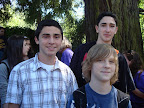 |
| From Camp Newman 2009 |
After a week’s delay, Camp is filled once again with the sounds of laughing and singing as our campers arrived. It was difficult to determine who was more excited: the campers, who pined away for the moment they could return to camp, or the staff, which counted the minutes until their campers arrived.
While the campers move into cabins and begin to learn the names of their bunkmates and counselors, the rest of the staff has begun facilitating what will undoubtedly be a fabulous Camp Newman summer experience.
Beginning Sabbatical Phase 2
Our congregation announces my upcoming sabbatical:
After serving us faithfully for eleven years, Rabbi Kipnes will begin the second part of his rabbinical sabbatical from May 17 through late August. (The first part took place in January 2008.) The term “sabbatical,” related to the word Shabbat (time of rest), refers to a leave from normal responsibilities. Its roots come from the Torah when God instructs Moses on Mount Sinai that the Israelites are to work the fields for six years and on the seventh year the land will have a Shabbat, a complete rest. Typically taken by rabbis around the world after each seven years of service to the community, a rabbinical sabbatical allows a rabbi to rest, study and experience new facets of Jewish spirituality and learning. It serves to rejuvenate a rabbi’s internal resources for the dual purposes of providing more knowledge for sermons and synagogue activities and creating an invaluable period of spiritual rejuvenation and professional rabbinic renewal.
Rabbi Kipnes is taking his sabbatical in three parts over three years. He will begin the second part (May 17 through August 19) following Shabbat services on May 15 (and the B’nai Mitzvah services on May 16).
How will our rabbi renew himself? Rabbi Kipnes will be studying early Chasidic commentaries on Torah and will also be tutored in conversational Hebrew. He will explore synagogue renewal through an extensive reading list and tours of synagogues of excellence around the country. He will lead a delegation to Camp Newman in Santa Rosa and visit Jewish summer camps in Washington State and Mississippi. He will volunteer to help victims of Hurricane Katrina in New Orleans. He will expand his personal spiritual practice by rediscovering the beauty of the Holy One in National Parks around America.
Although we will miss our rabbi during his weeks away, we understand that this sabbatical is essential to both his vibrancy and longevity. To ensure that our rabbi has the ability to retreat, reflect and renew, we have developed the following sabbatical coverage plans. Our competent and compassionate Student Rabbi Ari Margolis (contact him through Or Ami at 818-880-4880 or, beginning May 17th at ari@orami.org) will take a leading role in responding to the pastoral needs of our congregants. Where needed, he will make pastorals calls, arrange for funerals, make hospital visits and take care of the spiritual needs of our congregants. He will be supported by Cantor Cotler and other community Rabbis. Services will be led by Cantor Cotler, Student Rabbi Margolis, Sheryl Braunstein, Darryl Lieberstein, Aaron Meyer, Kim Gubner or some combination thereof. Our talented educators will continue to lead our excellent educational programs. Our fabulous office staff, led by Susie Stark, looks forward to assisting you (Susie@orami.org or 818-880-4880). Of course, our president Susan Gould (the4goulds@roadrunner.com) is always ready to listen and help.
Since we want our Rabbi to focus on his own renewal and spiritual growth, with his consent, we have instructed Rabbi Kipnes that during his sabbatical, he will not be reading his email, blog, facebook, or twitter, nor will he be accepting congregant phone calls. Although you might see him around town, please respectfully do not engage him in synagogue-related issues. We are proud of how well we take care of our Rabbi and we want him refreshed when he returns!
Rabbi Kipnes will return to our community at Shabbat services on Friday night, August 21. There, interspersed with the beautiful music of our Or Ami Chorale, Rabbi Kipnes will share reflections on the first part of his sabbatical. We wish him well and hope to see you there.
Baruch B’vo’echa * Baruch B’tzay-techa
Blessed may our Rabbi be as he goes off to learn * Blessed may he be as he returns to us renewed.
Dodgers Honor Or Ami & Me on Disability Awareness Night
 On Thursday, June 4th on the Dodger’s Stadium field, I will receive the EP Maxwell J. Schleifer Distinguished Service Award for Or Ami’s support of people with disabilities. The ceremony will take place sometime between 6:00 and 7:00 pm before the game. Come cheer on the Dodgers, Or Ami and the important work we do!
Our Congregation Or Ami believes that we are all created b’tzelem Elohim (in God’s image) and so we welcome all, including those with disabilities. We are extremely proud of our support of families with children with disabilities. Come cheer on the Dodgers, Rabbi Kipnes and Or Ami. Read our webpage welcoming people/couples/families with disabilities. (More nachas/joy: Congregant Dina Kaplan won the award last year.)
Brad Gore nominated me, writing:
It is my pleasure to nominate Rabbi Paul Kipnes for the EP Maxwell J. Schleifer Distinguished Service Award.
Rabbi Kipnes is by profession a community rabbi committed to opening up the Jewish community to people with disabilities, by avocation a tireless supporter of families with children with disabilities, and by familial ties, the brother of a man with Asperger’s. Rabbi Kipnes has touched the lives of thousands of families and inspired countless others to seek openness and equal access for people with disabilities.
BACKGROUND
In 1992, Rabbi Paul Kipnes convinced his then congregation, 900-family Temple Beth Hillel, Studio City, CA, to hire a Special Needs Coordinator to ensure that every child with special needs receives the support and attention he or she needs to grow spiritually, emotionally and intellectually as a member of the Jewish community. In 1998, the first policy Rabbi Kipnes asked his new community, Congregation Or Ami, Calabasas, CA, to enact was that “any child of a member who worked to the best of his/her ability had the right to a Jewish educational experience… and the privilege of becoming a Bar or Bat Mitzvah.” With that simply worded policy, Rabbi Kipnes ensured that families of children with disabilities – physical, mental, emotional or any combination – would find acceptance and a home in the Jewish community of the West San Fernando and Conejo Valleys. Rabbi Kipnes has spoken at national Jewish conventions on equal access, and consults with rabbis and congregations locally and throughout California on creating religious openness for Jewish families with disabilities. Whether in High Holy Day sermons or on his blog, Rabbi Kipnes is a tireless advocate for warmly welcoming people with disabilities into temples and the Jewish community.HIS PHILOSOPHY ABOUT SPECIALNEEDS CHILDREN IN THE COMMUNITY
Rabbi Paul Kipnes teaches that “There is a sense that children with special needs, physically, emotionally, mentally, don’t have a place in the synagogue, in the Jewish community. That’s just not true, particularly here at Congregation Or Ami. We have celebrated B’nai Mitzvah services with children with autism, emotional developmental problems, intense dyslexia, Tourette’s syndrome… The Bible and Judaism are available for all of us.”Rabbi Kipnes and his community emphasize that no matter what a child’s needs are, it’s never a question of if a child can become a Bar or Bat Mitzvah, it’s when the ceremony will take place. Rabbi Kipnes explains, “With special needs children, there are two values being played out, simultaneously. Working with Brandon Kaplan (one special needs teen), for instance, we saw that Brandon is a kid like any other kid created in the image of God, worthy of love. But Brandon is also a special kid and there is an honor and joy to the congregation that he participates to the fullness of his abilities. So he’s normal and special, but here’s the secret: so is every other kid.”
CREATING THE BRANDON KAPLAN SPECIAL NEEDS PROGRAM
Rabbi Kipnes and Congregation Or Ami created the Brandon Kaplan Special Needs Program to support the creation of Jewish educational, communal, and spiritual experiences for special needs children and their families within the West San Fernando and Conejo Valleys, irrespective of whether they are members of Congregation Or Ami. Oftentimes children with intellectual, learning or physical disabilities, and special health care needs and their families lack the Jewish spiritual support and educational opportunities available to able-bodied children. The Brandon Kaplan Special Needs Program helps to provide a safe, secure, enriching experience for these children, and in doing so we contribute to the overall quality of the entire family’s life. These families are already over-burdened by the extraordinary costs of providing specially trained teachers and aides, specialized educational tools and materials, therapies, and facilities. It is currently one of the few Jewish organizations in the West San Fernando and Conejo Valleys actively offering support to non-member families who are struggling to create Jewish experiences for their special needs students.DEVELOPING A SPECIAL NEEDS SUPPORT GROUP
Rabbi Kipnes opened the doors of Congregation Or Ami to host a twice monthly Special Needs Support Group including no cost specialized childcare, which provided support, information and resources to parents of children with special needs. The Support Group is co-sponsored by local and county Jewish organizations including the Union for Reform Judaism, HaMercaz (the Jewish Federation’s Special Needs program), Heschel West Day School and Kadima Heschel West Middle School, among others. Members of the Los Angeles Jewish community who received support included families with a son moved to a specialized facility, a profoundly disabled teen (who signs, but does not speak), 20+ year old young men, children with autism, and children with epilepsy-induced learning disabilities.TRAINING THE NEXT GENERATION OF RABBIS AND JEWISH EDUCATORS
Rabbi Kipnes believes that the key to gaining full equal access in the Jewish community for people with disabilities entails raising up a new generation of leaders committed to equal access. For the past four years, Rabbi Kipnes, in partnership with Hebrew Union College-Jewish Institute of Religion in Los Angeles (HUC-JIR), has mentored rabbinic and education students, usually in their 3rd or 4th year of a 5 year Masters degree program, on how to support special needs students and families. Each intern engages in regular phone calls to special needs families to gauge their experiences and develop plans to better integrate them into Jewish learning. With their mentor, Rabbi Kipnes, they explore pastoral counseling issues related to families with children with disabilities. They apprentice during decisions about whether and how to mainstream students for education. They learn to utilize a team approach to Jewish Special Needs Education bringing rabbi, educator, Bar/Bat Mitzvah tutor, classroom teacher, temple administrator and parents together to develop a synagogue IEP (Individualized Educational Plan) for special needs students and to work with educators and teachers to create classroom lesson plans appropriate for both special needs and able bodied students. This internship with Rabbi Kipnes is a much sought after placement for students at HUC-JIR.USING NEW TECHNOLOGY TO SPREAD THE MESSAGE OF EQUAL ACCESS
Rabbi Kipnes has presented at national Jewish conventions on the use of new technology to teach and offer support. He has pioneered the use of temple webpages to trumpet the message of openness. Congregation Or Ami is one of the first congregations to have a webpage devoted to individuals and families with special needs. He ensured that the message of access appears in prominent places on the webpage, including on the temple’s home page. Review the Special Needs Webpage. His blog is provides insights, reflections and inspiration, with special focus on concerns of special needs families. Commenting upon Jewish issues, communal endeavors and poignant moments with special needs students, the blog garnered the attention of members of the local community and Jews all over the country. Review the blog.CELEBRATING BAR/BAT MITZVAH CEREMONIES WITH JEWS WITH DISABILITIES
Whenever asked if a child with this or that special need could become Bar or Bat Mitzvah, the central Jewish “coming of age” ceremony, Rabbi Kipnes’ answer is always an emphatic “yes!” The Congregation has celebrated B’nai Mitzvah services with children with autism, emotional developmental problems, intense dyslexia, Tourette’s syndrome, Fragile X Syndrome and more. Young Brandon Kaplan’s Bar Mitzvah ceremony, reminded everyone that children with special needs can and should have access to all aspects of religious life. When 20 year old Matthew participated in a Sabbath service, the entire community celebrated but none more than the young man with Fragile X Syndrome. As his mother reflected, “Nervous though he was, he rose to the occasion and sang the blessings beautifully, with the flair of his personality shining through. I was so touched by your attention to him, allowing him to be himself.” Read about his participation.CELEBRATING PEOPLE WITH SPECIAL NEEDS
Congregation Or Ami hosts an annual Shabbat (Sabbath) service, led by students with profound disabilities. The service was designed around their needs. The Temple engages a sign language interpreter. Worshippers come from all over Los Angeles and Ventura Counties, from the Chaverim program of Jewish Family Service, and from local synagogues. Parents of children with special needs receive special blessings from the rabbi, and expressed deep appreciation for the support. Other worshippers described the being deeply moved by the experience. In addition, the rabbi’s sermon at High Holy Day Community Family services focused on Special Needs children. Moreover, Rabbi Kipnes ensure that members of his congregation regularly volunteer to support Brandon’s Buddies, which brings together children (special needs and others) for fun, sports and other activities. They sponsor a team in the Shane’s Inspiration walk. They bring a group each year to Game Day at Dodger Stadium for Special Needs Families.CONCLUSION
Rabbi Paul Kipnes has touched the lives of thousands of families with children with special needs throughout the Greater Los Angeles County. Because of his efforts, they have greater access to the Jewish community, special needs advocacy and education support. Because of his enthusiasm, families with special needs feel welcomed in the Jewish community. Because of his dedication, their children have reached religious maturity. Because of his inspiration, they have an open invitation to become more deeply involved in religious life. Through his many projects and efforts, Rabbi Paul Kipnes has demonstrated inspirational leadership in an effort to expand awareness about how people with disabilities can be productive citizens in our society. As such, I wholeheartedly encourage you to award Rabbi Paul Kipnes with the EP Maxwell J. Schleifer Distinguished Service Award.
Or Ami in Pictures

Or Ami Featured on Reform Judaism Blog (RJ.org)
Or Ami’s Confirmation Class was featured on the Reform Movement’s national blog, RJ.org in a posting called Confirming the Diversity within the Reform Movement.
Great picture too!