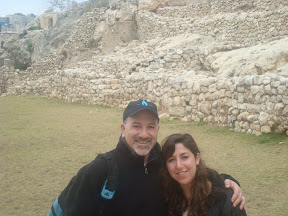
Tag: Israel

Day 2: Masada, Meaning and Questions that Matter

Someone once told me that anywhere else in the world, a tourist travels through a country, but in Israel the Jew journeys toward meaning. Up early (4:09 am – the result of too much jet-lag induced napping), with the hotel window open, a cool breeze and the sounds of the Holy land awakening, provides me with the chance to reflect back on yesterdays meaning-making on Masada and beyond.

Ultimate Questions

This morning’s ultimate question: If placed in the shoes of another, would we make the same choices? We hired a larger taxi for the day, to take us down south to Masada (the Dead Sea and Ein Gedi too). It was good to get out of raining Jerusalem, though who knew what kind of weather we would find beyond – divine blessing, it seems, at least in terms of weather. Clear, albeit cold, skies, and some strong winds met us on the mountaintop, making it sometimes chilly, but dry enough to walk around. Thankfully, the threat of ugly weather kept large numbers away from Masada, so we had this historic hilltop much to ourselves. We meandered, explored, took in the precious panorama surrounding us.

Much has been written about the difficult choices Masada’s first century Jewish residents had to make. Forced to flee Jerusalem under the Roman onslaught to King Herod’s Masada Palace retreat, they holed up, lived life, and prepared to fight the ever intensifying onslaughts by the Romans against Israel’s Jewish residents.

The new Museum at Masada offers a wonderful way to enter this ancient event. Jerusalem Post wrote about the Museum’s opening:

The visitors’ museum experience begins in the lobby, where they receive audio headsets. They then pass through nine rooms, each of which features artifacts placed in three-dimensional scenes that depict facets of the Masada story.

In the Herod room, for example, visitors enter a display of black, statue-like figures at a banquet scene. Spread amongst these figures are artifacts such as a stone table, amphoras which held Herod’s provisions, and terra sigillata ware (the finest dishware of the time.) As visitors move from room to room, their headsets automatically begin the narration for the corresponding space. The first eight rooms delve into the worlds of the Jewish rebels, the Romans, and Josephus Flavius, while the final room pays homage to Yadin’s work.

Later, ascending by tram, we were walking in the footsteps of the Jews on Masada. Even as we were enthralled with the beautiful 3-D vistas from the upper palace level looking over the whole desert, we faced with were their impossible choice: to live life as the slave – property – of the Romans, or to proclaim their freedom by self-determining that their lives must end while they are still a free people. (Full Masada story here).

Masada forced us 21st century Jews to consider: besides freedom, what do we value so highly that we will take strong measures to protect it? Eschew the Masada option if we like, but still we are left with the question: what do I value? Family, yes. Love, sure. Country? Homeland? Could we endanger our families for the sake of an ideal, or to save another? Would we today, for example, be willing to hide our generation’s Anne Frank? For what greater value would we step out and stand up? We American Jews are rarely forced to contemplate such questions.

Less important on the spectrum of ultimate questions was the decision to walk down the mountain, but to take the tram up. We decided that being exhausted and sweaty would impede the poignancy of the Masada experience up top. We saved it for the end, and after an energizing but exhausting descent, we regained our strength (and dried out our sweaty shirts) over lunch in the restaurant.

Wadis Go Wild
What do you do when things don’t turn out as expected? Get frustrated? Cry out in anger? Find new visions worthy of blessing? When do you realize that some things are just beyond your control, and it is time to “go with the flow?”

We intended to drive north to float in the (currently) frigid waters of the Dead Sea. Yet the rain had other plans for us. After fielding conflicting reports about whether the road north was open or closed, we drove up to see. Just before En Gedi, we witnessed something few chance upon safely. Hikers in Israel are regularly warned about the dangers of flash floods in the dry wadis of the Negev. Now, under clear skies, we were able to witness one ourselves. A wadi (dry canyon riverbed) had flooded, sending thousands of gallons of muddy water across the road. Just 200 feet separated the dry land on both sides. We waved to people on the other side. Yet, the police had stopped traffic, after a 4×4 got stuck in the muck. This could have been a buzzkill. Instead, like for Israelis and others in love with their land, the roadblock did little to douse spirits. People on both sides of the blockage parked, and hiked up the sides of the wadi. Some took out beach chairs and boiled water for Turkish coffee; others took to the heights to watch with amazement. I remember learning that perhaps the Israelites crossing the Red Sea could be explained right here: that a wadi flooding, just as suddenly runs out of water allowing the Israelites to cross, until just as suddenly a flash flood of muddy water catches and drowns the pursuing Egyptians. Whichever, it was majestic.

Letting go of the plan to swim in the Dead Sea (now a swirl of brilliant aqua and muddy chocolate brown), we decided to leave early to take the long route back to Jerusalem. This southern, western roundabout route would claim up to 3 hours to get back. Still, nothing ever works perfectly. Some roads were blocked off, forcing even more detours. Sometimes the rain came down in buckets, creating slippery conditions. Other times the fog decreased visibility so much that traffic slowed to a trickle as we could only see the road and the car in front of us. One travel companion wondered when the next plague would strike. Then came the hail, small mini-balls of ice, pelting the group around us at a traffic stop. We Jews sing Shir Hama’alot, a song of ascension, upon ascending to Jerusalem. I hummed the tune to myself in thanks for finally arriving back in Jerusalem after a much longer journey than expected.

Love of Spouse and Belief in God: Twin Claimants of that “Leap of Faith”
Ultimate questions of belief poked their heads out again at night as we shared dinner together in the hotel. Between bites of tuna sandwiches, penne and red sauce, sophisticated-sounding salads, and some bottled water, we shared stories of our engagements to our wives, regaling each other with the fun details of deciding and planning to ask. Here, a ring was hidden in a tie tack jewelry box. There, a Valentine’s Day gift box from Victoria Secret enclosed a promise of a future (clearly, a shiny ring beats new pj’s any day). One invited a girlfriend on a business lunch, exchanging the frustration of being “stood up” by the “business associate” with the joy of a proposal to make a life together forever. A picnic during a long sought performance at a Shakespeare festival provided the backdrop for another proposal. I shared our joyous moment in Yosemite, where I offered her the lights of Orion’s belt as a testament to my forever love of her (resizing her great grandmother’s ring would come later, as would the 5 stoned ring we later picked out – one stone for each member of our yet-to-be-created family). My 20 year old niece Yonina promised to share her engagement story with us eventually, when the right guy comes along. We also talked about who asked the father-in-law for permission ahead of time; when and how family was included in the announcement. (I remember hanging out in a Marie Callendar’s restaurant, nervously trying to eat a patty melt, as we waited for my future in-laws to finish work so we could share the exciting news with them.)

All that wonderful talk about love provided the perfect backdrop to an unexpected yet equally delicious discussion about truth and belief and Torah and science. Being surrounded by ultraorthodox Jewish families whose lives are proscribed by Talmudic law, and whose relationships to each other (the roles of men and women) and daily life (prayer, study, work) are often so different from our own, questions of faith get magnified. So we talked. Is there a midpoint between literalism/fundamentalism and blind belief? Can Judaism make room for Darwin and dinosaurs when Torah offers a very specific God-centric story about six days of creation? If aliens from five different worlds simultaneously were to make their presence known to us, how would that affect Jewish belief in the creation of humanity? Is God the proprietor of a divine candy shop, distributing sweets (blessings, goodness) to us whenever we wish? And what does it mean when our prayers are not answered?

Some worried that such questions might offend me, their rabbinical traveling companion. I relished the discussion. (Only a bite of the rugaleh from Marzipan, sitting up in my room, could have made it even sweeter.) You see, it’s my life’s work to push people beyond the literalist reading of Torah, to open them up to meaning and Torah’s search for ultimate meaning. That truth need not be historical; that science need not be seen as being in opposition to religious belief. That the foolish acts of fundamentalists (and their cynical misuse of religion to kill and maim) does not negate the possibility that God exists and is benevolent.

I endorse the eighteenth century Chassidic rebbe who said that anyone who reads Torah only (primarily?) as p’shat (on its plot level) is a fool. Torah is about life lessons, not historic truths. It answers the question “why” to complement science’s question about “how.” Its sometimes stark stories of creation, primitive medicine and miracles are on their surface merely the experience of a people in its infancy. Just as my children once viewed me as all powerful, all knowing but as they have grown have developed a more nuanced view of their all loving father, so too must we mine meaning from Torah – through study, midrash and more – to discover insights (and answers perhaps) to ultimate questions.

As I age, and realize how little control I truly have over things in life, I become increasingly aware of realities that are unquestionable: the love I share with my wife, my love and devotion to my children, and my experience that we are all connected in a Oneness others call God. I cannot prove the love of my wife by an empirical means any more that I can prove that God exists. A cynic could ascribe ulterior (non-love) motives to the former; the non-believer finds comfort in our ability NOT to be able to prove God. But love and belief go hand in hand. Both require a leap of faith. And I lovingly, though not blindly, leap forward. Can you?

Oh, how I loved that nighttime conversation! They say Jerusalem’s air is intoxicating. I’m more than ready to get high on such heady discussions again and again.

Its 5:50 am. Time to wake up. Breakfast and modern Jerusalem calls. I wonder what questions she will ask us today!?! Oy, gotta run. I’ll try to embed more pictures later. Check the new ones here.
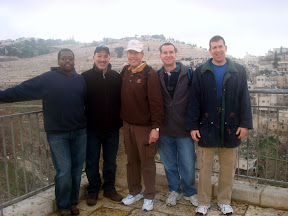
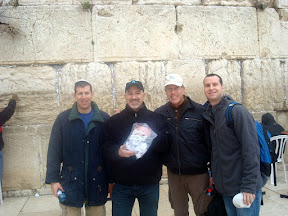
Jerusalem, Day 1


Our first full day in Israel we spent touring around Jerusalem. Our tour guide, Alexandra Benjamin, beautifully wove together archeological finds, Biblical verses, ancient history and modern realities to create a tapestry of Israel past, present and future.

We began at the City of David, an archeological dig of the original capitol city set up by King David in the year 1000 BCE (plus or minus). How fascinating to see how the Biblical stories of David’s life and kingdom correlate so well with the archeological finds. We marveled at the intersection of the Arab village, the ancient site and new Jewish homes. We viewed Hezekiah’s tunnel, an ancient tunnel dug to bring water into the city.

We stopped by the Kotel, writing prayers and placing them the wall. I wrote a special prayer asking for blessing for my family, our congregation, Israel and America and our world. I took special pride in placing in the Wall, prayers written by Or Ami congregants and students.

Walking under the Kotel Tunnels, that stretch the length of the western retaining wall of the Temple Mount, never fails to amaze me. To see stones the size of school buses that weigh 631 tons, and trying to imagine how they were moved into place so far up the wall. To walk along paved roads that our ancestors walked upon 2000 years ago. To view the huge underground cistern which stored water for the desert area city.

We gained a sense of the interreligious nature of the city of Jerusalem during a visit to the Church of the Holy Sepulchre, where tradition teaches Jesus was nailed to the cross and laid following his death. Six different Christian denominations/churches each have a role and ownership of different parts of the church and its rituals. I was moved by the way Christian pilgrims were moved so deeply by being in the Church.

Standing atop the rooftops of the Old City of Jerusalem, we stood equidistance between three domes: Islam’s Dome of the Rock, the Dome atop the Church of the Sepulchre, and the new dome atop a new synagogue in the Jewish Quarter. Moments later, we heard the Muslim call to worship, listened to the Church bells ringing, and saw Jews rushing to the Kotel for pre-Shabbat prayers.

I took part of our group – who hadn’t tired yet from jetlag – to Machane Yehuda, the open air Jewish market. How I love the hustle and bustle of that place in the hours before Shabbat. Sounds and smells, colors and tastes, mingle together amidst the cacophony that we call the Jewish people. Pushing, shoving, selling, buying, talking, laughing… it is a wonderful feel for the hum and buzz of this city. We bought only chocolate rugaleh from Marzipan. Warm and delicious.

The day ended with Shabbat dinner at a Lebanese restaurant nearby the hotel. Following kiddush and motzi over the challah, we enjoyed a delicious dinner of salads and meats. Delicious!

Another joy is being with my niece Yonina, who made aliyah a few years ago and currently serves in the army. This 20 year old is one amazing young woman!

Alas, its late again (10:30 pm Jerusalem time, 12:30 pm California time). I’m exhausted. I’ll fall asleep watching Troy, the story of another ancient city with a rich history.

Aliyat haNefesh, My Soul Ascends to Jerusalem

I’m in Israel now (though I wrote this on the plane trip over). This might be a good time to reflect upon the purpose of this trip. Israel Adventure 2009 has three purposes:

  • To attend the convention of the Central Conference of American Rabbis (Reform Movement rabbis) who meet once in seven years in Israel;
  • To help guide a small group of Or Ami people (Mark Wolfson and his current/future sons-in-law) through Israel;
  • To make my annual Aliyat haNefesh (spiritual ascent) to our Jewish holy land.

What is this Aliyat haNefesh? On Shabbat and Holy Days, when we marched with Torah we sing a verse from Tanach: Ki mitziyon tetzei Torah, u’dvar Adonai mirushalayim – From out of Zion comes forth Torah and the word of God from Jerusalem. Purposely placed in the middle of the prayer service, this song trumpets our Jewish reality: that on some cosmic (metaphysical?) level, we are all connected as Jews to Zion, to Israel, by an unseen umbilical cord. We Jews are called from deep within to reconnect to the womb.

Back on Yom Kippur 2007/5768, I spoke to Congregation Or Ami about deepening our relationship with Israel. I paraphrased the writings of my colleague (the rabbi of my youth, one of my role models) then President of the Association of Reform Zionist of America, Rabbi Stanley Davids, who called for an aliyat hanefesh, a spiritual aliyah. (My sermon also draws from the writings of Rabbi Robert H. Loewy.)

Today, on Yom Kippur, I call for a new kind of connection to Israel, an aliyat hanefesh, a spiritual aliyah. Aliyah, from the root, Ayin-Lamed-Hey means to
rise up. When you move to Israel, like my (then) 19 year old niece Yonina did,
we say you make aliyah. When traveling in Israel, and you go to Jerusalem, even
if you are in the north traveling down south, we say la’alot lirushalayim
that you make go up to Jerusalem, rising up to our spiritual center. When you
ascend the bimah to bless Torah, we say you have an aliyah, rising up to that
spiritual plane.

I ask you all to consider making it a religious duty to participate in an “aliyat hanefesh, a spiritual aliyah.” Let it be “a soul-driven aliyah that places love for Israel near the center of our lives. Aliyat hanefesh could be expressed by visits for study and for vacations, by extended sabbatical stays, by making certain that our children and grandchildren have extensive personal experiences of Israel, by becoming informed advocates for Israel and by personally making certain to celebrate Yom Ha’atzmaut as a religious holiday each May.”

Today, this Yom Kippur, I call for each of us to recommit to the covenant with God by committing to travel to Israel soon and again. Let us walk the streets of our holy land once every 5 to 10 years. Let its holiness wash over our souls…

For me, once every 5 years is not enough. It is my hope, my goal, to lead a group of Or Ami congregants to Israel once every 12 to 18 months. So while our Or Ami Summer 2009 trip was canceled – the economy took its toll on everyone’s travel plans – this CCAR convention, and Mark’s desire to take his sons-in-law for a week of touring, provided me with the opportunity to fulfill this year’s aliyat hanefesh.

Blog Israel 2009: Flying to Israel

Nineteen hours into the trip to Israel, we are aboard El Al flight 8, somewhere over the Atlantic Ocean, west of Lisbon. Lights are out; the plane is quiet. More than half of the passengers are asleep, except for me, Mark Wolfson (one travel partner), the Chasid up front putting on his tefillin to pray (it’s morning somewhere), and the Israeli behind me (who we believe is more than just our average traveler).

The trip has been beautifully uneventful so far, with a thought-provoking moments to keep the blood flowing.

(1) My travel partners for the first leg of Israel Adventure 2009 are Or Ami congregant Mark Wolfson, his two sons-in-law Dan Glassman and Jon Bronson, and his son-in-law-to-be Sundi Munavu. Mark and I traveled to Israel some five years back, during the Second Intifada. We called ourselves Or Ami’s Advance Team/Mission to Israel, ensuring for other congregants that it was safe to travel there. I will post my reflections from that trip on the blog. Anyway, going through security with a Kenyan proved interesting. As we have seen many times before, El Al security is phenomenal. I have never been so peppered with so many different questions, which I assumed would be checked out if there were parts that concerned them. I think security spoke with all of us, except Sundi. When the two security people conferred in front of me, in Hebrew, I chimed in, also in Hebrew. Was that a test of whether I was really a rabbi? As fascinated as I am with the security, am I being paranoid? Nonetheless, they waved him through. Sundi and I had an interesting conversation about profiling (called racial profiling here in the States), and about whether or not it feels different getting on a plane to Israel rather than driving through the U.S.A. Sundi seemed more accepting of it than I might have been, perhaps because of knowledge about an even higher level of screening to go in and out of Kenya. Which brings me back to the Israeli behind me. Is he our own personal Air Marshal, positioned such that he can keep an eye on us… on Sundi?

(2) Traveling the first leg on an American Airlines flight (El Al’s domestic partner), we were offered a choice of two meals: pulled pork or antipasto with various meats in the ham family. You’d think that if El Al partnered with another airline, you could expect at least ONE non-treif meal option. The salad, cheeses and warm chocolate chip cookie carried me through.

(3) American Airlines gave us each a personal video screen, preloaded with movies. Cool! I played a few games, winning at Sudoku. I began to watch Bottle Shock, a based on reality movie about a 1970’2 era blind taste test pitting California Wines against French Wines. Supposedly the Californian wines won, in France. I wouldn’t know, because they collected the video screens 40 minutes before landing, leaving me 20 minutes from the end of the movie. Wouldn’t you know it, not five minutes after they took back the screens, the captain announced that weather had shut down some runways at JFK and we would be circling for a bit. We landed 30 minutes late… Bummer. I’ll have to search out the video when we return.

(4) We are flying on a 747, in the upper deck. How cool! There are about 24 seats up here. Kind of private. The only scary part about it is that if, G!d forbid, we had to use the emergency slide out the emergency door, we are waaaaaaaaaaaaaaayyyyyyyyyy up here.
(5) I’ve been sleeping off and on. Though its 3:20 am California time; its 1 pm Israel time. Initially I planned to sleep straight through. Yet we arrive at 5 pm local time. If I want to get some sleep that night, so as to be awake to begin touring on Friday morning, I had better stay awake now. Not sure my body really likes 3:22 am.

Israel 2009: First Week’s Itinerary


I’m leaving for Israel tomorrow morning. My family understands how I feel about Israel. Its a cross between one child’s love of Camp Newman, another’s love of hanging with friends, and the third’s love of all things baseball. I’m blessed to be able to visit Israel yet again.

Here is my itinerary for the first week:

Thursday, Feb 19: Arrival
5:05 Arrive at Ben Gurion Airport
Take taxi to Jerusalem hotel – Citadel David
Eve Dinner in hotel (or walk into city)

Friday, Feb 20: The Old City
Early Breakfast in Hotel
7.30 Depart hotel by sherut (taxi)
8.00 City of David (nrn)
9.30 Walk up to Kotel
10.00 Kotel tunnel tour (r)
11.30 Continue touring Old City of Jerusalem.
Church of the Holy Sepulcher, Cardo, Arab Shuk and rooftops.
Stop for lunch in this time.
Depart Old City between 2 and 3pm and return to Hotel

Eve Shabbat Dinner and Evening Plans to be finalized in Israel
Possible: walk to Kotel/Western Wall for Shabbat experience

Saturday, Feb 21: Masada
AM Early Breakfast in hotel
Taxi to Masada
Ascend Masada – group decides if we walk up, down or both
Tour Masada
Descend Masada
Lunch nearby
Possible visit to Dead Sea
Eve Evening in Jerusalem

Sunday, Feb 22: Jerusalem: The New City
Breakfast at Hotel
8.10 Depart Hotel
8.40 Har Herzl Museum (r)
10.00 Tour Har Herzl
11.30 Travel to Supreme Court (nrn) (ft)
12.00 Supreme Court tour
1.30 Arrive at Knesset for tour at 1.45 (nrn) (ft)
3.15 Late lunch and poetry discussion at Tmol Shilshom
5.15 Shopping and wandering around Downtown, Nachalat Shiva area
Eve Dinner and Shopping in Jerusalem’s German Colony

Monday, Feb 23: Tel Aviv – The Old-New City
Breakfast at Hotel
8.30 Depart Jerusalem
9.30 Approx arrive in Tel Aviv
10.00 Independence Hall
11.00 Walking tour of Bauhaus Tel Aviv or Old Jaffa
12.30 Lunch
2.00 Palmach Museum
3.30 Depart Tel Aviv
4.30 (approx – Arrive in Jerusalem)
Eve Dinner and Nightlife in Jerusalem

Tuesday, Feb 24:
Breakfast in hotel
8:30 Depart hotel
9:00 Yad Vashem: Israel’s Holocaust Museum
Lunch Machane Yehuda Open Air Market
Possible visit to Yad L’Kashish, Lifeline to the Elderly
Eve Dinner (hopefully with Rabbi Jan Offel, Kol Tikva)

Professional Baseball in Israel: Take 2

Though I’d rather see my Red Sox behind this venture, I am excited to report that Israel might see a new Baseball in the next few years. Alan Schwartz, in the NYTimes baseball blog Bats, reports:

Yankees Partner Looks to Play Ball in Israel

By Alan Schwarz

Professional baseball in Israel could be alive, if not well. The nation’s first foray into pro ball – with most players from the Dominican Republic playing on poor fields before empty seats — ended in financial disaster after one season in 2007. But from that experience could rise another attempt, and a considerably more thoughtful one. Marv Goldklang, a limited partner of the Yankees and the owner of several prominent minor league teams, said Tuesday that he and a group of other North American baseball insiders hope to start an entirely new league in either 2010 or 2011. Goldklang was on an advisory committee of the first circuit, the Israel Baseball League, and was so dismayed with its operation that he and other members resigned before the league folded. “I could spend an hour telling you everything that went wrong,” he said of the first I.B.L. “Essentially what we’re doing now is forming a group of people to do some fairly serious due diligence – the type of
due diligence that, candidly, was not done the first time around.” The Israel Association of Baseball, which oversees amateur programs in the country, has given its blessing to the group – which also includes U.S. businessman Jeff Rosen, owner of the Maccabi Haifa Heat professional basketball team in the Israeli Premier League. Goldklang said that the other partners wished to remain anonymous at this early stage, perhaps because of the debacle two years ago. Goldklang expects to look into the feasibility of franchises in Tel Aviv, Jerusalem, Raanana (a city with a large Western population), Haifa and a few others with the hope of having six teams. “There are no ballparks there that you would consider a ballpark in an American sense,” Goldklang said. “There are fields suitable for youth baseball programs, but you wouldn’t put a college team on that field. “We need to develop a strategy to build ballparks that would be suitable for professional play, with couple of thousand people in park.” Goldklang said he would prefer to market baseball to Israelis much as it is in the U.S. minor leagues, as a communal place for fun rather than a serious sporting event. (Although nuns giving massages in the stands, a hit with Goldklang’s St. Paul Saints, might be a tough sell.) “We want to create an atmosphere that makes it enjoyable whether or not they’re quote-unquote baseball fans, and build from there,” Goldklang said. “A quarter or third of people who attend games are not necessarily fans. But they enjoy the experience, and they come to appreciate the game itself. What will appeal to Israelis once they come to the ballpark and what will get them to relate to the game on the field?” He added: “Israel is a place where dreams come true – notwithstanding the twists and turns you read about in the front part of the paper. Israel is that type of place. Hopefully what we’re doing is not too much of a dream.”

When Hope in America Inspires Dreaming in Jerusalem

Gershom Gorenberg writes in South Jerusalem:

Watching a videocast from Washington last night, it seemed to me that half of what seemed impossible when I wrote this has come true: Across the ocean, where hope was written off like a bad debt, it has been reborn.

Here, in Jerusalem, one still has to dream of the very possibility of dreaming. The pseudonymous and very wise Jeremiah Haber chides for even considering the possibility. But I know of no biological difference that allows Americans to imagine a better future and prevents us from doing so. With some trepidation at daring poetry in a blog, I’m posting this.

Desiderata

I am hoping for the rebirth of hope
I am waiting for the beat of wheels on steel, the railroad drumbeat rhythm,
I am waiting for the long-distance heaven express.
I believe its time to lay tracks up to heaven
I am waiting for Jimi Hendrix to rise and climb on, for Phil Ochs to declare he’s retracted his resignation,
to rise all bones and anger banging a guitar and climb on,
I am waiting for the kids in the high schools to lay down their guns and climb on
I believe the generation born dead, raised dead, schooled dead in the malls’ mausoleum marble will pass
I believe with an imperfect faith, cracked but still serviceable, that a generation will be born that knows how to hope.

I am waiting for new songs unto the Lord.
I am waiting for new psalms,
I am waiting for a pied saxophonist to march through suburbs outside Jerusalem, leading away the houses with red tile roofs and the grownups, and leave children and rats on green lawns
I am waiting for heavenly choruses to lean down, lean down, and with each note the guns in the hands of the green boys on the streetcorners of Jerusalem will grow wings and fly off, long grey dragonflies, toward the sun setting in white foam off Ashkelon
I am certain the stillborn generation can come alive
I believe with imperfect faith, used, dented, two cylinders skipping, low on brake fluid but still driving, that a generation can be born that knows how to sing.

I believe that Moses, Blake, Abe Heschel and Reb Nahman are not dead, they are tuning their guitars in a back room and will be back on stage for an encore any moment, for the real show,
when the rabbis will shed their black coats like old snakeskins, the monks and the sheikhs of jerusalem’s alleys will dance half-nude on Jaffa Road, roaring the choruses, reaching up drunk and trying to pull heaven down,
I believe a seven year old girl with umm kalthoum’s reborn voice, voice of clouds and fire, is even now singing in a room without chairs without schoolbooks in south Jerusalem, there are no lights in the staircase, there is broken glass in the street, there are skeletons on the park benches, bones without number, dead men in the buses, dead women whispering next to the empty notice boards next to the empty storefronts
her song will reach out the windows, it will seize the bones, they will grow flesh, they will fold up the housing projects like card tables, they will dance in the fields, they will build a new jerusalem out of clouds and fire,
they will be a generation that knows how to hope.

I believe dreams sleep but do not die
I believe songs are hiding in the wind
I believe that the drumbeats of hope are curled up in the couches of our hearts and will awaken, must awaken
I believe the tanks will turn into hippopotamuses and lumber out of their bases looking for rivers
I believe we are only waiting, only pausing to take a breath, before a generation is reborn that knows how to hope.

Five Must-Read Articles on Israel and Gaza

Israel Declares Cease-Fire: Goals Met. What does this all mean? Here are some 5 Must-Read articles that offer perspective on what has happened and is happening:

1. Gaza and Hamas: Was it about Education or Eradication? The focus for Israel and Barack Obama’s team should be on creating a clear choice for Hamas for the world to see: Are you about destroying Israel or building Gaza? As Thomas Friedman writes:

I was one of the few people who argued back in 2006 that Israel actually won the war in Lebanon started by Hezbollah. You need to study that war and its aftermath to understand Gaza and how it is part of a new strategic ballgame in the Arab-Israel arena, which will demand of the Obama team a new approach.

2. David Forman asks (and answers) 20 Questions:

15: Why is the world demonstrating against Israel, displaying pictures of Osama bin Laden’s comrades-in-arms, Hassan Nasrallah and Khaled Mashaal, as national heroes, instead of holding mass protests against terrorists (Islamic extremists) who stage their vicious attacks upon innocents in Mumbai, Bali, London, Madrid, Jordan, Egypt, the Twin Towers, and Israel – to mention only a few? David answers: Good point.

18: Thanks a lot, as if I didn’t know. Could it be that I sense that no matter how justified our war is with Hamas, that we are adopting the tactics of our enemy, or is there no choice but to fight Hamas according to its ground rules, thereby rationalizing away some of our objectively horrid behavior and, in the process, suspending all Jewish moral concerns, reducing us to a nation like any other nation? David answers: All the above.

3. Two Israeli Leftists, A.B. Yehoshua and Gideon Levy, face off on the Moral Implications of the Gaza war. A.B. Yehoshua writes:

There is something absurd in the comparison you draw about the number of those killed. When you ask how it can be that they killed three of our children and we cause the killing of a hundred and fifty, the inference one can draw is that if they were to kill a hundred of our children (for example, by the Qassam rockets that struck schools and kindergartens in Israel that happened to be empty), we would be justified in also killing a hundred of their children.

In other words, it is not the killing itself that troubles you but the number. On the face of it, one could answer you cynically by saying that when there will be two hundred million Jews in the Middle East it will be permissible to think in moral terms about comparing the number of victims on each side. But that is, of course, a debased argument. After all, you, Gideon, who live among the people, know very well that we are not bent on killing Palestinian children to avenge the killing of our children. All we are trying to do is get their leaders to stop this senseless and wicked aggression, and it is only because of the tragic and deliberate mingling between Hamas fighters and the civilian population that children, too, are unfortunately being killed. The fact is that since the disengagement, Hamas has fired only at civilians. Even in this war, to my astonishment, I see that they are not aiming at the army concentrations along the border but time and again at civilian communities.

Levy responds.

4. Title aside, The New York Times offers a surprisingly balanced review of the challenges of determining ethics in Urban Warfare in Weighing Crimes and Ethics in the Fog of Urban Warfare. They analyze the actions of Israel and Hamas. Here’s one taste, a frontal critique on Hamas, not usual for the New York Times:

The other key legal principle is discrimination: has a military struggled hard enough to hit only military targets and combatants, while trying to avoid purely civilian targets and noncombatants?

Deciding requires an investigation into battlefield circumstances that cannot be carried out while the fighting rages, and such judgments are especially difficult in urban guerrilla warfare, when fighters like Hamas live among the civilian population and take shelter there. While Israel is the focus of most criticism, legal experts agree that Hamas, a radical Islamic group classified by the United States and Europe as terrorist, violates international law.

Shooting rockets out of Gaza aimed at Israeli cities and civilians is an obvious violation of the principle of discrimination and fits the classic definition of terrorism. Hamas fighters are also putting civilians at undue risk by storing weapons among them, including in mosques, schools and allegedly hospitals, too, making them potential military targets. While urban and guerrilla warfare is not illegal, by fighting in the midst of civilians, often in civilian clothing, Hamas may also bring risk to noncombatants.

5. Of course, always check Jack’s War in Gaza Update (Ceasefire Edition) and the Muqata’s Israel @ War Special Edition.

New York Times: Why Israelis United on Gaza War

As I have said many times, the MSM (main stream media) in the states (and around the world) lacks the depth and background to make sense of what is happening in Israel, Gaza, and the Middle East. It is a scary neighborhood where Israel lives, and the MSM often misses the nuances and background. But one example: take a quick look at Memri.org (Middle East Media Research Institute) and you will see that what is being said and seen in Arab countries is far different from what the same Arab leaders are saying in the English press. Yet the MSM English press misses it often.

That is why I suggest different sources for news about Israel, including the daily rundown, compiled by Random Thoughts blog as well as the blogs on the bottom right column of this blog. Also

Along comes the New York Times, not known for its balanced reporting about Israel, with an article that gets most of it right. It illuminates a reality in Israel: that the vast majority of Israelis (at least the Jewish Israelis) support the offensive in Gaza. The war is seen almost unanimously as a just war:

…voices of dissent in this country have been rare. And while tens of thousands have poured into the streets of world capitals demonstrating against the Israeli military operation, antiwar rallies here have struggled to draw 1,000 participants. The Peace Now organization has received many messages from supporters telling it to stay out of the streets on this one.

Moreover,

“It is very frustrating for us not to be understood,” remarked Yoel Esteron, editor of a daily business newspaper called Calcalist. “Almost 100 percent of Israelis feel that the world is hypocritical. Where was the world when our cities were rocketed for eight years and our soldier was kidnapped? Why should we care about the world’s view now?”

War in Gaza Update: Who’s Saying What?

So much being written about Israel and Gaza. Here’s a rundown, compiled by Random Thoughts blog. Note that MSM (=Main Stream Media) and Blogsphere (=info and insights from bloggers worldwide):

Make sure to scroll down to the bottom to learn about Hamas in its own Words.

January 08, 2009

War in Gaza Update #13

Welcome to the War in Gaza Update #12. It is part of the continuing series of news and information about the War In Gaza.Previous editions of the round up can be found below:1* 2 *3* 3.5* 4* 4.5* 5* 5.5* 6*6.5 *7* 7.5* 8* 8.5.*9, *9.5, *10, *10.5, *11, *11.5, *12, *12.5.From the MSM:

Time: Can Israel Survive Its Assault on Gaza?
CNN: Security Council calls for cease-fire in Gaza
NY Times: Israel Condemns Vatican’s ‘Concentration Camp’ Remarks
NY Times: What You Don’t Know About Gaza (Biased, skewed and misleading.)
FOX: High-Profile Doctor in Gaza Called an ‘Apologist for Hamas’
Guardian: Obama camp ‘prepared to talk to Hamas’
YNET: A day with our troops in Gaza
YNET: ‘Not all Israelis are bad’
Artuz Sheva: Israel Accused of ‘War Crimes’ in a Complaint at The Hague.
Artuz Sheva: United Nations Calls for Ceasefire, United States Abstains.
Artuz Sheva: Netherlands: No Sanctions on Israel; Another Ceasefire Idea.

And now onto the blogosphere:

Aussie Dave and The Muqata continue live-blogging the war.

The IDF blog has all sorts of interesting information. Click here for pictures of tunnels that were dug for the purpose of kidnapping soldiers. This link provides a brief summary of things that were accomplished including information humanitarian aid trucks that rolled into Gaza, discovery of more tunnels, weaponry and the neutralization of some terrorists.

Seraphic Secret has updated It Can (and is) Happening Here. At Yourish W. abandons Israel again.

Treppenwitz writes about the rockets in the North. At the Jawa you’ll be shocked when you see Hamas Kills Innocent Palestinians (Rare Video). Augean Stables blogged Hamas in their own words. The Occidental Israeli Operation Cast Lead – Israeli Public.

I am going to keep hammering this story ‘Protestor’ Calls for Jews to ‘Go Back to the Oven’. Emmanuel Lopez is a ignorant fool who encourages the worst sort of behavior. The inherent hypocrisy he exhibits is shameful.

It is about time we get to read A Gaza Chronology that covers more than the past two weeks.

LGF covered A Staged Scene in a Gaza Hospital? – Update: CNN Yanks Video and Video: Hamas In Their Own Voices.

Yglesias covered Carter on Gaza. It is pretty much a festival of ignorance in the comments. Commentary reflected on Carter.

The Moderate Voice shared Gaza: Pride of the Arabs – Le Quotidien d’Oran of Algeria. Mother in Israel shared Updates and list of injured soldiers and civilians.

From Joshuapundit we have Hamas Torpedoes Egyptian Ceasefire Attempt. At No Quarter you can read BREAKING NEWS–UN Security Council Acts on Gaza.

EU Referendum shared I don’t think they understand. Snapped Shot says Israel Found Evidence of Hamas Crimes Against Humanity. The Elder Shared More on the jihadists’ joy at dead civilians and PalArab press roundup Jan 8 2009. In the American Thinker you can read Human shields: Where’s the outrage?At What War Zone BREAKING NEWS: Gaza War Turns Nuclear! Shiloh Musings has the International List of Rallies for Israel- Friday Jan. 9 And After and Traveling the Red Zone, Part D (Habad Shelter, Nitzan).Lady Light asks What can We do When Israel is at War. At Global Voices you can read Egypt: Bloggers on the Fence.Chabad has Editorial: Where Wills Collide, Israel Survives. Pat Buchanan’s big mouth is at it again.Dry Bones has Israel Breaks the Rules.This concludes our round up. Stay tuned for the next edition from Jack.Link

Two American Jewish Leaders Discuss Israel and Gaza

On To the Point with Warren Olney:

Listen to the Union for Reform Judaism’s Rabbi Eric Yoffie and Brit Tzedek v’Shalom’s Executive Director Diane Balser discuss The Crisis and Gaza and the Role of the American Jewish Community on KCRW and Public Radio International. (Wednesday, January 7, 2009)

Two American Jewish leaders, both supporters of Israel and of peace, coming down on different sides of the Gaza conflict. Hear their very enlightening conversation.

Gaining Perspective on Gaza

Often I find that without a good historical perspective, understanding whatever is happening today in Israel and the Middle East is nearly impossible. So here are some better places to find news, and some answers to questions being asked. Make sure to read below about whether the demonstrations are filled with anti-Semitism or not.

Blogger Ima On (and off) the Bima suggests Let’s Take it Real World, Old School

I was talking with some folks (as I do constantly) about the matzav (situation) in Israel. I feel a bit obsessed, as I think many of my fellow Israel-lovers and bloggers do, with the news. I can’t stop refreshing Muqata and IsraellyCool and I scroll through my tweets looking for the news. There are so many misconceptions being played out in the mainstream media (MSM)…

So I offer this challenge to you, my dear readers. I am always asking you to blog or tweet or comment or visit. But today’s challenge is a little different.

I’m asking you to pick one site or post or picture that you feel is representative of The Truth — not the stuff being thrown around by the MSM but the stuff that you find to be Real and Right. Start, perhaps, with one of Jack’s round ups or one of Jameel’s liveblogs, or even just the count from your QassamCount status update.

After the blogs (some of my new favorites are on the bottom right column of this blog), go straight to the Israeli newspapers

Instead of focusing on CNN or Fox, New York Times or Wall Street Journal (each of whom can only offer a small amount of news, without adequate background), I invite you to peruse Ha’aretz newspaper for news from Israel. Then Jerusalem Post, and Ynet.

Follow it up with a peak at Rosner’s Domain (Jpost blog), the Los Angeles Israeli Consulate and AIPAC.

Don’t get lost in the partial news. Realize that “Israel Seeks to Minimize Civilian Casualties, Facilitate Humanitarian Assistance“.

Read here about Israel’s attempts to prevent civilian casualties while carrying out its defensive operations in Gaza and how Israel’s operations in Gaza are proportionate and in complete compliance with international law. Consider how Hamas intentionally places civilians at risk and how Israel is continuing to facilitate the delivery of humanitarian assistance to Gaza.

Jeff Jacoby writes “Yes, it’s anti-Semitism” in the Boston Globe (my paper from the “old country”) , noting:

Criticizing Israel doesn’t make you anti-Semitic: If it’s been said once, it’s been said a thousand times. Yet somehow that message doesn’t seem to have reached the hundreds of anti-Israel demonstrators in Fort Lauderdale, Fla., who turned out last week to protest Israel’s military operation in Gaza. As their signs and chants made clear, it isn’t only the Jewish state’s policies they oppose. Their animus goes further.

Demonstrators chanted “Nuke, nuke Israel!” and carried placards accusing Israel of “ethnic cleansing” and bearing such messages as: “Did Israel take notes during the Holocaust? Happy Hanukkah.” To the dozen or so supporters of Israel gathered across the street, one demonstrator shouted: “Murderers! Go back to the ovens! You need a big oven.”

The Arab-Israeli conflict induces strong passions, and the line that separates legitimate disapproval of Israel from anti-Semitism may not always be obvious. But it’s safe to assume the line has been crossed when you hear someone urging Jews “back to the ovens.”

By the way, some ask: Why won’t Israel agree to a cease-fire?

Israel is interested in securing a durable, sustainable cease-fire. But experience has taught Israel to insist on creating the conditions that will prevent Hamas from reopening rocket fire on Israeli civilians.

Last spring, Israel tested whether Hamas would move toward peace by accepting Egypt’s proposal for a six-month lull in fighting. Israel adhered to the calm while Hamas, with the aid of Iran, significantly enhanced its weapons arsenal by smuggling longer-range and more sophisticated rockets into Gaza from Egypt. In the weeks before the 6-month calm was set to expire, Hamas fired hundreds of rockets and mortars into Israel and unilaterally announced it would not agree to extend the six-month calm, which it had been routinely violating with sporadic rocket attacks.

Hamas has regularly said that it uses cease-fires or periods of calm merely as tactics in its continuing war against Israel. The Hamas leader in Damascus, Khaled Meshaal, said earlier this year that a period of calm “is a tactic in conducting the struggle. … It is normal for any resistance that operates in its people’s interest … to sometimes escalate, other times retreat a bit. … The battle is to be run this way and Hamas is known for that.”

Simply ceasing fire today may not create the necessary conditions to prevent future hostilities. A cease-fire without strong monitoring systems to prevent Hamas from smuggling even longer-range and more precise weapons into Gaza and building up its terrorist army may only lead to a more volatile situation in the future.

Others wonder: Why is Israel using disproportionate force?

Israel’s response to the ongoing terrorism from Gaza is proportionate and in complete compliance with international law. Israel’s actions to stop Hamas rocket attacks are proportional to the risk Israeli civilians—900,000 of whom are now within rocket range—have faced, including the real prospect of mass casualties. Israel need not wait for a rocket to slam into a school full of children before it acts.

Israel is carrying out its defensive operations in Gaza using an appropriate application of force and is taking dramatic action to minimize civilian casualties that virtually no other military in the world would do. Israel puts the lives of its own soldiers at risk by providing advance warning to civilians that it intends to carry out operations in specific locations. Israel uses pinpoint targeting to achieve its goals. Israel drops leaflets and makes phone calls to targeted areas to warn citizens they are in danger, even if this means losing the element of surprise.

In contrast, Hamas deliberately attacks Israeli civilians and intentionally uses its own people as human shields. While Israel makes every effort to minimize civilian casualties, international law precludes Hamas from using civilians to protect legitimate military targets, as Hamas regularly does. Article 28 of the Fourth Geneva Convention clearly states, “The presence of a protected person may not be used to render certain points or areas immune from military operations.” The responsibility for civilian casualties when the civilians are used as human shields lies with the party that deliberately places them at risk, namely Hamas.

Israel’s military operation in Gaza is an act of self-defense, a right enshrined in Article 51 of the United Nations Charter. Its aim is to put an end to the more than 6,300 rocket and mortar attacks on Israeli citizens since Israel’s full withdrawal from Gaza in 2005.

Just some thoughts…

Why Israel Needed a Ground Operation

Rosner’s Domain offers this analysis of why Israel had to undertake a ground operation. Note that it begins with a perception by Israelis but quickly turns to the perception now within the Hamas, Hezbollah and other Arab Street minds:

Previous polls have shown that Israelis are apprehensive about the kind of ground operation in Gaza that has just begun. This is a direct reflection of Israelis’ dwindling confidence in the IDF’s ability to emerge victorious from a ground war in this dense and treacherous territory. And this very skepticism is a key factor in Israeli leaders’ decision to go in on the ground last night.

If Israelis, traumatized by the 2006 Lebanon war, have a hard time believing they can win a ground war against Hamas, so do Israel’s neighbors. Hamas spokespersons were bragging last week that Israel would not dare invade Gaza, and promised that the Jewish state would pay a high price if it did. If the Gaza war ended without a ground operation, Hamas leaders would have crowed that Israel was deterred by Palestinian forces, and this would have led to a further erosion of Israel’s reputation as a nation that cannot be intimidated. If Arab terrorists perceive Israel as a country wary of conflict, terrorist groups will only attack more in hopes of defeating the paper tiger.

So – the IDF and Israel’s leaders have three goals in launching this ground war: First, they want to make Hamas pay a price that will force it into a renewed ceasefire. Second, they must prove to the Arab world that Lebanon 2006 did not turn Israel into a country afraid of war. And third, they must engender renewed Israeli confidence in the country’s armed forces.

Prayers for Peace


As the war in Gaza intensifies, let us offer these prayers. Each comes from a colleague in Israel:

The first, from a colleague in Israel, Moshe Yehudai, Raanana:

Dear Friends,

Regardless of your political views, I call you at this moment, a few hours after the beginning of the ground incursion to Gaza, as ever, to be sensitive to human life, who are now in such a tremendous danger.

Jews and Arabs, men and women, young and old, soldiers and civilians – they are all created in the image of God. – This is my fundamental belief, and my fundamental prayer is that the bloodshed will be minimal.

Oseh shalom bimromav, hoo yaaseh shalom aleynu, al kol israel, al kol Yishmael ve’al kol bney adam. May the One who makes peace in the High Heavens, bring peace to us, to all Israel, to all Yishmael (Isaac’s step-brother, the father of Muslims) and to all people.

Another prayer:

A Prayer for Times of War
by Rabbi Yehoram Mazor, Av Beit Ha’Din of MARAM, Israel

May the Everlasting One who blessed our ancestors Abraham, Isaac and Jacob, Sarah, Rebecca, Rachel and Leah bless all the soldiers of the Israeli Defense Forces and all those who are protecting our people. May the Source of Blessing protect them and free them from all trouble and anxiety, and may all they do be blessed. May God send safety and redemption to all our soldiers in captivity.

May the Eternal have mercy on them and bring them from darkness to light and from enslavement to salvation, give them strength and save them. May the Eternal listen to all the prayers of our people.

Merciful God, may Your compassion be with us, and remember Your covenant with Abraham. May you spread the covering of Your peace over the descendants of Ishmael, son of Hagar, and over the descendants of Isaac, son of Sarah, and may it be fulfilled that they shall hammer their swords into spades and their spear into plowshare. Nation shall not lift up sword against nation and they shall learn war no more. And each shall sit under their vines and their fig trees and none shall disturb them.

And let us say: Amen