Category: blog archive

Kvell or Kvetch? Celebrate or Complain?

Kvell or Kvetch? Celebrate or Complain? That’s the choice we each can make. Thus Torah teaches: I place before you Blessing and Curse… At Or Ami, we choose to count our blessings and kvell (celebrating or sharing our joy). Here are three things we kvell about this week:

Kvell #1: Mitzvah Day. On Sunday, November 2, we helped strangers, foster kids we will never meet. We created 400 comfort bags to ensure that when these children are pulled from neglectful or abusive homes, they have their own toothbrush and t-shirt, a journal to write in, a book to read, and a teddy bear to cuddle. Our sanctuary became a sacred assembly line. Earlier that morning, Mishpacha Family Learning participants explored the nuances of the 36 times Torah teaches us to care for the stranger (more times than the commandments to observe Shabbat or keep kosher). Why kvell? Because the lessons of Torah infuse our community and goad us to transform the world with compassion and justice. We thank all who participated and donated the items, and especially Laurie Tragen-Boykoff and Shari Gillis for organizing Mitzvah Day. (As a member of a caring community, you might email them directly – copy me – to kvell and thank them.) Check out the pictures here.

Kvell #2: Honoring our Volunteers. Recently Or Ami was received the national Fain Social Action award for our work with Foster Care Outreach. Besides being our second Fain award in just six years, it trumpets something we all know: that helping others, particularly the most vulnerable children, animates the very soul of our synagogue. We kvell as we honor all those who lead us to such national recognition. Please read the next article and let us know if you can join us on Friday, November 20th as we honor who volunteered and donated to Prom Prep, Mitzvah Day, Childspree, Shoes that Fit, and ACAC program. A caring community recognizes and thanks those who promulgate the values of caring. Please respond so we can kvell about your caring.

Kvell #3: Office Reorganization. Creating an atmosphere of warmth and caring within our congregation is the responsibility of the whole community. In Leviticus, God tells the WHOLE Israelite community, K’doshim t’hiyu (be holy). The whole community, not just the leaders. That’s why we kvell when we recognize how caring are the office staff members at Or Ami. Their compassion and competence allows us to take our office organization to the next level. Beginning this week, Susie Stark will become the Assistant to the Rabbi (and Cantor), focusing on ritual, B’nai Mitzvah, henaynu (caring community), communications, development and our ever-expanding programming. This position will allow Susie, often called the caring face and voice of Or Ami, to assist me in deepening our caring community. Elisabeth Moore, our Financial Manager, will assume the duties of Office Manager, ensuring that our staff, our facility and our procedures exude the same competence and compassion that she has already brought to our financial office. Many of you have already commented (kvelled) at how, under Elisabeth’s gentle touch, the challah (from a new bakery) tastes sweeter, the building seems more organized and the financial questions are answered quickly and with patience. Except for ritual, B’nai Mitzvah, pastoral and other rabbinic issues, you will want to talk first to Elisabeth when you call. Of course, Kathy Haggerty continues to work diligently to ensure your needs are met with a smile. And we say l’hitra-ot (see you soon) to Lori Cole who leaves our synagogue community to focus on home and family (though we fully hope and expect she will be offering a helping hand during busy periods).

Finally, a kvetch (complaint). JKJK (teen code for “Just Kidding”). I have nothing to kvetch about, because I am actively attempting to follow the rabbinic dictum to count 100 blessings each day; I teach that we might start by just counting 18 blessings daily. If I spend to much time kvetching, I might miss opportunities to kvell. So join me in kvelling and counting blessings.

Hiddush, a New Way to Promote Religious Freedom and Diversity in Israel

Let’s celebrate Hiddush, new Jewish advocacy organization, aimed at “promoting religious freedom and diversity” in Israel. Its a public education organization comprised as a partnership between Israeli Jews and world Jewry. And it has a purpose, direction and leadership that makes it destined to move Israel in the direction of religious freedom.
Hiddush, which in Hebrew means innovation and renewal, marks an unprecedented new drive to strengthen Israel as a Jewish and democratic state and to realize the promise of Israel’s Declaration of Independence, which states that “The State of Israel… will uphold freedom of religion and conscience and ensure complete equality of social and political rights to all its inhabitants irrespective of religion.”
The new organization was launched at a press conference in Tel Aviv, Israel on September 14th, held at the historic building where, on May 14, 1948, Israel’s independence was announced and David Ben Gurion, the country’s first prime minister, read Israel’s Declaration of Independence.
Hiddush is led by Israeli and Jerusalem-based Rabbi Uri Regev, Esq. as its president and CEO (husband to Garri Regev, my former Bar Mitzvah tutor and clarinet teacher), and chaired by prominent Los Angeles-based American businessman and Jewish philanthropic and communal leader Stanley P. Gold. On its Board of Directors are author and activist Amos Oz and Rabbi Henry (Hank) Skirball, former head of NFTY in Israel.
This launch marks the first time that Jewish leaders hailing from the worlds of religion, finance, entertainment, academia, and more have come together from the various Jewish religious streams and secular Judaism and from diverse political views, to promote religious freedom and diversity in Israel.
Once I heard about the creation of Hiddush, its leadership and direction, it took me about 5 seconds to decide to sign up and support it. You should too! Support Hiddush here.

Living in the Year 2010… A List

My mom passed this one onto me:

YOU KNOW YOU ARE LIVING IN 2009 when..

1. You accidentally enter your password on the microwave.

2. You haven’t played solitaire with real cards in years.

3. You have a list of 15 phone numbers to reach your family of 3.

4. You e-mail the person who works at the desk next to you..

5. Your reason for not staying in touch with friends and family is that they don’t have e-mail addresses.

6. You pull up in your own driveway and use your cell phone to see if anyone is home to help you carry in the groceries.

7. Every commercial on television has a web site at the bottom of the screen.

8. Leaving the house without your cell phone, which you didn’t have the first 20 or 30 (or 60) years of your life, is now a cause for panic and you turn around to go and get it.

10. You get up in the morning and go on line before getting your coffee.

11. You start tilting your head sideways to smile.. : )

12. You’re reading this and nodding and laughing.

13. Even worse, you know exactly to whom you are going to forward this message.

14. You are too busy to notice there was no #9 on this list.

15. You actually scrolled back up to check that there wasn’t a #9 on this list.

AND NOW U R LAUGHING AT YOURSELF

Go on, forward this to your friends. You know you want to..

Blessing the Pets

I grew up with dogs as pets: Dukie (a great dane who knocked me over so I hit my head on the sandbox), Cookie (small cute), Candy (about whom, it is reported that when my parents wanted to adopt her out, I offered to keep her in my room and care for her myself), and others. Still, the idea of having a pet as an adult, never really entered my mind. I am a believer that – excepting my wife, of course – I don’t want anything in my house that won’t grow up and sometime move out on its own. (I know, the kids will probably move back in after college. Its expected, and probably hoped for by Michelle and me.)

So every year, come the reading of the Torah portion Noach, I find myself feeling a little guilty for not providing my children with a pet. I think they would have loved it; alas, the guilt…
Over the years, with the help of a cluster of Congregation Or Ami congregants – especially Marina Mann – I have come to appreciate the intensity with which people bond with their pets. They have taught me that my pastoral counseling skills can be extremely helpful to those who mourn the loss of a beloved pet. They encouraged me to collect prayers so that people whose pets have died can have some Jewish way to mark the death. We have become involved as a synagogue with The Gentle Barn, a farm that takes in animals that have been neglected and abused. Some years we have sponsored trips by the Foster Children we support (120 at this count) to The Gentle Barn where children who have been neglected or abused find solace and wholeness caring for animals who have been neglected or abused. And this week, our family Shabbat service will center around blessing God’s creatures.
Kabbalists teach that there are five kinds of souls, or as I prefer to teach, five aspects of our souls. Animals possess three of them. We honor them as created by the hand of God, possessing a spark of the Divine within. We remember that Adam was commanded to be a shomer adamah, a guardian of the earth, watching over the earth and its creatures. In fact, Adam was on a first name basis with all the animals (Adam gave them names.)
In a world where humans are eradicating species left and right, it is time once again to
take seriously our responsibility to care for all of God’s creatures. They are part of God’s creation. They are part of our world. They are part of our (okay, “your”) families.

I Wrote President Obama about Darfur

Even with my concerns about anti-semitism in Europe, the nuclear issue in Iran and other hotspots around the world, I took a moment to sign onto a letter to President Obama, co-signed by 100 rabbis, urging a sane, responsible policy toward the Sudan (and the continuing problems in the Darfur region). The letter, organized by Dr. Rafael Medoff, director of The David S. Wyman Institute for Holocaust Studies, in Washington, D.C., is below:

Dear Mr. President,

We were heartened by your statement last year that “There must be real pressure placed on the Sudanese government. We know from past experience that it will take a great deal to get them to do to the right thing.”

The Jewish community’s memories of the Holocaust provide a powerful reminder of the importance of taking strong action to stop genocide, and to punish the perpetrators of genocide.

We therefore hope that your policy with regard to Darfur will include the imposition of the strongest possible sanctions on the Sudanese government, pressure on Sudan’s allies to stop propping up its genocidal regime, and practical steps to implement the International Criminal Court’s warrant for the arrest of Sudanese president Omar al-Bashir.

Learn more about what is happening regarding Darfur and the Sudan at Jewish World Watch.

New Media: Taking our Temple to the Next Level

If Or Ami is so involved in blogging, eNewsletters, twitter, and Facebook, why am I sitting with our president Susan Gould and Board Member Kim Gubner (and 75 other rabbis and Jewish community leaders) in a Board of Rabbis and STAR sponsored seminar on Communicating and building relationships in an age of New Media?

We are here to hear and learn and figure out how to deepen the conversation within our community.
It is fascinating how many synagogues are experimenting with various social media and new media. I am fascinated by how so many are struggling to figure out how to get it started.
Workshops on working with the Main Stream Media mix with presentations on Social Media (facebook, del.i.cious, LinkedIn, Twitter). Conversations on how one-sided presentations (main stream media) is taking the back seat to the back-and-forth sharing and engaging of social media. A debate broke out as to whether what online communities are “real” communities or “virtual” communities.
I tend to believe that these communities are real. I do as much (more?) counseling that happens by email and facebook, as I do face to face. More people connect with our messages shared by eNewsletter, blog, facebook, than through a Shabbat evening sermon (and I would argue, a higher percentage of listeners/readers than most rabbis – even those in the bigger synagogues – do on a typical Shabbat eve/day at services). People connect, share, build relationships, inspire, motivate… and we synagogues do too.
I am proud that our Congregation Or Ami vigorously uses multiple types of social media and new media to create conversations between rabbi and congregants, and more importantly, between congregants themselves. I am excited to figure out how to deepen the connections…
The seminar is energizing for some of us; overwhelming for others. Some are frightened by the options for connecting, and the fear of the amount of work to do to make it work. Others, myself included, are energized by the new opportunities to bring people into the conversation… about Judaism, Torah, spirituality, God…
Enough. I’m multitasking during this fabulous presentation. I must get back to the seminar (and to multitask on another task as well).

Ger Hayiti: Feel the Heart of the Stranger

Sermon by Rabbi Paul Kipnes, Congregation Or Ami, Calabasas, CA
Yom Kippur 5770/2009

[For full endnotes, textual references and lyrics of songs sung/quoted, see Rabbi’s writings on our Or Ami website.]

A story: In the year 120 CE, in the land of Israel, a horrible plague swept through the holy land. So many took ill. Thousands succumbed. The plague took beloved friends and co-workers. By the time it ended, 24,000 had died. Whole families were wiped out.

Devastated, people struggled to understand why this plague had come. In an age before the Centers for Disease Control, they turned to their rabbinic leaders for explanation and comfort. Following the best pre-scientific knowledge of their day, these ancient rabbis concluded that the plague must be punishment for some appalling sin they committed.

Which fit. Because it was a time of terrible partisanship in the halls of Torah study. Here they were talking Torah and their arguments were supposed to be l’shem shamayim, for the sake of heaven. Yet as the disagreements intensified, words sharpened, and attacks by one study group on those who disagreed with them became vicious. Soon discussions about Jewish law became forums to destroy each others’ reputations, livelihoods, lives.

Then the great 2nd century scholar Rabbi Akiba figured it out. The plague’s cause to sinat chinam, the baseless hatred that the students had for each other. Searching for a cure, he turned to Torah. There in Leviticus, he read V’ahavta l’ray-a-cha kamocha – love your neighbor as yourself.

Having witnessed the way that so many students of Torah were engaged in the holiest of endeavors – the study of Torah – yet were still insensitive towards others, Akiva proclaimed that this great sin could only be remedied with gemilut chasadim, lovingkindness.

V’ahavta l’rayacha kamocha set a high standard of behavior. It was not about feeling love. Rather, each action we take which affects others must pass a specific litmus test: Would we want to be on the receiving end of that action? Rabbi Akiva challenged: Loving yourself, you must take the needs and desires of others into account. Do so and the world will quickly be cleansed of hatred and violence. So he rallied his surviving students to this new cause, an aspiration for holy living which accompanied holy learning.

Cantor and Chorale sing the Chorus and Verse from Cantor Doug Cotler’s song, Amar Rabi Akiva

Accepting the plagues as the result of sinful behavior, Akiva’s 2nd century colleague Ben Azzai suggested another fundamental principle in Torah to guide us. Lifting up a verse from the Creation story in Genesis – b’tzelem Elohim, that we were created in the image of God – Ben Azzai taught that though we may seem different, act differently, speak different languages, we are connected by the miraculous process of our creation. B’tzelem Elohim, being created in God’s image, proclaims that each human being is equally blessed, because we all are born with intrinsic value and worth.

B’tzelem Elohim set a new standard for our actions: since God is neither white nor black, male nor female, Jew nor non-Jew, and since every human being is an image of God, there is no preferred image. Therefore all people should be well treated as equals. If each person harbors God’s image within, we have the responsibility to care for, protect, and embrace every person. Even those we do not know. We need to open our hearts to the strangers in our midst, and to create communities of inclusion, where prejudice and hate give way to love and respect.

What a wonderful world that would be!

Cantor and Chorale sing a Chorus and Verse from Sheryl Braunstein and Paul Kipnes’ song, B’tzelem Elohim

Another story. We all know Moses, our people’s greatest hero. He is one who wrestled with the challenges of being a stranger in a strange land. Saved at birth by a non-Israelite princess. Raised in Pharaoh’s home. Struggling for decades with the secret of his birth. Moses watched his people struggle under the whip and sword. Until one day, after witnessing the abuse heaped upon an Israelite slave by his Egyptian taskmaster, Moses became incensed. Furious, Moses killed the taskmaster. When the act became known, Moses fled into the wilderness. There, he met Yitro, a Midianite priest, and there he fell in love with Tzipporah, Yitro’s beautiful headstrong daughter. In this wilderness, Tzipporah gave birth to their first son. Moses aptly named his son, Gershom, which means Ger hayiti b’eretz nochriya. Gershom, meaning I was a stranger in a strange land.

Some rabbis point to the naming of Gershom as one of the pivotal incidents in the onset of the Exodus. Before God could call Moses to service, before Moses could go down to Egypt to rescue the Israelites, he had to embrace an existential reality – that a fundamental part of his identity was the experience of being an outsider. To lead God’s people, to nurture the community toward holiness, Moses needed to feel in the very beating of his heart, the heart of the stranger.

We all know what it is like to feel like a stranger. You step into a room filled with people who look at you, and then return to their conversations, as if you were not there. You sit alone in class or in the office, and nobody turns to say hello. You enter a synagogue – somewhere else, of course – and no one makes you feel welcome. Though we all descended from one human, Adam, most of us have a tendency to categorize people as “like us” or “not like us” – by skin color, by race, by religion or sexual orientation, by socio-economic status. Most of the time, if we hang out with our own crowd, we feel secure that we are part of the group. But step outside the circle, and we feel the heart of the stranger. We feel misplaced, different.

Then at Mt. Sinai we received the Torah, and with it a moral imperative to remain keenly aware of people living at the margins. Did you know that the commandment to protect the defenseless in society from exploitation is the most often repeated injunction in the entire Torah, appearing more often than commandments to love God, keep kosher, or observe Shabbat? According to one count by the Talmud, no less than thirty-six times are we directed to protect the most vulnerable among us. In ancient Israel, it was understood that strangers, as outsiders with few support systems, were defenseless against injustice.

Later, we Jews saw Israel, our holy land, twice destroyed. Two times we experienced being scattered throughout the world, separated from our holy places, the source of our identity. Then in the Middle Ages, a sense of our own insecurity deepened, created by years of living at the whim of city-state rulers, who at a moment’s notice could expel us with just the knowledge in our heads and whatever we could carry on our backs. Those realities entered our hearts, pumping through our veins the blood of being the stranger.

Now, at every Passover seder, we eat bitter herbs and matzah and relive our flight from being a stranger. Every Sukkot, we re-experience wandering by living in sukkah booths. Every Shabbat, we sing Mi Chamocha, thanking God for bringing us out of Egypt. Again and again in the Bible and in our rituals, the memory of our slavery points us to one commandment: You shall not subvert the rights of the stranger… Remember that you were a slave in Egypt.

What does it really mean today to feel the heart of the stranger? Sometimes it just makes you sick.

A story: this summer Michelle, the boys and I visited the National Civil Rights Museum in Memphis, Tennessee. Located at the Lorraine Motel, where Dr. Martin Luther King, Jr. was assassinated, the Civil Rights Museum chronicles key episodes in the oppression of blacks and the subsequent struggle for civil rights. There, we learned in depth about the cynical machinations of racism that permeated our country’s legal, business and governmental system. There, we saw how nefarious forces over a short period of time had transformed forbidden slavery into a then acceptable system of brutal racial discrimination. The Museum’s depictions of the brave struggle for Arkansas school desegregation, of Rosa Parks’ sitting up front of the bus, of the Greensboro lunch counter sit-ins and of Freedom Summer illuminated the radiant power of an organized caring community to roll back prejudice. There we learn how one inspired man, working with other insightful, motivated people, turned this country back on the road toward justice.

Yet walking through the museum was emotionally draining. The photos and news clippings, eyewitness accounts and whites-only signs, were startling. It defied sensibility that in America, in my lifetime, lawyers and preachers, judges and governors, bus drivers and businessmen, Jews among them – could wrap themselves in the cloak of Biblical morality to justify the subjugation, and later separation, of the races. I was ashamed at how our country treated its own citizens. How deadened do you have to be inside to ignore our biblical mandates of b’tzelem Elohim and love thy neighbor as yourself? How numb do you have to be to the heart of the stranger to lynch someone who is marching just so they can sit at the front of the bus?

The institutionalization of racial discrimination in America back then, and the continued marginalization and often exploitation of other groups of people – blacks, Hispanics, Asians, the physically and mentally disabled, gays and lesbians, the working poor – defies every fundamental principle Judaism holds dear: that we were created in God’s image, that we must love our neighbors as ourselves, that we were strangers in a strange land. What is a Jew to do, when we hear of prejudice and discrimination, especially when the Bible is used to justify injustice?

Our Jewish hearts, like those of the Biblical prophets of Israel before us, must become incensed by this twisting of our values to support a status quo. Our responsibility is to speak out and act up to ensure those pushed to the margins are embraced and cared for.

We feel the heart of the stranger. That’s why Jews have been at the forefront of every significant social movement then and now: civil rights, women’s rights, anti-apartheid, ending genocide in Darfur, end of sanctioned torture, and more. We feel the heart of the stranger. It’s why Rabbi Abraham Joshua Heschel marched arm in arm with Dr. Martin Luther King Jr. in Selma. The heart of the stranger. It is why so many Or Ami congregants step forward in droves to support children in foster care, kids they never even met. The heart of the stranger.

I’m proud that Congregation Or Ami strives to live up to the standards set by Akiva, Ben Azzai and Moses. Nothing makes me kvell – beam with more pride – than when people speak about Or Ami as the place where people previously felt like they were on the margins of the community are welcomed back into the center. Our sanctuary is filled with people who “are young and old; able-bodied and have special needs; single and couples, divorced and blended families; people of various sexual orientations; multiracial people and multiethnic families; people whose lives range from whole to broken, and from struggling to wealthy.” We are a mosaic of Moses’ people.

So this year, let’s continue to cultivate within the heart of the stranger.

Perhaps next time you see a person with a different color skin than yours – perhaps black or brown, white, reddish or yellow – you will look first beneath their skin color to honor the image of God that resides within.

Maybe when a client or co-worker walks into the office – the Persian or Israeli, the Muslim woman wearing the head covering, we will withhold that knee-jerk prejudging – and try to will love that neighbor as ourselves.

Perhaps when we see someone walking down the street, or bussing our plates at a restaurant, and we start to wonder if he is an illegal immigrant, we will remember that we too were often strangers in a strange land.

And when we see the poorest of the poor, sitting on the sidewalk or sleeping under a park bench, we will shine them a smile. And then when we go home, let’s call our city councilors or write our congress people, to tell them that we feel shame that God’s children are living in the gutters. And then we will write a check to a hunger organization, and volunteer at the SOVA food pantry, and vote for people who will help erase homelessness and poverty from our streets once and for all.

And when we listen to cable news and hear tirades about why we cannot, should not, enact serious reform of our inexcusably deficient healthcare and health insurance system, remember that the stranger sitting in the row right in front of us might be someone whose mother or father, or cousin or friend, or they themselves, cannot get the care they need because our current system, that might serve you and me well enough, stands idly by while our neighbors bleed. Hopefully our hearts will do more than bleed for them. Hopefully we will stand up and advocate for them.

And next time we think about the men and women, who share love, but cannot marry, because they happen to be of the same gender, we will remember our Torah, which sees the b’tzelem Elohim in all people, would bless monogamous, consensual, gay or lesbian marriages, and you will honor and bless them too, as do I, your rabbi.

It is Yom Kippur, and we stand together to ask forgiveness for our sins. For the ways we have harmed others by our actions, and by our inactions as well. For standing idly by while our neighbors bleed, suffer, or struggle. For numbing ourselves to the heart of the stranger, and pretending that we weren’t once strangers too.

Because we are all neighbors, commanded to treat each other with love. Because we all are created in the image of God, making each of us valued and worthy. Because we remember what it is like to be marginalized, oppressed and ignored.

On this day especially, may God grant us the courage:

To break the chains that bind us
And make oppression disappear.
To help the stranger find a bed.
To remember that [we] must share our daily bread.

Torah teaches Tzedek, tzedek tirdof. May we remember Justice, justice, I will pursue you.

Cantor Cotler sings his song, “Justice, Justice”

Blessing for Non-Jewish Spouses and Partners on the Bimah at Yom Kippur Services

A Ritual for Yom Kippur Morning and Family Services
Adapted by Rabbi Paul Kipnes (Congregation Or Ami, Calabasas)
from Blessings Written by Rabbis Janet Marder and Denise Eger

[Background: At Congregation Or Ami, we honor and value all members of our community, including and especially those non-Jewish spouses and partners who have chosen to raise their children as Jews. The depth of our outreach and support is evident in the award-winning webpage for interfaith couples and families (http://www.orami.org/outreach/interfaith) which states “No one is more welcome at Or Ami than you.” Non-Jewish spouses are fully integrated into our community, standing on the bima as their children become Bar/Bat Mitzvah and sharing other simchas and sorrows with the congregation. We recognize the special gift and sacrifices our non-Jewish members make to raise their children as Jews. So at Yom Kippur services, just before we sang the Mi Chamocha prayer, we called them to the bima to bless them. I did not write this blessing. I thank my colleagues Rabbi Janet Marder who wrote this blessing, and Rabbi Denise Eger who helped me integrate it into the service. ]

Today I want to recognize and publicly acknowledge for the first time some very important people in our congregation. They are part of Congregation Or Ami because, somewhere along the way, they happened to fall in love with a Jewish man or woman, and that decision changed their life. I want to let you know in advance that in a few moments I am going to be calling up all non-Jewish spouses and partners to come to the bima for a special blessing of thanks and appreciation.

I hope that you will not be embarrassed or upset that I am singling you out in this way. The last thing I want is to make you feel uncomfortable. What I do want is to tell you how much you matter to our congregation, and how very grateful we are for what you have done.

You are a very diverse group of people. Some of you are living a Jewish life in virtually all respects. Some of you are devoutly committed to another faith. Some of you do not define yourselves as religious at all. You fall at all points along this spectrum, and we acknowledge and respect your diversity.

What we want to thank you for today is your decision to cast your lot with the Jewish people by becoming part of this congregation, and the love and support you give to your Jewish partner. Most of all, we want to offer our deepest thanks to those of you who are parents, and who are raising your sons and daughters as Jews.

In our generation, which saw one-third of the world’s Jewish population destroyed, every Jewish child is especially precious. We are a very small people, and history has made us smaller. Our children mean hope, and they mean life. So every Jewish boy and girl is a gift to the Jewish future. With all our hearts, we want to thank you for your generosity and strength of spirit in making the ultimate gift to the Jewish people.

Please, please…do not be shy and do not feel uncomfortable. It is important that we show you how much you have our love and respect, and there is no better time to say that than on the most important day in the Jewish year. Please come up now, and receive the heartfelt gratitude of your congregation.

[Music is played as non-Jewish spouses and partners come up on the bima]

You are the moms and dads who drive the carpool for Mishpacha, Kesher and Temple Teen Night. You help explain to your kids why it’s important to get up on Sunday morning or to come to Temple midweek, and to learn to be a Jew. You take classes and read Jewish books to deepen your own understanding, so you can help to make a Jewish home. You learn to make kugel and latkes; you try to like gefilte fish; you learn to put on a Seder; you build a Sukkah in the backyard. You join your spouse at the Shabbat table – maybe you even set that Shabbat table and make it beautiful.

You come to services, even when it feels strange and confusing at first. You hum along to those Hebrew songs, and some of you even learn to read that difficult language. You stand on the bima and pass the Torah to your children on the day they become Bar or Bat Mitzvah, and tell them how proud you are and how much you love them, and how glad you are to see them grow into young Jewish men and women.

We know that some of you have paid a significant price for the generous decision you made to raise Jewish children. You have made a painful sacrifice, giving up the joy of sharing your own spiritual beliefs and passing your own religious traditions down to your kids. I hope your children and your spouse tell you often how wonderful you are, and that their love and gratitude, and our love and gratitude, will be some compensation, and will bring you joy.

In your honor, I now ask our congregation to rise, and repeat after me as we offer you this ancient blessing from the Torah…

Yivarechecha Adonai V’yishm’recha – May God bless you and watch over you;

Yair Adonai Panav Eilecha Vi-chuneka – May the light of the Holy One shine upon you and be gracious unto you.

Yisa Adonai Panav Eilecha, V’yasem l’cha Shalom – May God be with you always and grant you the precious gift of peace.

It was Pharoah’s daughter, a non-Israelite (a non-Jew) nurtured that baby, who became Moses our leader, who saved our people from Egyptian slavery and received Torah for us and brought us to the gateway to the Promised Land. Similarly, you nurture your children, ensuring they grow up connected to the Jewish people. What you are doing is no less than miraculous. You are ensuring that Jewish values, Jewish tradition, and Or Ami continues to shine brightly. Thank you for being the miracle in our lives.

Todah Rabbah Lachem – Thank you all very much.

The Whole Earth is Filled with God’s Glory

M’lo Chol Ha’aretz K’vodo: The Whole Earth is Filled with God’s Glory
A Sermon by Rabbi Paul Kipnes, Congregation Or Ami, Calabasas, CA
Rosh Hashana 5770/2009

[for citations of rabbinic and modern sources, see the sermon on the Or Ami website]

Lead in: Sheryl Braunstein and Or Ami Chorale sing “B’tzelem Elohim”

Sheryl’s beautiful song reminds me that we all were created in God’s image and therefore can “see” God’s face in our encounters with other people. This summer, I encountered another face of the Holy One. And it moved me deeply.

I spent the summer on sabbatical, dedicated as a Shabbat, an opportunity to retreat, reflect, refresh. While our daughter was a CIT at the URJ Camp Newman in Santa Rosa all summer, Michelle, the boys and I “mini-vanned” across America. We stayed at 3 Jewish Summer Camps; visited 9 Baseball Parks; boated in 6 waterways; danced at 5 amazing concerts; meandered through 10 American history museums; wine-tasted throughout the Northwest; and snapped over 3,000 digital photos. During our summer odyssey, we drove over 6,000 miles, visiting 20 States in 31 days in our own Odyssey minivan.

Most memorable of all were the 14 amazing National Parks. There, we were overwhelmed by America’s natural beauty. Its spacious skies and amber waves of grain. Its purple mountains, majestic; those low-lying, fruited plains. Wherever we drove, from the mountains (in Colorado) to the prairies (in South Dakota) to Oregon’s oceans white with foam, I kept encountering… HaMakom.

Of the 70 names for God referred to in Torah, HaMakom, meaning “The Place”, stayed with me during the sabbatical. Why do we call God THE Place, HaMakom? It’s a metaphor. As physical beings, we sometimes best understand difficult concepts from a physical frame of reference. If you think about the meaning of a “place”, you may agree that it is more than just a geographical location. A place is a space which is capable of containing something else. When we call God HaMakom, we mean that everything is contained within God, while God is not contained in anything. As our Sages say: “God does not have a place, rather God is The Place … of the Universe.”

My heart first opened to HaMakom, “God as Everywhere”, as Michelle and I meandered for two days up the gorgeous Oregon Coast. Each scenic overlook brought us to a view more breath-taking than the last. Have you ever been so overwhelmed by the beauty of nature surrounding you that you lost track of time, of priorities, of yourself? Every inch of the Oregon coast was so darned beautiful. It was God’s country. It is God. HaMakom.

I felt a little like Adam in that first week following his creation. After the work of naming the animals, and the fun of dallying with Eve, what did Adam do? Midrash Tanhuma, a fifth century collection of rabbinic stories, tells us that Adam spent his free time admiring the glory of creation. Overwhelmed to his very core, Adam stood silent on the shores of the sea, contemplating the majesty around him. Then he lifted up his voice to extol God, saying: “Mah rabu ma’asecha Adonai – How great are your works, O Eternal Creator!

Imagine that! The first human being, Adam, the first to behold God’s creation, was so inspired that he became Creation’s first poet. Adam responded with astonishment, and with deep appreciation. Then he became philosophical. In both the simple beauty of the ocean and in the world’s complexity, Adam saw evidence of the Holy One.

Philosophers call this panentheism, with the world being in God and God being in the world.

The kabbalists, Jewish mystics, call this Ein Sof, that there is no end to the Holy One. God is everywhere. I just call it HaMakom.

Like Adam did, so often this summer I perceived signs of HaMakom, God’s Presence: in the ocean, in the mountains and the sky. My ears began to hear the praise-songs of nature. My heart, inspired beyond its usual capacity, began to burst.

Often we, who live closed off in cities, drive around in climate-controlled cars, work in climate-controlled offices, forget to take notice of the glorious splendor which surrounds us: California mountains and Pacific seashores, desert palm trees and picturesque sunsets? We make ourselves too busy, too stressed, too worried about money, or time, or our jobs, to see the wonder. We use every excuse to remain in our homes, walled off in our cars.

That was me. For most of my life. As many of you remember, I used to live with my gaze firmly locked on my CrackBerry. I used to walk around with my head down. Then I finally understood just what the Baal Shem Tov, the founder of Chasidism, was trying to say all those years ago: M’lo chol haaretz k’vodo, the whole earth is filled with God’s majestic creations, yet we humans take our hands and cover our eyes. Except during isolated moments, my hands blinded me to the beauty around us.

And then we visited the Grand Tetons in Wyoming. And then my eyes were truly opened wide.

And then I was awed into silence by the grandeur of Creation. It was like I was seeing clearly for the first time.

We were driving north by Jackson Lake, planning to scout out Yellowstone in the north. (Anyone been up there? Gorgeous, no?!) I had to pull off to the side of the road because I could not catch my breath. My family thought I wanted to take pictures. My son wondered if I was praying. Like Adam, I was just overwhelmed by the beauty. I needed to stop moving, and just take it in. I needed to find words to express the inspiration I felt.

This time the blackberry served a holy purpose. I took it out and wrote about my experience of wonder. I had to write something. The yearning was so powerful. The need to praise brought tears to my eyes.

In Torah, we read that when the Biblical scouts returned from scouting out the Holy Land, argue as they might about the Israelites’ ability to take possession of the land, they nonetheless wholeheartedly agreed in their praise of the land. They called it eretz zavat chalav u’dvash, a land flowing with milk and honey. I imagine how they must have welled up with emotion as they recounted discovering Israel’s beauty.

In the Grand Tetons, in the Louisiana Bayous, and all across this beautiful country of ours, I too welled up with intense emotion. America, every inch of it, is flowing with its own flavors of milk and honey. Some of us see it. Many of us miss it. The eighth century prophet Isaiah said it best: m’lo kol haaretz kvodo, the whole world filled with the Creator’s magnificence. God created. God sustains. God is. Here. In this place. The Place. HaMakom. This is God.

There once was a time when we Jews were inextricably tied to the land. Back in biblical times, we farmed and we harvested. Our holy days – Passover, Shavuot, Sukkot – were dedicated to celebrating the agricultural cycle- planting, reaping, harvesting. Following Israel’s 20th century rebirth, the poignancy was that we were once again reconnected with the earth. But for most of us here in America – few of us farmers – the distance between our lives and any land is vast and growing. But it wasn’t always that way.

I discovered, for example, that the humans, who have inhabited southern Utah for over 10,000 years, were integrally connected to a mysterious canyon, we now call Zion Canyon National Park. Originally it wasn’t to hike or take pictures, like we do. Or to rock climb or rest. They came for food and water… it was as simple as that. Human survival meant gleaning from the land its scant harvests. Archaic peoples, Ancestral Native Americans – Pueblo Dwellers and Southern Paiutes – had extensive and intuitive knowledge of the plants, animals, and seasons. They would hunt, fish, and gather. They grew modest crops, and, like Jews do on Sukkot, would harvest only after they offered thanks for the generous bounty.

Of course, this ancient way of life is gone now. Today, when most of us travel on vacation, our temporary home isn’t a brush shelter, but a hotel. Our water source comes from a tap, not the natural springs in the rocks. We don’t need to forage in order to live. Still, we turn to the land to harvest its gifts. What might our harvests be? For many National Park travelers, we come to collect not things but knowledge, not resources but memories, not trophies but satisfaction.

And so it was for us when we hiked through Zion Canyon National Park. The sun warmed the earth. Buds blossomed and birds soared. A quiet liveliness rustled through the park. And I encountered something else. In the sound of the song of a river, as a canyon wren scolded us, amidst the giant cliffs that made me think big and feel small. I stood silent, mouth agape; eyes open wide at the astonishing landscape. Despite unsettling changes in our world, while standing there and gazing deep into the soul of that canyon, I found contentment, a place of peace.

That, my friends, is the encounter with holiness, with kedusha. That is what our ancestor Jacob experienced when he sensed a ladder rising up to the heavens and sensed God standing beside it. In the middle of nowhere, he realized, Achen yesh Adonai Bamakom Hazeh vanochi lo yadati – Wow, God is in this place and I did not know it. He identified where he stood: Mah norah haMakom hazeh – How awesome is HaMakom, this place. Ein zeh ki im beit Elohim v’zeh sha’ar hashamayim – This is a house of God, a gateway to the heavens. HaMakom. God. In this place. Everyplace. A gateway to heavens. Everywhere. Yeish. God’s here. There. Everywhere.

Of course, this contentment and peace so often eludes us. Whether driving around the city, journeying through the High Holy Days, or stumbling through our lives, we easily miss the serenity within our reach. So how can we encounter HaMakom, the Divine right here?

My story: It was a hot, August Sunday, just before our cross country travels were to come to an end. Michelle, Daniel, Noah and I set out to hike up the Virgin River, a beautiful, flowing tributary that bisects Utah’s Zion Canyon National Park. Two hours into the hike, we entered the Narrows, so called because of the narrow space created by the towering canyon walls as they leaned in. Though awesome sights encircled us, rocky obstacles lurking beneath the water’s surface sought to trip us up. Walking sticks were needed to probe the path ahead for underwater holes.

Here one must tread carefully. Too much attention focused on the surrounding beauty, and a foot misplaced on the slippery upcropping of underwater rocks sends you splashing into the river. This is a lesson of everyday life. Pay attention or you might get tripped up.

At the same time, don’t miss out on what’s right before your eyes. The Narrows also taught us that when we spend too much attention focused on each individual step – so afraid of stumbling and getting soaked – we might miss the grandeur of creation: cascading waterfalls, multicolored rock shelves, turquoise blue skies. We might walk right past Jacob’s ladder, sha’ar shamayim, the gateway to heavenly inspiration.

It’s right there. And here. And everywhere. HaMakom. We work hard to maintain balance and find equilibrium. Sometimes we have to play it safe and walk with conservative care.

Yet other times, we can take a risk. Look up and around, open up to the splendor. As the mystics remind us, Ein Sof, there is no end to God’s Holy space.

So remember that HaMakom, The Place, God’s Place, is right here. At the Agoura Hills-Calabasas Community Center. This afternoon, at Paradise Cover in Malibu. And on Sukkot, around a campfire in Old Agoura. Yes, HaMakom is up top of Big Bear. In Malibu Creek State Park. On the hiking trail out behind your back gate.

In these difficult times, life’s pressures threaten to push us over the edge. But we can still go find the Holy One. There you just might find that contentment and peace you seek. On a walk with a friend around Calabasas Lake, watching the stars with your kid up on Mulholland, sharing a cup of coffee with a loved one in the back yard. It’s a tried and true path to spirituality. As Naturalist John Muir said: “…break clear away, once in awhile, and climb a mountain or spend [time] in the woods. [You will] Wash your spirit clean.”

That’s the secret to finding God. Remembering that it’s all HaMakom, a sacred place. This whole world is Kadosh, holy. The prophet Isaiah proclaimed it. The psalmist Doug Cotler sings it: M’lo kol haaretz kvodo, the whole world filled with the Creator’s glory. “[And] Even when it’s hard to hear, Surely God is always near For everywhere we stand is holy ground.” Kadosh.

Song: Cantor Doug Cotler and Or Ami Chorale sing Cantor Cotler’s Kadosh

The campers have arrived! Camp Newman, Summer 2009 has begun. Take a look at these pictures of Or Ami campers and staff (scroll down to see our campers)

From Camp Newman 2009

After a week’s delay, Camp is filled once again with the sounds of laughing and singing as our campers arrived. It was difficult to determine who was more excited: the campers, who pined away for the moment they could return to camp, or the staff, which counted the minutes until their campers arrived.

While the campers move into cabins and begin to learn the names of their bunkmates and counselors, the rest of the staff has begun facilitating what will undoubtedly be a fabulous Camp Newman summer experience.

There's No "Whine" in Swine: Shabbat at Camp Newman

California has long been the land of many seasons: flood, fire, earthquake…  This summer seems to be for us – and, truth be told, for much of the country and world – the season of the flu.  Influenza A, and for some, H1N1, the “dreaded Swine Flu”.  See Swine Ain’t Kosher at Jewish Summer Camp
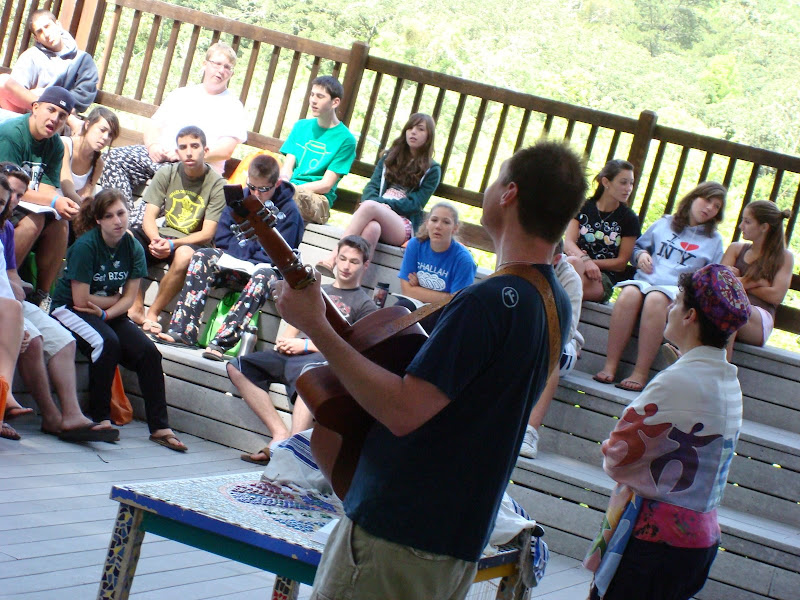
I’m sitting here in the middle of a Jewish summer camp, Santa Rosa, CA’s URJ Camp Newman, which has had its share of the flu cases.  And while the camp leadership made the prudent decision to postpone the start of camp, ultimately canceling the first session, I must confess that much of camp goes on normally. 

[Non-medical observation: there seems to be relatively very little of this swine flu at camp.  It appears that at any one time, only only about five to ten are either sick
or in the recovering/isolation phase.  At this point (ptew, ptew, ptew – I spit on the notion), there is no mass infection…  Given that on any given day at camp during any given summer there are that many or more with other types of illness, we are doing pretty good.  Ptew, ptew, ptew.  By the way, the leadership of this camp has been amazingly proactive, prudent and open – see Thanks May be Kosher Even if Swine is Not.]

You see, though there are moments when the flu is miserable; most who have had it are saying it is just 24-36 hours of fever and aches are uncomfortable, but then the worst is over and the next 4-5 days is just waiting until the contagion period has passed.  Amazingly, the main compaint to this separation period was that it was boring.  So our ad hoc bikur cholim (visiting the sick) committees responded by delivering DVDs and Subway sandwiches, organizing private concerts with Dan Nichols, visiting from a distance,” and arranging for the recovering group to dress in white to attend Shabbat services.  You see, there is no “Whine” in swine.  Especially once you realize that you can still have fun at camp in the midst of the recovery.  Its the one time that “separate but equal” may still have some meaning…

Still, camp runs well on its “new normal”.  We have pool time (breicha) and meal time (aruchat erev), CIT and Avodah leadership sessions and more. 

Shabbat Is Spiritual
So when Shabbat came and went for the 270+ staff, faculty, CITs (counselors in training) and Avodahniks (11th grade leadership track), it still felt like the Camp Shabbat we look forward to each year.  It was relaxing.  It was mystically magical.  After a period of worrying about what would ultimately happen when this dreaded flu hits the camp, Shabbat at Camp Newman brought with it an important Torah lesson: There’s No “Whine” in Swine!

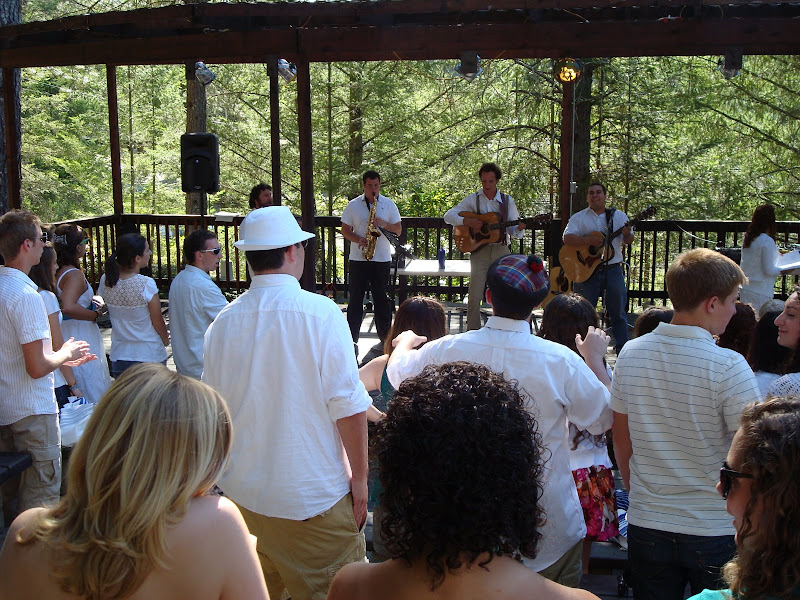
As the pictures evidence, Shabbat was as beautiful as ever.  Dressed in white, we gathered with the songleaders in the Beit Tefilah, our outdoor amphitheater chapel.  With beautiful pines in the background and a gorgeous blue sky overhead, we sang our songs of praise and offered words of thanks, to the Holy One.  Later that evening, we had our sweet song session on the basketball courts and Israeli dancing too.  The Shabbat was about as amazingly spiritual – “normal summer camp” as ever – with just three additions:

  • New Kind of Mechitza: We had separate seating (still mixed by gender), placing  staff who had been exposed during staff week over here, while CIT’s and Avodanikim – who had not – sat over there.
  • Nefesh section: the far back rows, a distance from the staff seating, were designated for the those whose souls (nefesh=soul) needed inspiration, while their bodies continued to move through the seven day flu isolation period
  • Special Prayer: We added a prayer, Mi Shebeirach, for all those who are ill or recovering, as well as for all of us who had to shelve hopes one kind of camp summer and replace them with goals for a different, though ultimately equally meaningful, camp summer. 

The rabbi (me), for his story, dressed up like Moses, who carried on a cell phone texting conversation with God, about what to do with the detrius of the first set of 10 commandment tablets.  While the second set was whole and holy, what about the broken pieces of the first set?  Weren’t those broken pieces holy as well?  Under God’s guidance, Moses decided to place those broken pieces within the ark as well; broken and whole residing together in holiness. 

Moses then helped us realize that the broken first tablets represented the brokenness we all feel: from those whose bodies are/were temporarily broken by the flu, those whose hopes were shattered for a camper-filled first week, those whose sleep was interrupted as they worked tirelessly to ensure that those in camp were safe and those who would ultimately come up to camp would be cared for and equally safe, those campers and their families from the canceled first session whose dreams for a few weeks at camp were destroyed by the need to make responsible, prudent decisions, and those of the staff whose painstaking prepared plans for the summer had to be reconsidered and restructured. 

Moses invited us all to close our eyes, envision a summer goal/hope that to be put aside and then to envision a new hope/goal for the remainder of the summer.  Moses then asked us to place both within the holy space in our hearts, those place marked sacred for summer camp.  Like Moses did with the two sets of tablets, let us carry both of them – broken dreams and new hopes – side by side. 

At summer camp, there’s no “whine” even amidst the swine, because everyone – those who are healthy and those who are not, those in recovery and those helping them recover – worked together to make it a spiritual, summer camp shabbat. 

When we placed tallitot over our heads, creating a physical manifestation of the sukat shalom (the shelter of peace) that we pray about in the Hashkeeveinu prayer, we all knew that we were blessed: blessed to be here, blessed to have healing come speedily, and blessed that summer camp life continues.  Because there is no “whine” in swine.

BTW, Rabbi Rick Winer’s Divrei Derech blogs about how things are returning to normal here at Camp Newman