Category: blog archive

Why Do We Need to Use a Shamash Candle?

8 Blogs for 8 Nights of Chanukah
Blog #4: Making Chanukah Come Alive, Four Nights Later

Question: Why do we need to use a candle – the Shamash (helper) candle – when we can just as easily use a match to light the Menorah?

It has to do with the “Way of the Long Pole.”

Some background: Back in Biblical times, in the outer chamber of the ancient Jerusalem Temple, the Menorah stood in a special area called the heichal (sanctuary). The Menorah was a five-foot, seven branched candelabra of pure gold. Every morning, a kohen (priest, member of the Israelite clergy) filled the menorah’s lamps with the purest olive oil; in the afternoon, he would climb a three-step foot-ladder to kindle the menorah’s lamps. The flames burned through the night, symbolizing the light of the Holy One radiating throughout Israel and the world.

Interesting Pair of Factoids:

  • Actually, it did not have to be a priest (kohen) who lit the menorah. The Jewish law states that an ordinary layperson could also perform this mitzvah.
  • But there was also a law that restricts entry into the ancient Jerusalem Temple’s Sanctuary to priests only. In the ancient world, ordinary Israelites could venture no further than the azarah (Temple courtyard).

These two ancient laws created a legal paradox: a layperson can light the menorah; but the menorah’s designated place is inside the Sanctuary, where a layperson could not enter.

Talk about inconsistencies:

  • If an ordinary person should be able to light the Menorah, why doesn’t Torah instruct us to place And if the sanctity of the ancient Menorah is such that it requires the higher holiness found in the sanctuary, why does the Torah permit someone without a kohen’s level of holiness to light it?

This paradox, teach the Chassidic rebbes, is intentionally set up by the Torah in order to convey to us a most profound lesson. You are here, and you want to be there (“there” being someplace better, loftier, more spiritual than “here”). But you are not there, and cannot get there for a good while, perhaps ever.

So what do you do? Do you act as if you’re already there? Or do you tell yourself that here’s just fine, and who needs there anyway? You could, of course, become a hypocrite, or you could come to terms with the limitations of your situation. But there’s also a third option – the Way of the Long Pole.

The solution – the “Way of the Long Pole” – is that a layperson could light the menorah by means of a long pole. This ordinary Israelite stands outside the ancient Sanctuary, extends to the Menorah a long pole with a flame on the end, and thereby lights the Menorah.

What a great solution to a spiritual problem!

The lesson of the long pole says that we should aspire to spiritual heights that lie beyond our reach. We should not desist from our efforts to reach that place. Even when we worry that we, ourselves, will never be “there,” we can still act upon places in the distance, influencing them, and even illuminating them.

At times, this means that someone closer to those places – to the Menorah – needs to reach over and light it for us. At other times, it means that we contrive a way to reach beyond where we are at the present time. In either case, we turn to (or turn into) a “lamplighter,” a person who carries a long pole with a flame at its end and goes from lamp to lamp to ignite them; no lamp is too lowly, and no lamp is too lofty, for the lamplighter and his pole.

The shamash candle reminds us of the Way of the Long Pole. This Chanukah, if you are gathered with a group without the ability to physically get close enough to light the Menorah, allow others to illumine for you the way to a higher spiritual place. If you are able, let the shamash candle be your “long pole,” transforming you into the “lamplighter,” illuminating the way ahead. Either way, may this Chanukah be an inspiring one for you and your loved ones.

[Now read my post about being a Lamplighter.]

  • For Chanukah Resources to enhance your celebration – songsheets, blessing sheets, 8 Nights of Chanukah Tzedakah, 8 stories, and more – go to www.orami.org/chanukah
  • Come back each night to the blog (http://rabbipaul.blogspot.com) for more 8 Blogs for 8 Nights: Answers to Questions You Never Thought About, which enhance your understanding of Chanukah.
  • If you would answer today’s question differently, or have other Chanukah ideas/questions, please share your insights in a comment. I will make a donation to tzedakah for every comment written.

[Adapted from A Long Pole, an article by Yanki Tauber]

How Can We Make Our Ritual Uplifting and Meaningful?

8 Blogs for 8 Nights of Chanukah
Blog #4: Making Chanukah Come Alive, Four Nights Later

Question: Everyone is kvetching that we should just light and give gifts. How Can We Make Our Ritual Uplifting and Meaningful?

As you are gathering around the candles, before you light them, view one of these videos on a computer, laptop or iPod:

Remember, Chanukah – like all Jewish holy days – deserves the kavod (respect) and simcha (joy) that modern technology, teaching techniques and entertainment offers. Liven up your celebration every night!

  • For Chanukah Resources to enhance your celebration – songsheets, blessing sheets, 8 Nights of Chanukah Tzedakah, 8 stories, and more – go to www.orami.org/chanukah
  • Come back each night to the blog (http://rabbipaul.blogspot.com) for more 8 Blogs for 8 Nights: Answers to Questions You Never Thought About, which enhance your understanding of Chanukah.
  • If you would answer today’s question differently, or have other Chanukah ideas/questions, please share your insights in a comment. I will make a donation to tzedakah for every comment written.

What Happened Historically Back in Israel During the Time of the Maccabees?

8 Blogs for 8 Nights of Chanukah
Blog #3: The True Story of Chanukah: Complex, Bloody, Challenging

Question: Chanukah Is About More than Lights and Menorah. What Happened Historically Back in Israel During the Time of the Maccabees?

David Brooks (NYTimes columnist) writes in his article titled The Hanukkah Story:

Tonight Jewish kids will light the menorah, spin their dreidels and get their presents, but Hanukkah is the most adult of holidays. It commemorates an event in which the good guys did horrible things, the bad guys did good things and in which everybody is flummoxed by insoluble conflicts that remain with us today. It’s a holiday that accurately reflects how politics is, how history is, how life is.

It begins with the spread of Greek culture. Alexander’s Empire, and the smaller empires that succeeded it, brought modernizing ideas and institutions to the Middle East. At its best, Hellenistic culture emphasized the power of reason and the importance of individual conscience. It brought theaters, gymnasiums and debating societies to the cities. It raised living standards, especially in places like Jerusalem.

Many Jewish reformers embraced these improvements. The Greeks had one central idea: their aspirations to create an advanced universal culture. And the Jews had their own central idea: the idea of one true God. The reformers wanted to merge these two ideas.

Urbane Jews assimilated parts of Greek culture into their own, taking Greek names like Jason, exercising in the gymnasium and prospering within Greek institutions. Not all Jews assimilated. Some resisted quietly. Others fled to the hills. But Jerusalem did well. The Seleucid dynasty, which had political control over the area, was not merely tolerant; it used imperial money to help promote the diverse religions within its sphere.

In 167 B.C., however, the Seleucid king, Antiochus IV, issued a series of decrees defiling the temple, confiscating wealth and banning Jewish practice, under penalty of death. It’s unclear why he did this. Some historians believe that extremist Jewish reformers were in control and were hoping to wipe out what they saw as the primitive remnants of their faith. Others believe Antiochus thought the Jews were disloyal fifth columnists in his struggle against the Egyptians and, hence, was hoping to assimilate them into his nation.

Regardless, those who refused to eat pork were killed in an early case of pure religious martyrdom.

As Jeffrey Goldberg, who is writing a book on this period, points out, the Jews were slow to revolt. The cultural pressure on Jewish practice had been mounting; it was only when it hit an insane political level that Jewish traditionalists took up arms. When they did, the first person they killed was a fellow Jew.

In the town of Modin, a Jew who was attempting to perform a sacrifice on a new Greek altar was slaughtered by Mattathias, the old head of a priestly family. Mattathias’s five sons, led by Judah Maccabee, then led an insurgent revolt against the regime.

The Jewish civil war raised questions: Who is a Jew? Who gets to define the right level of observance? It also created a spiritual crisis. This was not a battle between tribes. It was a battle between theologies and threw up all sorts of issues about why bad things happen to faithful believers and what happens in the afterlife — issues that would reverberate in the region for centuries, to epic effect.

The Maccabees are best understood as moderate fanatics. They were not in total revolt against Greek culture. They used Greek constitutional language to explain themselves. They created a festival to commemorate their triumph (which is part of Greek, not Jewish, culture). Before long, they were electing their priests.

On the other hand, they were fighting heroically for their traditions and the survival of their faith. If they found uncircumcised Jews, they performed forced circumcisions. They had no interest in religious liberty within the Jewish community and believed religion was a collective regimen, not an individual choice.

They were not the last bunch of angry, bearded religious guys to win an insurgency campaign against a great power in the Middle East, but they may have been among the first. They retook Jerusalem in 164 B.C. and rededicated the temple. Their regime quickly became corrupt, brutal and reactionary. The concept of reform had been discredited by the Hellenizing extremists. Practice stagnated. Scholarship withered. The Maccabees became religious oppressors themselves, fatefully inviting the Romans into Jerusalem.

Generations of Sunday school teachers have turned Hanukkah into the story of unified Jewish bravery against an anti-Semitic Hellenic empire. Settlers in the West Bank tell it as a story of how the Jewish hard-core defeated the corrupt, assimilated Jewish masses. Rabbis later added the lamp miracle to give God at least a bit part in the proceedings.

But there is no erasing the complex ironies of the events, the way progress, heroism and brutality weave through all sides. The Maccabees heroically preserved the Jewish faith. But there is no honest way to tell their story as a self-congratulatory morality tale. The lesson of Hanukkah is that even the struggles that saved a people are dappled with tragic irony, complexity and unattractive choices.

Now read Rabbi Paul Kipnes’ Chanukah as the Second Sukkot: True Story of Chanukah

[Reprinted from David Brooks (New York Times), The Hanukkah Story, December 2009]

  • For Chanukah Resources to enhance your celebration – songsheets, blessing sheets, 8 Nights of Chanukah Tzedakah, 8 stories, and more – go to www.orami.org/chanukah
  • Come back each night to the blog (http://rabbipaul.blogspot.com) for more 8 Blogs for 8 Nights: Answers to Questions You Never Thought About, which enhance your understanding of Chanukah.
  • If you would answer today’s question differently, or have other Chanukah ideas/questions, please share your insights in a comment. I will make a donation to tzedakah for every comment written.

With Only Enough Oil for One Day, How did the Jews React as Nightfall Approached?

8 Blogs for 8 Nights of Chanukah
Blog #2: Miracle Meditation for the Second Candle and the Second Day of Chanukah

Question: With only enough oil to last for one day, how did the Jews react as nightfall approached at the end of that first day?

The miracle of the second candle is one of surprise, joy, and delight. With the benefit of hindsight, and with the story so entrenched in Jewish culture and consciousness, we have to work to imagine the anxiety, shock and celebration that must have ensued when the light burned past its time.

Picture the scene: Jews are gathered around the newly purified Jerusalem Temple. They hold one another, celebrating the victory, supporting one another over the losses. Nonetheless, they are keenly aware that the flame is about to go out in the Menorah. They feel the sadness that the oil, enough for one day, is almost fully consumed. This represents another loss, another bit of damage inflicted by Antiochus’ Assyrian-Greeks. Still, they congregate around the Menorah. This Jewish community wants to bask in the Light and celebrate the victory for as long as it will last.

During times of anxiety, people react in different ways.

For some, tension makes tempers flare. We imagine debates breaking out among the Maccabees over whether to continue fighting for complete political independence, or to be satisfied with having beaten the enemy back. Failing to appreciate the renewed light emanating from the Menorah, they begin arguing: “We have our menorah back: purify the oil, focus on holy, and light the flame of faith again.” “No, we must instead endure more darkness. Therefore, purify the oil, focus on the holy, and don’t abandon the fight until it is done.”

For others, miracles abound in every moment. For them, recognition grew that just being there – in Jerusalem, at the Temple, in front of the Menorah, was miraculous enough. They thought that it was foolish to waste precious moments arguing when the Light, so finite, was about to go out. They separated from the debaters to find comfort and strength in the illumination of the Menorah. And then…

Before anyone realized it, a buzz starts to go through the crowd. First one person and then another realized that the flame had been burning “too long.” There was more light, more hope, than they had dared to expect. Soon everyone was cheering and singing. The Light would not go out! The political choices were still before them, but the spiritual promise mattered more. The Light will not go out!

Tonight, as you light the second candle of Chanukah, strive to be like those who take comfort in the Light of the Menorah. Take care not to rush through the candle lighting. Take time to chant blessings, to sing songs. Tell the story if you did not tell it last night. Cherish light. Cherish family and friends. Recount the miracles, the joy and the surprises of your life.

Perhaps take a few quiet moments in front of the second candle or during the second day of Hanukah and consider:

  • What are the miracles of joy, surprise, and delight in your life?
  • Was there a time when you were you recovering from loss, or preparing to face an uncertain future, when you got a gift – a sudden surge of hope, of Light, a promise for the future?

For Chanukah Resources to enhance your celebration – songsheets, blessing sheets, 8 Nights of Chanukah Tzedakah, 8 stories, and more – go to www.orami.org/chanukah

Come back each night to the blog (http://rabbipaul.blogspot.com) for more 8 Blogs for 8 Nights: Answers to Questions You Never Thought About, which enhance your understanding of Chanukah. If you would answer the question differently, share your insights in a comment. I will make a donation to tzedakah for every comment written.

[Adapted from Miracle Meditations for Chanukah by Rabbi Debra Orenstein]

Jacob, Joseph and His Brothers: A New – Challenging – Interpretation

Rabbi Judith Abrams PhD., of Maqom (a school for Adult Talmud Study) shares insights into Torah. Her insights open our eyes and hearts to a new take on familiar story. Her vision offers much to those who are content to rest on assumptions about family patterns. She reminds us that one of the strengths of the biblical narrative is its ability to challenge us to reconsider difficult situations.

[Originally posted on Tzei u’Lmad: A Blog of Continuing Jewish Education]

Rabbi Abrams asks us to consider…

One of the glories of Torah is that it speaks in so many different languages all at once. This includes the story of Joseph. The story of Joseph and his brothers is usually framed, in fact is presented in the Torah text, as a tale of brotherly hostility, however greatly regretted later. But there is another possible interpretation that lies beneath the surface of the story. It’s just one of many possible interpretations, and one that may be uncomfortable to contemplate but which, I think, has textual evidence to support it.

We begin with the striped coat, the kutonet passim. There is only one other person in Tanach who has such a garment: Tamar. We learn that she has such a garment after she is raped by her half-brother Amnon (II Samuel 13:10-19). After this rape, she tears her robe and puts ashes on her head. There (II Samuel 13:18), we learn that only royal virgin daughters wear such garments. Tamar, apparently, feels that she is no longer entitled to wear these robes. It is against this background that we must look into Joseph, his coat, and what became of him and it.

By the time that Jacob gives Joseph his striped coat, his mother, Rachel, has been dead for many years: she died on the way back from Padan Aram, giving birth to Benjamin. Joseph’s story begins (Genesis 37:1) when he is seventeen years old. There, we learn that Israel loved Joseph more than all his other children and gives him a coat; a coat that we later learn should only be worn by royal virgins. The only other person who has such a coat is sexually abused by a relative. Therefore, we could imagine that Joseph is sexually abused by a relative…by that relative who gave him the coat…by his father. When we see Joseph’s story from this starting point, the rest of his story begins to make much more sense.

From this perspective, what the brothers do is heroic, not evil. They see the abuse. One child is singled out, as we see happen in such present-day situations. The brothers decide to help Joseph get away from his abuser by sending him to Egypt (Genesis 37:18-33). The brothers liberate him from his striped garment, the symbol of his shame and abuse, and return it to their father, as if to say, “We know what you did to Joseph and we have stepped in to stop it. We won’t let you abuse any of us again so you can keep this coat.” Jacob is distraught in the extreme, tearing his own clothes and covering his head with ashes (Genesis 37:34-35).

the lower antelope slot canyon near pageThis is odd. When Rachel dies, he buries her by the road, sets up a few stones to mark the spot and then continues on his journey (Genesis 35:17-21). He is not described as mourning her and we are never even informed of the deaths of Leah and the two handmaidens. But Joseph, Jacob mourns dramatically. Is it because he lost his replacement for Rachel or because of his own sense of guilt and shame or, perhaps, both?

Whatever the case, Joseph’s subsequent life is marked by the signs of earlier sexual abuse. He falls prey to Potiphar’s wife (Genesis 39:6-8). Childhood victims of sexual abuse tend to be abused later in life, as well. Joseph displays this tendency. Joseph also has a tendency toward self-aggrandizement, which, in this interpretation, could be a coping mechanism to help him deal with the abuse he has suffered.

Once Joseph is completely secure in his position in Egypt, utterly defended by wealth and position, he does not send word to his family to bring them to Egypt. He does not feel safe. In fact, he betrays his sense that his father is still a threatening presence in his life in the moment that he reveals himself to his brothers. He asks, “Is my father still alive? (Genesis 45:3)” Given the theory we are exploring, the import behind the question becomes clear: he is asking if he is released from his bondage of fear and shame. He is asking if his father is dead so he can finally feel safe. He sends his brothers back home with enough wealth that they need not come back to Egypt for quite some time, if ever.

Even when he finally sees Jacob again, Joseph still does not feel safe. He presents himself with a retinue and with all the trappings of his office (Genesis 46:29). The wording of the meeting is ambiguous. It could be read as Joseph falling on Jacob in tears. Or it could be the other way around. It is easy to imagine that Joseph would inwardly cringe at any contact with his tormenter; no matter how contrite and powerless he might appear. Any survivor of childhood abuse knows that it is only with the death of the abuser that one feels finally, utterly safe from him or her.

Even then, Joseph is careful to keep his father at arm’s length. He has Jacob settle, not with him, but in Goshen (Genesis 47:4). He sees Jacob only at the very end of Jacob’s life (Genesis 48:10-22). Doesn’t this seem odd? Joseph was second only to Pharaoh in power. He could have seen Jacob at any time. But Joseph avoids him assiduously.

What does this reading of Joseph’s story bring us? I offer this interpretation of Joseph’s story not to shame Jacob but to elevate the brothers and to understand what could be motivating Joseph’s actions. In addition, this interpretation can help those who experience sexual abuse or who are recovering from it. I also believe that the tie with Tamar’s story is too deliberate to be ignored. Does it cast our patriarch in a bad light? Yes, but that’s hardly new. Jacob is a profoundly flawed individual who doesn’t seem to respect boundaries at any time in his life. It is not difficult to imagine that he might not respect Joseph’s boundaries, as well. I hope this possible interpretation of Joseph’s story offers comfort to those who may be dealing with family abuse.

8 Blogs of Chanukah: Why did Antiochus’ army ruin all the oil in the Jerusalem Temple?

8 Blogs for 8 Nights of Chanukah
Blog #1: Oil and the Secret of the Jew

Question: Why did Antiochus’ army ruin all the oil in the Jerusalem Temple?

When Antiochus’ Assyrian-Greeks entered the Jerusalem Temple, they contaminated all the oils that were in the Temple. One would expect them to plunder the Temple’s gold and silver, the precious stones, as is the custom of warriors — yet the Talmud makes no mention of this type of pillaging. What possessed the Assyrian-Greeks to single-mindedly go about desecrating the oil, and with such thoroughness that it was only through a miracle that one jug was left untouched?

Oil played an important role in the Temple. It was used in special offerings and to fuel the Menorah. The Kohen Gadol (High Priest) and kings were anointed with it. What is special about oil?

The Kabbalists (Jewish mystics) point to oil’s refusal to mix with other liquids. Oil always rises to the top. It is a liquid that embodies transcendence, holiness. In Kabbalistic terms, oil is the embodiment of that aspect of the soul that relates to the Holy One in a manner that transcends intellect. Oil is the intuitive love and commitment of the soul to God that is not bound by the strictures of rationality and reasoning.

It was the “oil” aspect of the Jew, our commitment to God/godliness/holiness, that the Assyrian-Greeks could not abide. Our devotion to ethical living. Our commitment to social justice. Our Torah-based demand that we and the world live in a way that brings into the world tzedek (justice), emet (truth), ahava (love) and shalom (peace). When each of my actions is Godly-deed, an act that is bigger than me, that then becomes threating to those who would taint the world with egotism, self-indulgence and fear.

And so Antiochus’ armies went after the oil. Every enemy goes after the life-source of their opponent — the wells, the food stocks. The Assyrian-Greeks went after the oil. For therein resides the secret of the Jew.

This Chanukah, as you light candles (even if they are fueled by wax instead of oil), remember that we celebrate – in part – because of the triumph of holy living, ethical living, over self-interest, egotism and fear.

Come back each night to the blog for another of these 8 Blogs for 8 Nights: Answers to Questions You Never Thought About, which enhance your understanding of Chanukah. If you would answer the question differently, share your insights in a comment. I will make a donation to tzedakah for every comment written.

For Chanukah Resources to enhance your celebration – songsheets, blessing sheets, 8 Nights of Chanukah Tzedakah, 8 stories, and more – go to www.orami.org/chanukah

[Adapted from Victory of Light – Mitzvat Ner Chanukah 5738/1977, a discourse by Rabbi Menachem M. Schneerson.]

The More Tzedakah, The More Peace

Why give of our time and energy to others? 

Jewish tradition teaches in Pirkay Avot (the Talmudic Teachings of our Ancestors) that the giving of tzedakah (charitable donations or the gift of our time) increases the shalom (peace) in our world.  Experiences over the past weekend, hearing from Or Ami congregants who gave of their time and energy, provided a wealth of evidence of the validity of this teaching.

So many people gave the tzedakah of their time:

  • Chaperoning Foster Care kids (previously strangers to them) during our award-winning Foster Kid  Childspree
  • Playing with children with disabilities at Brandon’s Village, a universally accessible playground
  • Delivering sufganiot (jelly-filled donuts) to fellow congregants in celebration of Chanukah

To read their email reflections on the experience is to understand that when we give of ourselves to others, we are filled with a warm sense of wonder and, yes, shalom (here translated as “wholeness”).  Next time you are wondering if you have enough time to give, to volunteer, remember these reflections and ask yourself instead  “Do I have enough shalom (peace/wholeness) in my life?” Then go volunteer – because it is right (tzedek) and because it is good for you!

  • Lucille Goldin, Vice President (Calabasas resident): I was honored by shopping with a young mother who has a five month old baby girl. Her first question was can I put my money with my babies to get her a stroller as I really need one because she is getting very heavy to carry. Kohl’s doesn’t carry strollers. She then told me how cold it was were they lived because the walls are very thin, I didn’t ask, we just made sure to get the baby some very warm sleepers and warm clothes.  Between the sale Kohl’s had and our coupons we not only did well for her daughter but were able to get her some jeans, and shoes which she so desperately needed.  Today I am going to Babies are Us to get her a stroller and I plan to drop it off with Lovette who will see it gets to her case worker for delivery to her.  When we said goodbye yesterday her mother said in Spanish (which she translated) God bless me and was tearful. I hugged her mother and went to hug her.  She was hesitant at first and I could see she was on the verge of tears.  She did in fact give me that hug and then broke down and cried so overwhelmed from the bags she was carrying out of the store.  I believe this will be the nicest gift I receive this year.  It really is a gift to be able to help others. 
  • Jill Marder-Meyer (Westlake Village Resident): Foster Care Childspree is an incredible occurrence and, as always, my daughter and I had an wonderful time participating.  We chaperoned a 9 year old boy who had a great time buying shoes, a necklace for his mother and a remote control helicopter for him to play with his father in the park. Though we encouraged him to buy warm clothes or other essentials, he said he didn’t need them. …He was happy to have the belt, shoes, hat and gifts that, without Childspree, he wouldn’t have been able to get.  Not only did he take his money to buy things for his Mom and Dad.  He asked me if I liked this job. I said, “I love it, why?”  He said, “I just wanted to know.”  He then asked us if we needed anything, he would buy it for us. How warm to have a 9 year old boy caring about others and not just what he could have for himself. What a mitzvah for us to be able to participate in this event.  Thank you Kim Gubner (Childspree organizer) and Congregation Or Ami for allowing us to be a part of this.
  • Randee Hilborne (Los Angeles resident): Five of us chaperoned a 3 year old girl (her brother was the 9 year old that Jill wrote about!) and we shopped with her and her mother! I spoke in length with the mom and she was so appreciative of all we were doing for her kids.  I also met the grandmother as well who couldn’t stop thanking us. The little girl was adorable-loved with my two kids and loved being with the other two high school friends we brought along. She was so fun and was so happy to be able to pick out things. She couldn’t stop talking about her “princess dress” and her “Dora light up” shoes!! She was so proud and excited; she was really bubbling over with pride! Her mom was a doll and we took her phone number.  She told us that her kids loved to read and so we decided as a family that we are going to share some of our books with them. You just cannot help but become attached to your families you are with and just want to give and give! We are so blessed to be part of the Congregation Or Ami community and everything we do to help out others. …  I actually met a shopper in Kohls who asked me what we were doing. She asked about Or Ami was so touched and thought how wonderful it was what we were doing. That really meant a lot to me and made me feel so good inside. Also, met one of Kim’s friends who is not a member of Or Ami and just decided to donate and be part of the shopping spree.  She felt so blessed … and also honored to be part of what we were doing for the community.  Childspree was an incredible day as always!
  • Andrea Setterstrom, non-member: I was fortunate to be asked by my very best friend, Lucille Goldin to share in this wonderful Childspree event.  Although I am not of the Jewish community, I was proud to be included amoung such admirable people who gave of themselves with either their organizational skills,  time, money or treats.   You opened your hearts to every person, needy or volunteer who was present.  I was the second volunteer to meet my recipient.  He was a nine year old boy who was as cute as you could imagine. I thought I might get some insight into what sort of things he needed by asking questions about school, sports, etc.  What I learned is that he was very determined not to get what I thought he needed but to get ONLY what he liked…TOYS.  He didn’t wear jeans, sweats, hoodies, long sleeve shirts, shorts, hats, belts or anything that wasn’t black.  He didn’t need socks, undies or shoes.  What he needed was a remote controlled helicopter, a baseball and a star wars figurine.  After much negotiation, we compromised and he had a ball filling my arms with the baseball, helicopter, star wars figurine and some much needed t-shirts, pajamas, and a very special gift for his sister complete with wrapping paper and a musical card.  He was so proud of his accomplishment and when we met his 22 year old sister at the end, she was absolutely shocked to see clothes in his bag.  I have no doubt that he is the proudest of the special heart necklace for his sister who takes care of him; he promised to hide the gift until Christmas. What I discovered was that my arms were filled with much more than the items he purchased.  They were filled with the joy of experiencing this special moment with my new friend who could not hug me enough when the evening came to a end.  He even insisted on serving me refreshments while I was standing in line to pay for his purchases.  What a gentlemen!  He has stolen my heart as have all of the people who put this event together.

No less than 36 times does the Torah command us to care for the stranger.  As I teach over and over again, that is more than the amount of times it tells us to celebrate Shabbat, keep kosher or do just about anything else.  Our participation with Childspree – under Kim Gubner’s inspirational leadership – ensured that we continued to fulfill this mitzvah, even in the midst of an economy that might have given any of us an excuse to turn inward instead of outward.  Our tzedakah – our time and charitable donations – brings a sense of peace to those receiving the gifts and to those who chaperon others.

Congregation Or Ami shines because of people like these volunteers – who turn inward to help each other and reach out to help those most vulnerable outside our community. 

What Does a Vibrant Jewish Community Look Like?

This past Friday to Sunday, the light of Or Ami was shining brightly.  Just thinking about how so many people participated in so many programs, projects and simchas energizes me. 

Dealing with Difficult People: Friday 11:00 am-2:00 pm
I often say that the reason Or Ami is so warm and welcoming is, first and foremost, because our staff embodies the values of Henaynu (we are here for each other).  It is all about the warm way they answer the phones, the caring way they help people through crises, and the humane way we deal with financial or educational issues.  How does a synagogue staff deepen its ability to embody our most cherished values?  Friday, our entire office and program staff gathered at Cantor Doug Cotler’s home to reflect upon how we deal with challenging issues or challenging people. It is not enough to say “this is the policy” or “you are being mean” or “that’s just the way it is.”  A caring community responds with caring even with people who are not being caring, because we recognize that personal pain can cause people to lash out.  So we studied Jewish texts on Tochecha (how to respond to those who are rebuking/yelling); we reflected upon case studies from synagogues and camps around the country.  We created Ten Commandments of Dealing with Challenging People.  How wonderful to take the time to reflect, so that the caring can deepen and the congregation can benefit.

Remembering Biggie: Friday, 4:00-5:00 pm
We memorialized Grandpa Biggie, the larger than life storytelling father of our congregant.  Stories about him were enthralling.  The Cantor’s music was comforting.  Being with the Or Ami community during this time of sadness offered comfort and strength.  May his memory be for a blessing.

Rethinking the Rape of Dina: Friday, 7:30-9:00 pm
Someone once said that Reality TV must have been created by Jews since the beauty and brilliance of Torah is that it discloses both the perfection AND the blemishes of our ancestors.  At Adult Study Shabbat services, we studied the Rape of Dinah, from the WRJ’s Women’s Torah Commentary. It is a horrifying, often skipped-over story describing the rape and silencing of Jacob and Leah’s daughter and the subsequent rampage of retribution and death that followed.  How important it felt to give voice to Dinah whose voice is not heard in Torah! Dinah, like so many other raped women around the world, need their stories to be told. We announced the new Save Congo project of Jewish World Watch, which focuses in part on helping vast villages of women who are being raped as part of a concerted effort by the guerrillas and militia. 

First Steps on the Road to Jewish Adulthood: Saturday, 10:00-11:45 am and 4:00-5:45 pm
If you have not attended one of Or Ami’s B’nai Mitzvah services, you are missing an inspiring experience. I am constantly impressed by how Cantor Cotler finds ways of getting everyone to sing and smile.  Our young people, so well prepared by our B’nai Mitzvah teacher Diane Townsend, lead with confidence and excitement.  Their divray Torah (speeches) expressed important and relevant lessons from the Torah. Guests talk about the warm personal feeling of the services; they compliment how much of the service (most of it) our Reform Jewish teens lead.

Brandon’s Buddies: Saturday, 10:30 am-1:00 pm
Opening the community to all people, regardless of a person’s challenges or disabilities, is a core value at Or Ami. That’s why we support Brandon’s Buddies,a program of The K.E.N. Project, a non-profit organization run by Dina Kaplan.  Brandon’s Buddies is a free play date on the first Saturday of every month at Brandon’s Village (a universally accessible playground) at Gates Canyon Park in Calabasas.  It offers children with and without disabilities the opportunity to play together.  Congregation Or Ami sponsors the playdate four times per year.  As sponsor, we provided arts and crafts activities, face painting, snacks, and other activities like basketball or singing for the kids to enjoy.  As Dina Kaplan wrote, Or Ami coordinator Helayne Sharon and all the other volunteers were fantastic!  We had a huge turnout and it was lots of fun for all the kids.  Even the teenagers (especially the boys) said that they had a really good time.

Building Friendships while Running All Over the Mall: Saturday, 12:30-4:00 pm

Our teen youth group gathered at the Topanga Mall for socializing, fun and group building.  As they followed clues that led them from one end of the mall to the other, the participants deepened friendships.  As significant were the activities that occurred behind the scenes, under the nurturing guidance of LoMPTY advisor Michelle Westmiller.  Our youth board – mostly sophomores in high school – brainstormed, planned and facilitated programs for their peers.  Our Union for Reform Judaism has discovered that future Jewish leadership gain many of the most important leadership skills during program planning in Temple youth groups. 

Shopping for 50 Kids with Someone Else’s Money: Saturday, 4:00-6:30 pm

Or Ami arranges two Childspree Shopping sprees during the year, one for Back to School supplies and clothes in the summer and one for the Holidays in December. These events take place at Kohl’s department store. In the early years, Meryvn’s has donated $100 gift cards for the Back to School event. These days, congregants donated $100 per child. Or Ami adults and children, organized by chairperson Kim Gubner, volunteer their time by chaperoning the 50 foster children through the store and helping them shop. For some of these foster children, this shopping trip represents the only time in the year that they can go shopping for themselves.  The beauty of Childspree is that it difficult to know who is helping who. The smiles on the volunteers’ faces are as bright as those of the children picking out new things. We met 20 year olds raising young boys following the death of their mother, new moms who did not even own a stroller, and a 9 year old boy who had a great time buying shoes, a necklace for his mother and a remote control helicopter for him to play with his father in the park.

Re-Building a Golden Calf: Sunday, 9:00-11:30 am

When the Israelites built and worshipped the Golden Calf, they broke trust with God (and Moses) in so devastating a way as if they were a bridegroom who engaged in adultery on the eve of his marriage.  After reliving the Golden Calf debacle, our students and their parents explored the Torah story to see how God, after getting very angry, worked with Moses to rebuild the relationship with the Israelites.  Adults viewed the G-dcast video.  We all discussed apology and forgiveness, about confession and restitution, and about how one rebuilds broken trust. 

1,480 Jelly Donuts: Sunday, 11:30 am-1:00 pm
The day ended with deliveries of sufganiot (fried jelly donuts), delivered by volunteers to all Or Ami congregants and faculty.  In Celebration of Chanukah, the Festival of Rededication, Or Ami sends sweetness to our extended family.  In Israel, Jews eat jelly-filled dough, friend in oil, in remembrance of Chanukah’s miracle of oil.  We offer hope that during this darkest season of the year, we all find ways of illuminating the good and caring in the world.  Attached to each box of sufaniot is a multicolored brochure offering links to our online resources to light up their Chanukah celebrations. 

Kvelling about Your Jewish Experience at Temple

In so many synagogues around the country, people know how to kvetch complain) more than they know how to kvell (offer praise). At Or Ami, we have learned that if we invite people to share their Or Ami moments – experiences worth kvelling about – we discover quickly that we are touching people’s lives in deeply spiritual ways.

I received this email from an Or Ami family, and with their permission, share it here. I’m kvelling at their kvelling. (If you have an Or Ami moment to share, please add it in the comment space below.)

November 2009

Dear Rabbi Kipnes,

I am not quite sure where to start. Daniel and I joined Congregation Or Ami with our kids Zach and Jacqueline just over 2 years ago. From the very start, we were welcomed with open arms. We joined the congregation because some of our very best friends were members. We were looking for a place primarily to begin Bar/Bat Mitzvah training for our children. What we got is so much more!!!

Shortly after we joined, my mother, as you know, became very ill. The outpouring of support and caring from our temple friends, to congregants we hadn’t even met, to you, our Rabbi, was astounding. This really was our first real confirmation we knew we were in the right place.

Daniel and I both grew up on Jewish homes, with very little Jewish education. Mine was virtually non-existent. We had all of the traditions and values of a good Jewish home, but I had spent almost no time in a synagogue. Daniel became a Bar Mitzvah, but aside from that, his Jewish education was very limited as well.

So, we knew when we were joining a temple, we needed to find one that fit in with our goals for our children, but yet not be so “Jewish” that we would be intimidated. We did the usual “shul shopping”, and eventually decided upon Congregation Or Ami. Our decision was really based on the fact that some of our very best friends had become members, and oh yea…we kinda liked the Rabbi!

Our first High Holiday services with Congregation Or Ami further proved that we had made the right choice. The services were warm, inviting, inclusive and made someone with as little Jewish background as myself feel comfortable, eager to hear more, to do more, to embrace this “family” that we suddenly were a part of.

Tashlich was another awe-inspiring event that really opened my eyes up to the uniqueness of our temple. The fact that a couple of hundred of us could break bread, share wine and enjoy such an intimate, spiritual affair together on the beach just further discounted any fears we may have had that were not going to fit into a typical temple. This temple, we quickly learned, was anything but typical!

The past year has been so difficult for so many of us. Or Ami has been so responsive and respectful to the needs of its congregants. I was chosen to be part of a special Hayenu committed assembled specifically to make calls and just check in with the congregants to see if they had any general or specific needs or concerns that perhaps we, as a congregation, or you, as the Rabbi, could help with. EVERY congregant was called! Wow! What temple does that? Just as every new congregant gets a Shabbat welcome basket from the congregation and every member family gets donuts and other Hanukkah goodies personally delivered to their home every year. Again…anything but typical.

Nor is it typical that my husband and I were asked to carry the Torah at this year’s High Holiday services. We were certainly not asked because we are big donors. The feeling of support and family from this congregation…from you…is more than we ever could have wished for, hoped for, or certainly expected!

We continue to grow each time we step outside of our comfort zone and attend another temple event or function. While the kids and I raved about Mitzvah Day last year, my husband had to experience it for himself this year to understand the impact and breadth of this amazing community service event. He was like a little kid, racing around to see if he could be the one to complete the most backpacks for displaced foster children.

Today I attended my first Torah study. What do I know about Torah??? So little! But, you know what? I was comfortable, intrigued, engaged, and now eager to return to another one soon! Why? Because of the intelligent, passionate, educated, interested people who make up our temple! People who take time out of their busy schedules to schmooze and kibbitz and can appreciate the value of spending time like this with old friends and new friends.

I started this letter months ago, have put it aside, added to it, and could keep doing so until it is well… my own Jewish Journal. But, that is not the point. The point, the initial point anyway, was to let you know how happy we are to be members of Congregation Or Ami. To let you know we had many temples to choose from, and were not even sure we made the right choice when we chose Or Ami. But, it did not take long to realize there could not have been a better choice, or a better fit for our family. So much of it has to do with the congregation, but so much of this has to do with you. I never thought I would seriously join a temple where the Rabbi ever even learned my name. I certainly never thought I would be able to consider myself friends with the Rabbi. Well, I am happy you know me as Faryl, and honored to be a congregant…and a friend!

Thank you for welcoming us so warmly into your “home”.

Fondly,

Faryl Oschin

America vs. The Narrative: The Omnipresent Story Taking Hold in the Arab-Muslim World

America vs. The Narrative

What should we make of Maj. Nidal Malik Hasan, who apparently killed 13 innocent people at Fort Hood?Here’s my take: Major Hasan may have been mentally unbalanced — I assume anyone who shoots up innocent people is. But the more you read about his support for Muslim suicide bombers, about how he showed up at a public-health seminar with a PowerPoint presentation titled “Why the War on Terror Is a War on Islam,” and about his contacts with Anwar al-Awlaki, a Yemeni cleric famous for using the Web to support jihadist violence against America — the more it seems that Major Hasan was just another angry jihadist spurred to action by “The Narrative.” What is scary is that even though he was born, raised and educated in America, The Narrative still got to him.The Narrative is the cocktail of half-truths, propaganda and outright lies about America that have taken hold in the Arab-Muslim world since 9/11. Propagated by jihadist Web sites, mosque preachers, Arab intellectuals, satellite news stations and books — and tacitly endorsed by some Arab regimes — this narrative posits that America has declared war on Islam, as part of a grand “American-Crusader-Zionist conspiracy” to keep Muslims down.Yes, after two decades in which U.S. foreign policy has been largely dedicated to rescuing Muslims or trying to help free them from tyranny — in Bosnia, Darfur, Kuwait, Somalia, Lebanon, Kurdistan, post-earthquake Pakistan, post-tsunami Indonesia, Iraq and Afghanistan — a narrative that says America is dedicated to keeping Muslims down is thriving. Although most of the Muslims being killed today are being killed by jihadist suicide bombers in Pakistan, Iraq, Afghanistan and Indonesia, you’d never know it from listening to their world. The dominant narrative there is that 9/11 was a kind of fraud: America’s unprovoked onslaught on Islam is the real story, and the Muslims are the real victims — of U.S. perfidy.Have no doubt: we punched a fist into the Arab/Muslim world after 9/11, partly to send a message of deterrence, but primarily to destroy two tyrannical regimes — the Taliban and the Baathists — and to work with Afghans and Iraqis to build a different kind of politics. In the process, we did some stupid and bad things. But for every Abu Ghraib, our soldiers and diplomats perpetrated a million acts of kindness aimed at giving Arabs and Muslims a better chance to succeed with modernity and to elect their own leaders. The Narrative was concocted by jihadists to obscure that.It’s working. As a Jordanian-born counterterrorism expert, who asked to remain anonymous, said to me: “This narrative is now omnipresent in Arab and Muslim communities in the region and in migrant communities around the world. These communities are bombarded with this narrative in huge doses and on a daily basis. [It says] the West, and right now mostly the U.S. and Israel, is single-handedly and completely responsible for all the grievances of the Arab and the Muslim worlds. Ironically, the vast majority of the media outlets targeting these communities are Arab-government owned — mostly from the Gulf.”This narrative suits Arab governments. It allows them to deflect onto America all of their people’s grievances over why their countries are falling behind. And it suits Al Qaeda, which doesn’t need much organization anymore — just push out The Narrative over the Web and satellite TV, let it heat up humiliated, frustrated or socially alienated Muslim males, and one or two will open fire on their own. See: Major Hasan.“Liberal Arabs like me are as angry as a terrorist and as determined to change the status quo,” said my Jordanian friend. The only difference “is that while we choose education, knowledge and success to bring about change, a terrorist, having bought into the narrative, has a sense of powerlessness and helplessness, which are inculcated in us from childhood, that lead him to believe that there is only one way, and that is violence.”What to do? Many Arab Muslims know that what ails their societies is more than the West, and that The Narrative is just an escape from looking honestly at themselves. But none of their leaders dare or care to open that discussion. In his Cairo speech last June, President Obama effectively built a connection with the Muslim mainstream. Maybe he could spark the debate by asking that same audience this question: “Whenever something like Fort Hood happens you say, ‘This is not Islam.’ I believe that. But you keep telling us what Islam isn’t. You need to tell us what it is and show us how its positive interpretations are being promoted in your schools and mosques. If this is not Islam, then why is it that a million Muslims will pour into the streets to protest Danish cartoons of the Prophet Muhammad, but not one will take to the streets to protest Muslim suicide bombers who blow up other Muslims, real people, created in the image of God? You need to explain that to us — and to yourselves.”

So What are We Jews? A Religious Group or a People?

So what are we Jews?  A religion or faith group (like Protestants or Catholics)? An ethnic group with our bagels and lox?  A people?Ask many non-involved Jews and they will most likely answer: a religion.  But we have only consider ourselves a religious group since Napoleon offered Jews emancipation from the ghetto if we became Frenchmen of the Mosaic persuasion (a religious group).  Before that, and since, we have been primarily a people. 
Thus Daniel Gordis writes in A Requiem for Peoplehood (in a Jerusalem Post article):

Judaism as a faith system, of course, is nothing new. But from time immemorial, we have also seen ourselves as a people. From the moment that Pharaoh refers to the Jews as “the people, the Children of Israel” (Exodus 1:9), it is clear even to our enemies that Abraham’s clan has morphed into a nation.FOR MILLENNIA, rank-and-file Jews understood this. We cultivated bonds of mutual obligation, even when we profoundly disagreed, even when our faith wore thin. Kol Yisrael areivim zeh la-zeh, all Jews are responsible one for another, the tradition has long insisted.And it actually worked. It was peoplehood that got American college students to wage a relentless battle to free Soviet Jews, with whom they had virtually nothing obvious in common.It was due to peoplehood that IAF pilots flew converted cargo planes into an Ethiopian civil war in order to save people of a different race, a radically different faith system and virtually no shared history, bringing them to Israel in Operation Solomon.And it is peoplehood that has continually led American Jews – despite their absolute disinterest in making aliya and their profound differences with Israel about conversion policy and the peace process – to support Israel both financially and politically.

Perhaps the answer is D, all of the above.  Still, the notion that Jews are a people transcends time and space.  It helps explain what connects Jews of different backgrounds, different racial heritages, or different nationalities.  Which leaves me wondering: How do we reinforce the peoplehood part of being a Jew in a country that prefers to compare us to other religions?

Why I Am Thankful This Thanksgiving


From a friend of a friend of a friend:

I am thankful:

For the wife
Who says its hot dogs tonight,
Because she is home with me,
And not out with someone else.

For the husband
Who is on the sofa
Being a couch potato,
Because he is home with me
And not out at the bars.

For the teenager
Who is complaining about doing dishes
Because it means she is at home, not on the streets.

For the taxes I pay
Because it means I am employed.

For the mess to clean after a party
Because it means I have been surrounded by friends.

For the clothes that fit a little too snug
Because it means I have enough to eat.

For my shadow that watches me work
Because it means I am out in the sunshine

For a lawn that needs mowing,
Windows that need cleaning,
And gutters that need fixing
Because it means I have a home.

For all the complaining
I hear about the government
Because it means we have freedom of speech.

For the parking spot
I find at the far end of the parking lot
Because it means I am capable of walking
And I have been blessed with transportation.

For my huge heating bill
Because it means I am warm.

For the lady behind me in temple who sings off key
because it means I can hear.

For the pile of laundry and ironing
Because it means I have clothes to wear.

For weariness and aching muscles at the end of the day
Because it means I have been capable of working hard.

For the alarm that goes off
In the early morning hours
Because it means I am alive.

What to Talk about at the Thanksgiving Table

I had a great conversation with a Daily News journalist. He turned out an interesting article on Thanksgiving table talk.

A battered economy, political divisions and an erosion of common courtesy could make family feasts tough to swallow this Thanksgiving, By Kevin Modesti, Staff Writer

All over the United States today, families and friends will express gratitude for their blessings, share in the proverbial bounty of the harvest, and enjoy the company of loved ones.

And try not to get into food fights over politics or finances.

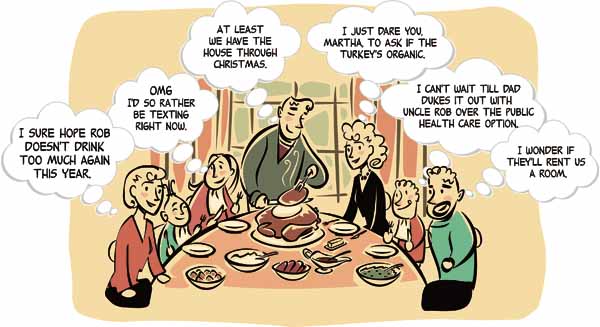
It’s often a challenge for relatives to maintain a properly warm and loving atmosphere on Thanksgiving, given the risk that siblings and cousins might stir up more grudges than gravy.

But it could even be harder in a year when economic stresses and political divisions seem particularly sharp, commentators decry a breakdown of social civility, and the juiciest topics for dinner-table conversation could trigger arguments.

“During difficult times, all other tensions are amplified,” said Rabbi Paul Kipnes of Congregation Or Ami in Calabasas. “In a sense, we can expect these tensions to be amplified around the table.”

What to do about it? Other than make sure nobody gives thanks for Sarah Palin just as stridently liberal Uncle Fred lifts the carving knife?

Some face the threat with humor.

“This Thanksgiving,” satirist Andy Borowitz wrote on Twitter, “I will exercise portion control and only insult one relative.”

Others see it as a serious problem with practical solutions.

The Emily Post Institute, run by great-grandchildren of America’s original arbiter of etiquette, chose Thanksgiving week to ask readers of its Web site how they “handle a boorish relative’s inappropriate table conversation.” (We’ll get to the results.)

And still others see it as a potentially uplifting part of the Thanksgiving experience, encouraging families to temper their stresses and differences of opinion by emphasizing their joys and their more fundamental common values.

Michael Gerson, a family and child psychologist who teaches at California Lutheran University in Thousand Oaks, acknowledged that economic and political unpleasantness is all around us.

“But I don’t think it has to come into the home (when a family gathers),” Gerson said. “Oftentimes, the home becomes a sanctuary for peace and comfort. It’s harder if your home is in foreclosure.”

On the phone from the Emily Post Institute in Burlington, Vt., Dan Post Senning, a 32-year-old great-great-grandson of Emily Post who specializes in the company’s Web site, offered suggestions for keeping, say, a shouting match over health care legislation from wrecking the tranquility.

If possible, avoid a divisive topic. “I’m not saying, `Avoid it forever,’ but avoid it during a Thanksgiving meal that Mom has taken a long time to prepare and people have traveled a long way to enjoy,” Post Senning said. “The rule of polite dinner conversation is you avoid questions of religion and politics.”

Think of more pleasant things to talk about. “We give the same advice to people going to business gatherings: Have a couple of topics of conversation in your pocket,” Post Senning said. “It could be general stuff like, `Did you see the last episode of “Jon and Kate”?’ or it could be stuff in your own life. Or it could be something you’re thankful for.”

If an opinionated relative is bound to mouth off, prepare yourself to listen without being drawn into an argument or making it personal. “If you have an uncle (with) a conservative streak you find abhorrent, remind yourself people are not likely to persuade each other over the Thanksgiving turkey,” Post Senning said. “The issues are going to be there to settle another day.”

Be an observer. Post Senning suggests that instead of getting embroiled in a fight, you watch and listen to that opinionated cousin with the detachment of an anthropologist, using the occasion to learn about views other than your own. By asking someone how he or she arrived at this philosophy, and explaining the roots of your own beliefs, you might find more in common than you expected.

Be sensitive. At a time when family members might be going through widely different experiences financially, “remind yourself what everybody’s situation is,” Post Senning said.

This advice is meant for most families but not all.

“For some families,” Post Senning said, “it wouldn’t be a good dinner if we didn’t have a chance to hash out our differences.”

At emilypost.com, the poll on what to do about inappropriate table talk found a majority choosing the option: “Engage the offender, try to steer the discussion into safer territory.”

Rabbi Kipnes said he’s urging congregants to look around the table today and “tell each other why they’re thankful these people are in their lives.”

He also wants people to remember that, while they can enjoy a plentiful table, many others in the nation aren’t as fortunate.

Said Gerson, the psychologist: “As much as the dinner can be anxiety-provoking, it can also be looked at as an opportunity to create a festive and supportive environment.”

Gerson said that at the Thanksgiving table, as in politics and economic analysis, “It’s all in how you spin it, I suppose.”