Category: blog archive

Sweetest Bar Mitzvah Moment #2

We were in the middle of the Baraghimian Bar Mitzvah. Child number three was doing a fabulous job leading the service. Parents were schepping nachas (filling with joy); friends and family were enjoying the experience.

Having traveled to Israel with the whole family, including the grandparents, I knew the grandparents were a wonderful couple, unafraid to speak of and share their love. I recall walking down Masada, sharing stories of how we each got engaged.

Now, during the Bar Mitzvah, as I looked over to where Grandpa and Grandma were sitting, I caught them in one of the sweetest Bar Mitzvah moments yet. Without taking his eyes off his grandson, Grandpa reached over, took Grandma’s hand and held on. Grandma wrapped her hand around his. All the while, their eyes never left their grandson.

That’s love. It made my Shabbat!

Holy Yoga! The Rabbi Gets to Wear Sweats to Temple

I will be showing up in my sweats at Temple again on Wednesday, February 3rd for another installment of our Holy Yoga series, a (sometimes) monthly drop in yoga experience in the back of the sanctuary. I’ll be there with my mat and sweats. I’m hoping others will too. Why?

In early December, almost two dozen showed up for Rav Yoga, a Jewish spiritual yoga experience with my friend, Rabbi Heather Altman. Rabbi Altman inspired our yoga practice:

Drawing on the Hebrew connection between “rav” (rabbi-teacher) and “rov” (plenty), Rav Yoga means Abundant Yoga, as well as Yoga Rabbi. In Rav Yoga, Heather united yoga and Judaism in a manner that was authentic to both beautiful traditions. Rav Yoga practice empowered, renewed, and connected our body, mind, and soul.

I first encountered Yoga as a Spiritual Practice at the Institute for Jewish Spirituality (IJS) retreats. The embodiment of mindfulness was transformative. For a few years, I practiced yoga regularly as a spiritual practice. For me, yoga was just as the IJS described it:

We work with our physical bodies by intentionally assuming poses that stretch, lengthen, and strengthen the body. We learn to pay attention more fully to sensations in our bodies as they move into various shapes and forms, and to the breath that flows in and out. Over time our bodies and our awareness become stronger, more flexible, more balanced, and more relaxed. As we release tensions and blocks in the body, even at the cellular level, there is often release of tensions and constrictions held in the mind and the emotions as well. As this process unfolds, we can experience more spaciousness and renewed capacities for movement and growth in our lives. As we return to the yoga mat to practice regularly, we learn to ground ourselves in awareness of the moment and in our attunement to details of our inner lives as they show up in the stretching, holding and releasing of the poses. And as the surface constrictions give way to a more expansive sense of possibility underneath, spiritual awakenings and movement can happen as well.

Since I fell out of my practice (though my wife pushes, prods, entices me back every so often), I figured that if I made it part of my Temple responsibilities, I would practice. Last month’s yoga session was great. I look forward to February’s session, led by yoga instructor/congregant Julie Buckley.

If you are in the area, come:

  • Holy Yoga with Rabbi Kipnes, Wednesday, Feb 3, 9-11 am
  • Julie asks that we each bring a large towel and a small, face towel in addition to a mat (or two large towels if you do not have a mat). If you have a strap, bring that too.
  • RSVP to my assistant Susie Stark (susie@orami.org).

At the Wall, Which Side is the Right One? The Kotel Belongs to the Entire Jewish People

Rabbi Eric Yoffie, president of the Union for Reform Judaism, wrote:

I am saddened and dismayed by recent events at the Western Wall. These events are a tragedy — a blow to the State of Israel and to the unity of the Jewish people.

Love of Israel unites Jews everywhere. Love of Jerusalem unites Jews everywhere. For many of these Jews, the single most important symbol of both Israel and Jerusalem is the Western Wall.

Why turn that symbol into a source of division? Why should the Wall be an ultra-Orthodox synagogue rather than a place that belongs to us all — a place where all Jews can find space to pray, to gather, and to celebrate the Jewish homeland and the Jewish people?

Twenty years ago I proposed a solution to the problem of access to the Wall, and it remains the best answer. There is ample room to divide the Wall into three areas: one for men to pray according to Orthodox custom; one for women to pray according to Orthodox custom; and one for non-Orthodox prayer and secular and civil ceremonies of various kinds.

However, instead of moving in the direction of equal access for all to one of Judaism’s most important religious and national sites, exactly the opposite has happened.

When a small group of women — traditional in observance and modestly dressed — has tried to organize occasional prayer services, which involve only those practices clearly permitted by halachah (traditional Jewish law), the women are spat upon, cursed and hustled away by the police, who generally do little or nothing to protect them from the harassers.

Ceremonies of national significance — tributes to fallen soldiers, the welcoming of new immigrants — were long held in the public areas behind the prayer section of the Wall, but they have now been curtailed or stopped altogether. The reason? Religious authorities who control the Wall have demanded that ultra-Orthodox standards be applied to such gatherings — meaning, for example, that the sexes must be segregated and that singing by women is prohibited.

Non-Orthodox religious youth groups that used to gather regularly in the same plaza area away from the Wall to enthusiastically pray and sing during their visits know that such services are no longer permitted.

When challenged, the religious authorities at the Wall talk of the “Robinson Arch” solution, which is an insult and no solution at all. Non-Orthodox Jews are permitted to pray at Robinson’s Arch, an archaeological site at a distance from the Wall that is not seen by most Jews as being part of the Wall at all.

The argument that permitting Reform and Conservative Jews to pray in the area of the Wall will lead to chanting by Catholics or Buddhists is absurd. Reasonable accommodations regarding non-Jewish religious ritual have been made at every other religious site in Israel. If anyone has been unreasonable, it has been the Jewish authorities at the Wall, who attempted to prevent Pope Benedict XVI from wearing his crucifix during his visit to the Kotel. The Pope rightly ignored them.

It may be that for now the law is on the side of those who impose these restrictions, and that others who wish to challenge them may have to accept the penalty for doing so. But it seems to me that recent events were more an attempt to intimidate and harass religious women than to enforce the law.

What is most important here, however, is that our goal in these troubled times is make Jews everywhere feel closer to Jerusalem and to the Jewish State. Driving Jews away from the Wall is self-defeating and foolish. To put it simply, the more Jews who visit the Wall — for religious, civic or national purposes — the better off we are.

And since there is not a single, universally accepted religious standard that governs Jewish religious life, we should make no attempt to impose one at the Kotel. What we need, rather, is to be respectful of each other’s choices and customs.

Throughout the generations, the Kotel has been a source of inspiration to Jews everywhere. It is a concrete symbol of our love for Jerusalem and our common Jewish destiny. The Wall belongs to the entire Jewish people; it must be a place that unifies our people, where all Jews are welcomed and all are respected.

Learn more. Take Action.

Being in Or Ami’s Shabbat Service was Like Being in a Relaxing Yoga Class

Our congregant Ray Joelson recently reflected upon the experience when his son Jay became a Bar Mitzvah. With his permission, I share it here:

Our son recently became Bar Mitzvah at Congregation Or Ami and there is much for our family to reflect upon and even more to carry forward and cherish for a lifetime. The culmination of our preparations, deliberations, and expectations seemed to all focus on this one day that was so unique and fulfilling and that was magically orchestrated into a seemingly flawless service by Rabbi Paul Kipnes, Cantor Doug Cotler and Bar Mitzvah teacher Diane Townsend.

Only on the evening of the rehearsal with Cantor Doug, about a week before the Bar Mitzvah did the full impact of our son’s learning with Diane become evident to us. Leading up to the Bar Mitzvah, we had enjoyed the muffled sound of his singing in the shower and the practicing of his Torah portion, but we never quite got to hear the real thing. We consider our son talented, but the rehearsal with Cantor Doug revealed a singing voice that we were completely unaware of. Diane had somehow managed to bring a dormant talent to the surface and our son seemed to revel in the joy of his own voice. What a gift! Yes, my wife and I shed tears at the rehearsal, and little did we know this was only the beginning.

On the big day, Or Ami’s Calabasas, CA sanctuary, filled with our friends, family, and anxieties, transformed into a special place where our hopes, dreams and expectations were soon to be realized. Perhaps this same magic happens in all Temples, but Rabbi Paul, Cantor Doug and Diane are a very hard act to follow. Without hesitation, our son followed their cues and like clockwork, it all came together. It became obvious that our son had developed a very special bond with his teachers at Or Ami. Some said being in our Shabbat service was like being in a relaxing yoga class; some said the joy of the music overwhelmed them. Others said that it was the best service they had ever attended. All agreed the service was very beautifully different from their own Temples’ services.

Something very special happened to me too on that day. The collective experience of bearing witness to my oldest son address the congregation, read from the Torah and basically conduct the service all by himself, made me aware of the role we parents play in passing down Jewish tradition, and how that role is supported by the inner workings of Congregation Or Ami. A strange but familiar feeling overcame me as the service came to an end, as if I had been here before, and I quickly realized that I was feeling the same feelings I had felt at my own Bar Mitzvah service. The sense of L’dor Vador, transmitting Torah from generation to generation.

How to Plant Your Garden (of Life)

In honor of Tu B’shvat, the Jewish Arbor Day

First, You Come To The Garden Alone,
While The Dew Is Still On The Roses….

For The Garden Of Your Daily Living,

Plant Three Rows Of Peas:

1. Peace Of Mind
2. Peace Of Heart
3. Peace Of Soul

Plant Four Rows Of Squash:

1. Squash Gossip
2. Squash Indifference
3. Squash Grumbling
4. Squash Selfishness

Plant Four Rows Of Lettuce:

1. Lettuce Be Faithful
2. Lettuce Be Kind
3. Lettuce Be Patient
4. Lettuce Really Love One Another

No Garden Is Without Turnips:

1. Turnip For Meetings
2. Turnip For Service
3. Turnip To Help One Another

To Conclude Our Garden We Must Have Thyme:

1. Thyme For Each Other
2. Thyme For Family
3. Thyme For Friends

Water Freely With Patience And Cultivate With Love.
There Is Much Fruit In Your Garden
Because You Reap What You Sow.

[adapted from an item that was passed around on the internet]

I Almost Made Myself Cry at the Bar Mitzvah

There we stood, Rabbi and three generations of the Tillis family, preparing to physically pass down the Torah midor lador (from generation to generation).  This primarily Reform Movement tradition makes manifest what is happening in fact and deed: that another young adult is receiving Torah from his ancestors.  At the end of this line of stood a young man Jared, who though he spent his life challenged by special needs and multiple treatments – a rare form of non-convulsive epilepsy, speech therapy, vision therapy, challenges reading and decoding – now stood ready to do what every other 13 year old boy does.  Jared was becoming a Bar Mitzvah. 

I looked out at the crowd of family and friends.  On their faces I saw utter amazement; reflected in their eyes was the wonder that this young man, in spite of all the challenges he faces, had led the prayer service so beautifully.  His Bar Mitzvah teacher, the incomparably talented Diane Townsend, had been by his side, pointing to each transliterated syllable so that he could chant the prayers at his own pace.  Too see how creatively she had retransliterated each word in a way that it would be comprehensible to this specific Bar Mitzvah boy is to witness a master teacher at work.  Yes, we had already each experienced that Shehecheyanu moment, that blessed happening that reminds us all that we were just touched by the miraculous. 

What words could I say which would further capture the holiness before us?  And how to do it in such a way that everyone would understand on their own level: the Bar Mitzvah boy in his specifically special manner of comprehension and the guests who had been touched by the Transcendent? 

We are taught that Torah was revealed in 70 languages at once so that each person could comprehend it.  Who is to say that which languages they were?  Perhaps some were the language understood by a child with special needs. Maybe the simple concepts that a profoundly challenged child could comprehend.

So I told them: We are taught that Torah was given to everyone at Mt. Sinai: the rich and the poor, the strong and the less strong, the healthy and the sick.  Yes, even those who stuttered (Moses), were leprous (later, Miriam), or were beaten down by the challenges of their lives (all the Israelites) received the Holy Torah.

I reminded them, lovingly, that sometimes we doubt who was able to receive Torah, but that as long as there are people who believe (I looked at Mom and Dad and older sister), everyone can grasp hold of the holy books. 

I said a bunch of other words too, but as I looked out at the congregation, seeing not a dry eye in the sanctuary, I started to choke up too, and mumbled something that I cannot remember anymore.

Then we passed Torah down midor lador (from generation to generation) completing the cycle.

Worshippers were moved.  One said, “Jared’s service was the most moving and touching ceremony I have ever been to” while another explained that she “will never forget Jared’s amazing ability to turn an ordinary ritual into a meaningful event that we will carry in our hearts forever.”  

I am left with three profound memories of this Bar Mitzvah service:

  • That this young man, standing on the shoulders of all the Jews who came before him, became a Bar Mitzvah just like the best of them;
  • That we are blessed to have a teacher as skilled as Diane Townsend who finds a way to point each child – no matter how challenged, no matter how reticent – toward Torah;
  • That the Holy One of Blessing (God) blessed us this day by allowing each of us to experience the transcendent holiness of this Bar Mitzvah. 

…Shehecheyanu v’kiy’manu v’higee-anu lazman hazeh – Blessed are You, God … for giving us life, for keeping us in life, and for bringing us to this special moment. 

(BTW, the other Bar Mitzvah boy earlier that day made me proud, amazed, and inspired.  Because he was special too. Not special needs.  Just special, like every child is special.  But that’s another blog post.)

Congregation Or Ami exudes openness and welcoming of families with children with special needs.  Read about it.

Tu B’shvat: A Person is Like a Tree in the Field


With Tu B’shvat (the Jewish Holy Day of Trees) coming up, I have been exploring the relationship between nature, trees, humanity and Judaism. I came across this quote from Rabbi Yisrael of Chortkov (in Ginzei Yisrael), who teaches hope in the face of dispair:

There is a lesson hinted at by Tu BeShvat, for “a person is like a tree of the field.” When the wheel of fortune has turned for someone and they are down, when they see no way to keep their head above water; they have lost all hope and are despairing – then they should ponder a tree in winter. Its leaves have fallen, its moisture has dried up, it is almost a dead stump in the ground. Then suddenly, it begins to revive and to draw moisture from the earth. Slowly it blossoms, then brings forth fruits. People should learn from this not to despair, but to take hope and have courage, for they too are like a tree.”

As Quoted in Yitzhak Buxbaum, A Person is Like a Tree: A Sourcebook for Tu BeShvat

A Prayer for the People of Haiti

A prayer for the people of Haiti, 

who, on a good day, 
must take heroic measures

just to wake the next, 

And who must now find a way 

to live through the end of the world: 


O Compassionate One,
whose relief work is beyond our capabilities 

Breathe life today into those buried alive 

and strengthen the response capacity
 of Your relief workers in this world


To hear those who have yet to be saved,
To hear those who have been saved
but whose limbs and lives are crushed,
To hear those who pray
For those who can no longer pray for themselves.

O Source of Speech,
embedded in the language of love, 

Fortify the souls of those who call out now in rescue

O Life Force,
expressed in the language of loss, 

Send strength to those who, with their last strength 

Now seek nothing more than finding loved ones 


A prayer for the people of Haiti,
who on this day
take heroic measures 
just to survive, 

And with the world’s help,
Will find a way
to live into 
an new world,
Though one rebuilt
on the rubble of unfathomable loss.


O Source of Response to need, 

Be the blessing

Of prayers realized.

And we say: Amen

Adapted by Rabbi Shawn Zevit from a prayer by Bradley Burston, Israel News 


With thanks to the Union for Reform Judaism for sharing this resource with me

My favorite place to donate to help Haitians is the Reform Movement Haiti Relief Fund:

In the wake of the horrific destruction that has hit Haiti, our national organization, the Union for Reform Judaism (URJ), has opened its disaster relief fund to aid those devastated by the severe earthquake. With a still-unimaginable number of casualties, relief and support is being directed to help rescue and recovery efforts scale up rapidly. A number of our partner organizations are already on the ground or on their way to provide assistance. Donations to the Union for Reform Judaism Haiti Relief Fund can be made online at www.urj.org/relief or by sending a check to Union for Reform Judaism, Attention: Development, 633 Third Avenue, 7th floor, New York, NY, 10017.

Background: Our Reform Jewish community has a long history of generosity when natural disasters devastate communities, when houses of worship burn in the fires of racial prejudice, when terrorism causes havoc, and when other disasters cause untold harm across the planet. In such times, the Union for Reform Judaism activates the Union Disaster Fund for contributions, which are then forwarded to appropriate agencies. In recent years the Union Disaster Relief Fund has provided help to the victims September 11, floods in Europe, earthquakes in South America and Southeast Asia, Black churches that were burned in Southern United States and the Grand Forks community when it flooded. In the wake of the hurricanes that battered the Gulf Coast in 2005, more than $3 million in donated funds were raised to help the victims and agencies that are assisting them and the congregations of Louisiana, Mississippi, Texas and Florida.The Union for Reform Judaism is a member of the Jewish Coalition for Disaster Relief, which allows a unified Jewish response to natural and man-made crises that occur outside of North America.

Breathing the Name of God

In this week’s parasha, we encounter Moses at the burning bush, speaking to God. In response to the instruction to go down to Egypt to free the Israelites from Pharaoh’s oppression, he asks a simple question: When people ask who You are, what shall I tell them? The answer: Ehiyeh asher Ehiyeh. I am who I am. I was who I was. I am who I will be… God uses God’s name: Yod-Hey-Vav-Hey. Usually pronounced euphemistically as “Adonai,” God’s name is something more.

At services tonight at Congregation Or Ami, we will talk about what God’s name is and what the name teaches us about our lives. Here’s a foretaste…

My teacher, Rabbi Lawrence Kushner, the Reform Movement’s Rabbi-Mystic-Scholar, explains this name in Breathing the Name of God [From Rabbi Lawrence Kushner: Eyes Remade for Wonder]. Read and consider:

The letters of the Name of God in Hebrew are YOD, HAY, VAV, and HAY. They are frequently mispronounced as “Yahveh.” But in truth they are unutterable. Not because of the holiness they evoke, but because they are all vowels and you cannot pronounce all the vowels at once without risking respiratory injury.

This word is the sound of breathing. The holiest Name in the world, the Name of the Creator, is the sound of your own breathing.

That these letters are unpronounceable is no accident. Just as it is no accident that they are also the root letters of the Hebrew verb “to be.” Scholars have suggested that a reasonable translation of the four-letter Name of God might be The One Who Brings Into Being All That Is. So God’s Name is the Name of Existence itself. And, since God is holy, then so is all creation. At the burning bush, Moses asks for God’s Name, but God only replies with Ehyeh-hasher-ehyeh, which is often incorrectly rendered by the static English, “I am who I am.” But in truth the Hebrew may denote the future tense: “I will be who I will be.” Here is a Name (and a God) who is neither completed nor finished. This God is literally not yet.

Or Ami in the News: Membership Shabbat

In a new Jewish ritual, recently affiliated members of Congregation Or Ami walk through a tunnel of tallits (prayer shawls) held by veteran congregants. After they transitioned from “newness” into being fully part of the synagogue family, Rabbi Paul Kipnes and Cantor Doug Cotler, amidst joy and tears, offered blessings of welcome. Synagogue president Susan Gould invited these newest members to participate in the community’s vast array of learning options and social action projects.

Kid Tzedakah: A Plastic Bag Filled with Coins

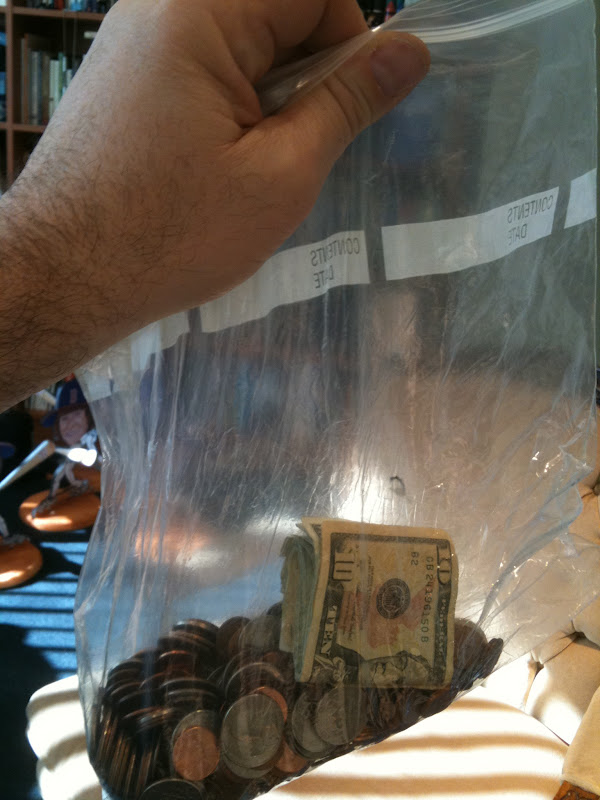
Three children walk up to a rabbi after services, requesting to speak with him.  The oldest, almost eleven, speaks for the other two nine year olds.  With maturity and poise, she explains that each Shabbat and during other holy days and regular days, the three of them put tzedakah into their tzedakah box.  It is part of their regular ritual welcoming Shabbat and it is very meaningful to them.  When the box became too full, they opened it, counted it, and with a small donation from their parents to make it even, they have $54.00. (Actually, they actually collected $55 but used one dollar to “seed” their next tzedakah collection drive, ensuring that this donation was a multiple of chai (18=life).  So pictured above is the gallon-sized ziploc bag filled with pennies, nickles, quarters and dimes, plus a few bills.  Kid tzedakah, I call it. 

Kid tzedakah may be the most important kind of tzedakah of all.  Although Kid Tzedakah is not listed on Maimonides’ Ladder of Tzedakah (8 Rungs of Tzedakah) which weights the different ways of giving, I believe that we should place Kid Tzedakah somewhere in the top three.  Kid tzedakah is the ziploc bag or piggie bank or tzedakah box filled with coins which young children bring into their synagogues and give to the rabbi, or bring to other organizations and donate to support other causes.  Kid Tzedakah usually amounts to a multiple of 18, never over $72 or $90.  It never is listed on donor boards or donor honor rolls.  But it is the most precious of all. 

Kid tzedakah is the way that one generation ensures that the other understands the importance of giving. It is the process, set up by parents, to make giving tzedakah a regular practice of the next generation.  For a certain generation, Kid tzedakah was given to Keren Ami (the fund for Israel, usually through the Jewish National Fund) whose blue and white tzedakah boxes once sat in every Jewish home.  Today, sometimes Kid tzedakah is synagogue-based, when our children donate regularly at the beginning of the Religious and Hebrew School classes.  Other times, it is the ritual of placing a few coins into the tzedakah box before lighting Shabbat candles.  Some people allow the children to collect the coins that come out of parents’ pockets and place them weekly into the tzedakah box. 

Kid tzedakah may be the lifeblood of the Jewish people, ensuring that our children understand that giving of our resources – money, and yes, time and energy – is central to being a Jew.  That when we sing in our prayerbook – L’takein olam b’malchut Shaddai – that we fix the world, returning it to the idea envisioned by God – this is the essence of Judaism.   That the ritual of giving must continue into their adult lives. 

So thank you, Gross family children, for giving your $54 of Kid Tzedakah.  We will use it to help families in our community who are struggling through this difficult economy.  We will ensure they have food on their tables and a roof over their heads. 

How Does God Appear to You?

I’ve been thinking a lot about God again.  Perhaps it is because I am about to spend a week at the Institute for Jewish Spirituality‘s Hevraya retreat for Rabbis and Cantors.  Perhaps it is because we will be talking about God and how we see God at Adult Study Shabbat services this Friday night.  More likely, I am thinking about God because, well, God is a part of my life and just like I think about my wife and kids and co-workers and family and friends… I think about God a lot too. 

This week’s parasha (Torah portion) provides a great place to enter the discussion.  God announces to Moses who (or what) God is.  Ehiyeh asher ehiyeh – I am what I am, I am what I will be, I was what I will be – I am the totality of existence.  Not a Being.  Not an idol.  Not a Thing. I am Yud-Hey-Vav-Hey… a combination of three verbs – Was, Is, Will Be.  I AM! 

What does that mean?  My colleague, Rabbi Laura Geller, wrote a beautiful D’var Torah this week that explores this idea.  Our congregation will discuss it at Friday night services at 7:30 pm this Shabbat.  Read on, then comment and/or come to services.

D’var Torah by Rabbi Laura Geller
(Originally published in Ten Minutes of Torah and Reform Voices of Torah and RJ.org)

It happened again this week–this time at the gym. Just as I was finishing my workout, someone called to me:
“You’re Rabbi Geller, right?”
“Right.”
“You know what, rabbi? I don’t believe in God.”

It is hard to know how to respond when that happens. Usually I mumble about giving me a call to discuss it. Other times, when I have more time, I ask the person to describe the “god” he or she doesn’t believe in.

Nine times out of ten it is the god that the person first met as a child, the one who looks like an old man with a beard who lives somewhere in the sky and knows if you’ve been bad or good. The person is usually surprised when I say: “You know, I don’t believe in that ‘god’ either.”

The more we talk, the more the person shares how for him, coming to synagogue only reinforces that image of a god. Even our prayer book, gender neutral as it is, seems to support the image of a powerful ruler, delivering us from oppressors and saving us from tyrants. While the words don’t actually say it, this god looks like a king or a powerful father.

I don’t believe in that god either.

This week’s Torah portion begins: “God spoke to Moses . . . . ‘I am the Eternal. I appeared to Abraham, Isaac, and Jacob as El Shaddai, but I did not make myself known to them by My name YHVH.’ ” Read more.

Al Tifrosh Min Hatzibur – What Does Separating/Connecting to the Community Mean in a CyberWorld?

http://www.valerieherskowitz.com/images/photo-online_community.jpgOur world is changing… will our synagogues keep up? 

My kids’ world is different than mine.  They email, text, ichat (though my son told me this morning that skype has better video), facebook, watch tv, play video games and still seem to get their homework done. My wife tells me that they cannot focus as well or break off easily from the multisensory always wired world in which they exist.  Yes, this concerns me.  Yet I keep wondering if our concerns, while rightly focused on what will become of their lives as they develop these multitasking meta-personalities,  are just further evidence the fact that we just might not “get it.”  (Are we the parents of the 1960’s, decrying long hair and rock and roll music, things once described as the downfall of civilization as we know it?  Or are we pre-Maccabees seeing the downfall of Jewish values?)

My rabbinic colleagues sometimes argue about what online social networking really means.  They differentiate between “real community” and “virtual world,” claiming that the former creates actual connections while the latter is, well, unreal. I keep wondering if differentiations they make are meaningless, because people increasingly live lives online, so that if we fail to embrace this new reality, we – synagogues, rabbis, non-networking communities – will soon become “virtual/unreal” ourselves. 

Now comes Brad Stone, whose New York Times’ article The Children of Cyberspace: Old Fogies by their 20’s, suggests that the newest generation thinks and experiences the world differently from previous generations.  He holds up his Kindle experience to illustrate beautifully his point: 

My 2-year-old daughter surprised me recently with two words: “Daddy’s book.” She was holding my Kindle electronic reader.  Here is a child only beginning to talk, revealing that the seeds of the next generation gap have already been planted. She has identified the Kindle as a substitute for words printed on physical pages. I own the device and am still not completely sold on the idea. My daughter’s worldview and life will be shaped in very deliberate ways by technologies like the Kindle and the new magical high-tech gadgets coming out this year — Google’s Nexus One phone and Apple’s impending tablet among them. She’ll know nothing other than a world with digital books, Skype video chats with faraway relatives, and toddler-friendly video games on the iPhone. She’ll see the world a lot differently from her parents.

Then he talks about what’s real and what’s not:

And after my 4-year-old niece received the very hot Zhou-Zhou pet hamster for Christmas, I pointed out that the toy was essentially a robot, with some basic obstacle avoidance skills. She replied matter-of-factly: “It’s not a robot. It’s a pet.”

What does this mean to our communities?  Listen to Mizuko Ito, a cultural anthropologist and associate researcher at the University of California Humanities Research Institute, who said

that children who play these games would see less of a distinction between their online friends and real friends; virtually socializing might be just as fulfilling as a Friday night party. And they would be more likely to participate actively in their own entertainment, clicking at the keyboard instead of leaning back on the couch.

We synagogues, and religious communities, will want to open ourselves to how the cyberworld reframes the rabbinic dictim al tifrosh min hatzibur – do not separate yourself from the community.  If I am not within the synagogue, or even a member of a synagogue, but I read Jewish books, participate in online study sessions, watch/pray with streaming video services, socially-network with other like-minded Jews, email prayers about people who are sick and email prayer to be put in the Jerusalem’s Kotel (Western Wall) … am I one who is tifrosh – separated from the community – or not?  Because my kids, and increasingly more of my congregants, and clearly so many of our 15, 20, and 30 year olds, feel so connected.

Jews and Blogs: Its a Big Blogging World Out There

There is a wide world of Jewish blogging out there. Jewish bloggers are commenting on everything from spirituality and ritual, to Israel and the Middle East, to politics and prayer. They are often the first ones with up to the minute commentary on Jewish issues of the day; clearly the best source for what is happening in Israel during a conflict.

A weekly summary of the Jewish blogsphere is published weekly as Haveil Havalim, a Carnival of Bloggers. Founded by Soccer Dad, Haveil Havalim is a carnival of Jewish blogs — a weekly collection of Jewish & Israeli blog highlights, tidbits and points of interest collected from blogs all around the world. It’s hosted by different bloggers each week and coordinated by Jack. The term ‘Haveil Havalim,’ which means “Vanity of Vanities,” is from Qoheleth, (Ecclesiastes) which was written by King Solomon. King Solomon built the Holy Temple in Jerusalem and later on got all bogged down in materialism and other ‘excesses’ and realized that it was nothing but ‘hevel,’ or in English, ‘vanity.’

This week’s Heveil Havalim Carnival is up at Ima on (and off) the Bima.

Other favorite bloggers include:
Divrei Derech by Rabbi Rick Winer
Rabbi Eric M. Berk: Blog
RJ.org, the Reform Movement’s Blog