Category: blog archive

When Hope in America Inspires Dreaming in Jerusalem

Gershom Gorenberg writes in South Jerusalem:

Watching a videocast from Washington last night, it seemed to me that half of what seemed impossible when I wrote this has come true: Across the ocean, where hope was written off like a bad debt, it has been reborn.

Here, in Jerusalem, one still has to dream of the very possibility of dreaming. The pseudonymous and very wise Jeremiah Haber chides for even considering the possibility. But I know of no biological difference that allows Americans to imagine a better future and prevents us from doing so. With some trepidation at daring poetry in a blog, I’m posting this.

Desiderata

I am hoping for the rebirth of hope
I am waiting for the beat of wheels on steel, the railroad drumbeat rhythm,
I am waiting for the long-distance heaven express.
I believe its time to lay tracks up to heaven
I am waiting for Jimi Hendrix to rise and climb on, for Phil Ochs to declare he’s retracted his resignation,
to rise all bones and anger banging a guitar and climb on,
I am waiting for the kids in the high schools to lay down their guns and climb on
I believe the generation born dead, raised dead, schooled dead in the malls’ mausoleum marble will pass
I believe with an imperfect faith, cracked but still serviceable, that a generation will be born that knows how to hope.

I am waiting for new songs unto the Lord.
I am waiting for new psalms,
I am waiting for a pied saxophonist to march through suburbs outside Jerusalem, leading away the houses with red tile roofs and the grownups, and leave children and rats on green lawns
I am waiting for heavenly choruses to lean down, lean down, and with each note the guns in the hands of the green boys on the streetcorners of Jerusalem will grow wings and fly off, long grey dragonflies, toward the sun setting in white foam off Ashkelon
I am certain the stillborn generation can come alive
I believe with imperfect faith, used, dented, two cylinders skipping, low on brake fluid but still driving, that a generation can be born that knows how to sing.

I believe that Moses, Blake, Abe Heschel and Reb Nahman are not dead, they are tuning their guitars in a back room and will be back on stage for an encore any moment, for the real show,
when the rabbis will shed their black coats like old snakeskins, the monks and the sheikhs of jerusalem’s alleys will dance half-nude on Jaffa Road, roaring the choruses, reaching up drunk and trying to pull heaven down,
I believe a seven year old girl with umm kalthoum’s reborn voice, voice of clouds and fire, is even now singing in a room without chairs without schoolbooks in south Jerusalem, there are no lights in the staircase, there is broken glass in the street, there are skeletons on the park benches, bones without number, dead men in the buses, dead women whispering next to the empty notice boards next to the empty storefronts
her song will reach out the windows, it will seize the bones, they will grow flesh, they will fold up the housing projects like card tables, they will dance in the fields, they will build a new jerusalem out of clouds and fire,
they will be a generation that knows how to hope.

I believe dreams sleep but do not die
I believe songs are hiding in the wind
I believe that the drumbeats of hope are curled up in the couches of our hearts and will awaken, must awaken
I believe the tanks will turn into hippopotamuses and lumber out of their bases looking for rivers
I believe we are only waiting, only pausing to take a breath, before a generation is reborn that knows how to hope.

Blessings for Today: A New Day in America

What an inspiring week. Another peaceful transition from one president to another. An affirmation of equality, of hope, of our belief that b’tzelem Elohim, we were all created in the image of God. At times like these, Jews seek words to express the holiness and the hopefulness of the moment.

Janethewriter posts Blessings for Today: A New Day in America on RJ.org, the Reform Movement’s blog.

We Jews have blessings for all occasions: for bread, for wine, for joyous times, for sad times, upon seeing a rainbow, for flowers and herbs, for social action… the list goes on. Each morning we thank God for returning our souls to our bodies and for a host of other daily miracles: enabling us to distinguish day from night, opening our eyes, freeing the captive, lifting the fallen, and so on. In our minyan this morning, we added three more blessings for the day: Baruch atah Adonai, asher sam chelki b’medinah chofesheet v’democratit.
Praised are You, Adonai, Who has allowed me to live in a free and democratic country. Baruch atah Adonai, asher tzivanu lirdof acharei ha’tzedek tokh milui chovoteinu ha’ezrahiyyot.
Praised are You, Adonai, Who commands us to pursue justice through the fulfillment of our civic obligations. Baruch atah Adonai, asher tzivanu la’asok b’ma’asei tikkun ha’olam.
Praised are You, Adonai, Who commands us to engage in acts of repairing the world. I would add a fourth: Baruch atah Adonai eloheinu melech ha’olam shecheyanu v’kiy’manu v’higyanu lazman hazeh.
Praised are You, Adonai, Sovereign of the universe, for giving us life, for sustaining us, and for enabling us to reach this time of joy. Amen.

3 Rabbis to Offer Prayers at Obama Inauguration Service


JTA broke the news a few days ago in the Jewish world that 3 rabbis

Reform Rabbi David Saperstein, Conservative Rabbi Jerome Epstein and Orthodox Rabbi Haskel Lookstein are scheduled to take part in the Jan. 21 event at the National Cathedral in Washington… Saperstein, the director of the Religious Action Center of Reform Judaism, offered a prayer on the night Obama accepted the Democratic nomination at last summer’s convention in Denver.

Haaretz comes to highlight the higher profile that religion is playing in the Democratic world and in this first African-American President’s inauguration. After a politically astute, yet very disappointing decision to invite the upcoming dean of the Christian Right world, and strong marriage equality opponent Rick Warren, President-elect Obama is offering some very significant invitations:

… Obama asked V. Gene Robinson, the first openly gay Episcopal bishop, to lead prayers at Sunday’s kickoff for the inauguration at the Lincoln Memorial. Gay rights groups rejoiced, while some conservative Christians wrung their hands.

Then at the January 21 National Prayer Service that caps the inauguration:

The Reverand Sharon Watkins, the first woman president of the Christian Church (Disciples of Christ), a Protestant group, will deliver the sermon.

A prayer will be offered at the National Cathedral by Ingrid Mattson, the first woman president of the Islamic Society of North America, according to an official who spoke on condition of anonymity because they were not authorized to release the information. The Islamic Society, based in Indiana, is the nation’s largest Muslim group.

Five Must-Read Articles on Israel and Gaza

Israel Declares Cease-Fire: Goals Met. What does this all mean? Here are some 5 Must-Read articles that offer perspective on what has happened and is happening:

1. Gaza and Hamas: Was it about Education or Eradication? The focus for Israel and Barack Obama’s team should be on creating a clear choice for Hamas for the world to see: Are you about destroying Israel or building Gaza? As Thomas Friedman writes:

I was one of the few people who argued back in 2006 that Israel actually won the war in Lebanon started by Hezbollah. You need to study that war and its aftermath to understand Gaza and how it is part of a new strategic ballgame in the Arab-Israel arena, which will demand of the Obama team a new approach.

2. David Forman asks (and answers) 20 Questions:

15: Why is the world demonstrating against Israel, displaying pictures of Osama bin Laden’s comrades-in-arms, Hassan Nasrallah and Khaled Mashaal, as national heroes, instead of holding mass protests against terrorists (Islamic extremists) who stage their vicious attacks upon innocents in Mumbai, Bali, London, Madrid, Jordan, Egypt, the Twin Towers, and Israel – to mention only a few? David answers: Good point.

18: Thanks a lot, as if I didn’t know. Could it be that I sense that no matter how justified our war is with Hamas, that we are adopting the tactics of our enemy, or is there no choice but to fight Hamas according to its ground rules, thereby rationalizing away some of our objectively horrid behavior and, in the process, suspending all Jewish moral concerns, reducing us to a nation like any other nation? David answers: All the above.

3. Two Israeli Leftists, A.B. Yehoshua and Gideon Levy, face off on the Moral Implications of the Gaza war. A.B. Yehoshua writes:

There is something absurd in the comparison you draw about the number of those killed. When you ask how it can be that they killed three of our children and we cause the killing of a hundred and fifty, the inference one can draw is that if they were to kill a hundred of our children (for example, by the Qassam rockets that struck schools and kindergartens in Israel that happened to be empty), we would be justified in also killing a hundred of their children.

In other words, it is not the killing itself that troubles you but the number. On the face of it, one could answer you cynically by saying that when there will be two hundred million Jews in the Middle East it will be permissible to think in moral terms about comparing the number of victims on each side. But that is, of course, a debased argument. After all, you, Gideon, who live among the people, know very well that we are not bent on killing Palestinian children to avenge the killing of our children. All we are trying to do is get their leaders to stop this senseless and wicked aggression, and it is only because of the tragic and deliberate mingling between Hamas fighters and the civilian population that children, too, are unfortunately being killed. The fact is that since the disengagement, Hamas has fired only at civilians. Even in this war, to my astonishment, I see that they are not aiming at the army concentrations along the border but time and again at civilian communities.

Levy responds.

4. Title aside, The New York Times offers a surprisingly balanced review of the challenges of determining ethics in Urban Warfare in Weighing Crimes and Ethics in the Fog of Urban Warfare. They analyze the actions of Israel and Hamas. Here’s one taste, a frontal critique on Hamas, not usual for the New York Times:

The other key legal principle is discrimination: has a military struggled hard enough to hit only military targets and combatants, while trying to avoid purely civilian targets and noncombatants?

Deciding requires an investigation into battlefield circumstances that cannot be carried out while the fighting rages, and such judgments are especially difficult in urban guerrilla warfare, when fighters like Hamas live among the civilian population and take shelter there. While Israel is the focus of most criticism, legal experts agree that Hamas, a radical Islamic group classified by the United States and Europe as terrorist, violates international law.

Shooting rockets out of Gaza aimed at Israeli cities and civilians is an obvious violation of the principle of discrimination and fits the classic definition of terrorism. Hamas fighters are also putting civilians at undue risk by storing weapons among them, including in mosques, schools and allegedly hospitals, too, making them potential military targets. While urban and guerrilla warfare is not illegal, by fighting in the midst of civilians, often in civilian clothing, Hamas may also bring risk to noncombatants.

5. Of course, always check Jack’s War in Gaza Update (Ceasefire Edition) and the Muqata’s Israel @ War Special Edition.

New York Times: Why Israelis United on Gaza War

As I have said many times, the MSM (main stream media) in the states (and around the world) lacks the depth and background to make sense of what is happening in Israel, Gaza, and the Middle East. It is a scary neighborhood where Israel lives, and the MSM often misses the nuances and background. But one example: take a quick look at Memri.org (Middle East Media Research Institute) and you will see that what is being said and seen in Arab countries is far different from what the same Arab leaders are saying in the English press. Yet the MSM English press misses it often.

That is why I suggest different sources for news about Israel, including the daily rundown, compiled by Random Thoughts blog as well as the blogs on the bottom right column of this blog. Also

Along comes the New York Times, not known for its balanced reporting about Israel, with an article that gets most of it right. It illuminates a reality in Israel: that the vast majority of Israelis (at least the Jewish Israelis) support the offensive in Gaza. The war is seen almost unanimously as a just war:

…voices of dissent in this country have been rare. And while tens of thousands have poured into the streets of world capitals demonstrating against the Israeli military operation, antiwar rallies here have struggled to draw 1,000 participants. The Peace Now organization has received many messages from supporters telling it to stay out of the streets on this one.

Moreover,

“It is very frustrating for us not to be understood,” remarked Yoel Esteron, editor of a daily business newspaper called Calcalist. “Almost 100 percent of Israelis feel that the world is hypocritical. Where was the world when our cities were rocketed for eight years and our soldier was kidnapped? Why should we care about the world’s view now?”

War in Gaza Update: Who’s Saying What?

So much being written about Israel and Gaza. Here’s a rundown, compiled by Random Thoughts blog. Note that MSM (=Main Stream Media) and Blogsphere (=info and insights from bloggers worldwide):

Make sure to scroll down to the bottom to learn about Hamas in its own Words.

January 08, 2009

War in Gaza Update #13

Welcome to the War in Gaza Update #12. It is part of the continuing series of news and information about the War In Gaza.Previous editions of the round up can be found below:1* 2 *3* 3.5* 4* 4.5* 5* 5.5* 6*6.5 *7* 7.5* 8* 8.5.*9, *9.5, *10, *10.5, *11, *11.5, *12, *12.5.From the MSM:

Time: Can Israel Survive Its Assault on Gaza?
CNN: Security Council calls for cease-fire in Gaza
NY Times: Israel Condemns Vatican’s ‘Concentration Camp’ Remarks
NY Times: What You Don’t Know About Gaza (Biased, skewed and misleading.)
FOX: High-Profile Doctor in Gaza Called an ‘Apologist for Hamas’
Guardian: Obama camp ‘prepared to talk to Hamas’
YNET: A day with our troops in Gaza
YNET: ‘Not all Israelis are bad’
Artuz Sheva: Israel Accused of ‘War Crimes’ in a Complaint at The Hague.
Artuz Sheva: United Nations Calls for Ceasefire, United States Abstains.
Artuz Sheva: Netherlands: No Sanctions on Israel; Another Ceasefire Idea.

And now onto the blogosphere:

Aussie Dave and The Muqata continue live-blogging the war.

The IDF blog has all sorts of interesting information. Click here for pictures of tunnels that were dug for the purpose of kidnapping soldiers. This link provides a brief summary of things that were accomplished including information humanitarian aid trucks that rolled into Gaza, discovery of more tunnels, weaponry and the neutralization of some terrorists.

Seraphic Secret has updated It Can (and is) Happening Here. At Yourish W. abandons Israel again.

Treppenwitz writes about the rockets in the North. At the Jawa you’ll be shocked when you see Hamas Kills Innocent Palestinians (Rare Video). Augean Stables blogged Hamas in their own words. The Occidental Israeli Operation Cast Lead – Israeli Public.

I am going to keep hammering this story ‘Protestor’ Calls for Jews to ‘Go Back to the Oven’. Emmanuel Lopez is a ignorant fool who encourages the worst sort of behavior. The inherent hypocrisy he exhibits is shameful.

It is about time we get to read A Gaza Chronology that covers more than the past two weeks.

LGF covered A Staged Scene in a Gaza Hospital? – Update: CNN Yanks Video and Video: Hamas In Their Own Voices.

Yglesias covered Carter on Gaza. It is pretty much a festival of ignorance in the comments. Commentary reflected on Carter.

The Moderate Voice shared Gaza: Pride of the Arabs – Le Quotidien d’Oran of Algeria. Mother in Israel shared Updates and list of injured soldiers and civilians.

From Joshuapundit we have Hamas Torpedoes Egyptian Ceasefire Attempt. At No Quarter you can read BREAKING NEWS–UN Security Council Acts on Gaza.

EU Referendum shared I don’t think they understand. Snapped Shot says Israel Found Evidence of Hamas Crimes Against Humanity. The Elder Shared More on the jihadists’ joy at dead civilians and PalArab press roundup Jan 8 2009. In the American Thinker you can read Human shields: Where’s the outrage?At What War Zone BREAKING NEWS: Gaza War Turns Nuclear! Shiloh Musings has the International List of Rallies for Israel- Friday Jan. 9 And After and Traveling the Red Zone, Part D (Habad Shelter, Nitzan).Lady Light asks What can We do When Israel is at War. At Global Voices you can read Egypt: Bloggers on the Fence.Chabad has Editorial: Where Wills Collide, Israel Survives. Pat Buchanan’s big mouth is at it again.Dry Bones has Israel Breaks the Rules.This concludes our round up. Stay tuned for the next edition from Jack.Link

Two American Jewish Leaders Discuss Israel and Gaza

On To the Point with Warren Olney:

Listen to the Union for Reform Judaism’s Rabbi Eric Yoffie and Brit Tzedek v’Shalom’s Executive Director Diane Balser discuss The Crisis and Gaza and the Role of the American Jewish Community on KCRW and Public Radio International. (Wednesday, January 7, 2009)

Two American Jewish leaders, both supporters of Israel and of peace, coming down on different sides of the Gaza conflict. Hear their very enlightening conversation.

Gaining Perspective on Gaza

Often I find that without a good historical perspective, understanding whatever is happening today in Israel and the Middle East is nearly impossible. So here are some better places to find news, and some answers to questions being asked. Make sure to read below about whether the demonstrations are filled with anti-Semitism or not.

Blogger Ima On (and off) the Bima suggests Let’s Take it Real World, Old School

I was talking with some folks (as I do constantly) about the matzav (situation) in Israel. I feel a bit obsessed, as I think many of my fellow Israel-lovers and bloggers do, with the news. I can’t stop refreshing Muqata and IsraellyCool and I scroll through my tweets looking for the news. There are so many misconceptions being played out in the mainstream media (MSM)…

So I offer this challenge to you, my dear readers. I am always asking you to blog or tweet or comment or visit. But today’s challenge is a little different.

I’m asking you to pick one site or post or picture that you feel is representative of The Truth — not the stuff being thrown around by the MSM but the stuff that you find to be Real and Right. Start, perhaps, with one of Jack’s round ups or one of Jameel’s liveblogs, or even just the count from your QassamCount status update.

After the blogs (some of my new favorites are on the bottom right column of this blog), go straight to the Israeli newspapers

Instead of focusing on CNN or Fox, New York Times or Wall Street Journal (each of whom can only offer a small amount of news, without adequate background), I invite you to peruse Ha’aretz newspaper for news from Israel. Then Jerusalem Post, and Ynet.

Follow it up with a peak at Rosner’s Domain (Jpost blog), the Los Angeles Israeli Consulate and AIPAC.

Don’t get lost in the partial news. Realize that “Israel Seeks to Minimize Civilian Casualties, Facilitate Humanitarian Assistance“.

Read here about Israel’s attempts to prevent civilian casualties while carrying out its defensive operations in Gaza and how Israel’s operations in Gaza are proportionate and in complete compliance with international law. Consider how Hamas intentionally places civilians at risk and how Israel is continuing to facilitate the delivery of humanitarian assistance to Gaza.

Jeff Jacoby writes “Yes, it’s anti-Semitism” in the Boston Globe (my paper from the “old country”) , noting:

Criticizing Israel doesn’t make you anti-Semitic: If it’s been said once, it’s been said a thousand times. Yet somehow that message doesn’t seem to have reached the hundreds of anti-Israel demonstrators in Fort Lauderdale, Fla., who turned out last week to protest Israel’s military operation in Gaza. As their signs and chants made clear, it isn’t only the Jewish state’s policies they oppose. Their animus goes further.

Demonstrators chanted “Nuke, nuke Israel!” and carried placards accusing Israel of “ethnic cleansing” and bearing such messages as: “Did Israel take notes during the Holocaust? Happy Hanukkah.” To the dozen or so supporters of Israel gathered across the street, one demonstrator shouted: “Murderers! Go back to the ovens! You need a big oven.”

The Arab-Israeli conflict induces strong passions, and the line that separates legitimate disapproval of Israel from anti-Semitism may not always be obvious. But it’s safe to assume the line has been crossed when you hear someone urging Jews “back to the ovens.”

By the way, some ask: Why won’t Israel agree to a cease-fire?

Israel is interested in securing a durable, sustainable cease-fire. But experience has taught Israel to insist on creating the conditions that will prevent Hamas from reopening rocket fire on Israeli civilians.

Last spring, Israel tested whether Hamas would move toward peace by accepting Egypt’s proposal for a six-month lull in fighting. Israel adhered to the calm while Hamas, with the aid of Iran, significantly enhanced its weapons arsenal by smuggling longer-range and more sophisticated rockets into Gaza from Egypt. In the weeks before the 6-month calm was set to expire, Hamas fired hundreds of rockets and mortars into Israel and unilaterally announced it would not agree to extend the six-month calm, which it had been routinely violating with sporadic rocket attacks.

Hamas has regularly said that it uses cease-fires or periods of calm merely as tactics in its continuing war against Israel. The Hamas leader in Damascus, Khaled Meshaal, said earlier this year that a period of calm “is a tactic in conducting the struggle. … It is normal for any resistance that operates in its people’s interest … to sometimes escalate, other times retreat a bit. … The battle is to be run this way and Hamas is known for that.”

Simply ceasing fire today may not create the necessary conditions to prevent future hostilities. A cease-fire without strong monitoring systems to prevent Hamas from smuggling even longer-range and more precise weapons into Gaza and building up its terrorist army may only lead to a more volatile situation in the future.

Others wonder: Why is Israel using disproportionate force?

Israel’s response to the ongoing terrorism from Gaza is proportionate and in complete compliance with international law. Israel’s actions to stop Hamas rocket attacks are proportional to the risk Israeli civilians—900,000 of whom are now within rocket range—have faced, including the real prospect of mass casualties. Israel need not wait for a rocket to slam into a school full of children before it acts.

Israel is carrying out its defensive operations in Gaza using an appropriate application of force and is taking dramatic action to minimize civilian casualties that virtually no other military in the world would do. Israel puts the lives of its own soldiers at risk by providing advance warning to civilians that it intends to carry out operations in specific locations. Israel uses pinpoint targeting to achieve its goals. Israel drops leaflets and makes phone calls to targeted areas to warn citizens they are in danger, even if this means losing the element of surprise.

In contrast, Hamas deliberately attacks Israeli civilians and intentionally uses its own people as human shields. While Israel makes every effort to minimize civilian casualties, international law precludes Hamas from using civilians to protect legitimate military targets, as Hamas regularly does. Article 28 of the Fourth Geneva Convention clearly states, “The presence of a protected person may not be used to render certain points or areas immune from military operations.” The responsibility for civilian casualties when the civilians are used as human shields lies with the party that deliberately places them at risk, namely Hamas.

Israel’s military operation in Gaza is an act of self-defense, a right enshrined in Article 51 of the United Nations Charter. Its aim is to put an end to the more than 6,300 rocket and mortar attacks on Israeli citizens since Israel’s full withdrawal from Gaza in 2005.

Just some thoughts…

Why Israel Needed a Ground Operation

Rosner’s Domain offers this analysis of why Israel had to undertake a ground operation. Note that it begins with a perception by Israelis but quickly turns to the perception now within the Hamas, Hezbollah and other Arab Street minds:

Previous polls have shown that Israelis are apprehensive about the kind of ground operation in Gaza that has just begun. This is a direct reflection of Israelis’ dwindling confidence in the IDF’s ability to emerge victorious from a ground war in this dense and treacherous territory. And this very skepticism is a key factor in Israeli leaders’ decision to go in on the ground last night.

If Israelis, traumatized by the 2006 Lebanon war, have a hard time believing they can win a ground war against Hamas, so do Israel’s neighbors. Hamas spokespersons were bragging last week that Israel would not dare invade Gaza, and promised that the Jewish state would pay a high price if it did. If the Gaza war ended without a ground operation, Hamas leaders would have crowed that Israel was deterred by Palestinian forces, and this would have led to a further erosion of Israel’s reputation as a nation that cannot be intimidated. If Arab terrorists perceive Israel as a country wary of conflict, terrorist groups will only attack more in hopes of defeating the paper tiger.

So – the IDF and Israel’s leaders have three goals in launching this ground war: First, they want to make Hamas pay a price that will force it into a renewed ceasefire. Second, they must prove to the Arab world that Lebanon 2006 did not turn Israel into a country afraid of war. And third, they must engender renewed Israeli confidence in the country’s armed forces.

Prayers for Peace


As the war in Gaza intensifies, let us offer these prayers. Each comes from a colleague in Israel:

The first, from a colleague in Israel, Moshe Yehudai, Raanana:

Dear Friends,

Regardless of your political views, I call you at this moment, a few hours after the beginning of the ground incursion to Gaza, as ever, to be sensitive to human life, who are now in such a tremendous danger.

Jews and Arabs, men and women, young and old, soldiers and civilians – they are all created in the image of God. – This is my fundamental belief, and my fundamental prayer is that the bloodshed will be minimal.

Oseh shalom bimromav, hoo yaaseh shalom aleynu, al kol israel, al kol Yishmael ve’al kol bney adam. May the One who makes peace in the High Heavens, bring peace to us, to all Israel, to all Yishmael (Isaac’s step-brother, the father of Muslims) and to all people.

Another prayer:

A Prayer for Times of War
by Rabbi Yehoram Mazor, Av Beit Ha’Din of MARAM, Israel

May the Everlasting One who blessed our ancestors Abraham, Isaac and Jacob, Sarah, Rebecca, Rachel and Leah bless all the soldiers of the Israeli Defense Forces and all those who are protecting our people. May the Source of Blessing protect them and free them from all trouble and anxiety, and may all they do be blessed. May God send safety and redemption to all our soldiers in captivity.

May the Eternal have mercy on them and bring them from darkness to light and from enslavement to salvation, give them strength and save them. May the Eternal listen to all the prayers of our people.

Merciful God, may Your compassion be with us, and remember Your covenant with Abraham. May you spread the covering of Your peace over the descendants of Ishmael, son of Hagar, and over the descendants of Isaac, son of Sarah, and may it be fulfilled that they shall hammer their swords into spades and their spear into plowshare. Nation shall not lift up sword against nation and they shall learn war no more. And each shall sit under their vines and their fig trees and none shall disturb them.

And let us say: Amen

Come to the Jewish Blog Carnival

A very nice edition of Haveil Havalim, the Jewish Blog Carnival, is now up over at Ima on and off the Bima. Check it out!

Founded by Soccer Dad, Haveil Havalim is a carnival of Jewish blogs — a weekly collection of Jewish & Israeli blog highlights, tidbits and points of interest collected from blogs all around the world. It’s hosted by different bloggers each week and coordinated by Jack. The term ‘Haveil Havalim,’ which means “Vanity of Vanities,” is from Qoheleth, (Ecclesiastes) which was written by King Solomon. King Solomon built the Holy Temple in Jerusalem and later on got all bogged down in materialism and other ‘excesses’ and realized that it was nothing but ‘hevel,’ or in English, ‘vanity.’

Post categories include:

  • Israel on our minds and our blogs…
  • Jewish Life and Culture…
  • And Everything Else… (Jewish and blogged)

Check it out here.

Coping with an Autistic Brother: A Teenager’s Take

OR:
Siblings of People with Special Needs: Next Steps in Disability Awareness Outreach

Or Ami spends significant time and energy embracing and supporting families with children with special needs. We are proactively welcoming, because our tradition teaches us that we all were created b’tzelem Elohim, in God’s image.

Taking our lead from the Union for Reform Judaism’s Disability Awareness initiatives, we have come to understand that “with special needs children, there are two values being played out, simultaneously. Working with one child, Brandon Kaplan, for instance, we saw that Brandon is a kid like any other kid created in the image of God, worthy of love. But Brandon is also a special kid and there is an honor and joy to the congregation that he participates to the fullness of his abilities. So he’s normal and special, but here’s the secret: so is every other kid.”

Often though we focus on the needs of the person with special needs, or on the struggles of being his/her parent. We welcome special needs children into our education programs and kvell as they become B’nai Mitzvah. Our Or Ami Center for Jewish Parenting sponsors a support group for people with special needs.

Now comes the New York Times reporting on NPR’s poignant account of the experiences of the sister of a boy with autism. The article, and story, Coping with an Autistic Brother: A Teenager’s Take, is powerful listening. It reminds us that the constellation of those touched by disabilities is far wider than we often consider. It goads us to explore more deeply how we reach out – really reach out – to all those affected.

The New York Times Well blog reviews the story:

The piece focuses on 15-year-old Marissa Skillings, whose 11-year-old brother Andrew has Asperger’s syndrome, a form of autism. Marissa talks about the challenges of living with a brother on the autism spectrum.

He talks nonstop; talking and talking and talking. He’ll tell anybody information about any animal whether they want to hear it or not. People can tell Andrew has a disability….When he gets nervous he moves his hands back and forth.

Having a brother with autism takes a toll on Marissa’s relationship with her parents. Her brother often interrupts and makes it difficult for her to receive attention. Sometimes she stays out as late as her curfew allows so she can avoid time at home.

I come home and deal with it when I have to, and when I don’t have to deal with it, I make sure I don’t.

She and her brother tell the story of the time a neighborhood boy picked on Andrew. She chased the bully down the street, cornered the boy and slapped him. I don’t hate my brother. I’d kill for him. But I could kill him too.

Read/hear the NPR story (and see pictures of Marissa and Andrew) here.

I was astounded after listening to this story. With all the good work we do, here is another important area in our outreach to families of people with special needs that we haven’t really focused on yet. Although our Jewish tradition teaches “lo alecha ham’lacha ligmor – it is not up to us to complete the task,” we do need to explore each challenge as we become aware of it. So this story has led me to ponder three questions (perhaps you can help me learn and respond):

  1. What would congregational support of the siblings of people with special needs look like?
  2. Do any siblings have any suggestions for us?
  3. Are any synagogues doing this already?

Living with Rockets: Live from Sederot

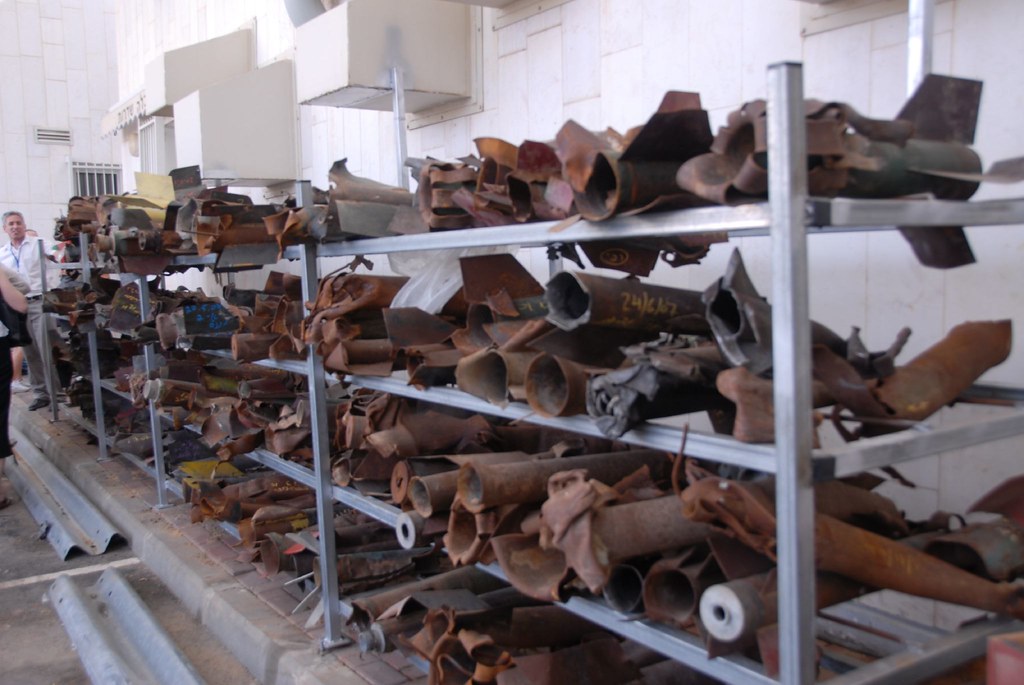
What is it like to live with the knowledge that any moment missiles might rain down on you? To understand this is to understand the situation in Southern Israel that led to Israel’s operation against Hamas.

David Farer in Living with Rockets describes what it is like to live in Sederot with the daily barrage of rockets from Gaza. Notice the heightening of senses, of awareness of subtle changes in the rockets’ sounds, of the normalcy that invades what should be “normal.” Notice how acts of heroism go unnoticed because “its just what we do.” He writes:

On Tuesday morning, as I was getting ready to leave my home, a woman’s voice said “Tzeva Adom! Tzeva Adom! Tzeva Adom!” over Sderot’s public speaker system. I had already heard this alarm a few times that morning, and several hundred times since I moved to Sderot. It meant that a rocket fired by Hamas in Gaza would explode somewhere in or near Sderot in about fifteen seconds. I went about my business, turning off my computer and packing my books, as I awaited the explosion. When the inevitable happened, I heard that unmistakable cracking sound at the tiny fraction of an instant, the KA of the KABOOM! It indicated that Hamas had been lucky this time and hit somebody’s home, instead of their rockets landing in a field whose mud muffled the blast. One learns to pick up these subtle differences in kinds of explosion if one lives in Sderot. Less subtle was that my building shuddered, and my windows danced in their frames; I felt the slight shove of the shockwave going through my body. I knew that this Kassam rocket had landed within a few blocks of my home.

The missile, as you will read, hits the building across the alley. Reporter’s life becomes part of the story.

Prosper Peretz owns the Peretz Shefa Market on this street, Mivtza Sinai (the street hit by the missile).

His shop stood immediately opposite the home that was hit, and he surveyed the scene from the sidewalk in front of his foodstore. I often shopped in his little store, which his parents had founded. He lived above the shop with his wife and children, all of whom help run the family business. I asked Peretz if he had been present when the rocket exploded. A calm and soft-spoken man, who spent much of his life in army uniform, he nodded his head. I asked about damage on his side of the street. He pointed to blown-out windows above his shop. Peretz was polite, but evidently not in a communicative mood today. I walked inside to greet Peretz’s daughter and to buy a chocolate bar. I asked her about her experience of the bombing. She told me she had been upstairs when the rocket hit her neighbor’s home across the street, but that she ran downstairs just in time to see her father taking care of “the one who was wounded.” My eyebrows went up. “What’s that?”, I asked. She told me she ran downstairs and saw her father bandaging a bleeding man who was lying on the sidewalk outside their shop. Prosper Peretz, a man with the calm, humble demeanor of the professional soldier, had told me none of that. I went out to ask him what he did. He smiled slightly and told me that one of the sons of the family whose house had been hit had been walking down the street, either to or from home, when the alarm went off. Hearing the recording, he tried to run into the Peretz Shefa Market, but he did not run fast enough. The man had received two shrapnel wounds, one of which made a gash on his cheek. The second piece of metal opened the artery on the left side of the young man’s neck. Blood being pumped up to his brain was squirting out in bursts, each burst in accordance with the heart beat that sent the blood in the direction of his brain. The young man would clearly have bled to death soon had Peretz not taken action. His daughter walked downstairs to the sidewalk to see her father saving a life. She went into their shop to call an ambulance. This ambulance had left just a minute or two before I arrived, carrying the man whose life Prosper Peretz had saved. “I see”, I said. Peretz told me he was able to do that because of the good training he had received in the army. “And by the way, why are you wearing a mere undershirt on a cold and rainy day?” I asked him “I used my shirt on the guy’s neck.” I pointed to what I now understood to be bloodstains on Peretz’s undershirt, and he just nodded his head – “It happens here.” I stood there trying to think of a way to express my admiration for someone who had just saved a life, but who had no wish to display that fact, when the alarm sounded.

How does one live a life when this is the reality? To face that question is to face the reasons behind Israel’s operation against Hamas. Make sure to click over to the blog, Living with Rockets, to read more about the situation under which Southern Israel did and does live.

Wars Sicken Me, Even Wars that I Support, Says National Reform Jewish Leader

Rabbi Eric Yoffie, president of the Union for Reform Judaism, articulately explains how most American Jews support the current Israeli response to Hamas’ seven year barrage of missiles:

Wars sicken me, even wars that I support. I support Israel’s offensive in Gaza, but watching it on TV — the images of bombed-out buildings, crying women and, inevitably, the bodies of innocent bystanders — is a painful experience. I suspect that most American Jews feel the same discomfort that I feel. They support the military offensive too, but they are well aware of the risks that it entails, and they expect Israel to be both politically wise and morally sensitive in how it fights. It is especially important to us that Israel do everything humanly possible to avoid the death of innocents and to prevent a humanitarian crisis in Gaza. There is much evidence that Israel has worked hard to limit the carnage, and the credibility of Israel’s leaders in providing assurances on these points is an important factor in assuring the continued support of American Jews — and, indeed, of all Americans — for the Gaza campaign.

Further, Rabbi Yoffie puts this conflict into the larger issues facing our world:

American Jews have a commonsense approach to these matters. We are aware that American forces have gone halfway around the globe to engage in a war in Afghanistan against terrorists who once carried out an attack on American soil. We know that civilians have frequently died in that war because terrorists make a point of operating in civilian areas. We know too that this war has the support of our liberal president-elect. So why, we ask, should Israel’s center-left government, after long periods of restraint and desperate efforts to renew the cease-fire, be expected to refrain from fighting terrorists that are regularly attacking from right across the border? And we are certain that if rockets were being launched from Canada into our own homes in Michigan or Maine, we would demand immediate action, and our government would quickly oblige. American Jews see Israel’s Gaza offensive as a tragic necessity, unwelcome but inevitable, carried out by a reluctant Israeli government doing what it must to end rocket attacks against its citizenry. In short, American Jews are, as usual, sensible and centrist, and supporting Israel in her hour of need. Read on.